Results by title
178 books match the query 'Identification' and 5 start with i
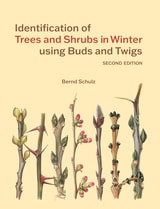
Identification of Trees & Shrubs in Winter Using Buds and Twigs, Second Edition
Bernd Schulz
Royal Botanic Gardens, Kew, 2025
An updated edition of Bernd Schulz’s unrivaled practical guide to identifying trees and shrubs in winter.
This second edition of the essential reference book for plant identification in winter is updated with new illustrations and fully revised text.
To many plant lovers winter seems like lost time, but a glance at the twigs of trees and shrubs shows that this does not need to be the case. In contrast to other life forms, trees and shrubs do not die above ground but enclose their shoots for the next year in buds, presenting many characters which hardly change over time. Using these bud and twig characters, deciduous trees and shrubs can be classified reliably in winter, which is particularly important during planting time.
Comprehensive and easy to use, Identification of Trees & Shrubs in Winter using Buds and Twigs contains over seven hundred species identifiable via their winter buds and twigs. The illustrated identification keys are easy to use, and a summary set of keys is provided as an appendix. Detailed descriptions are accompanied with 1,900 illustrations.
[more]
Identification of Trees and Shrubs in Winter Using Buds and Twigs
Bernd Schulz
Royal Botanic Gardens, Kew, 2018
For many plant lovers, winter seems like a lost time. The bursts of color and distinctive leaf shapes disappear, leaving what seems like ambiguous branches. But there is no need for botanical enthusiasts to hunker down until spring. What we overlook as “dead trees” are simply shoots covered up for the season. If we look closer, we’ll see that trees and shrubs have distinct shapes to their buds and twigs that allow them to be classified reliably in winter.
While most books focus on identifying leaves and other seasonal characteristics, this practical guide is one of the few that will allow gardeners to identify trees and shrubs while they are in their dormant state. It covers more than seven hundred species and includes easy-to-use illustrated identification keys. More than 1,400 color images make it even easier to spot the distinctive pieces of these plants.
While most books focus on identifying leaves and other seasonal characteristics, this practical guide is one of the few that will allow gardeners to identify trees and shrubs while they are in their dormant state. It covers more than seven hundred species and includes easy-to-use illustrated identification keys. More than 1,400 color images make it even easier to spot the distinctive pieces of these plants.
[more]
In Reunion
Transnational Korean Adoptees and the Communication of FamilyDocan-Morgan, Sara
Temple University Press, 2024
“Do you know your real parents?” is a question many adoptees are asked. In In Reunion, Sara Docan-Morgan probes the basic notions of family, adoption, and parenthood by exploring initial meetings and ongoing relationships that transnational Korean adoptees have had with their birth parents and other birth family members. Drawing from qualitative interviews with adult Korean adoptees in the United States and Denmark, as well as her own experiences as an adoptee, Docan-Morgan illuminates the complexities of communication surrounding reunion.
The paradoxes of adoption and reunion—shared history without blood relations, and blood relations without shared history—generate questions: What does it mean to be “family”? How do people use communication to constitute family relationships? How are family relationships created, maintained, and negotiated over time? In Reunion details adoptive and cultural identities, highlighting how adoptees often end up shouldering communicative responsibility in their family relationships. Interviews reveal how adoptees navigate birth family relationships across language and culture while also attempting to maintain relationships with their adoptive family members.
Docan-Morgan details the challenges, rewards, and contradictions of reunion. She also offers practical recommendations for transnational adoptees in reunion, adoptees considering reunion, adoptive families, and adoption practitioners.
In tracing the stories of the intercultural dynamics inherent in adoptees’ reunions, Docan-Morgan demonstrates the effort, flexibility, empathy, self-reflection, and time required to navigate long-term relationships with birth families.
[more]
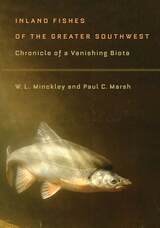
Inland Fishes of the Greater Southwest
Chronicle of a Vanishing BiotaW. L. Minckley and Paul C. Marsh
University of Arizona Press, 2009
This comprehensive new book replaces and substantially expands upon the landmark Fishes of Arizona, which has been the authoritative source since it was first published in 1973. Inland Fishes of the Greater Southwest is a one-volume guide to native and non-native fishes of the lower Colorado River basin, downstream from the Grand Canyon, and of the northern tributaries of the Sea of Cortez in the United States and Mexico. In all, there are in-depth accounts of more than 165 species representing 30 families. The book is not limited to the fish. It provides insights into their aquatic world with information on topography, drainage relations, climate, geology, vegetational history, aquatic habitats, human-made water systems, and conservation. A section of the book is devoted to fish identification, with keys to native and non-native families as well as family keys to species. The book is illustrated with more than 120 black-and-white illustrations, 47 full-color plates of native fishes, and nearly 40 maps and figures.
Many native fish species are unique to the Southwest. They possess interesting and unusual adaptations to the challenges of the region, able to survive silt-laden floods as well as extreme water temperatures and highly fluctuating water flows ranging from very low levels to flash floods. However, in spite of being well-adapted, many of the fish described here are threatened or endangered, often due to the acts of humans who have altered the natural habitat. For that reason, Inland Fishes of the Greater Southwest presents a vast amount of information about the ecological relationships between the fishes it describes and their environments, paying particular attention to the ways in which human interactions have modified aquatic ecosystems—and to how humans might work to ensure the survival of rapidly disappearing native species.
Many native fish species are unique to the Southwest. They possess interesting and unusual adaptations to the challenges of the region, able to survive silt-laden floods as well as extreme water temperatures and highly fluctuating water flows ranging from very low levels to flash floods. However, in spite of being well-adapted, many of the fish described here are threatened or endangered, often due to the acts of humans who have altered the natural habitat. For that reason, Inland Fishes of the Greater Southwest presents a vast amount of information about the ecological relationships between the fishes it describes and their environments, paying particular attention to the ways in which human interactions have modified aquatic ecosystems—and to how humans might work to ensure the survival of rapidly disappearing native species.
[more]
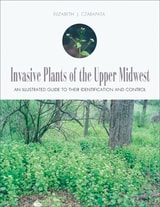
Invasive Plants of the Upper Midwest
An Illustrated Guide to Their Identification and ControlElizabeth J. Czarapata
University of Wisconsin Press, 2005
Invasive Plants of the Upper Midwest is an informative, colorful, comprehensive guide to invasive species that are currently endangering native habitats in the region. It will be an essential resource for land managers, nature lovers, property owners, farmers, landscapers, educators, botanists, foresters, and gardeners.
Invasive plants are a growing threat to ecosystems everywhere. Often originating in distant climes, they spread to woodlands, wetlands, prairies, roadsides, and backyards that lack the biological controls which kept these plant populations in check in their homelands.
Invasive Plants of the Upper Midwest includes more than 250 color photos that will help anyone identify problem trees, shrubs, vines, grasses, sedges, and herbaceous plants (including aquatic invaders). The text offers further details of plant identification; manual, mechanical, biological, and chemical control techniques; information and advice about herbicides; and suggestions for related ecological restoration and community education efforts. Also included are literature references, a glossary, a matrix of existing and potential invasive species in the Upper Midwest, an index with both scientific and common plant names, advice on state agencies to contact with invasive plant questions, and other helpful resources.
The information in this book has been carefully reviewed by staffs of the Wisconsin Department of Natural Resources Bureau of Endangered Resources and the University of Wisconsin-Madison Arboretum and other invasive plant experts.
[more]