Results by title
83 books match the query 'Inclusive Education' and 7 start with i
Improving Learning and Mental Health in the College Classroom
Robert Eaton
West Virginia University Press, 2023
How teachers can help combat higher education’s mental health crisis.
Mental health challenges on college campuses were a huge problem before COVID-19, and now they are even more pronounced. But while much has been written about higher education’s mental health crisis, very little research focuses on the role played by those on campus whose influence on student well-being may well be greatest: teachers. Drawing from interviews with students and the scholarship of teaching and learning, this book helps correct the oversight, examining how faculty can—instead of adding to their own significant workloads or duplicating counselors’ efforts—combat student stress through adjustments to the work they already do as teachers.
Improving Learning and Mental Health in the College Classroom provides practical tips that reduce unnecessary discouragement. It demonstrates how small improvements in teaching can have great impacts in the lives of students with mental health challenges, while simultaneously boosting learning for all students.
Improvising Across Abilities
Pauline Oliveros and the Adaptive Use Musical InstrumentThe AUMI Editorial Collective
University of Michigan Press, 2024
This book, which contains wisdom from many who have been affected by their work with the instrument and the people who use it, is a representation of how music and extemporized performance have touched the lives and minds of scholars and families alike. Not only has AUMI provided the opportunity to grow in listening to others who may speak differently (or not at all), but it has been used as an avenue for a diverse set of people to build friendships with others whom they may have never otherwise even glanced at in the street. By providing a space for every person who comes across AUMI to perform, listen, improvise, and collaborate, the continuing development of this instrument contributes to a world in which every person is heard, welcomed, and celebrated.
Inaccessible Access
Rethinking Disability Inclusion in Academic Knowledge CreationKelly Fagan Robinson
Rutgers University Press, 2025

Inclusive Musical Theatre
Tools and Curriculum for Rehearsal and PerformanceJamie Cacciola-Price
Intellect Books, 2025
A comprehensive guide to creating inclusive and accessible musical theater at the high school level.
This book is a comprehensive guide that presents a research-backed curriculum and strategies for creating an inclusive and accessible musical theater rehearsal and performance process for high schoolers. It draws on the author's doctoral research and extensive teaching experience to provide practical tools, assessments, and process modifications to support students of all learning needs and backgrounds.
The book begins by exploring the historical context and legal frameworks surrounding special education in public schools, as well as the intersection of drama education and disability studies. It then delves into an in-depth analysis of traditional actor training methods, highlighting their ableist origins and the need for adaptations to foster radical inclusion.
The core of the text outlines a twenty-nine-week rehearsal and performance curriculum, broken into three distinct phases, that is designed to scaffold skill development, promote ensemble collaboration, and empower diverse learners. Accompanying the unit plans are detailed assignments, assessments, and grading rubrics that align with national and state arts standards. Additionally, the author provides a wealth of supporting documents, such as student contracts, production resources, and a sample warm-up guide.
By championing inclusive practices rooted in the principles of Universal Design for Learning and culturally responsive pedagogy, this book equips drama educators with the tools to create transformative theatrical experiences for all students.
Inclusive Teaching
Strategies for Promoting Equity in the College ClassroomKelly A. Hogan
West Virginia University Press, 2022
Award-winning teachers offer practical tips for addressing inequities in the college classroom and for making all students feel welcome and included.
In a book written by and for college teachers, Kelly Hogan and Viji Sathy provide tips and advice on how to make all students feel welcome and included. They begin with a framework describing why explicit attention to structure enhances inclusiveness in both course design and interactions with and between students. Inclusive Teaching then provides practical ways to include more voices in a series of contexts: when giving instructions for group work and class activities, holding office hours, communicating with students, and more. The authors finish with an opportunity for the reader to reflect on what evidence to include in a teaching dossier that demonstrates inclusive practices.
The work of two highly regarded specialists who have delivered over a hundred workshops on inclusive pedagogy and who contribute frequently to public conversations on the topic, Inclusive Teaching distills state-of-the-art guidance on addressing privilege and implicit bias in the college classroom. It seeks to provide a framework for individuals and communities to ask, Who is being left behind and what can teachers do to add more structure?
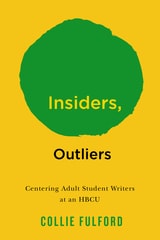
Insiders, Outliers
Centering Adult Student Writers at an HBCUCollie Fulford
Rutgers University Press, 2025
Winner of the 2026 Outstanding Book Award in the Monograph category from the Conference on College Composition and Communication
Insiders, Outliers invites readers into the lives of adult HBCU students for whom college is one meaningful activity among many. Although adults over the age of twenty-four comprise a quarter of all undergraduates, they are institutionally segregated and only partially served by a US higher education system that remains organized around traditional-aged learners. Even as such students are regarded as a market for postsecondary institutions, they are routinely marginalized by institutional barriers. Students’ stories of their personal, professional, community, and academic writing experiences illuminate a critical need for more age-inclusive practices across academia. Their cases also offer new conceptual models of writing as an ethical and emotional practice that fuels changes for individuals and the people and institutions that they care about—including higher education. What adult students reveal about writing across their life domains has powerful implications for conceptualizing writing as a complex form of agency and for teaching writing across the curriculum.
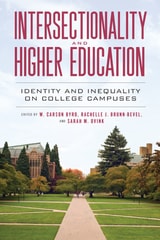
Intersectionality and Higher Education
Identity and Inequality on College CampusesW. Carson Byrd
Rutgers University Press, 2019