Results by title
366 books match the query 'International' and 28 start with i

Imagining China
Rhetorics of Nationalism in an Age of GlobalizationStephen J. Hartnett
Michigan State University Press, 2017

Import Competition and Response
Edited by Jagdish Bhagwati
University of Chicago Press, 1982

Indigenous Peoples and Borders
Sheryl Lightfoot and Elsa Stamatopoulou, editors
Duke University Press, 2024
Contributors. Tone Bleie, Andrea Carmen, Jacqueline Gillis, Rauna Kuokkanen, Elifuraha Laltaika, Sheryl Lightfoot, David Bruce MacDonald, Toa Elisa Maldonado Ruiz, Binalakshmi “Bina” Nepram, Melissa Z. Patel, Manoel B. do Prado Junior, Hana Shams Ahmed, Elsa Stamatopoulou, Liubov Suliandziga, Rodion Sulyandziga, Yifat Susskind, Erika M. Yamada
Industry at the Crossroads
Robert E. Cole, Editor
University of Michigan Press, 1982
Institutions and Investments
Foreign Direct Investment in China during an Era of ReformsJun Fu
University of Michigan Press, 2000
Intellectual Property
Trade, Competition, and Sustainable Development The World Trade Forum, Volume 3Thomas Cottier and Petros C. Mavroidis, Editors
University of Michigan Press, 2003
Largely a victory for OECD countries, the present state of intellectual property rights has important implications for developing countries. The incorporation of intellectual property rights into the WTO system will eventually change the relationship of trade, competition, and intellectual property. It will equally have to assist in providing equitable sharing of benefits in the use of plant genetic resources. All of these issues are essential for the revision of exclusions from patenting in TRIPs. This volume offers insights into how this difficult task could and should be approached in a balanced manner and will be essential reading for economists and trade and intellectual property lawyers interested in the subject. Moreover, the volume will be relevant to agricultural economists as it addresses complex problems in the interstices of trade, intellectual property, plant genetic resources, and sustainable development.
Thomas Cottier is Professor of European and International Economic Law, University of Bern, and Managing Director, World Trade Institute, University of Bern.
Petros C. Mavroidis is Professor of Law, University of Neuchâtel. He formerly worked in the Legal Affairs Division of the World Trade Organization.
Marion Panizzon is Research Fellow, University of Bern.
Simon Lacey is Research Fellow, University of Bern.

Intermediaries, Interpreters, and Clerks
African Employees in the Making of Colonial AfricaEdited by Benjamin N. Lawrance, Emily Lynn Osborn, and Richard L. Roberts
University of Wisconsin Press, 2006
By uncovering the role of such men (and a few women) in the construction, function, and legal apparatus of colonial states, the essays in this volume highlight a new perspective. They offer important insights on hegemony, collaboration, and resistance, structures and changes in colonial rule, the role of language and education, the production of knowledge and expertise in colonial settings, and the impact of colonization in dividing African societies by gender, race, status, and class.

International Bankruptcy
The Challenge of Insolvency in a Global EconomyJodie Adams Kirshner
University of Chicago Press, 2018
With International Bankruptcy, Jodie Adams Kirshner explores the issues involved in determining which courts should have jurisdiction and which laws should apply in addressing problems within. Kirshner brings together theory with the discussion of specific cases and legal developments to explore this developing area of law. Looking at the key issues that arise in cross-border proceedings, International Bankruptcy offers a guide to this legal environment. In addition, she explores how globalization has encouraged the creation of new legal practices that bypass national legal systems, such as the European Insolvency Framework and the Model Law on Cross-Border Insolvency of the United Nations Commission on International Trade Law. The traditional comparative law framework misses the nuances of these dynamics. Ultimately, Kirshner draws both positive and negative lessons about regulatory coordination in the hope of finding cleaner and more productive paths to wind down or rehabilitate failing international companies.

International Development Policies
Perspectives for Industrial CountriesSidney Dell
Duke University Press, 1991
Tracing the fundamental changes of the last forty years in international development policies toward the Third World, Dell details the transformation from a policy of collective responsibility on the part of the international community to the current status, in which the commitment of governments of industrial countries to Third World development is greatly diluted. He examines the growing conflicts in world trade and analyzes the failure of the international economic community to develop a long-run strategy for dealing with the world debt crisis.
Other topics addressed include the future of the international monetary system, the viability of small countries, strategies for development of basic needs, and the prospects for foreign private investment.

International Differences in Entrepreneurship
Edited by Josh Lerner and Antoinette Schoar
University of Chicago Press, 2010
Often considered one of the major forces behind economic growth and development, the entrepreneurial firm can accelerate the speed of innovation and dissemination of new technologies, thus increasing a country's competitive edge in the global market. As a result, cultivating a strong culture of entrepreneurial thinking has become a primary goal throughout the world.
Surprisingly, there has been little systematic research or comparative analysis to show how the growth of entrepreneurship differs among countries in various stages of development. International Differences in Entrepreneurship fills this void by explaining how a country's institutional differences, cultural considerations, and personal characteristics can affect the role that entrepreneurs play in its economy. Developing an understanding of the origins of entrepreneurs as well as the choices they make and the complexity of their activities across countries and industries are of central importance to this volume. In addition, contributors consider how environmental factors of individual economies, such as market regulation, government subsidies for banks, and support for entrepreneurial culture affect the industry and the impact that entrepreneurs have on growth in developing nations.

International Differences in the Business Practices and Productivity of Firms
Edited by Richard B. Freeman and Kathryn L. Shaw
University of Chicago Press, 2009
In recent years, globalization and the expansion of information technologies have reshaped managerial practices, forcing multinational firms to adjust business practices to different environments and domestic companies to adjust to their foreign competitors. In International Differences in the Business Practices and Productivity of Firms, a distinguished group of contributors examines the phenomenon of widespread differences in managerial practices across firms, establishments within firms, and countries.
This volume brings together eight studies that combine qualitative and quantitative insider analysis of business practices such as the use of teams, incentive pay, lean manufacturing, and quality control, revealing the elements that determine which practices are adopted and why. International Differences in the Business Practices and Productivity of Firms offers a much-needed model for measuring the productivity and performance of international firms in a fast-paced global economy.
International Dimensions of Monetary Policy
Edited by Jordi Galí and Mark Gertler
University of Chicago Press, 2010
United States monetary policy has traditionally been modeled under the assumption that the domestic economy is immune to international factors and exogenous shocks. Such an assumption is increasingly unrealistic in the age of integrated capital markets, tightened links between national economies, and reduced trading costs. International Dimensions of Monetary Policy brings together fresh research to address the repercussions of the continuing evolution toward globalization for the conduct of monetary policy.
In this comprehensive book, the authors examine the real and potential effects of increased openness and exposure to international economic dynamics from a variety of perspectives. Their findings reveal that central banks continue to influence decisively domestic economic outcomes—even inflation—suggesting that international factors may have a limited role in national performance. International Dimensions of Monetary Policy will lead the way in analyzing monetary policy measures in complex economies.
International Economic Cooperation
Edited by Martin Feldstein
University of Chicago Press, 1988

International Economic Relations
Commission of Inquiry into National Policy in International Economic Relations
University of Minnesota Press, 1934
International Economic Relations was first published in 1934. Minnesota Archive Editions uses digital technology to make long-unavailable books once again accessible, and are published unaltered from the original University of Minnesota Press editions.
International Economic Transactions
Issues in Measurement and Empirical ResearchEdited by Peter Hooper and J. David Richardson
University of Chicago Press, 1991
Questioning the quality of current data and analytical procedures, this ambitious volume proposes innovative research designs and methods for data enhancement, and offers new data on trade prices and service transactions for future studies. Leading researchers address the measurement of international trade flows and prices, including the debate over measurement of computer prices and national productivity; compare international levels of manufacturing output; and assess the extent to which the United States has fallen into debt to the rest of the world.

International Environmental Policy
From the Twentieth to the Twenty-First CenturyLynton Keith Caldwell
Duke University Press, 1996
International Financial Issues in the Pacific Rim
Global Imbalances, Financial Liberalization, and Exchange Rate PolicyEdited by Takatoshi Ito and Andrew K. Rose
University of Chicago Press, 2008

International Taxation and Multinational Activity
Edited by James R. Hines Jr.
University of Chicago Press, 2001

International Trade Law Through the Cases
Volume IJulian Arato, Joseph Weiler, Kathleen Claussen, Sungjoon Cho
Michigan Publishing Services, 2027
International trade law is a manifold. It comprises a wide array of international legal instruments designed to discipline states in their regulation of cross-border trade, including primarily trade in goods and services but also intellectual property, digital trade, and even investment. The study of international trade law requires choices. As the title of this book suggests, the choice of this particular book is to study international trade law through the cases—in particular the robust case law of the WTO. The theory behind our approach is rather that developing a firm foundation in the law and jurisprudence of the WTO will provide a student with the tools to confidently and competently analyze any international trade instrument on their own. The focus here is primarily (though not exclusively) on the law of the WTO, but the goal is to learn the key concepts and disciplines of international trade law writ large.
International Trade Law Through the Cases
Volume IIJulian Arato, Joseph Weiler, Kathleen Claussen, Sungjoon Cho
Michigan Publishing Services, 2027
International trade law is a manifold. It comprises a wide array of international legal instruments designed to discipline states in their regulation of cross-border trade, including primarily trade in goods and services but also intellectual property, digital trade, and even investment. The study of international trade law requires choices. As the title of this book suggests, the choice of this particular book is to study international trade law through the cases—in particular the robust case law of the WTO. The theory behind our approach is rather that developing a firm foundation in the law and jurisprudence of the WTO will provide a student with the tools to confidently and competently analyze any international trade instrument on their own. The focus here is primarily (though not exclusively) on the law of the WTO, but the goal is to learn the key concepts and disciplines of international trade law writ large.

International Trade and Human Rights
Foundations and Conceptual Issues (World Trade Forum, Volume 5)Frederick M. Abbott, Christine Breining-Kaufmann and Thomas Cottier, Editors
University of Michigan Press, 2005
The missing link between the international trade regime and human rights has become one of the key concerns of critics of the WTO. The World Trade Forum 2001 at the World Trade Institute in Berne provided a unique framework for considering the manifold issues relevant to this topic. This book goes beyond listing the different arguments in favor of or against globalization and offers recommendations to the international community for possible reforms so as to better account for the human rights interests affected by the process of globalization.
Frederick M. Abbott is the Edward Ball Eminent Scholar Professor of International Law at Florida State University College of Law. He is the editor of China in the World Trading System: Defining the Principles of Engagement (1998) and author of The International Intellectual Property System: Commentary and Materials (with Thomas Cottier and Francis Gurry, 1999).
Christine Breining-Kaufmann is Professor of Law at the University of Zurich and Senior Research Fellow as well as a member of the Board of the World Trade Institute in Berne. Her publications include Hunger als Rechtsproblem: Völkerrechtliche Aspekte eines Rechtes auf Nahrung (1991) and Globalization and Labour Rights: The Conflicting Relationship between Core Labour Rights and International Economic Institutions (2006).
Thomas Cottier is Managing Director of the World Trade Institute and Professor of Law at the University of Berne. He has co-edited the previous four volumes of the World Trade Forum series.
International Trade in East Asia
Edited by Takatoshi Ito and Andrew K. Rose
University of Chicago Press, 2005
Comprised of twelve fascinating studies, International Trade in East Asia highlights many of the trading practices between countries within the region as well as outside of it. The contributors bring into focus some of the region's endemic and external barriers to international trade and discuss strategies for improving productivity and fostering trade relationships. Studies on some of the factors that drive exports, the influence of research and development, the effects of foreign investment, and the ramifications of different types of protectionism will particularly resonate with the financial and economic communities who are trying to keep pace with this dramatically altered landscape.
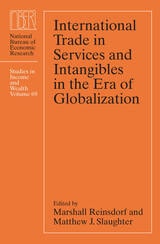
International Trade in Services and Intangibles in the Era of Globalization
Edited by Marshall B. Reinsdorf and Matthew J. Slaughter
University of Chicago Press, 2009
Quantitative measures of international exchange have historically focused on trade in tangible products or capital. However, services have recently become a larger portion of developed economies and international trade, and will only increase in the future. In International Trade in Services and Intangibles in the Era of Globalization, Marshall Reinsdorf and Matthew J. Slaughter examine new and emerging patterns of trade, especially the growing importance of transactions involving services or intangible assets such as intellectual property.
A distinguished team of contributors analyzes the challenges involved in measuring trade in intangibles, the comparative advantages enjoyed by United States service industries, and the heightened international competition for jobs, capital investment, economic growth, and tax revenue that results from trade in services. This comprehensive volume will be necessary reading for scholars seeking to understand the rapidly changing global economy.
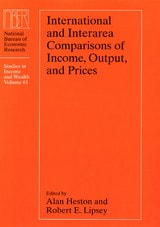
International and Interarea Comparisons of Income, Output, and Prices
Edited by Alan Heston and Robert E. Lipsey
University of Chicago Press, 1999
International and Interarea Comparisons of Income, Output, and Prices includes discussions of developments in the United Nations International Comparison Program, the largest effort in this field, and in the ICOP program on the production side, including efforts in both to extend the comparisons to the formerly planned economies. Other papers in this volume explore new programs on interspatial comparisons within the United States. There are also theoretical papers on how interspatial comparisons should be made and several examples of uses of such comparisons.

International and Language Education for a Global Future
Fifty Years of U.S. Title VI and Fulbright-Hays ProgramsDavid S. Wiley
Michigan State University Press, 2010
The contributions to this book address the role that the U.S. Department of Education Title VI and Fulbright-Hays programs have played in building the largest and highest quality infrastructure in the world for training in languages and other aspects of foreign area knowledge. The volume celebrates the 50th anniversary of the Title VI and associated Fulbright-Hays programs, which have established more than 150 centers of excellence for modern foreign language and area studies and international business education in more than 60 U.S. universities.
The authors review the history of the programs, including their founding and their cumulative impacts on internationalizing the American university at the graduate and undergraduate levels. They review how programs for foreign research, technology for foreign information access, and undergraduate programs have built the foundations of U.S. language-learning materials for use in college courses and government with improved language-learning pedagogies, erected the most distinguished library holdings on foreign countries, supported in-depth research abroad in virtually every nation, and created capacity to teach more than 200 less commonly taught languages.
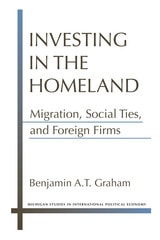
Investing in the Homeland
Migration, Social Ties, and Foreign FirmsBenjamin A.T. Graham
University of Michigan Press, 2019
Graham’s analysis draws on new data from face-to-face interviews with the managers of over 450 foreign firms operating in two developing countries: Georgia and the Philippines. Diaspora-owned and diaspora-managed firms are better connected than other foreign firms and they use social ties to resolve disputes and influence government policy. At the same time, Graham shows that diaspora-affiliated firms are no more socially responsible than their purely foreign peers—at root, they are profit-seeking enterprises, not development NGOs. Graham identifies implications for policymakers seeking to capture the development potential of diaspora investment and for managers of multinational firms who want to harness diasporans as a source of sustained competitive advantage.

Invisible China
How the Urban-Rural Divide Threatens China’s RiseScott Rozelle and Natalie Hell
University of Chicago Press, 2020
As the glittering skyline in Shanghai seemingly attests, China has quickly transformed itself from a place of stark poverty into a modern, urban, technologically savvy economic powerhouse. But as Scott Rozelle and Natalie Hell show in Invisible China, the truth is much more complicated and might be a serious cause for concern.
China’s growth has relied heavily on unskilled labor. Most of the workers who have fueled the country’s rise come from rural villages and have never been to high school. While this national growth strategy has been effective for three decades, the unskilled wage rate is finally rising, inducing companies inside China to automate at an unprecedented rate and triggering an exodus of companies seeking cheaper labor in other countries. Ten years ago, almost every product for sale in an American Walmart was made in China. Today, that is no longer the case. With the changing demand for labor, China seems to have no good back-up plan. For all of its investment in physical infrastructure, for decades China failed to invest enough in its people. Recent progress may come too late. Drawing on extensive surveys on the ground in China, Rozelle and Hell reveal that while China may be the second-largest economy in the world, its labor force has one of the lowest levels of education of any comparable country. Over half of China’s population—as well as a vast majority of its children—are from rural areas. Their low levels of basic education may leave many unable to find work in the formal workplace as China’s economy changes and manufacturing jobs move elsewhere.
In Invisible China, Rozelle and Hell speak not only to an urgent humanitarian concern but also a potential economic crisis that could upend economies and foreign relations around the globe. If too many are left structurally unemployable, the implications both inside and outside of China could be serious. Understanding the situation in China today is essential if we are to avoid a potential crisis of international proportions. This book is an urgent and timely call to action that should be read by economists, policymakers, the business community, and general readers alike.
Issues in US-EC Trade Relations
Edited by Robert E. Baldwin, Carl B. Hamilton, and André Sapir
University of Chicago Press, 1988
Issues in US-EC Trade Relations presents the results of a conference organized by the NBER and the Centre for European Policy Studies. In it, North American and European trade specialists offer theoretical, empirical, and historical analyses of some of the major issues on which American and Community officials disagree and also formulate realistic policies for settling present disputes. Contributors consider such topics as the legal aspects of trade between the two regions, agricultural policy, different ways the United States and members of the European Community use embargoes to attempt to induce foreign countries to change particular political actions, the growing trend toward protectionism and responses to this policy, international trade in services, and trade policy in oligopolistic environments. In most cases, each general subject is approached from both an American and a European perspective.