Results by title
751 books match the query 'International Relations' and 34 start with i
Identities, Borders, Orders
Rethinking International Relations TheoryMathias Albert
University of Minnesota Press, 2001
An interdisciplinary exploration of the role of sovereignty, national identity, and borders in international politics.
Political Science
An interdisciplinary exploration of the role of sovereignty, national identity, and borders in international politics.Informed by current debates in social theory, Identities, Borders, Orders brings together a multinational group of respected scholars to seek and encourage imaginative adaptations and recombinations of concepts, theories, and perspectives across disciplinary lines. These contributors take up a variety of substantive, theoretical, and normative issues such as migration, nationalism, citizenship, human rights, democracy, and security. Together, their essays contribute significantly to our understanding of sovereignty, national identity, and borders. Contributors: Didier Bigo, Institut d’Etudes Politiques de Paris; Lothar Brock, U of Frankfurt am Main; Chris Brown, London School of Economics; Neil Harvey, New Mexico State U; Martin O. Heisler, U of Maryland; Rey Koslowski, Rutgers U; Friedrich Kratochwil, Ludwig Maximilians U, Munich; Ronnie D. Lipschutz, UC Santa Cruz; Richard W. Mansbach, Iowa State U; David Newman, Ben Gurion U of the Negev, Israel; Antje Wiener, Queen’s U of Belfast; and Frankie Wilmer, Montana State U.
Ideologies of Hispanism
Mabel Moraña
Vanderbilt University Press, 2005
Imagining China
Rhetorics of Nationalism in an Age of GlobalizationStephen J. Hartnett
Michigan State University Press, 2017
Imperial Encounters
The Politics of Representation in North-South RelationsRoxanne Doty
University of Minnesota Press, 1996
Offers a fresh perspective on power relationships in global politics.
“Developed/underdeveloped,” “first world/third world,” “modern/traditional”-although there is nothing inevitable, natural, or arguably even useful about such divisions, they are widely accepted as legitimate ways to categorize regions and peoples of the world. In Imperial Encounters, Roxanne Lynn Doty looks at the way these kinds of labels influence North-South relations, reflecting a history of colonialism and shaping the way national identity is constructed today.
Employing a critical, poststructuralist perspective, Doty examines two “imperial encounters” over time: between the United States and the Philippines and between Great Britain and Kenya. The history of these two relationships demonstrates that not only is the more powerful member allowed to construct “reality,” but this construction of reality bears an important relationship to actual practice. Doty is particularly interested in the way in which the South has been represented by policymakers, scholars, and journalists, and how these representations have influenced specific encounters. Doty also uses the insights of Edward Said to argue that the power dynamic that allows the North to define the global identity of nations in the South ultimately tells us more about northern powers than about their southern neighbors. Doty then considers the persistence of representational practices, particularly with regard to Northern views of human rights in the South and contemporary social science discourses on North-South relations. She ends with the argument that the discipline of international relations needs to be reformed by broadening the repertoire of theoretical and analytical tools available to scholars studying global politics. Important and timely, Imperial Encounters brings a fresh perspective to the debate over the past-and the future-of global politics.
Imperial Israel and the Palestinians
The Politics of ExpansionNur Masalha
Pluto Press, 2000
Masalha argues that the heart of the conflict between Zionist immigrants/settlers and the native Palestinians has always been about land, territory, demography and water. He documents how Israeli policy has made it a priority to expel the Palestinians, either by war or peaceful measures. But these imperialist tendencies are not restricted to extremist zealots. The author uncovers the expansionist policies found in Labour Zionism and Kookist ideology.
Chapters cover the Whole Land of Israel Movement, Zionist Revisionism and the Likud Party, Gush Emunim and the religious fundamentalists, parties and movements of the far right and the evolution of Israeli Jewish public attitudes since 1967.

Imperialism in the Twentieth Century
A.P. Thornton
University of Minnesota Press, 1980
Imperialism in the Twentieth Century was first published in 1978. Minnesota Archive Editions uses digital technology to make long-unavailable books once again accessible, and are published unaltered from the original University of Minnesota Press editions.
"Nothing is filed under the heading 'imperialism' in the archives of any nation-state that owned an empire. Foreign affairs, or external relations, are catalogued there, and a place is found for imperial administration and colonial trade; but 'imperialism' is always a listing in someone else's index, never one's own. It is not the name a government uses to classify the policies it sets in motion. It is the name given them by those who adopt a particular attitude... In our time the attitude toward this control is hostile."
With these words A.P. Thornton takes on a complex and elusive term, imperialism,and pursues its meaning and implications in the years of imperial decline. The disappearance of territorial empire, according to Thornton, did not bring imperial impulses to an end, nor did it destroy the power relationships set up in the heyday of empire. Casting a cool eye on the claims of both imperialism and nationalism—the principal countervailing force—Thornton brings imagination, wide learning, and clarifying wit to bear upon a subject that remains significant in the last quarter of the twentieth century.
In Pursuit of Their Dreams
A History of Azorean Immigration to the United StatesJerry R. Williams
Tagus Press, 2007
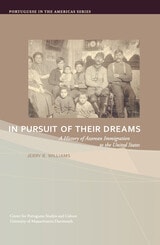
Jerry Williams' history of Azorean immigration to the United States offers us valuable insight into the experience and culture of Portuguese immigrants and their descendants. This account fills a major gap in American immigration history and gives us a comprehensive overview of how Portuguese-Americans—now numbering close to a million people—have come to constitute a vibrant and highly visible presence within southeastern New England, the areas around San Francisco and San Diego, Hawaii, and the New Jersey/New York metropolitan area. Even though Azorean immigrants all came from similar cultural and social backgrounds, Williams shows how regionally specific opportunity structures and social hierarchies have contributed to significant differences within the Portuguese-American experience.
Starting with the whaling routes that first connected the mid-Atlantic archipelago with the ports of call in New England and California in the early 1800s, Williams lays out the complex relationship between the Azores and the US that has continued into the present. We learn how particular patterns of poverty, overpopulation and social inequality in the Azores pushed large numbers of the islands' inhabitants to leave their homes in search of better opportunities for themselves and their children. He tells the story of how the early whalers who jumped ship in New Bedford, San Francisco, or Hawaii were followed by kin and fellow villagers who had heard of plentiful jobs in New England's textile mills, gold and land in California, or agricultural work on Hawaiian plantations. Williams' account allows us to understand the importance of family and community connections throughout the immigrants' arduous transition from peasant life to industrial society.

In the Shadow of Munich
British Policy towards Czechoslovakia from the Endorsement to the Renunciation of the Munich Agreement (1938-1942)Vít Smetana
Karolinum Press, 2008
In the Shadow of Powers
Dantes Bellegarde in Haitian Social ThoughtPatrick Bellegarde-Smith
Vanderbilt University Press, 2019
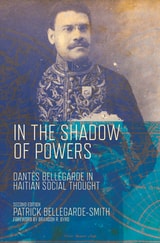
Throughout much of the twentieth century and even to this day, there has been a dearth of scholarship on the intellectual and political contributions of Haitians. In the Shadow of Powers, first published in 1985, was a corrective to this oversight and remains a foundational text. Bellegarde-Smith traces the history of Haiti through the life and career of his grandfather Dantès Bellegarde, one of Haiti's influential diplomats and preeminent thinkers. As Brandon R. Byrd describes in his foreword to this new edition, "Bellegarde was driven by a subversive, racially inclusive vision of civilized progress. He believed in and continued to push for Haiti to establish an existence for itself, black people, and the colonized world independent of the considerable shadow cast by the world's military, economic, and industrial powers." Scholars and students who want to learn about the intellectual and political foundations of Haiti, its influence on other intellectuals worldwide, and its struggles against imperialism continue to find this to be an invaluable classic.
India China
Rethinking Borders and SecurityL.H.M. Ling, Adriana Erthal Abdenur, Payal Banerjee, Nimmi Kurian, Mahendra P. Lama, and Li Bo
University of Michigan Press, 2016
Challenging the Westphalian view of international relations, which focuses on the sovereignty of states and the inevitable potential for conflict, the authors from the Borderlands Study Group reconceive borders as capillaries enabling the flow of material, cultural, and social benefits through local communities, nation-states, and entire regions. By emphasizing local agency and regional interdependencies, this metaphor reconfigures current narratives about the China India border and opens a new perspective on the long history of the Silk Roads, the modern BCIM Initiative, and dam construction along the Nu River in China and the Teesta River in India.
Together, the authors show that positive interaction among people on both sides of a border generates larger, cross-border communities, which can pressure for cooperation and development. India China offers the hope that people divided by arbitrary geo-political boundaries can circumvent race, gender, class, religion, and other social barriers, to form more inclusive institutions and forms of governance.
India as Kingmaker
Status Quo or Revisionist PowerMichael O. Slobodchikoff and Aakriti A. Tandon
University of Michigan Press, 2022
As India finds itself in the envious position of kingmaker, both the status quo and revisionist major powers are jockeying for India’s support for either upholding or revising the current world order. Using India’s bilateral treaties as a proxy measure of the strength of its relationship with other major powers, Slobodchikoff and Tandon determine whether India will remain neutral in its foreign policy approach or adopt a more assertive role in shaping the future global order. This book provides an in-depth analysis of India’s bilateral ties with major powers that include the United States, Russia, China, Japan, as well as the European Union (including the United Kingdom, France, and Germany) and uses network analysis to study India’s foreign policy positions with other major powers.
Indigenous Peoples and Borders
Sheryl Lightfoot and Elsa Stamatopoulou, editors
Duke University Press, 2024
Contributors. Tone Bleie, Andrea Carmen, Jacqueline Gillis, Rauna Kuokkanen, Elifuraha Laltaika, Sheryl Lightfoot, David Bruce MacDonald, Toa Elisa Maldonado Ruiz, Binalakshmi “Bina” Nepram, Melissa Z. Patel, Manoel B. do Prado Junior, Hana Shams Ahmed, Elsa Stamatopoulou, Liubov Suliandziga, Rodion Sulyandziga, Yifat Susskind, Erika M. Yamada
Indonesia
Archipelago of FearAndre Vltchek
Pluto Press, 2012
Indonesia: Archipelago of Fear is a fascinating and at times unsettling journey into the world's most populous Muslim nation as it struggles to emerge from decades of dictatorship and the plunder of its natural resources.
Andre Vltchek brings together more than a decade of investigative journalism in and around Indonesia to chart the recent history of the country, from the revolution which overthrew General Suharto's genocidal dictatorship in 1998 to the present day. He covers the full breadth of the country from Islamic Aceh to mostly Catholic East Timor.
Tracing Indonesia's current problems back to Suharto's coup and the genocide of 1965 – and the support given by the West to Suharto – Vltchek provides an intimate and deeply humane insight into the hopes and fears of Indonesia's people.
Inside Al-Qaeda and the Taliban
Beyond Bin Laden and 9/11Syed Saleem Shahzad
Pluto Press, 2011
President Obama may have delivered on his campaign promise to kill Osama bin Laden, but as an Al-Qaeda strategist bin Laden has been dead for years. This book introduces and examines the new generation of Al-Qaeda leaders who have been behind the most recent attacks.
Investigative journalist Syed Saleem Shahzad dedicated his life to revealing the strategies and inner workings of Al-Qaeda and the Taliban. He had access to top-level commanders in both movements, as well as within the ISI, Pakistan's intelligence service. Shahzad's work was praised by US Secretary of State Hillary Clinton for 'bringing to light the troubles extremism poses to Pakistan's stability.' Inside Al-Qaeda and the Taliban explains the wider aims of both organisations and provides an essential analysis of major terrorist incidents, including the 2008 Mumbai attacks.
In May 2011, Shahzad was abducted and killed in Pakistan, days after writing an article suggesting that insiders in the Pakistani navy had colluded with Al-Qaeda in an attack on a naval air station. This book is a testament to his fearless reporting and analytical rigour. It will provide readers worldwide with an invaluable introduction to a new phase of the ongoing struggle against terrorism which threatens lives in so many countries.
Integration and Disintegration in NATO
Processes of Alliance Cohesion and Prospects for Atlantic CommunityFrancis A. Beer
The Ohio State University Press, 1969
Francis A. Beer’s classic study of NATO, first published in 1969 at the critical time of French withdrawal, focuses on processes of Atlantic alliance cohesion and implications for cross-Atlantic relationships. At the present time, as NATO faces existential threats in the form of fresh attacks and skepticism, Beer’s foundational analysis remains essential. He surveys five key areas of alliance activity: political consultation, military forces, armaments, infrastructure, and science. Across each, he identifies a recurring pattern: nationalism, self-interest, and state-level dominance repeatedly constrain and often work against collective action, even in areas where technical logic might otherwise unify coalition members.
Significant support for cooperation, Beer argues, can emerge during periods of international crisis, when member states are pressed to set aside individual concerns for common security. International crises are challenging but need not be destructive. To the contrary, crises provide opportunities for creative institutional leadership. As the book shows, a well-articulated ideology, connected to variable coalitions in different issue areas, can bring members together to maintain and build collective political-military institutions.
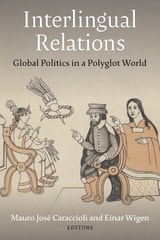
Interlingual Relations
Global Politics in a Polyglot WorldMauro J. Caraccioli and Einar Wigen, Editors.
University of Michigan Press, 2026
International politics is often conducted in two languages or more, and since no two languages are exactly the same, what is possible to say in one language may be impossible to say in another. Translation is at the heart of global politics, and interlingual relations traverse time, space, culture, and state borders. Interlingual Relations builds on emergent literature on translation in International Relations (IR) to propose a unique research agenda for scholars of global politics, offering multiple directions and sets of principles for sustained study.
The contributors use various methodologies to explore these interfaces and encounters in different sites, bringing together multiple subfields, approaches, and disciplinary paradigms across IR’s history. Together they offer a more truly global perspective on international affairs, going beyond the hegemony of English to demonstrate the interconnectedness between “high” politics and everyday life. They show the role of translation in global politics as one of world-making, whereby social roles, rules, and responsibilities establish the semblance of order despite not sounding or meaning the same to all actors. In establishing Interlingual Relations as a foundational part of IR, the book offers another key to studying global interactions and the high political stakes in the theories, methods, and ethics of translation.
International Political Earthquakes
Michael Brecher
University of Michigan Press, 2008
International Political Earthquakes is the masterwork of the preeminent scholar Michael Brecher. Brecher, who came of age before World War II, has witnessed more than seven decades of conflict and has spent his career studying the dynamics of relations among nations throughout the world.
When terrorism, ethnic conflict, military buildup, or other local tensions spark an international crisis, Brecher argues that the structure of global politics determines its potential to develop into open conflict. That conflict, in turn, may then generate worldwide political upheaval. Comparing international crises to earthquakes, Brecher proposes a scale analogous to the Richter scale to measure the severity and scope of the impact of a crisis on the landscape of international politics.
Brecher's conclusions about the causes of international conflict and its consequences for global stability make a convincing case for gradual, nonviolent approaches to crisis resolution.
Michael Brecher is R. B. Angus Professor of Political Science at McGill University.
International Propaganda
Its Legal and Diplomatic ControlL. John Martin
University of Minnesota Press, 1958
International Propaganda was first published in 1958. Minnesota Archive Editions uses digital technology to make long-unavailable books once again accessible, and are published unaltered from the original University of Minnesota Press editions.
As the principal weapon of the cold war, international propaganda is a matter of grave importance to anyone concerned with international relations. Here, in the first study of its kind, Dr. Martin analyzes the efforts and trends toward the control of such propaganda by means of international law, domestic law, and diplomacy. As a background for his study, he traces the development of international propaganda, discusses its definitions, and describes the propaganda activities of the three giants in the field - the United States, Great Britain, and the Soviet Union.
International Relations and Scientific Progress
STRUCTURAL REALISM RECONSIDEREDPatrick James
The Ohio State University Press, 2002
International Security in a World of Fragile States
Islamic States and Islamist OrganizationsS. Yaqub Ibrahimi
University of Michigan Press, 2022
Following the 9/11 attacks on New York and Washington, DC, there has been an increasing interest among scholars, students, and the interested public to study and learn about the Islamist-oriented terrorist organizations called Jihadi Salafi Groups (JSGs). Considering that these organizations emerged in highly fragile states, S. Yaqub Ibrahimi asks: how and why is state fragility linked to the emergence of JSGs?
Ibrahimi bases his study on three events: the establishment of al-Qaeda in Afghanistan in 1998, the rise of Islamic State in the post-Saddam Hussein Iraq, and the failed al-Qaeda effort to establish a base in Saudi Arabia in 2003. These case studies contain major aspects and features of the rise of JSGs and, together, explain the contribution of state fragility to the process of the formation and expansion of these terrorist organizations.
International Security in a World of Fragile States stands out as a pivotal work on the interconnection between the root causes of JSGs and state fragility conditions and their amalgamated role in the formation and evolution of these organizations. It contributes to IR and international security debates by developing a comprehensive but readily understandable narrative of the rise of JSGs in Islamic countries, and examining them in an analytical framework in which their root causes are categorized on individual, group, and international levels.
Internationalizing "International Communication"
Chin-Chuan Lee, editor
University of Michigan Press, 2015
Interpretive Quantification
Methodological Explorations for Critical and Constructivist IRJ. Samuel Barkin and Laura Sjoberg, editors
University of Michigan Press, 2017
In Interpretive Quantification, ten highly regarded scholars in the field of International Relations apply quantitative methods and formal models to specific constructivist and critical research questions. In this way, each chapter serves not only as evidence that methods can productively be applied across paradigms, but also as a guide as to how this may be done. In sum, the contributors make a compelling case that when researchers cordon off particular methods for merely ideological reasons, they circumscribe their own paradigms and hinder their own research agenda.

Interrupting Genocide
A Model for Reconciliation and Social HealingJocelyn R. Barrett
University of Michigan Press, 2027
For decades, genocide education has focused primarily on prevention, identifying early warning signs and intervening before mass atrocities unfold. But when prevention fails, reconciliation becomes a post-genocide concern, leaving societies in a suspended state of trauma, mistrust, and fragmentation. Interrupting Genocide provides a practical framework to challenge that gap. Grounded in social identity theory and built from years of research and fieldwork, the Social Identity Model for Reconciliation reimagines reconciliation as a dynamic process that can begin during genocide, not as an after practice.
Drawing on powerful, real-life testimonies from survivors, former perpetrators, and second-generation youth from the Holocaust and the Rwandan Genocide, the book examines how identity, belonging, and group behavior contribute to violence as well as the possibility of repair. At its core, the book reveals how group dynamics such as dehumanization, polarization, and stigmatization evolve through conflict, and how targeted reconciliation strategies can disrupt these patterns in real time. From faith-based healing and intergroup dialogue to economic reintegration and grassroots community practices, the book offers practical pathways for rebuilding fractured social bonds. Accessible, deeply human, and urgent in its message, Interrupting Genocide provides theoretical insight and real-world tools to rethink how societies heal.
Interspecies Politics
Nature, Borders, StatesRafi Youatt
University of Michigan Press, 2020
This book explores the ways that international politics is a form of interspecies politics, one that involves the interactions, ideas, and practices of multiple species, both human and nonhuman, to generate differences and create commonalities. While we frequently think of having an international politics “of” the environment, a deep and thoroughgoing anthropocentrism guides our idea of what political life can be, which prevents us from thinking about a politics “with” the environment. This anthropocentric assumption about politics drives both ecological degradation and deep forms of interhuman injustice and hierarchy.
Interspecies Politics challenges that assumption, arguing that a truly ecological account of interstate life requires us to think about politics as an activity that crosses species lines. It therefore explores a postanthropocentric account of international politics, focusing on a series of cases and interspecies practices in the American borderlands, ranging from the US-Mexico border in southern Texas, to Guantánamo Bay in Cuba, to Isle Royale, near the US-Canadian border. The book draws on international relations, environmental political theory, anthropology, and animal studies, to show how key international dimensions of states—sovereignty, territory, security, rights—are better understood as forms of interspecies assemblage that both generate new forms of multispecies inclusion, and structure forms of violence and hierarchy against human and nonhuman alike.
Into New Territory
American Historians and the Concept of US ImperialismJames G. Morgan
University of Wisconsin Press, 2014
Tracing the emergence of the concept of US imperialism, James G. Morgan shows how radical and revisionist scholars in the 1950s and 1960s first challenged the paradigm of denying an American empire. As the Vietnam War created a critical flashpoint, bringing the idea of American imperialism into the US mainstream, radical students of the New Left turned toward Marxist critiques, admiring revolutionaries like Che Guevara. Simultaneously, a small school of revisionist scholars, led by historian William Appleman Williams at the University of Wisconsin, put forward a progressive, nuanced critique of American empire grounded in psychology, economics, and broader historical context. It is this more sophisticated strand of thinking, Morgan argues, which demonstrated that empire can be an effective analytical framework for studying US foreign policy, thus convincing American scholars to engage with the subject seriously for the first time.
Ireland in the World Order
A History of Uneven DevelopmentMaurice Coakley
Pluto Press, 2012
Ireland in the World Order examines Ireland’s development from the medieval to the modern era, comparing its unique trajectory with that of England, Scotland and Wales.
Maurice Coakley focuses on key elements that contributed to Ireland’s development, examining its bloody and violent incorporation into the British state, its refusal to embrace the Protestant Reformation and failure to industrialise in the 19th century. Coakley considers the crucial question of why Ireland’s national identity has come to rest on a mass movement for independence.
Cutting through many of the myths – imperialist and nationalist – which have obscured the real reasons for Ireland's course of development, Ireland in the World Order provides a new perspective for students and academics of Irish history.
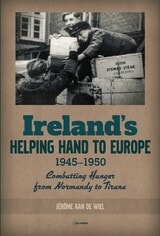
Ireland's Helping Hand to Europe
Combatting Hunger from Normandy to Tirana, 1945–1950Jérôme aan de Wiel
Central European University Press, 2021
Post-war Marshall Plan aid to Europe and indeed Ireland is well documented, but practically nothing is known about simultaneous Irish aid to Europe. This book provides a full record of the aid – mainly food but also clothes, blankets, medicines, etc. – that Ireland donated to continental Europe, including France, the Netherlands, Hungary, the Balkans, Italy, and zones of occupied Germany.
Starting with Ireland’s neutral wartime record, often wrongly presented as pro-German when Ireland in fact unofficially favoured the western Allies, Jerome aan de Wiel explains why Éamon de Valera’s government sent humanitarian aid to the devastated continent. His book analyses the logistics of collection and distribution of supplies sent abroad as far as the Greek islands.
Despite some alleged Cold-War hijacking of Irish relief – and this humanitarianism was not above the politics of that East-West confrontation – it became mostly a story of hope, generosity and European Christian solidarity. Rich archival records from Ireland and the European beneficiary countries, as well as contemporary local and national newspapers across Europe, allow the author to measure and describe not only the official but also the popular response to Irish relief schemes. This work is illustrated with contemporary photographs and some key graphs and tables that show the extent of the aid programme.

Irish Writers in the Irish American Press, 1882-1964
Stephen G. Butler
University of Massachusetts Press, 2018
Irish Writers in the Irish American Press spans the period from Oscar Wilde's 1882 American lecture tour to the months following JFK's assassination and covers the century in which Irish American identity was shaped by immigration, religion, politics, and economic advancement. Through a close engagement with Irish American periodicals, Butler offers a more nuanced understanding of the connections between Irish literary studies and Irish American culture during this period.
Iron Will
Global Extractivism and Mining Resistance in Brazil and IndiaMarkus Kröger
University of Michigan Press, 2020
By drawing on a detailed field research and other sources, this book explains precisely which resistance strategies are able to influence both political and economic outcomes. Kröger expands the focus of traditionally Latin American extractivism research to other contexts such as India and the growing extractivist movement in the Global North. In addition, as the book is a multi-sited political ethnography, it will appeal to sociologists, political scientists, anthropologists, geographers, and others using field research among other methods to understand globalization and global political interactions. It is the most comprehensive book on the political economy and ecology of iron ore and steel. This is astonishing, given the fact that iron ore is the second-most important commodity in the world after oil.
Is There Still a West?
The Future of the Atlantic AllianceEdited & Intro by William Anthony Hay & Harvey Sicherman
University of Missouri Press, 2007
Isolation and Engagement
Presidential Decision Making on China from Kennedy to NixonWilliam Waltman Newmann
University of Michigan Press, 2022

Israel and the American National Interest
A Critical ExaminationCheryl A. Rubenberg
University of Illinois Press, 1986
Israel and the Clash of Civilisations
Iraq, Iran and the Plan to Remake the Middle EastJonathan Cook
Pluto Press, 2008
Journalist Jonathan Cook explores Israel’s key role in persuading the Bush administration to invade Iraq, as part of a plan to remake the Middle East, and their joint determination to isolate Iran and prevent it from acquiring nuclear weapons that might rival Israel’s own.
This concise and clearly argued book makes the case that Israel's desire to be the sole regional power in the Middle East neatly chimed with Bush’s objectives in the “war on terror”.
Examining a host of related issues, from the ethnic cleansing of Palestinians to the role of Big Oil and the demonisation of the Arab world, Cook argues that the current chaos in the Middle East is the objective of the Bush administration – a policy that is equally beneficial to Israel.
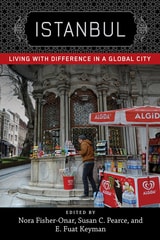
Istanbul
Living with Difference in a Global CityFisher-Onar, Nora
Rutgers University Press, 2018
Rather than exploring Istanbul as one place at one time, the contributors to this volume focus on the city’s experience of migration and globalization over the last two centuries. Asking what Istanbul teaches us about living with people whose hopes jostle with one’s own, contributors explore the rise, collapse, and fragile rebirth of cosmopolitan conviviality in a once and future world city. The result is a cogent, interdisciplinary exchange about an urban space that is microcosmic of dilemmas of diversity across time and space.