264 books match the query 'Introduction' and 46 start with i

cover of Identity, Language, and Mind: An Introduction to the Philosophy of John Perry

Identity, Language, and Mind

An Introduction to the Philosophy of John Perry

Edited by Albert Newen and Raphael van Riel

CSLI, 2012

As one of the world’s most eminent living philosophers, John Perry has covered a remarkable breadth of subjects in his published work, including semantics, indexicality, self-knowledge, personal identity, and consciousness. Looking particularly at the way in which he deals with issues of self, communication, and reality, this volume is organized in seven chapters that highlight a different aspect of Perry’s work on the intersection of these subjects. A fundamental work for students and scholars, Identity, Language, and Mind explores questions that are not only essential in understanding Perry’s writings, but also contemporary philosophy as a whole.
[more]
cover of Importing the European Army: The Introduction of European Military Techniques and Institutions in the Extra-European World, 1600-1914

Importing the European Army

The Introduction of European Military Techniques and Institutions in the Extra-European World, 1600-1914

David B. Ralston

University of Chicago Press, 1996

In a study that extends well beyond military history, David B. Ralston documents the ways in which five different countries—Russia, the Ottoman Empire, Egypt, China, and Japan—refashioned their armed forces along European lines during the three centuries after 1600. The appropriation of Western military institutions in countries outside of Europe was, Ralston argues, the major force driving these countries to adopt European administrative, economic, and cultural modes.

Following the same format in his discussion of each country, Ralston makes this central theme in world history easily accessible to students while offering scholars a sophisticated understanding of the exact nature of the changes brought about by Europeanizing military reforms.

David B. Ralston, associate professor of history at the Massachusetts Institute of Technology, is the author of The Army of the Republic.
[more]
cover of International Organizations and Research Methods: An Introduction

International Organizations and Research Methods

An Introduction

Fanny Badache, Leah R. Kimber and Lucile Maertens, Editors

University of Michigan Press, 2023

Scholars have studied international organizations (IOs) in many disciplines, thus generating important theoretical developments. Yet a proper assessment and a broad discussion of the methods used to research these organizations are lacking. Which methods are being used to study IOs and in what ways? Do we need a specific methodology applied to the case of IOs? What are the concrete methodological challenges when doing research on IOs? International Organizations and Research Methods: An Introduction compiles an inventory of the methods developed in the study of IOs under the five headings of Observing, Interviewing, Documenting, Measuring, and Combining. It does not reconcile diverging views on the purpose and meaning of IO scholarship, but creates a space for scholars and students embedded in different academic traditions to reflect on methodological choices and the way they impact knowledge production on IOs.

[more]
cover of Introduction To Poetics

Introduction To Poetics

Tzvetan Todorov

University of Minnesota Press, 1981
[more]
cover of Introduction to Adaptive Arrays

Introduction to Adaptive Arrays

Robert A. Monzingo

The Institution of Engineering and Technology, 2011
This second edition is an extensive modernization of the bestselling introduction to the subject of adaptive array sensor systems. With the number of applications of adaptive array sensor systems growing each year, this look at the principles and fundamental techniques that are critical to these systems is more important than ever before.
[more]
cover of Introduction to Airborne Radar

Introduction to Airborne Radar

Geroge W. Stimson

The Institution of Engineering and Technology, 1998

Introduction to Airborne Radar is the revision of the classic book privately published by Hughes Aircraft Company in 1983. Lavishly produced in full color, the book was quite unlike any commercially published radar book produced by the major technical publishers. The combination of clear, understandable writing and the unparalleled illustrations established the text-reference as a 'must-have' for engineers, technicians, pilots, and even sales and marketing people within the radar and aerospace industry. The book was authored by veteran Hughes engineer and Technical Manager George W. Stimson, a publications specialist. Individual chapters were thoroughly reviewed by the appropriate experts within the Hughes Radar Systems Group. The book was initially available 1983-1987 only to those within the Hughes family: employees and customers, primarily the military. Restriction was lifted in 1987. Hughes went through three printings and 40,000 copies 1983-1993, mostly by word-of-mouth testimonials and demand. Upon retirement from Hughes, George Stimson successfully negotiated for the rights to the book and made an agreement with SciTech Publishing to do a major revision of the text to update it. The resulting Second Edition has been overwhelmingly positive and a best-seller. Second Edition The revision is extensive: thirteen entirely new chapters cover the technological advances over the fifteen years since publication, two chapters considered obsolete have been deleted entirely, three chapters are extensively rewritten and updated, two chapters have been given new sections, and fourteen chapters have been given minor tweaks, corrections, and polishing. The book has grown from 32 chapters to 44 chapters in 584 efficiently-designed pages. Efforts have been made to bring more even-handed coverage to radars developed outside of Hughes Aircraft, while older and less important Hughes radars have been deleted or abbreviated. Chapter 44 catalogs many of the cutting edge radars in functioning aircraft and near-service aircraft in early stages of production. The book's appeal is to a diverse audience: from military pilots and radar officers eager to gain a sound technical understanding of the complex systems that their lives depend upon, on up through technicians, marketing, and sales people, to the radar system design specialists, who may 'know all that stuff' but who deeply admire the expression and thus use the book to teach others who have questions. The market encompasses companies directly involved in the radar business and those on the periphery, college professors of engineering and physics themselves, along with students in aviation, aeronautics, and electromagnetics and radar courses. The cross-disciplinary and multi-level demand for the book shows that the book should not be pigeon-holed as just a radar book for electrical engineers. Virtually anybody with a knowledge of high school algebra, trigonometry, and physics will be able to read and absorb most of the material.
[more]
cover of Introduction to Animal Rights: Your Child or the Dog?

Introduction to Animal Rights

Your Child or the Dog?

Gary L. Francione, foreword by Alan Watson

Temple University Press, 2000

Two-thirds of Americans  polled by the Associated Press agree with the following statement: "An animal's right to live free of suffering should be just as important as a person's right to live free of suffering." More than 50 percent of Americans believe that it is wrong to kill animals to make fur coats or to hunt them for sport. But these same Americans eat hamburgers, take their children to circuses and rodeos, and use products developed with animal testing. How do we justify our inconsistency?

In this easy-to-read introduction, animal rights advocate Gary Francione looks at our conventional moral thinking bout animals. Using examples, analogies, and thought-experiments, he reveals the dramatic inconsistency between what we say we believe about animals and how we actually treat them.

Introduction to Animal Rights: Your Child or the Dog? provides a guidebook to examining our social and personal ethical beliefs. It takes us through concepts of property and equal consideration to arrive at the basic contention of animal rights: that everyone -- human and  non-human -- has the right not to be treated as a means to an end. Along the way, it illuminates concepts and theories that all of us use but few of us understand -- the nature of "rights" and "interests," for example, and the theories of Locke, Descartes, and Bentham.

Filled with fascinating information and cogent arguments, this is a book that you may love or hate, but that will not fail to inform, enlighten, and educate.
[more]
cover of Introduction to Aristotle: Second Edition, Revised and Enlarged

Introduction to Aristotle

Second Edition, Revised and Enlarged

Aristotle

University of Chicago Press, 1974

Since the publication of the original edition in 1947, Richard McKeon's Introduction to Aristotle has become the standard text for a variety of courses in philosophy and the humanities. For this revised and enlarged edition, Professor McKeon has completely rewritten his General Introduction and his introductions to the particular works. He has also expanded the collection to include material from On the Parts of Animals and the Rhetoric.

Aristotle's contribution to Western civilization is enormous. Our language, our distinctions, our ways of thinking, all are profoundly affected by his work. Since an understanding of Aristotle is indispensable for the understanding of our own culture, the ready availability of his work is crucial.

This collection, for students and general readers alike, provides in one volume Posterior Analytics (Logic), De Anima (On the Soul), Nicomachean Ethics, and Poetics, complete and unabridged, together with generous selections from Physics, On the Parts of Animals, Metaphysics, Politics, and Rhetoric. These works, together with Professor McKeon's revised introductions, provide a convenient and thorough exposure to the works of Aristotle and to the structural interrelations in the Aristotelian system of thought.
[more]
cover of Introduction to Biomechatronics

Introduction to Biomechatronics

Graham M. Brooker

The Institution of Engineering and Technology, 2012
This is the age of biomechatronics, a time where mechanics and electronics can interact with human muscle, skeleton, and nervous systems to assist or replace limbs, senses, and even organs damaged by trauma, birth defects, or disease. Introduction to Biomechatronics provides biomedical engineering students and professionals with the fundamental mechatronic (mechanics, electronics, robotics) engineering knowledge they need to analyze and design devices that improve lives. The first half of the book provides the engineering background to understand all the components of a biomechatronic system: the human subject, stimulus or actuation, transducers and sensors, signal conditioning elements, recording and display, and feedback elements. It also includes the major functional systems of the body to which biomechatronics can be applied including: biochemical, nervous, cardiovascular, respiratory, and musculoskeletal. The second half discusses five broadly based inventions from a historical perspective and supported by the relevant technical detail and engineering analysis. It begins with the development of hearing prostheses including middle-ear implantable hearing devices and the amazingly successful cochlear implant. This is followed by sensory substitution and visual prostheses that researchers hope will do the same for the blind as the cochlear implant has done for the deaf. The last three chapters are more mechatronic in focus, examining artificial hearts, respiratory aids from the iron lung to the latest CPAP devices, and finally artificial limbs from the first hooks and peg legs to limbs that move and have a sense of touch.
[more]
cover of Introduction to Biomechatronics: Mechatronic considerations, Volume 1

Introduction to Biomechatronics

Mechatronic considerations, Volume 1

Graham M. Brooker

The Institution of Engineering and Technology, 2025

Introduction to Biomechatronics, Second Edition, combines fundamental mechatronic (mechanics, electronics, robotics) engineering knowledge with state-of-the-art device designs that improve quality of life for patients worldwide. This new edition is comprehensively updated and includes new chapters on brain-machine interfaces and exoskeletons.
[more]
cover of Introduction to Biomechatronics: Systems and applications, Volume 2

Introduction to Biomechatronics

Systems and applications, Volume 2

Graham M. Brooker

The Institution of Engineering and Technology, 2025
Introduction to Biomechatronics, Second Edition, combines fundamental mechatronic (mechanics, electronics, robotics) engineering knowledge with state-of-the-art device designs that improve quality of life for patients worldwide. This new edition is comprehensively updated and includes new chapters on brain-machine interfaces and exoskeletons.
[more]
cover of Introduction to Broadband Communication Systems

Introduction to Broadband Communication Systems

Cajetan M. Akujuobi

The Institution of Engineering and Technology, 2008
Broadband networks, such as asynchronous transfer mode (ATM), frame relay, and leased lines, allow us to easily access multimedia services (data, voice, and video) in one package. Exploring why broadband networks are important in modern-day telecommunications, Introduction to Broadband Communication Systems covers the concepts and components of both standard and emerging broadband communication network systems.
[more]
cover of Introduction to Classical and New Testament Greek: A Unified Approach

Introduction to Classical and New Testament Greek

A Unified Approach

Michael Boler

Catholic University of America Press, 2020
The defining feature of this textbook is the treatment of classical and New Testament Greek as one language using primary sources. All the example sentences the students will translate are real Greek sentences, half of which are taken from classical literature and philosophy and half of which are directly from the New Testament. The advantage of this approach is that it highlights the linguistic, literary, and historical connections between classical Greece and early Christianity. Rather than having students memorize isolated tables and artificial sentences, Michael Boler spent years combing through thousands of pages of literature, philosophy, and scripture to find short, powerful sentences that not only teach the grammatical concepts in each chapter, but also contain seeds of wisdom that will spark wonder and discussion. Introduction to New Testament and Classical Greek is born out of classroom experience in a Catholic liberal arts university whose students were disappointed to be forced to choose between textbooks that taught classical Greek in isolation and ones that focused exclusively on the New Testament. By the end of this book, students will have read over 200 lines of scripture and an equal amount of ancient literature from Homer to Aristotle. They will also have the grammatical knowledge to continue to read classical and New Testament Greek. Each chapter contains a section at the end that delves deeply into the etymology and background of the words and passages encountered in the respective chapter. Professors will thus be able to use these chapters as a bridge to philosophical, theological, historical, and literary topics that will enrich the class.
[more]
cover of Introduction to Digital Wireless Communications

Introduction to Digital Wireless Communications

Hong-Chuan Yang

The Institution of Engineering and Technology, 2017
This book provides an efficient introduction to fundamental and advanced digital transmission technologies in current and future wireless communication systems. The objective is to help students and engineers quickly grasp the operating principles and design trade-offs of various wireless transmission technologies, which will enable them to carry out product development or perform academic research in the field.
[more]
cover of Introduction to Electronic Warfare Modeling and Simulation

Introduction to Electronic Warfare Modeling and Simulation

David L. Adamy

The Institution of Engineering and Technology, 2006
This unique book covers the whole field of electronic warfare modeling and simulation at a systems level, including chapters that describe basic electronic warfare (EW) concepts. Written by a well-known expert in the field with more than 24 years of experience, the book explores EW applications and techniques and the radio frequency spectrum, with primary emphasis on HF (high frequency) to microwave. A detailed resource for entry-level engineering personnel in EW, military personnel with no radio or communications engineering background, technicians and software professionals, the work helps you understand the basic concepts required for modeling and simulation, as well as fidelity and other practical aspects of simulation design and application. You get clear explanations of important mathematical concepts, such as decibel notation and spherical trigonometry. This informative reference explains how to facilitate the generation of realistic computer models of EW equipment. Moreover, it describes specific types of EW equipment, how they work and how each is mathematically modeled. The book concludes with a description of the various types of models and simulations and the ways they are applied to training and equipment testing tasks.
[more]
cover of Introduction to Engineering Design: A Conceptual Overview

Introduction to Engineering Design

A Conceptual Overview

Kenneth Alfano

Michigan Publishing Services, 2025

Introduction to Engineering Design: A Conceptual Overview provides a basic overview of the process of engineering design – the "heart" of engineering – in a broadly accessible manner that assumes no specialized knowledge. The focus is on breadth over depth, for a contextual framework that can in turn facilitate more detailed or focused learning later on. Relevant for a wide range of engineering disciplines, it outlines core design process fundamentals while also introducing various related points along the way.
 
Engineering design courses are often project-oriented, and rightly so, given that the process is best understood through some amount of experience. But a conceptual foundation is likewise critical for this subject. It helps enable experiential learning to relate the broad context of design process elements to the specific context of a given project. Further, engineering students tend to start out more acquainted with thinking about math and science subjects, where there is often one way – or at least a clear best way – to a “right” answer. The design process, by marked contrast, is largely qualitative and open-ended. Relatedly, it can (perhaps ironically) aid early learners to point out how varied and inconsistent the usage can be for some terminology – so the book does so at times, to help preempt confusion down the road.
 
In addition to being a text for an introductory college course, the book can also serve as a supplemental or reference text for later courses or on the job, or simply a general overview for those curious about the subject.

[more]
cover of Introduction to Esports Management: First Edition

Introduction to Esports Management

First Edition

Dina Gentile

FiT Publishing, 2022

The esports industry has experienced rapid expansion across management, marketing, and overall operations of esports events, as well as distribution of programming and gaming. College programs are adding courses, minors, and major programs of study to capitalize on the growing popularity and interest of esports to prepare future professionals in this booming industry. In response to the astronomical growth in esports worldwide, this first edition of Introduction to Esports Management was developed.

Introduction to Esports Management is a first-of-its-kind resource to explore the full breadth of topics on the management and administration of esports and gaming across a variety of settings. It offers coverage of topics specific to esports, such as streaming, branding, esports careers, esports operations and strategic planning, along with the cultural impact of esports. The text examines traditional sport management topics including governance, event/facility management, and marketing with deliberate consideration of how these essential elements are adjusted to address the esports environment and its unique stakeholder groups. Ultimately, Introduction to Esports Management is a timely and well-organized classroom resource that addresses core areas of the industry and immersive feedback from esports professionals in the field.
[more]
cover of Introduction to Husserlian Phenomenology

Introduction to Husserlian Phenomenology

Rudolf Bernet, Iso Kern, and Eduard Marbach

Northwestern University Press, 1993
This comprehensive study of Husserl's phenomenology concentrates on Husserl's emphasis on the theory of knowledge. The authors develop a synthetic overview of phenomenology and its relation to logic, mathematics, the natural and human sciences, and philosophy. The result is an example of philology at its best, avoiding technical language and making Husserl's thought accessible to a variety of readers.
[more]
cover of Introduction to Metadata: Third Edition

Introduction to Metadata

Third Edition

Murtha Baca

J. Paul Getty Trust, The, 2016

Metadata provides a means of indexing, accessing, preserving, and discovering digital resources. The volume of digital information available over electronic networks has created a pressing need for standards that ensure correct and proper use and interpretation of the data by its owners and users. Well-crafted metadata is needed more now than ever before and helps users to locate, retrieve, and manage information in this vast and complex universe.
 
The third edition of Introduction to Metadata, first published in 1998, provides an overview of metadata, including its types, roles, and characteristics; a discussion of metadata as it relates to Web resources; and a description of methods, tools, standards, and protocols for publishing and disseminating digital collections. This revised edition is an indispensable resource in the field, addressing advances in standards such as Linked Open Data, changes in intellectual property law, and new computing technologies, and offering an expanded glossary of essential terms.
 
[more]
cover of Introduction to Middle Welsh

Introduction to Middle Welsh

Joshua Byron Smith

Catholic University of America Press, 2026

Introduction to Middle Welsh offers a comprehensive introduction to Middle Welsh grammar, leading the student through sixty chapters of carefully scaf­folded exercises and readings. Written in an engaging style and aimed toward learners without any knowledge of Modern Welsh, this book guides students to a high intermediate level of proficiency with the language, focusing par­ticularly on prose. The first twenty chapters employ both original Middle Welsh sentences and simplified sentences based on originals, allowing learners to master basic grammatical concepts without being overwhelmed by vocabulary. New vo­cabulary is introduced at the end of each lesson, so that learners can complete the exercises and translation without looking up words in the glossary. The glossary, for its part, contains over 1,500 vocabulary items, which provides students with many of the most commonly used words in Middle Welsh liter­ature. When available, useful etymologies are also provided, making connec­tions to languages that students might already know. In addition to several hundred carefully chosen sentences for translation exercises, Introduction to Middle Welsh includes eighteen selections from literature, ranging from poetry to law, showing the variety of the Middle Welsh literary corpus. Ideal for the classroom or self-taught learners, Introduction to Middle Welsh will appeal to those with an interest in Welsh, medieval literature, and Celtic studies.
[more]
cover of Introduction to Moral Theology (Catholic Moral Thought, Volume 1)

Introduction to Moral Theology (Catholic Moral Thought, Volume 1)

Romanus Cessario, O.P.

Catholic University of America Press, 2001

The present volume, the first in the new Catholic Moral Thought series, responds to the need for a new introduction to the basic and central elements of Catholic moral theology written in the light of Veritatis splendor.
[more]
cover of Introduction to Moral Theology, revised edition

Introduction to Moral Theology, revised edition

Romanus Cessario

Catholic University of America Press, 2013

Originally published in 2001, Introduction to Moral Theology responded to the need for a new introduction to the basic and central elements of Catholic moral theology written in the light of Veritatis splendor. Since then, it has become a standard text for students and a reputable resource on such topics as moral theology and the good of the human person created in God's image; natural law; principles of human action; determination of the moral good through objects, ends, and circumstances; and the virtues, gifts of the Holy Spirit, and the Beatitudes.
[more]
cover of Introduction to Natural Language Semantics

Introduction to Natural Language Semantics

Henriëtte de Swart

CSLI, 1998

Semantics is defined as the study of meaning expressed by elements of a language or combinations thereof. Utterances are not just noises or scribbles, they are used to convey information, and they are linked with kinds of events and with states of mind.

This text examines what issues semantics, as a theory of meaning, should address; determining what the meanings of words of the language are and how to semantically combine elements of a language to build up complex meanings. Logical languages are then developed as formal metalanguages to natural language. Subsequent chapters address propositional logic, the syntax and semantics of (first-order) predicate logic as an extension of propositional logic, and Generalized Quantifier theory. Going beyond extensional theory, Henri'tte de Swart relativizes the interpretation of expressions to times to account for verbal tense, time adverbials and temporal connectives and introduces possible worlds to model intensions, modal adverbs and modal auxiliaries.

This broad overview of natural language semantics should cover most of the points addressed in an introductory course. Numerous exercises punctuate each chapter and an example exam based on the materials presented is included, making this volume a perfect textbook and resource for any undergraduate or graduate-level introductory course in semantics.

[more]
cover of Introduction to Non-Marxism

Introduction to Non-Marxism

François Laruelle

University of Minnesota Press, 2014

Following the collapse of the communist states it was assumed that Marxist philosophy had collapsed with it. In Introduction to Non-Marxism, François Laruelle aims to recover Marxism along with its failure by asking the question “What is to be done with Marxism itself?”

To answer, Laruelle resists the temptation to make Marxism more palatable after the death of metaphysics by transforming Marxism into a mere social science or by simply embracing with evangelical fervor the idea of communism. Instead Laruelle proposes a heretical science of Marxism that will investigate Marxism in both its failure and power so as to fashion new theoretical tools.

In the course of engaging with the material of Marxism, Laruelle takes on the philosophy of Marx along with important philosophers who have extended that philosophy including Althusser, Balibar, Negri as well as the attempt at a phenomenological Marxism found in the work of Michel Henry. Through this engagement Laruelle develops with great precision the history and function of his concept of determination-in-the-last-instance. In the midst of the assumed failure of Marxism and the defections and resentment that followed, Laruelle’s non-Marxism responds with the bold declaration: “Do not give up on theory!”

[more]
cover of Introduction to Nordic Cultures

Introduction to Nordic Cultures

Edited by Annika Lindskog and Jakob Stougaard-Nielsen

University College London, 2020

Introduction to Nordic Cultures is an innovative, interdisciplinary introduction to Nordic history, cultures, and societies from medieval times to today. The textbook spans the whole Nordic region, covering historical periods from the Viking Age to modern society, and engages with a range of subjects: from runic inscriptions on iron rings and stone monuments, via eighteenth-century scientists, Ibsen’s dramas and turn-of-the-century travel, to twentieth-century health films and the welfare state, nature ideology, Greenlandic literature, Nordic Noir, migration, ‘new’ Scandinavians, and stereotypes of the Nordic. This book provides fundamental knowledge and insights into the history and structures of Nordic societies while constructing critical analyses around specific case studies that help build an informed picture of how societies grow and of the interplay between history, politics, culture, geography, and people.
 
[more]
cover of Introduction to Old Javanese Language and Literature: A Kawi Prose Anthology

Introduction to Old Javanese Language and Literature

A Kawi Prose Anthology

Mary S. Zurbuchen

University of Michigan Press, 1976

The oldest and most extensive written language of Southeast Asia is Old Javanese, or Kawi. It is the oldest language in terms of written records, and the most extensive in the number and variety of its texts. Javanese literature has taken many forms. At various times, prose stories, sung poetry or other metrical types, chronicles, scientific, legal, and philosophical treatises, prayers, chants, songs, and folklore were all written down. Yet relatively few texts are available in English. The unstudied texts remaining are an unexplored record of Javanese culture as well as a language still alive as a literary medium in Bali.
Introduction to Old Javanese Language and Literature represents a first step toward remedying the dearth of Old Javanese texts available to English-speaking students. The ideal teaching companion, this anthology offers transliterated original texts with facing-page English translations. Theanthology focuses on prose selections, since their straightforward style and syntax offer the beginning student the most rewarding experience. Four sections make up the collection. Part I offers several short readings as the most accessible entry point into Old Javanese. Part II contains two moralistic fables from an Old Javanese retelling of the Hindu Pañcatantra cycle. Part III takes up the epic, providing excerpts from one of the books of the Old Javanese retelling of the Mahābhārata. Part IV offers excerpts from two chronicles, the generic conventions of which challenge received notions of history writing because of their supernaturalism and folkloric elements.
Includes introduction, glossary, and notes.
[more]
cover of Introduction to Philosophical Principles: Logic, Physics, and the Human Person, Third edition

Introduction to Philosophical Principles

Logic, Physics, and the Human Person, Third edition

Brian Kemple

St. Augustine's Press, 2026
[more]
cover of Introduction to Probability for Data Science

Introduction to Probability for Data Science

Stanley Chan

Michigan Publishing Services, 2021

[from the Preface] This introductory textbook in undergraduate probability emphasizes the inseparability between data (computing) and probability (theory) in our time. It examines the motivation, intuition, and implication of the probabilistic tools used in science and engineering:
  1. Motivation: In the ocean of mathematical definitions, theorems, and equations, why should we spend our time on this particular topic but not another?
  2. Intuition: When going through the deviations, is there a geometric interpretation or physics beyond those equations?
  3. Implication: After we have learned a topic, what new problems can we solve?
[more]
cover of Introduction to Public Librarianship

Introduction to Public Librarianship

Kathleen de la Peña McCook

American Library Association, 2018

Put simply, there is no text about public librarianship more rigorous or comprehensive than McCook's survey. Now, the REFORMA Lifetime Achievement Award-winning author has teamed up with noted public library scholar and advocate Bossaller to update and expand her work to incorporate the field's renewed emphasis on outcomes and transformation. This "essential tool" (Library Journal) remains the definitive handbook on this branch of the profession. It covers every aspect of the public library, from its earliest history through its current incarnation on the cutting edge of the information environment, including

  • statistics, standards, planning, evaluations, and results;
  • legal issues, funding, and politics;
  • organization, administration, and staffing;
  • all aspects of library technology, from structure and infrastructure to websites and makerspaces;
  • adult services, youth services, and children's services;
  • associations, state library agencies, and other professional organizations;
  • global perspectives on public libraries; and
  • advocacy, outreach, and human rights.

Exhaustively researched and expansive in its scope, this benchmark text continues to serve both LIS students and working professionals.

[more]
cover of Introduction to Public Librarianship

Introduction to Public Librarianship

Kathleen de la Peña McCook

American Library Association, 2011

[more]
cover of Introduction to Public Librarianship

Introduction to Public Librarianship

American Library Association, 2004
[more]
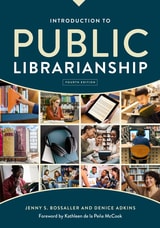
cover of Introduction to Public Librarianship, Fourth Edition

Introduction to Public Librarianship, Fourth Edition

Jenny S. Bossaller and Denice Adkins; Foreword by Kathleen de la Peña McCook

American Library Association, 2024

Dubbed "a peerless ambassador for public libraries, educating future professionals, current professionals in other parts of the field, and anyone else interested about the irreplaceable and irrepressible entities that are public libraries” (Library Quarterly), the newest edition of this trusted resource has been reimagined and restructured to make it even more relevant and useful. The definitive handbook on this branch of the profession, it covers every aspect of the public library, from its earliest history through its current incarnation on the cutting edge of the information environment, including

  • a summary of current and historical issues in public libraries;
  • a new chapter on financing which covers traditional sources, creative funding, capital campaigns, special projects, and the pros and cons of public/private partnerships;
  • statistics, standards, planning, evaluations, and results;
  • legal issues and politics, including how different states are set up, the role of state libraries, defining service population, and when the law and values conflict (such as union/non-union scenarios);
  • updated coverage of important advocacy issues, including advocacy for access, the legal limits of advocacy, involving the community in advocacy, and communicating the effectiveness of the public library to stakeholders;
  • organization, administration, and staffing, from the differences between small libraries and large systems to current issues like non-MLIS library workers and unionization;
  • learning about who public libraries serve by utilizing community analysis, community needs assessments, and diversity considerations;
  • adult services, youth services, children's services, and serving special populations such as older adults, adults with special needs, schools, daycares, and the incarcerated;
  • library technology, from structure and infrastructure to websites and makerspaces;
  • issues related to library buildings and master plans, such as gathering community input and working with an architect on library spaces and library services outside of the library;
  • library associations, state library agencies, and other professional organizations;
  • disaster planning and recovery from technological, ecological, and biological disasters; and
  • global perspectives on public libraries.
[more]
cover of Introduction to RF Stealth

Introduction to RF Stealth

David L. Lynch Jr.

The Institution of Engineering and Technology, 2004
This is the only book focused on the complete aspects of RF Stealth design. It is the first book to present and explain first order methods for the design of active and passive stealth properties. Everything from Electronic Order of Battle to key component design is covered.
[more]
cover of Introduction to Radar Target Recognition

Introduction to Radar Target Recognition

P. Tait

The Institution of Engineering and Technology, 2006

This book text provides an overview of the radar target recognition process and covers the key techniques being developed for operational systems. It is based on the fundamental scientific principles of high resolution radar, and explains how the underlying techniques can be used in real systems, taking into account the characteristics of practical radar system designs and component limitations. It also addresses operational aspects, such as how high resolution modes would fit in with other functions such as detection and tracking.
[more]
cover of Introduction to Reference Sources in Health Science

Introduction to Reference Sources in Health Science

American Library Association, 2008

[more]
cover of Introduction to Reference Sources in the Health Sciences

Introduction to Reference Sources in the Health Sciences

Jeffrey T. Huber

American Library Association, 2014

[more]
cover of Introduction to Sacramental Theology: Signs of Christ in the Flesh

Introduction to Sacramental Theology

Signs of Christ in the Flesh

Jose Granados

Catholic University of America Press, 2021
Introduction to Sacramental Theology presents a complete overview of sacramental theology from the viewpoint of the body. This viewpoint is supported, in the first place, by Revelation, for which the sacraments are the place where we enter into contact with the body of the risen Jesus. It is a viewpoint, secondly, which is firmly rooted in our concrete human bodily experience, thus allowing for a strong connection between faith and life, creation and redemption. From this point of view, the treatise on the sacraments occupies a strategic role. For the sacraments appear, not as the last of a series of topics (after dealing with Creation, Christ, the Church), but as the original place in which to stand in order to contemplate the entire Christian mystery. This point of view of the body, which resonates with contemporary philosophy, sheds fruitful light on classical themes, such as the relationship of the sacraments with creation, the composition of the sacramental sign, the efficacy of the sacraments, the sacramental character, the role of the minister, or the relationship of the sacrament with the Church as a sacrament. As a result of this approach, the Eucharist takes on a central role, since this is the sacrament where the body of Jesus is made present. The rest of the sacraments are seen as prolongations of the eucharistic body, so as to fill all the time and space of the faithful. This foundation of the theology of the sacraments in eucharistic theology is supported by an analysis of the patristic and medieval tradition. In order to support its conclusions, Introduction to Sacramental Theology examines the doctrine of Scripture (especially St. John and St. Paul), the main patristic and medieval authors (St. Augustine, Hugh of St. Victor, St. Bonaventure, St. Thomas Aquinas), the response of Trent to the protestant challenges, up to modern authors such as Scheeben, Rahner, Ratzinger, or Chauvet, including the teaching of Vatican II about the Church as a kind of sacrament.
[more]
cover of Introduction to Scholastic Theology

Introduction to Scholastic Theology

Ulrich G. Leinsle

Catholic University of America Press, 2010
With this book, distinguished historian of philosophy Ulrich Leinsle offers the first comprehensive introduction to scholastic theology -- a textbook for both Protestant and Catholic students.
[more]
cover of Introduction to Sensors for Ranging and Imaging

Introduction to Sensors for Ranging and Imaging

Graham Brooker

The Institution of Engineering and Technology, 2009

This is a comprehensive textbook and reference that provides a solid background in active sensing technology. Beginning with a historical overview and an introductory section on signal generation, filtering and modulation, it follows with a section on radiometry (infrared and microwave) as a background to the active sensing process. The core of the book is concerned with active sensing, starting with the basics of time-of-flight sensors (operational principles, components), and goes through the derivation of the radar range equation, and the detection of echo signals, both fundamental to the understanding of radar, sonar and lidar imaging. Several chapters cover signal propagation of both electromagnetic and acoustic energy, target characteristics, stealth and clutter. The remainder of the book involves the basics of the range measurement process, active imaging with an emphasis on noise and linear frequency modulation techniques, Doppler processing, and target tracking.
[more]
cover of Introduction to Sociocultural Anthropology: Adaptations, Structures, Meanings

Introduction to Sociocultural Anthropology

Adaptations, Structures, Meanings

David Haines

University Press of Colorado, 2017

An Introduction to Sociocultural Anthropology exposes students to the cultural detail and personal experiences that lie in the anthropological record and extends their anthropological understanding to contemporary issues.

The book is divided into three parts that focus on the main themes of the discipline: ecological adaptations, structural arrangements, and interpretive meanings. Each chapter provides an overview of a particular topic and then presents two case examples that illuminate the range of variation in traditional and contemporary societies. New case examples include herders’ climate change adaptations in the Arctic, matrilineal Muslims in Indonesia, Google’s AI winning the Asian game Go, mass migration in China, cross-cultural differences in the use of social media, and the North American response to the Syrian refugee crisis. Instructors will also have digital access to all the book’s illustrations for class review.

Covering the full range of sociocultural anthropology in a compact approach, this revised and updated edition of Cultural Anthropology: Adaptations, Structures, Meanings is a holistic, accessible, and socially relevant guide to the discipline for students at all levels.
[more]
cover of Introduction to the History of Indian Buddhism

Introduction to the History of Indian Buddhism

Eugène Burnouf

University of Chicago Press, 2010

The most influential work on Buddhism to be published in the nineteenth century, Introduction à l’histoire du Buddhisme indien, by the great French scholar of Sanskrit Eugène Burnouf, set the course for the academic study of Buddhism—and Indian Buddhism in particular—for the next hundred years. First published in 1844, the masterwork was read by some of the most important thinkers of the time, including Schopenhauer and Nietzsche in Germany and Emerson and Thoreau in America.

Katia Buffetrille and Donald S. Lopez Jr.’s expert English translation, Introduction to the History of Indian Buddhism, provides a clear view of how the religion was understood in the early decades of the nineteenth century. Burnouf was an impeccable scholar, and his vision, especially of the Buddha, continues to profoundly shape our modern understanding of Buddhism. In reintroducing Burnouf to a new generation of Buddhologists, Buffetrille and Lopez have revived a seminal text in the history of Orientalism.


[more]
cover of Introduction to the Mystery of the Church

Introduction to the Mystery of the Church

Benoit-Dominique de La Soujeole, OP

Catholic University of America Press, 2014

An ecclesiological survey presenting a doctrinal synthesis of the church.
[more]
cover of Introduction to the Smart Grid: Concepts, technologies and evolution

Introduction to the Smart Grid

Concepts, technologies and evolution

Salman K. Salman

The Institution of Engineering and Technology, 2017

In recent years it has become increasingly apparent that conventional electrical networks cannot meet the requirements of the 21st century. These include reliability, efficiency, liberalisation of electricity markets, as well as effective and seamless integration of various types of renewable energy sources, electric vehicles, and customers as players. The emergence of new technologies such as distributed control, monitoring devices, and tremendous advances in information and communication technology have paved the way to realize the Smart Grid concept.
[more]
cover of Invitation to Law and Society, Second Edition: An Introduction to the Study of Real Law

Invitation to Law and Society, Second Edition

An Introduction to the Study of Real Law

Kitty Calavita

University of Chicago Press, 2016

Law and society is a rapidly growing field that turns the conventional view of law as mythical abstraction on its head. Kitty Calavita brilliantly brings to life the ways in which law is found not only in statutes and courtrooms but in our institutions and interactions, while inviting readers into conversations that introduce the field’s dominant themes and most lively disagreements. Deftly interweaving scholarship with familiar examples, Calavita shows how scholars in the discipline are collectively engaged in a subversive exposé of law’s public mythology. While surveying prominent issues and distinctive approaches to both law as it is written and actual legal practices, as well as the law’s potential as a tool for social change, this volume provides a view of law that is more real but just as compelling as its mythic counterpart.

With this second edition of Invitation to Law and Society, Calavita brings up to date what is arguably the leading introduction to this exciting, evolving field of inquiry and adds a new chapter on the growing law and cultural studies movement.

[more]
cover of Invitation to Law and Society, Second Edition: An Introduction to the Study of Real Law

Invitation to Law and Society, Second Edition

An Introduction to the Study of Real Law

Kitty Calavita

University of Chicago Press, 2016

This is an auto-narrated audiobook version of this book.

Law and society is a rapidly growing field that turns the conventional view of law as mythical abstraction on its head. Kitty Calavita brilliantly brings to life the ways in which law is found not only in statutes and courtrooms but in our institutions and interactions, while inviting readers into conversations that introduce the field’s dominant themes and most lively disagreements. Deftly interweaving scholarship with familiar examples, Calavita shows how scholars in the discipline are collectively engaged in a subversive exposé of law’s public mythology. While surveying prominent issues and distinctive approaches to both law as it is written and actual legal practices, as well as the law’s potential as a tool for social change, this volume provides a view of law that is more real but just as compelling as its mythic counterpart.

With this second edition of Invitation to Law and Society, Calavita brings up to date what is arguably the leading introduction to this exciting, evolving field of inquiry and adds a new chapter on the growing law and cultural studies movement.

[more]
cover of Invitation to Law and Society: An Introduction to the Study of Real Law

Invitation to Law and Society

An Introduction to the Study of Real Law

Kitty Calavita

University of Chicago Press, 2010

Law and Society is a rapidly-growing interdisciplinary field that turns on its head the conventional, idealized view of the “Law” as a magisterial abstraction. Kitty Calavita’s Invitation to Law and Society brilliantly brings to life the ways in which law shapes and manifests itself in the institutions and interactions of human society, while inviting the reader into conversations that introduce the field’s dominant themes and most lively disagreements. 

Deftly interweaving scholarship with familiar personal examples, Calavita shows how scholars in the discipline are collectively engaged in a subversive exposé of law’s public mythology. While surveying prominent issues and distinctive approaches to the use of the law in everyday life, as well as its potential as a tool for social change, this volume provides a view of law that is more real but just as compelling as its mythic counterpart. In a field of inquiry that has long lacked a sophisticated yet accessible introduction to its ways of thinking, Invitation to Law and Society will serve as an engaging and indispensible guide.

[more]