Results by title
477 books match the query 'Italy' and 19 start with i

Iceman
Uncovering the Life and Times of a Prehistoric Man Found in an Alpine GlacierBrenda Fowler
University of Chicago Press, 2001
Illegitimacy in Renaissance Florence
Thomas Kuehn
University of Michigan Press, 2002
The Florentine catasto, a fiscal survey of households taken at several points in the fifteenth century, locates hundreds of illegitimate children and reveals a great deal about their household circumstances and parentage. Supplementing this information are notarial documents and family account books. Illegitimacy in Renaissance Florence places Florentine illegitimate children in a complete legal context, culminating in examination of several Florentine legal cases. Thomas Kuehn shows how lawyers were called on to cope with and make legal sense of the actions and prejudices of Florentines toward their illegitimate kin.
It is clear, in its simplest terms, that illegitimacy in Florence was a permanent, if not fixed, status. Most illegitimate children, especially girls, were abandoned; infanticide was undoubtedly practiced. But even those children raised by benevolent fathers and granted legitimation always remained "legitimatus" and not "legitimus." Florentines whose illegitimate paternity was admitted were overwhelmingly born of elite fathers but poor or servile mothers. In neither social nor legal terms did the illegitimate share fully in the personhood of the legitimate adult male Florentine citizen. Still, ambiguities of status could be useful for those with sufficient wealth and social standing to exploit their potential.
Illegitimacy in Renaissance Florence will appeal to social historians of Europe, medieval and early modern, especially those concerned with family life, women, and children, as well as all those interested in Florentine history. Legal historians will find it useful as well.
Thomas Kuehn is Professor of History, Clemson University.
Images and Translations
The Etruscans AbroadLarissa Bonfante
University of Michigan Press, 2023
Professor Larissa Bonfante’s great gift was the ability to evoke, in a fresh, immediate, and convincing way, the experiences, beliefs, and thoughts of people living more than two thousand years ago. Her final publication, Images and Translations: The Etruscans Abroad, communicates the sensations of other times and places, from the day-to-day to the solemnly ritualistic.
The world of the Etruscans, sophisticated and pleasure-loving, radiated throughout a vast area of the ancient world – a world very different from our own. Relying on a wealth of creative works, Images and Translations examines the expertise and productions of the artists who made them, the tastes of those who used them, and the sometimes surprising results of the exchanges between creators and buyers. Just as the French demand for Chinese ceramics in the seventeenth century gave birth to the unprecedented famille colors, so the production of Greek ceramics for the Etruscan market produced singularly expressive depictions. Humorous, pious, or erotic to the buyers, they could be shocking to the culture that made them.
Images and Translations explores areas in much closer economic and cultural contact than is usually recognized. The volume finds threads of connection not only between Italy and Greece, but between Italy and northern Europe—today’s France and Germany—as well as between Italy and the Near East. Etruscan influence runs through Western history, into the Renaissance, and emerges in imagery still evocative today.
Imperial City
Rome under NapoleonSusan Vandiver Nicassio
University of Chicago Press, 2009
In 1798, the armies of the French Revolution tried to transform Rome from the capital of the Papal States to a Jacobin Republic. For the next two decades, Rome was the subject of power struggles between the forces of the Empire and the Papacy, while Romans endured the unsuccessful efforts of Napoleon’s best and brightest to pull the ancient city into the modern world. Against this historical backdrop, Nicassio weaves together an absorbing social, cultural, and political history of Rome and its people. Based on primary sources and incorporating two centuries of Italian, French, and international research, her work reveals what life was like for Romans in the age of Napoleon.
“A remarkable book that wonderfully vivifies an understudied era in the history of Rome. . . . This book will engage anyone interested in early modern cities, the relationship between religion and daily life, and the history of the city of Rome.”—Journal of Modern History
“An engaging account of Tosca’s Rome. . . . Nicassio provides a fluent introduction to her subject.”—History Today
“Meticulously researched, drawing on a host of original manuscripts, memoirs, personal letters, and secondary sources, enabling [Nicassio] to bring her story to life.”—History
In Defense of Women
A Bilingual EditionPompeo Colonna
Iter Press, 2024
Pompeo Colonna’s In Defense of Women (1530), presented in this volume in Latin and English translation, is one of several important defenses of women composed in the fifteenth and sixteenth centuries by male advocates of women’s moral and intellectual worth. Known as a cardinal and a warrior, but also as an active participant in sixteenth-century Italian literary circles, Colonna addresses the work to his cousin Vittoria Colonna, the most renowned Italian woman poet of the era, who, he writes, had urged him to undertake it. His Defense not only refutes arguments of women’s inferiority and incapacity but, remarkably, asserts their ability to hold political office and govern. It contains original Latin text and a critical introduction by Franco Minonzio. It also features a foreword by Margaret L. King, as well as a postscript by King, tracing the separate male-authored and female-authored Renaissance defenses of women.
In Dialogue with the Other Voice in Sixteenth-century Italy
Literary and Social Contexts for Women's WritingEdited by Julie D. Campbell and Maria Galli Stampino
Iter Press, 2011
—Elissa Weaver
Professor of Italian, Emerita, University of Chicago
In Praise of Disobedience
Clare of Assisi, A NovelDacia Maraini
Rutgers University Press, 2023
In the Shadow of the Swastika
Hermann Wygoda
University of Illinois Press, 1998

Infinite Variety
The Life and Legend of the Marchesa CasatiScot D. Ryersson
University of Minnesota Press, 2004
Influences
Art, Optics, and Astrology in the Italian RenaissanceMary Quinlan-McGrath
University of Chicago Press, 2013
Innovation in the Italian Counter-Reformation
Shannon McHugh
University of Delaware Press, 2011
Published by University of Delaware Press. Distributed worldwide by Rutgers University Press.
Inventing the Renaissance
The Myth of a Golden AgeAda Palmer
University of Chicago Press, 2025
WINNER OF THE HUGO AWARD
A New Yorker Best Book of 2025
An irreverent new take on the Renaissance, which reveals it as anything but Europe’s golden age.
From the darkness of a plagued and war-torn Middle Ages, the Renaissance (we’re told) heralds the dawning of a new world—a halcyon age of art, prosperity, and rebirth. Hogwash! or so says award-winning novelist and historian Ada Palmer. In Inventing the Renaissance, Palmer turns her witty and irreverent eye on the fantasies we’ve told ourselves about Europe’s not-so-golden age, myths she sets right with sharp clarity.
Palmer’s Renaissance is altogether desperate. Troubled by centuries of conflict, she argues, Europe looked to a long-lost Roman Empire (even its education practices) to save it from unending war. Later historians met their own political challenges with a similarly nostalgic vision, only now they looked to the Renaissance and told a partial story. To right this wrong, Palmer offers fifteen provocative portraits of Renaissance men and women (some famous, some obscure) whose lives reveal a far more diverse, fragile, and wild Renaissance than its glowing reputation suggests.
Italian Art 1400-1500
Sources and DocumentsCreighton Gilbert
Northwestern University Press, 1980
Italian Chronicles
Raymond N. Stendhal
University of Minnesota Press, 2017
Nineteenth-century French writer Marie-Henri Beyle, better known by his pen name Stendhal, is one of the earliest leading practitioners of realism, his stories filled with sharp analyses of his characters’ psychology. This translation of Stendhal’s Chroniques italiennes is a collection of nine tales written between 1829 and 1840, many of which were published only after his death. Together these collected tales reveal a great novelist working with highly dramatic subject matter to forge a vision of life lived at its most intense.
The setting for these tales is a romanticized Italy, a place Stendhal viewed as unpolluted by bourgeois inhibitions and conformism. From the hothouse atmosphere of aristocratic convents to the horrors of the Cenci family, the tales in Italian Chronicles all feature passionate, transgressive characters engaged in “la chasse au bonheur”—the quest for happiness. Most of the tragic, violent tales are based on historical events, with Stendhal using history to validate his characters’ extreme behaviors as they battle literal and figurative oppression and try to break through to freedom.
Complete with revenge, bloody daggers, poisonings, and thick-walled nunneries, this new translation of Italian Chronicles includes four never-before-translated stories and a fascinating introduction detailing the origins of the book. It is sure to gratify established Stendhal fans as well as readers new to the writer.
Italian Locations
Reinhabiting the Past in Postwar CinemaNoa Steimatsky
University of Minnesota Press, 2008
Fascism and the Second World War left Italy indelibly changed, and cinema was arguably the art that most rigorously confronted the devastated nation. In this examination of four Italian filmmakers, Noa Steimatsky brilliantly maps their forceful negotiation of Italy’s identity and posits that the cinematic forms they employ constitute an imaginary reinhabiting of Italy-one that is inextricably linked with the political, physical, and symbolic predicament of reconstruction.
A dynamic intersection of pictorial and photographic, architectural and literary discourses inform Steimatsky’s revisionist interrogation of exemplary works from the 1940s to the mid–1960s. From the earliest documentary work of Michelangelo Antonioni on the River Po to Pier Paolo Pasolini’s re-siting of the Gospel in the arid, peripheral landscape of the Italian south, and from Roberto Rossellini’s tracing of a neorealist project in ruinous Berlin to Luchino Visconti’s wrought grandeur visited upon a humble Sicilian fishing village, Italian Locations probes the historical experience of displacement, anachronism, and a thoroughly contemporary anxiety in the cinematic arena.
For Steimatsky, Antonioni’s modernist achievement, informed by his native landscape, Rossellini’s neorealist image of Italy as a nation of ruins, Visconti’s reaching back to the nineteenth century and even more archaic pasts, and Pasolini’s ambivalence about modernity-all partake in a search for a politically and culturally redeemed Italy.
Noa Steimatsky is associate professor of the history of art and film studies at Yale University.
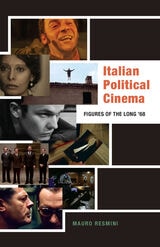
Italian Political Cinema
Figures of the Long ’68Mauro Resmini
University of Minnesota Press, 2022
An exploration of how film has made legible the Italian long ’68 as a moment of crisis and transition
Traditionally, the definition of political cinema assumes a relationship between cinema and politics. In contrast to this view, author Mauro Resmini sees this relationship as an impasse. To illustrate this theory, Resmini turns to Italian cinema to explore how films have reinvented the link between popular art and radical politics in Italy from 1968 to the early 1980s, a period of intense political and cultural struggles also known as the long ’68.
Italian Political Cinema conjures a multifaceted, complex portrayal of Italian society. Centered on emblematic figures in Italian cinema, it maps the currents of antagonism and repression that defined this period in the country’s history. Resmini explores how film imagined the possibilities, obstacles, and pitfalls that characterized the Italian long ’68 as a moment of crisis and transition. From workerism to autonomist Marxism to feminism, this book further expands the debate on political cinema with a critical interpretation of influential texts, some of which are currently only available in Italian.
A comprehensive and novel redefinition of political film, Italian Political Cinema introduces its audience to lesser-known directors alongside greats such as Pasolini, Bertolucci, Antonioni, and Bellocchio. Resmini offers access to untranslated work in Italian philosophy, political theory, and film theory, and forcefully advocates for the continued artistic and political relevance of these films in our time.
Italy and American Female Imagination
Debra Bernardi
The Ohio State University Press, 2025

Italy at the Polls, 1983
A Study of the National ElectionsHoward R. Penniman, ed.
Duke University Press, 1987
Italy to Argentina
Travel Writing and Emigrant ColonialismTullio Pagano
Amherst College Press, 2023
“Italy to Argentina shows meticulous bibliographic work and is attentive to both fundamental and marginal texts in a double task, on the one hand, of textual analysis, and on the other, of rescuing and recovering a corpus forgotten by critics even when it is highly significant. It is, then, a research work that addresses the Italian emigration to Argentina from an original point of view, linking texts that have not been studied or that have not been sufficiently analyzed.” —Fernanda Elisa Bravo Herrera, author of Huellas y recorridos de una utopía: La emigración italiana en la Argentina
"From Boccadasse to La Boca. Tullio Pagano complexifies the relationship between ‘diaspora’ and ‘colonialism’ in the context of Italian migration to South America. In six thematic chapters, Pagano explores the thought of authors on and off the canon. Such diverse voices lead the reader to a new approach to the study of emigrant colonialism and creole studies, towards a deeper, more realistic understanding of the ‘conquest of the desert’ that Italian emigrants wanted to perform in Argentina."—Giuseppe Gazzola, Stony Brook University