Results by title
185 books match the query 'Jazz' and 8 start with i

I Walked With Giants
The Autobiography of Jimmy HeathJimmy Heath and Joseph McLaren, foreword by Bill Cosby, introduction by Wynton Marsalis
Temple University Press, 2010
In this extraordinary autobiography, the legendary Heath creates a “dialogue” with musicians and family members. As in jazz, where improvisation by one performer prompts another to riff on the same theme, I Walked with Giants juxtaposes Heath’s account of his life and career with recollections from jazz giants about life on the road and making music on the world’s stages. His memories of playing with his equally legendary brothers Percy and Albert (aka “Tootie”) dovetail with their recollections.
Heath reminisces about a South Philadelphia home filled with music and a close-knit family that hosted musicians performing in the city’s then thriving jazz scene. Milt Jackson recalls, “I went to their house for dinner…Jimmy’s father put Charlie Parker records on and told everybody that we had to be quiet till dinner because he had Bird on…. When I [went] to Philly, I’d always go to their house.” Today Heath performs, composes, and works as a music educator and arranger. By turns funny, poignant, and extremely candid, Heath’s story captures the rhythms of a life in jazz.
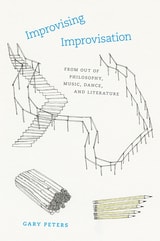
Improvising Improvisation
From Out of Philosophy, Music, Dance, and LiteratureGary Peters
University of Chicago Press, 2017
Guided by Kant, Hegel, Heidegger, and especially Deleuze—and exploring a range of artists from Hendrix to Borges—Peters illuminates new fundamentals about what, as an experience, improvisation truly is. As he shows, improvisation isn’t so much a genre, idiom, style, or technique—it’s a predicament we are thrown into, one we find ourselves in. The predicament, he shows, is a complex entwinement of choice and decision. The performativity of choice during improvisation may happen “in the moment,” but it is already determined by an a priori mode of decision. In this way, improvisation happens both within and around the actual moment, negotiating a simultaneous past, present, and future. Examining these and other often ignored dimensions of spontaneous creativity, Peters proposes a consistently challenging and rigorously argued new perspective on improvisation across an extraordinary range of disciplines.
In The Break
The Aesthetics Of The Black Radical TraditionFred Moten
University of Minnesota Press, 2003
Investigates the connections between jazz, sexual identity, and radical black politics
In his controversial essay on white jazz musician Burton Greene, Amiri Baraka asserted that jazz was exclusively an African American art form and explicitly fused the idea of a black aesthetic with radical political traditions of the African diaspora. In the Break is an extended riff on “The Burton Greene Affair,” exploring the tangled relationship between black avant-garde in music and literature in the 1950s and 1960s, the emergence of a distinct form of black cultural nationalism, and the complex engagement with and disavowal of homoeroticism that bridges the two. Fred Moten focuses in particular on the brilliant improvisatory jazz of John Coltrane, Ornette Coleman, Albert Ayler, Eric Dolphy, Charles Mingus, and others, arguing that all black performance—culture, politics, sexuality, identity, and blackness itself—is improvisation.
For Moten, improvisation provides a unique epistemological standpoint from which to investigate the provocative connections between black aesthetics and Western philosophy. He engages in a strenuous critical analysis of Western philosophy (Heidegger, Kant, Husserl, Wittgenstein, and Derrida) through the prism of radical black thought and culture. As the critical, lyrical, and disruptive performance of the human, Moten’s concept of blackness also brings such figures as Frederick Douglass and Karl Marx, Cecil Taylor and Samuel R. Delany, Billie Holiday and William Shakespeare into conversation with each other.
Stylistically brilliant and challenging, much like the music he writes about, Moten’s wide-ranging discussion embraces a variety of disciplines—semiotics, deconstruction, genre theory, social history, and psychoanalysis—to understand the politicized sexuality, particularly homoeroticism, underpinning black radicalism. In the Break is the inaugural volume in Moten’s ambitious intellectual project-to establish an aesthetic genealogy of the black radical tradition
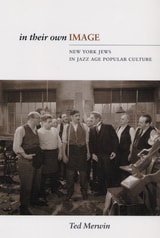
In Their Own Image
New York Jews in Jazz Age Popular CultureMerwin, Ted
Rutgers University Press, 2006
The Jazz Age of the 1920s is an era remembered for illegal liquor, innovative music and dance styles, and burgeoning ideas of social equality. It was also the period during which second-generation Jews began to emerge as a significant demographic in New York City. In TheirOwn Image examines thegrowing cultural visibility of Jewish life amid this vibrant scene.
From the vaudeville routines of Fanny Brice, Eddie Cantor, George Jessel, and Sophie Tucker, to the slew of Broadway comedies about Jewish life and the silent films that showed immigrant families struggling to leave the ghetto, images and representations of Jews became staples of interwar popular culture. Through the performing arts, Jews expressed highly ambivalent feelings about their identification with Jewish and American cultures. Ted Merwin shows how they became American by producing and consuming not images of another group, but images of themselves. As a result, they humanized Jewish stereotypes, softened anti-Semitic attitudes, and laid the groundwork for today’s Jewish comedians.
An entertaining look at the role popular culture plays in promoting the acculturation of an ethnic group, In Their Own Image enhances our understanding of American Jewish history and provides a model for the study of other groups and their integration into mainstream society.

Indigenous Pop
Native American Music from Jazz to Hip HopEdited by Jeff Berglund, Jan Johnson, and Kimberli Lee
University of Arizona Press, 2016
From Joe Shunatona and the United States Indian Reservation Orchestra to Jim Pepper, from Buffy Saint-Marie to Robbie Robertson, from Joy Harjo to Lila Downs, Indigenous Pop vividly addresses the importance of Native musicians and popular musical genres, establishing their origins and discussing what they represent.
Arranged both chronologically and according to popular generic forms, the book gives Indigenous pop a broad new meaning. In addition to examining the transitive influences of popular music on Indigenous expressive forms, the contributors also show ways that various genres have been shaped by what some have called the “Red Roots” of American-originated musical styles. This recognition of mutual influence extends into the ways of understanding how music provides methodologies for living and survival.
Each in-depth essay in the volume zeros in on a single genre and in so doing exposes the extraordinary whole of Native music. This book showcases the range of musical genres to which Native musicians have contributed and the unique ways in which their engagement advances the struggle for justice and continues age-old traditions of creative expression.
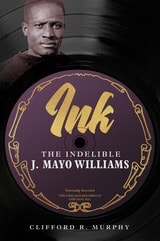
Ink
The Indelible J. Mayo WilliamsClifford R. Murphy
University of Illinois Press, 2024
<p>Vivid and engaging, <i>Ink</i> brings to light the extraordinary journey of a Black businessman and athlete.</p>
Intents and Purposes
Philosophy and the Aesthetics of ImprovisationEric Lewis
University of Michigan Press, 2019
It's About Time
The Dave Brubeck StoryFred Hall
University of Arkansas Press, 1996
A much-revered icon of jazz, Dave Brubeck is, as Doug Ramsey calls him, “one of the most celebrated and successful jazz musicians of all time.”
It’s About Time, Fred Hall’s biography, explores the many influences on Brubeck’s life and music: his youth on a cattle ranch in the foothills of the Sierras; a stint in Europe with Patton’s army during World War II; the development of the West Coast jazz scene and the rise of the Dave Brubeck Quartet; musical relationships with Paul Desmond, Eugene Wright, Joe Morello, and many more jazz greats; his phenomenal experiments with polytonality and polyrhythm; his fifty-three-year marriage to Iola, manager, collaborator, and mother of their six children; and important career breakthroughs, such as the first-ever million-selling jazz single, “Take Five.”
Including an annotated discography, It’s About Time is much more than an upbeat examination of the Brubeck phenomenon. It is also a penetrating view of the culture, the music, the musicians, the recording industry, and race relations of the country and the century that gave birth to jazz.