Results by title
458 books match the query 'Literature' and 21 start with i
Imagining Adoption
Essays on Literature and CultureMarianne Novy, Editor
University of Michigan Press, 2003
Imagining Literacy
Rhizomes of Knowledge in American Culture and LiteratureBy Ramona Fernandez
University of Texas Press, 2001
Defining the "common knowledge" a "literate" person should possess has provoked intense debate ever since the publication of E. D. Hirsch's controversial book Cultural Literacy: What Every American Needs to Know. Yet the basic concept of "common knowledge," Ramona Fernandez argues, is a Eurocentric model ill-suited to a society composed of many distinct cultures and many local knowledges.
In this book, Fernandez decodes the ideological assumptions that underlie prevailing models of cultural literacy as she offers new ways of imagining and modeling mixed cultural and non-print literacies. In particular, she challenges the biases inherent in the "encyclopedias" of knowledge promulgated by E. D. Hirsch and others, by Disney World's EPCOT Center, and by the Smithsonian Institution. In contrast to these, she places the writings of Zora Neale Hurston, Maxine Hong Kingston, Gloria Anzaldúa, and Leslie Marmon Silko, whose works model a cultural literacy that weaves connections across many local knowledges and many ways of knowing.
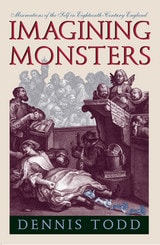
Imagining Monsters
Miscreations of the Self in Eighteenth-Century EnglandDennis Todd
University of Chicago Press, 1995
Mary Toft's outrageous claim was accepted because of a common belief that the imagination of a pregnant woman could deform her fetus, creating a monster within her. Drawing on largely unexamined material from medicine, embryology, philosophy, and popular "monster" exhibitions, Todd shows that such ideas about monstrous births expressed a fear central to scientific, literary, and philosophical thinking: that the imagination could transgress the barrier between mind and body.
In his analysis of the Toft case, Todd exposes deep anxieties about the threat this transgressive imagination posed to the idea of the self as stable, coherent, and autonomous. Major works of Pope and Swift reveal that they, too, were concerned with these issues, and Imagining Monsters provides detailed discussions of Gulliver's Travels and The Dunciad illustrating how these writers used images of monstrosity to explore the problematic nature of human identity. It also includes a provocative analysis of Pope's later work that takes into account his physical deformity and his need to defend himself in a society that linked a deformed body with a deformed character.
Immanuel Wallerstein and the Problem of the World
System, Scale, CultureDavid Palumbo-Liu, Bruce Robbins, and Nirvana Tanoukhi, eds.
Duke University Press, 2011
Contributors. Gopal Balakrishnan, Tani E. Barlow, Neil Brenner, Richard E. Lee, Franco Moretti, David Palumbo-Liu, Bruce Robbins, Helen Stacy, Nirvana Tanoukhi, Immanuel Wallerstein, Kären Wigen
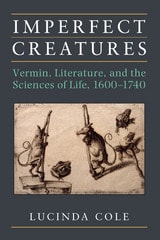
Imperfect Creatures
Vermin, Literature, and the Sciences of Life, 1600-1740Lucinda Cole
University of Michigan Press, 2016
As Cole illustrates, human health and demographic problems—notably those of feeding populations periodically stricken by hunger, disease, and famine—were tied to larger questions about food supplies, property laws, national identity, and the theological imperatives that underwrote humankind’s claim to dominion over the animal kingdom. In this context, Cole’s study indicates, so-called “vermin” occupied liminal spaces between subject and object, nature and animal, animal and the devil, the devil and disease—even reason and madness. This verminous discourse formed a foundational category used to carve out humankind’s relationship to an unpredictable, irrational natural world, but it evolved into a form for thinking about not merely animals but anything that threatened the health of the body politic—humans, animals, and even thoughts.
Imperfection and Defeat
The Role of Aesthetic Imagination in Human SocietyVirgil Nemoianu
Central European University Press, 2006
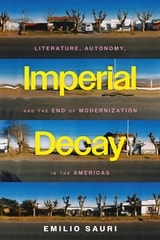
Imperial Decay
Literature, Autonomy, and the End of Modernization in the AmericasEmilio Sauri
Northwestern University Press, 2027
Demonstrating how art and literature remain vital to alternative imaginaries beyond the power of imperialism and modernization
Imperial Decay: Literature, Autonomy, and the End of Modernization in the Americas employs a dynamic, comparative approach to contemporary literature and visual art, showing how fiction, photography, poetry, and film from Latin America and the United States vividly illuminate the present. Focusing on the period from the end of the Cold War to the financial crisis of the late 2000s, Emilio Sauri contends that what brings these media together is not just the history of hemispheric connections but also, and more strikingly, the question of the artwork’s autonomy.
Elaborating on influential accounts that reveal how US hegemony in Latin America and the resistance it inspired throughout the region are bound up with the promise of modernization, Imperial Decay offers unique insights into the hollowing out of this promise at the end of the so-called American Century. Tracing this commitment back to the modernisms of the last century and forward to more recent works, this book casts canonical figures such as Ernest Hemingway, Walker Evans, and Gabriel García Márquez in a new and necessary light while developing a compelling interpretive framework for contemporary writers and artists from across the region, including Roberto Bolaño and Benjamin Kunkel, Alejandro Cartagena and Yvonne Venegas, and Kleber Mendonça Filho. Ultimately, Sauri shows why the work of art remains vital to the task of envisioning alternatives to the immiserations, ecological devastation, and degraded forms of life wrought by imperial decay.
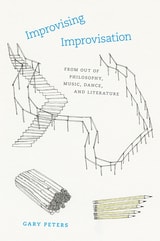
Improvising Improvisation
From Out of Philosophy, Music, Dance, and LiteratureGary Peters
University of Chicago Press, 2017
Guided by Kant, Hegel, Heidegger, and especially Deleuze—and exploring a range of artists from Hendrix to Borges—Peters illuminates new fundamentals about what, as an experience, improvisation truly is. As he shows, improvisation isn’t so much a genre, idiom, style, or technique—it’s a predicament we are thrown into, one we find ourselves in. The predicament, he shows, is a complex entwinement of choice and decision. The performativity of choice during improvisation may happen “in the moment,” but it is already determined by an a priori mode of decision. In this way, improvisation happens both within and around the actual moment, negotiating a simultaneous past, present, and future. Examining these and other often ignored dimensions of spontaneous creativity, Peters proposes a consistently challenging and rigorously argued new perspective on improvisation across an extraordinary range of disciplines.
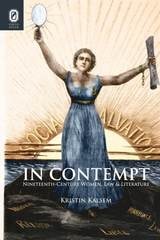
In Contempt
Nineteenth-Century Women, Law, and LiteratureKristin Kalsem
The Ohio State University Press, 2012
In Contempt: Nineteenth-Century Women, Law, and Literature, by Kristin Kalsem, explores the legal advocacy performed by nineteenth-century women writers in publications of nonfiction and fiction, as well as in real-life courtrooms and in the legal forum provided by the novel form.

In the Company of Books
Literature and Its "Classes" in Nineteenth-Century AmericaSarah Wadsworth
University of Massachusetts Press, 2006
With sections focusing on segmentation by age, gender, and cultural status, In the Company of Books analyzes the ways authors and publishers carved up the field of literary production into a multitude of distinct submarkets, differentiated their products, and targeted specific groups of readers in order to guide their book-buying decisions. Combining innovative approaches to canonical authors such as Nathaniel Hawthorne, Louisa May Alcott, Mark Twain, and Henry James with engaging investigations into the careers of many lesser-known literary figures, Sarah Wadsworth reveals how American writers responded to—and contributed to—this diverse, and diversified, market.
In the Company of Books contends that specialized editorial and marketing tactics, in concert with the narrative strategies of authors and the reading practices of the book-buying public, transformed the literary landscape, leading to new roles for the book in American culture, the innovation of literary genres, and new relationships between books and readers. Both an exploration of a fragmented print culture through the lens of nineteenth-century American literature and an analysis of nineteenth-century American literature from the perspective of this subdivided marketplace, this wide-ranging study offers fresh insight into the impact of market forces on the development of American literature.
Incapacity
Wittgenstein, Anxiety, and Performance BehaviorSpencer Golub
Northwestern University Press, 2014
In this highly original study of the nature of performance, Spencer Golub uses the insights of Ludwig Wittgenstein into the way language works to analyze the relationship between the linguistic and the visual in the work of a broad range of dramatists, novelists, and filmmakers, among them Richard Foreman, Mac Wellman, Peter Handke, David Mamet, and Alfred Hitchcock. Like Wittgenstein, these artists are concerned with the limits of language’s representational capacity. For Golub, it is these limits that give Wittgenstein’s thought a further, very personal significance—its therapeutic quality with respect to the Obsessive Compulsive Disorder from which he suffers.
Underlying what Golub calls “performance behavior” is Wittgenstein’s notion of “pain behavior”—that which gives public expression to private experience. Golub charts new directions for exploring the relationship between theater and philosophy, and even for scholarly criticism itself.
Infinite Constellations
An Anthology of Identity, Culture, and Speculative ConjunctionsEdited by Khadijah Queen and K. Ibura
University of Alabama Press, 2023
A galaxy of voices. A universe of belonging.
The innovative fictions in Infinite Constellations showcase the voices and visions of 30 remarkable writers, both new and established, from the global majority: Native American/First Nation writers, South Asian writers, East Asian writers, Black American writers, Latinx writers, and Caribbean and Middle Eastern writers. These are visions both familiar and strange, but always rooted in the mystery of human relationships, the deep honoring of memory, and the rootedness to place and the centering of culture.
The writers in this anthology mirror, instruct, bind and unbind, myth-make and myth-invert, transform and transmute, make us belly-laugh or hum our understanding, gasp or whisper gently, and remember that sometimes we need to holler and fight as we grieve. Any dangers herein, imagined or observed in poem and story, transport us: moving from latent to extant, then unleashed.
This work does not presume; it presents and blossoms, creating a constellation of appearances, a symphony of belonging.
“In collecting this work,” note editors Khadijah Queen and K. Ibura, “we felt humbled by the love threaded throughout the voices speaking to us in stories and poems that vault beyond expectation and settle in our consciousness as an expansion of what’s possible when we tend to one another with intention. We felt lifted, held aloft in these arrangements of language. We hope that as you read each story and poem, you will find the same sense of empowerment and celebration that we know has sustained us over countless generations, and in their beauty and humor and intelligence and complexity, continue to enrich us still.”
CONTRIBUTORS
George Abraham / Kenzie Allen / Shreya lla Anasuya / Thea Anderson / Wendy Chin-Tanner / Alton Melvar M. Depanas / Yohanca Delgado / Jennifer Elise Foerster / Aerik Francis / André O. Hoilette / Brian K. Hudson / K. Ibura / Pedro Iniguez / Ruth Ellen Kocher / Ra’Niqua Lee / Tonya Liburd / Kenji C. Liu / Shalewa Mackall / Lucien Darjeun Meadows / Melanie Merle / Juan J. Morales / Thirii Myo Kyaw Myint / Cindy Juyound Ok / Daniel José Older / Soham Patel / Lynn C. Pitts/ Khadijah Queen / Sheree Renée Thomas / Sarah Sophia Yanni / dg nanouk okpik / shakirah peterson

Infinite Conversation
Maurice Blanchot
University of Minnesota Press, 1992
“Blanchot waits for us still to come, to be read and reread. . . I would say that never as much as today have I pictured him so far ahead of us.” Jacques Derrida
Intangible Materialism
The Body, Scientific Knowledge, and the Power of LanguageRonald Schleifer
University of Minnesota Press, 2009
Taking as his point of departure Norbert Weiner’s statement that information is basic to understanding materialism in our era, Ronald Schleifer shows how discoveries of modern physics have altered conceptions of matter and energy and the ways in which both information theory and the study of literature can enrich these conceptions. Expanding the reductive notion of “the material” as simply matter and energy, he formulates a new, more inclusive idea of materialism.
Schleifer’s project attempts to bridge the divisions between the humanities and the sciences and to create a nonreductive materialism for the information age. He presents a materialistic account of human bodily experience by delving into language and literature that powerfully represents our faces, voices, hands, and pain. For example, he examines the material resources of poetic “literariness” as it is revealed in the condition of Tourette’s syndrome. Schleifer also investigates gestures of the hand in the formation of sociality, and he studies pain as both a physiological and phenomenological experience.
This ambitious work explores physiological analyses, evolutionary explanations, and semiotic descriptions of materialism to reveal how aspects of physical existence discover meaning in experience.
Intention Interpretation
edited by Gary Iseminger
Temple University Press, 1995
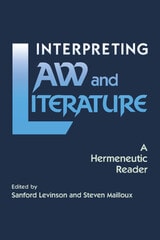
Interpreting Law and Literature
A Hermeneutic ReaderSanford Levinson and Steven Mailloux
Northwestern University Press, 1988
"Contemporary theory has usefully analyzed how alternative modes of interpretation produce different meanings, how reading itself is constituted by the variable perspectives of readers, and how these perspectives are in turn defined by prejudices, ideologies, interests, and so forth. Some theorists gave argued persuasively that textual meaning, in literature and in literary interpretation, is structured by repression and forgetting, by what the literary or critical text does not say as much as by what it does. All these claims are directly relevant to legal hermeneutics, and thus it is no surprise that legal theorists have recently been turning to literary theory for potential insight into the interpretation of law. This collection of essays is designed to represent the especially rich interactive that has taken place between legal and literary hermeneutics during the past ten years."
Introduction To Poetics
Tzvetan Todorov
University of Minnesota Press, 1981

Introduction to Old Javanese Language and Literature
A Kawi Prose AnthologyMary S. Zurbuchen
University of Michigan Press, 1976
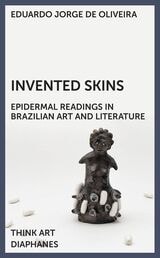
Invented Skins
Epidermal Readings in Brazilian Art and LiteratureEduardo Jorge De Oliveira
Diaphanes, 2023
Skin is unique to each individual. Acting as a record, it details aspects of a person and a collective memory. Each skin possesses a sensitivity that touches and it is touched by the world. It mediates temperature fluctuations and is marked by cuts, accidents, and its own history. Skin marks us in the world, giving us the outline of individuals. Invented Skins focuses on the skin to consider the social dimension of texts and images throughout cultural memory, showing that skin is a biological reality that occupies a physical and psychic space but also unfolds in the imagination.
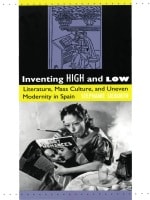
Inventing High and Low
Literature, Mass Culture, and Uneven Modernity in SpainStephanie Sieburth
Duke University Press, 1994
Choosing two historical moments of sweeping material and cultural change in Spanish history, Sieburth reads two novels from the 1880s (by Benito Pérez Galdós) and two from the 1970s (by Juan Goytisolo and Carmen Martín Gaite) as fictional theories about the impact of modernity on culture and politics. Her analysis reveals that the high/low division in the cultural sphere reinforces other kinds of separations—between social classes or between men and women—dear to the elite but endangered by progress. This tension, she shows, is particularly evident in Spain, where modernization has been a contradictory and uneven process, rarely accompanied by political freedom, and where consumerism and mass culture coexist uneasily with older ways of life.
Weaving together a wide spectrum of diverse material, her work will be of interest to readers concerned with Spanish history and literature, literary theory, popular culture, and the relations between politics, economics, gender, and the novel.
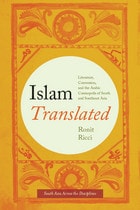
Islam Translated
Literature, Conversion, and the Arabic Cosmopolis of South and Southeast AsiaRonit Ricci
University of Chicago Press, 2011
In Islam Translated, Ronit Ricci uses the Book of One Thousand Questions—from its Arabic original to its adaptations into the Javanese, Malay, and Tamil languages between the sixteenth and twentieth centuries—as a means to consider connections that linked Muslims across divides of distance and culture. Examining the circulation of this Islamic text and its varied literary forms, Ricci explores how processes of literary translation and religious conversion were historically interconnected forms of globalization, mutually dependent, and creatively reformulated within societies making the transition to Islam.