Results by title
175 books match the query 'Mayas' and 5 start with i
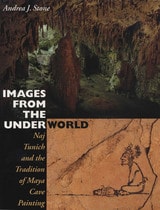
Images from the Underworld
Naj Tunich and the Tradition of Maya Cave PaintingBy Andrea J. Stone
University of Texas Press, 1995
In 1979, a Kekchi Maya Indian accidentally discovered the entrance to Naj Tunich, a deep cave in the Maya Mountains of El Peten, Guatemala. One of the world's few deep caves that contain rock art, Naj Tunich features figural images and hieroglyphic inscriptions that have helped to revolutionize our understanding of ancient Maya art and ritual.
In this book, Andrea Stone takes a comprehensive look at Maya cave painting from Preconquest times to the Colonial period. After surveying Mesoamerican cave and rock painting sites and discussing all twenty-five known painted caves in the Maya area, she focuses extensively on Naj Tunich. Her text analyzes the images and inscriptions, while photographs and line drawings provide a complete visual catalog of the cave art, some of which has been subsequently destroyed by vandals.
This important new body of images and texts enlarges our understanding of the Maya view of sacred landscape and the role of caves in ritual. It will be important reading for all students of the Maya, as well as for others interested in cave art and in human relationships with the natural environment.
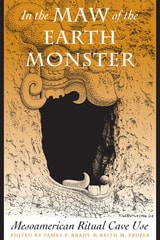
In the Maw of the Earth Monster
Mesoamerican Ritual Cave UseEdited by James E. Brady and Keith M. Prufer
University of Texas Press, 2005
As portals to the supernatural realm that creates and animates the universe, caves have always been held sacred by the peoples of Mesoamerica. From ancient times to the present, Mesoamericans have made pilgrimages to caves for ceremonies ranging from rituals of passage to petitions for rain and a plentiful harvest. So important were caves to the pre-Hispanic peoples that they are mentioned in Maya hieroglyphic writing and portrayed in the Central Mexican and Oaxacan pictorial codices. Many ancient settlements were located in proximity to caves.
This volume gathers papers from twenty prominent Mesoamerican archaeologists, linguists, and ethnographers to present a state-of-the-art survey of ritual cave use in Mesoamerica from Pre-Columbian times to the present. Organized geographically, the book examines cave use in Central Mexico, Oaxaca, and the Maya region. Some reports present detailed site studies, while others offer new theoretical understandings of cave rituals. As a whole, the collection validates cave study as the cutting edge of scientific investigation of indigenous ritual and belief. It confirms that the indigenous religious system of Mesoamerica was and still is much more terrestrially focused that has been generally appreciated.
In the Realm of Nachan Kan
Postclassic Maya Archaeology at Laguna De On, BelizeMarilyn A. Masson
University Press of Colorado, 2000
In the Realm of Nachan Kan opens a window on Postclassic Maya patterns of cultural development and organization through a close examination of the small rural island of Laguna de On, a location that was distant from the governing political centers of the day. Using diachronic analysis of regional settlement patterns, ceramic traditions, household and ritual features, and artifacts from the site, Masson tracks developmental changes throughout the Postclassic period. These data suggest that affluent patterns of economic production and local and long-distance exchange were established within northern Belize by the eleventh century, and continued to develop, virtually uninterrupted, until the time of Spanish arrival.
In addition, Masson analyzes contemporary political and religious artistic traditions at the temples of Mayapan, Tulum, and Santa Rita to provide a regional context for the changes in community patterns at Laguna de On. These cultural changes, she maintains, are closely correlated with the rise of Mayapan to power and participation of sites like Laguna de On in a pan-lowland economic and ritual interaction sphere. Offering a thoroughly new interpretation of Postclassic Mayan civilization. In the Realm of Nachan Kan is a must for scholars of Mesoamerican history and culture.
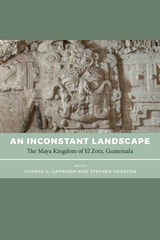
Inconstant Landscape
The Maya Kingdom of El Zotz, GuatemalaThomas G. Garrison
University Press of Colorado, 2020
In this volume, contributors address the challenges faced by smaller polities on the peripheries of powerful kingdoms and ask how subordination was experienced and independent policy asserted. Leading experts provide cutting-edge analysis in varied topics and detailed discussion of the development of this major site and the region more broadly. The first half of the volume contains a historical narrative of the cultural sequence of El Zotz, tracing the changes in occupation and landscape use across time; the second half provides deep technical analyses of material evidence, including soils, ceramics, stone tools, and bone.
The ever-changing, inconstant landscapes of peripheral kingdoms like El Zotz reveal much about their more dominant—and better known—neighbors. An Inconstant Landscape offers a comprehensive, multidisciplinary view of this important but under-studied site, an essential context for the study of the Classic Maya in Guatemala, and a premier reference on the subject of peripheral kingdoms at the height of Maya civilization.
Contributors: Timothy Beach, Nicholas Carter, Ewa Czapiewska-Halliday, Alyce de Carteret, William Delgado, Colin Doyle, James Doyle, Laura Gámez, Jose Luis Garrido López, Yeny Myshell Gutiérrez Castillo, Zachary Hruby, Melanie Kingsley, Sheryl Luzzadder-Beach, Cassandra Mesick Braun, Sarah Newman, Rony Piedrasanta, Edwin Román, and Andrew K. Scherer
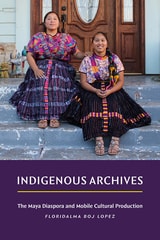
Indigenous Archives
The Maya Diaspora and Mobile Cultural ProductionFloridalma Boj Lopez
Duke University Press, 2026