Results by title
178 books match the query 'Media' and 4 start with i
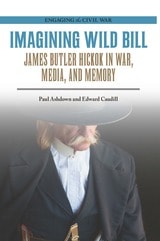
Imagining Wild Bill
James Butler Hickok in War, Media, and MemoryPaul Ashdown and Edward Caudill
Southern Illinois University Press, 2020
When it came to the Wild West, the nineteenth-century press rarely let truth get in the way of a good story. James Butler “Wild Bill” Hickok’s story was no exception. Mythologized and sensationalized, Hickok was turned into the deadliest gunfighter of all, a so-called moral killer, a national phenomenon even while he was alive.
Rather than attempt to tease truth from fiction, coauthors Paul Ashdown and Edward Caudill investigate the ways in which Hickok embodied the culture of glamorized violence Americans embraced after the Civil War and examine the process of how his story emerged, evolved, and turned into a viral multimedia sensation full of the excitement, danger, and romance of the West.
Journalists, the coauthors demonstrate, invented “Wild Bill” Hickok, glorifying him as a civilizer. They inflated his body count and constructed his legend in the midst of an emerging celebrity culture that grew up around penny newspapers. His death by treachery, at a relatively young age, made the story tragic, and dime-store novelists took over where the press left off. Reimagined as entertainment, Hickok’s legend continued to enthrall Americans in literature, on radio, on television, and in the movies, and it still draws tourists to notorious Deadwood, South Dakota.
American culture often embraces myths that later become accepted as popular history. By investigating the allure and power of Hickok’s myth, Ashdown and Caudill explain how American journalism and popular culture have shaped the way Civil War–era figures are remembered and reveal how Americans have embraced violence as entertainment.
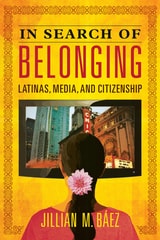
In Search of Belonging
Latinas, Media, and CitizenshipJillian M Baez
University of Illinois Press, 2018
Innovative and informed by a wealth of new evidence, In Search of Belonging answers important questions about the ways Latinas perform citizenship in today’s America.
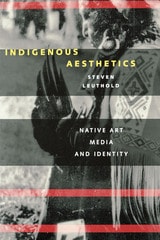
Indigenous Aesthetics
Native Art, Media, and IdentityBy Steven Leuthold
University of Texas Press, 1998
What happens when a Native or indigenous person turns a video camera on his or her own culture? Are the resulting images different from what a Westernized filmmaker would create, and, if so, in what ways? How does the use of a non-Native art-making medium, specifically video or film, affect the aesthetics of the Native culture?
These are some of the questions that underlie this rich study of Native American aesthetics, art, media, and identity. Steven Leuthold opens with a theoretically informed discussion of the core concepts of aesthetics and indigenous culture and then turns to detailed examination of the work of American Indian documentary filmmakers, including George Burdeau and Victor Masayesva, Jr. He shows how Native filmmaking incorporates traditional concepts such as the connection to place, to the sacred, and to the cycles of nature. While these concepts now find expression through Westernized media, they also maintain continuity with earlier aesthetic productions. In this way, Native filmmaking serves to create and preserve a sense of identity for indigenous people.
Intransigent Imaginaries
Black Ambivalence in Media and CultureJerome P. Dent, Jr.
Rutgers University Press, 2027
Intransigent Imaginaries: Black Ambivalence in Media and Culture examines why Blackness continues to function as antagonism in fantasy, science fiction, and horror, even in contemporary films and television created by Black artists and celebrated for their progressive politics. Drawing on Afropessimism, psychoanalysis, and genre theory, Jerome P. Dent, Jr. argues that genre itself organizes desire, threat, and narrative closure in ways that consistently position Blackness as danger, excess, or containment. Rather than focusing on whether representations are positive or negative, the book shifts attention to the narrative architectures and visual economies that make those images possible in the first place. Through close readings of works such as Get Out, Us, Nope, Black Panther, A Wrinkle in Time, and major science fiction franchises, Intransigent Imaginaries challenges dominant assumptions about progress, representation, and repair. Refusing the consolations of uplift, the book insists on analytic clarity, asking what criticism looks like when redemption is structurally foreclosed.