Results by title
94 books match the query 'Middle Ages, 600-1500' and 6 start with i
If Adam Had Not Sinned
The Reason for the Incarnation from Anselm to ScotusJustus H. Hunter
Catholic University of America Press, 2020
In Search of the Triune God
The Christian Paths of East and WestEugene Webb
University of Missouri Press, 2013
Under the broad umbrella of the Christian religion, there exists a great divide between two fundamentally different ways of thinking about key aspects of the Christian faith. Eugene Webb explores the sources of that divide, looking at how the Eastern and Western Christian worlds drifted apart due both to the different ways they interpreted their symbols and to the different roles political power played in their histories. Previous studies have focused on historical events or on the history of theological ideas. In Search of the Triune God delves deeper by exploring how the Christian East and the Christian West have conceived the relation between symbol and experience.
Webb demonstrates that whereas for Western Christianity discussion of the doctrine of the Trinity has tended toward speculation about the internal structure of the Godhead, in the Eastern tradition the symbolism of the Triune God has always been closely connected to religious experience. In their approaches to theology, Western Christianity has tended toward a speculative theology, and Eastern Christianity toward a mystical theology.
This difference of focus has led to a large range of fundamental differences in many areas not only of theology but also of religious life. Webb traces the history of the pertinent symbols (God as Father, Son of God, Spirit of God, Messiah, King, etc.) from the Hebrew Bible and New Testament through patristic thinkers and the councils that eventually defined orthodoxy. In addition, he shows how the symbols, interpreted through the different cultural lenses of the East and the West, gradually took on meanings that became the material of very different worldviews, especially as the respective histories of the Eastern and Western Christian worlds led them into different kinds of entanglement with ambition and power.
Through this incisive exploration, Webb offers a dramatic and provocative new picture of the history of Christianity.
In the Company of Demons
Unnatural Beings, Love, and Identity in the Italian RenaissanceArmando Maggi
University of Chicago Press, 2006
Maggi leads us straight to the heart of what Italian Renaissance culture thought familiar spirits were. Through close readings of Giovan Francesco Pico della Mirandola, Strozzi Cigogna, Pompeo della Barba, Ludovico Sinistrari, and others, we find that these spirits or demons speak through their sudden and striking appearances—their very bodies seen as metaphors to be interpreted. The form of the body, Maggi explains, relies on the spirits’ knowledge of their human interlocutors’ pasts. But their core trait is compassion, and sometimes their odd, eerie arrivals are seen as harbingers or warnings to protect us. It comes as no surprise then that when spiritual beings distort the natural world to communicate, it is vital that we begin to listen.
Innovation and Tradition in the Writings of the Venerable Bede
SCOTT DEGREGORIO
West Virginia University Press, 2006
Works prior to this book focused on Bede as not only a European, but also as an English scholar, historian, scientist, or a biographer of saints, and have used a traditional approach towards his explanation of the Bible. Bede's interpretation of his work, its continuous progress, and the reasons behind his hurried appointment to an authority almost as high as the Church Fathers are all topics examined within the text. Essays are by Roger Ray, Faith Wallis, Calvin B. Kendall, George Hardin Brown, Scott DeGregorio, Arthur G. Holder, Lawrence T. Martin, Walter Goffart, and Joyce Hill.
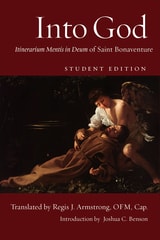
Into God, student edition
Itinerarium Mentis in Deum of Saint BonaventureRegis J. Armstrong
Catholic University of America Press, 0
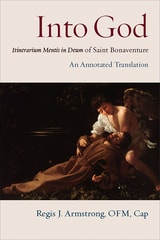
Into God
An Annotated Translation of Saint Bonaventure's Itinerarium Mentis in DeumCap. Regis J. Armstrong,OFM
Catholic University of America Press, 2020