Results by title
98 books match the query 'Migrations' and 5 start with i
Impure Migration
Jews and Sex Work in Golden Age ArgentinaMir Yarfitz
Rutgers University Press, 2019
In Search of New England's Native Past
Selected Essays by Gordon M. DayGordon M. Day
University of Massachusetts Press, 1998
This volume highlights the work of the late Gordon M. Day, renowned for his groundbreaking research on the history and culture of the Western Abenakis and their Indian neighbors. Where previous historians had tended to portray northern New England as an area largely devoid of aboriginal peoples, Day established beyond all doubt the presence of Abenaki settlements along the eastern shore of Lake Champlain as well as the upper reaches of the Connecticut and Merrimack rivers.
For nearly three decades, Day focused his work on the community of Saint Francis, or Odanak, in Quebec, to which Abenaki refugees from interior New England had fled, beginning in the mid-seventeenth century and continuing into the nineteenth. Drawing on the methods of several disciplines, including ethnology, linguistics, and ethnohistory, he synthesized data from fragmentary historical records, oral traditions, and place names to reconstruct a world assumed to be lost.
In The Name Of Hawaiians
Native Identities and Cultural PoliticsRona Tamiko Halualani
University of Minnesota Press, 2002
A critical and personal inquiry into the historical factors behind Hawaiian identity
Deep within the historical imagination, there lies the image of a Western explorer surrounded by dark and strange natives. In the modern and postmodern spaces of tourism, one finds the reflections of an antiquated nativism that is already dead, however commercially viable. And in the statutes of the State of Hawai‘i, the Aloha spirit is codified into the ideology of multiculturalism. Where, among the multiple representations and constructions of what is "Hawaiian," is Hawaiian identity actually lived?
Rona Tamiko Halualani analyzes the diverse formations and practices of Hawaiian identity and sociality, on the U.S. mainland as well as on the islands, across several interrelated contexts: museum culture, explorer journals, maps, tourism, census technology, blood quantum mandates, neocolonial administration, and lived community practice. Halualani shows how these contexts represent larger forces from different historical moments that significantly changed the social relations surrounding Hawaiians, the ways in which they have been identified, and how they make sense of who they are. Throughout she interweaves the countering narratives and practices by indigenous Hawaiians as they seek authorization of their identities, land rights, and culture.
In the Aftermath of Migration
Renegotiating Ancient Identity in Southeastern ArizonaAnna A. Neuzil
University of Arizona Press, 2008
This research explores the social changes that took place in the Safford and Aravaipa valleys during the thirteenth through the fifteenth centuries A.D. as a result of an influx of migrants from the Kayenta and Tusayan regions of northeastern Arizona. Focusing on domestic architecture and ceramics, the author evaluates how migration affects the expression of identity of both migrant and indigenous populations in the Safford and Aravaipa valleys and provides a model for research in other areas where migration played an important role.
Archaeologists interested in the Greater Southwest will find a wealth of information on these little-known valleys that provides contextualization for this important and intriguing time period, and those interested in migration in the ancient past will find a useful case study that goes beyond identifying incidents of migration to understanding its long-lasting implications for both migrants and the local people they impacted.
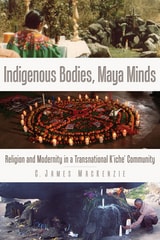
Indigenous Bodies, Maya Minds
Religion and Modernity in a Transnational K'iche' CommunityC. James MacKenzie
University Press of Colorado, 2016
Indigenous Bodies, Maya Minds examines tension and conflict over ethnic and religious identity in the K’iche’ Maya community of San Andrés Xecul in the Guatemalan Highlands and considers how religious and ethnic attachments are sustained and transformed through the transnational experiences of locals who have migrated to the United States.
Author C. James MacKenzie explores the relationship among four coexisting religious communities within Highland Maya villages in contemporary Guatemala—costumbre, traditionalist religion with a shamanic substrate; “Enthusiastic Christianity,” versions of Charismaticism and Pentecostalism; an “inculturated” and Mayanized version of Catholicism; and a purified and antisyncretic Maya Spirituality—with attention to the modern and nonmodern worldviews that sustain them. He introduces a sophisticated set of theories to interpret both traditional religion and its relationship to other contemporary religious options, analyzing the relation among these various worldviews in terms of the indigenization of modernity and the various ways modernity can be apprehended as an intellectual project or an embodied experience.
Indigenous Bodies, Maya Minds investigates the way an increasingly plural religious landscape intersects with ethnic and other identities. It will be of interest to Mesoamerican and Mayan ethnographers, as well as students and scholars of cultural anthropology, indigenous cultures, globalization, and religion.