Results by title
210 books match the query 'Missouri' and 7 start with i
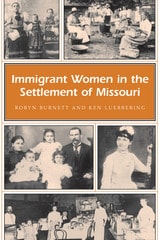
Immigrant Women in the Settlement of Missouri
Robyn Burnett & Ken Luebbering
University of Missouri Press, 2005
Because it examines the lives of women from many social classes and ethnic backgrounds, Immigrant Women in the Settlement of Missouri does much to explain the rich cultural diversity Missouri enjoys today. The photographs and narratives relating to Czech, French, German, Hungarian, Irish, Italian, and Polish life will remind descendants of immigrants that many customs and traditions they grew up practicing have roots in their home countries and will also promote understanding of the customs of other cultures. In addition to the ethnic and class differences that affected these women’s lives, the book also notes the impact of the various eras in which they lived, their education, the circumstances of their migrations, and their destinations across Missouri.
With their engaging and straightforward narrative, Burnett and Luebbering take the reader chronologically through the history of the state from the colonial period to the Civil War and industrialization. Like all Missouri Heritage Readers, this one is presented in an accessible format with abundant illustrations, and it is sure to please both general readers and those engaged in immigrant and women’s studies.
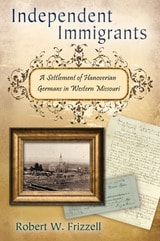
Independent Immigrants
A Settlement of Hanoverian Germans in Western MissouriRobert W. Frizzell
University of Missouri Press, 2007
Between 1838 and the early 1890s, German peasant farmers from the Kingdom of Hanover made their way to Lafayette County, Missouri, to form a new community centered on the town of Concordia. Their story has much to tell us about the American immigrant experience—and about how newcomers were caught up in the violence that swept through their adoptive home.
Robert Frizzell grew up near Concordia, and in this first book-length history of the German settlement, he chronicles its life and times during those formative years. Founded by Hanoverian Friedrich Dierking—known as “Dierking the Comforter” for the aid he gave his countrymen—the Concordia settlement blossomed from 72 households in 1850 to 375 over the course of twenty years. Frizzell traces that growth as he examines the success of early agricultural efforts, but he also tells how the community strayed from the cultural path set by its freethinker founder to become a center of religious conservatism.
Drawing on archival material from both sides of the Atlantic, Frizzell offers a compelling account for scholars and general readers alike, showing how Concordia differed from other German immigrant communities in America. He also explores the conditions in Hanover—particularly the village of Esperke, from which many of the settlers hailed—that caused people to leave, shedding new light on theological, political, and economic circumstances in both the Old World and the New.
When the Civil War came, the antislavery Hanoverians found themselves in the Missouri county with the greatest number of slaves, and the Germans supported the Union while most of their neighbors sympathized with Confederate guerrillas. Frizzell tells how the notorious “Bloody Bill” Anderson attacked the community three times, committing atrocities as gruesome as any recorded in the state—then how the community flourished after the war and even bought out the farmsteads of former slaveholders.
Frizzell’s account challenges many historians’ assumptions about German motives for immigration and includes portraits of families and individuals that show the high price in toil and blood required to meet the challenges of making a home in a new land. Independent Immigrants reveals the untold story of these newcomers as it reveals a little-known aspect of the Civil War in Missouri.
Indians and Archaeology of Missouri, Revised Edition
Carl H. Chapman & Eleanor F. Chapman
University of Missouri Press, 1983
This expanded edition of Indians and Archaeology of Missouri gives an excellent introduction to the cultural development of Missouri’s Indians during the past twelve thousand years. Providing a new chapter on the Hunter Foragers of the Dalton period and substantial revision of other chapters to incorporate recent discoveries, the Chapmans present knowledge based upon decades of experience with archaeological excavations in an understandable and fascinating form.
The first edition of Indians and Archaeology of Missouri has been recognized in Missouri and nationally as one of the best books of its kind. The Missouri Historical Review called it “simply indispensable.” The Plains Anthropologist added similar praise: “Clearly written and exceptionally well illustrated…it is the answer to the amateur’s prayers.” Archaeology described it as “a boon to Missouri’s many amateur archaeologists, a useful source of information for professionals and interesting reading for the layman.”
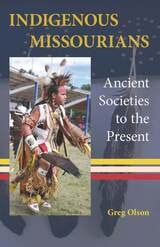
Indigenous Missourians
Ancient Societies to the PresentGreg Olson
University of Missouri Press, 2023
The history of Indigenous people in present-day Missouri is far more nuanced, complex, and vibrant than the often-told tragic stories of conflict with white settlers and forced Indian removal would lead us to believe. In this path-breaking narrative, Greg Olson presents the Show Me State’s Indigenous past as one spanning twelve millennia of Native presence, resilience, and evolution. While previous Missouri histories have tended to include Indigenous people only during periods when they constituted a threat to the state’s white settlement, Olson shows us the continuous presence of Native people that includes the present day.
Beginning thousands of years before the state of Missouri existed, Olson recounts how centuries of inventiveness and adaptability enabled Native people to create innovations in pottery, agriculture, architecture, weaponry, and intertribal diplomacy. Olson also shows how the resilience of Indigenous people like the Osages allowed them to thrive as fur traders, even as settler colonialists waged an all-out policy of cultural genocide against them.
Though the state of Missouri claimed to have forced Indigenous people from its borders after the 1830s, Olson uses U.S. Census records and government rolls from the allotment period to show that thousands remained. In the end, he argues that, with a current population of 27,000 Indigenous people, Missouri remains very much a part of Indian Country, and that Indigenous history is Missouri history.
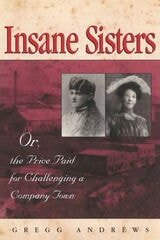
Insane Sisters
Or, the Price Paid for Challenging a Company TownGregg Andrews
University of Missouri Press, 2020
Insane Sisters is the extraordinary tale of two sisters, Mary Alice Heinbach and Euphemia B. Koller, and their seventeen- year property dispute against the nation's leading cement corporation—the Atlas Portland Cement Company.
In 1903, Atlas built a plant on the border of the small community of Ilasco, located just outside Hannibal—home of the infamous cave popularized in Mark Twain's most acclaimed novels. The rich and powerful Atlas quickly appointed itself as caretaker of Twain's heritage and sought to take control of Ilasco. However, its authority was challenged in 1910 when Heinbach inherited her husband's tract of land that formed much of the unincorporated town site. On grounds that Heinbach's husband had been in the advanced stages of alcoholism when she married him the year before, some of Ilasco's political leaders and others who had ties to Atlas challenged the will, charging Heinbach with undue influence.
To help fight against the local lawyers and politicians who wanted Atlas to own the land, Heinbach enlisted the help of her shrewd and combative sister, Euphemia Koller, by making her co-owner of the tract. In a complex case that went to the Missouri Supreme Court four times, the sisters fiercely sought to hang on to the tract. However, in 1921 the county probate court imposed a guardianship over Heinbach and a circuit judge ordered a sheriff's sale of the property. After Atlas purchased the tract, Koller waged a lonely battle to overturn the sale and expose the political conspiracies that had led to Ilasco's conversion into a company town. Her efforts ultimately resulted in her court- ordered confinement in 1927 to Missouri's State Hospital Number One for the Insane, where she remained until her death at age sixty-eight.
Insane Sisters traces the dire consequences the sisters suffered and provides a fascinating look at how the intersection of gender, class, and law shaped the history and politics of Ilasco. The book also sheds valuable new light on the wider consolidation of corporate capitalism and the use of guardianships and insanity to punish unconventional women in the early twentieth century.

Interstate '85
The Royals, The Cardinals, and the Show-Me World SeriesMarshall Garvey
University of Missouri Press, 2025
In this blend of baseball and cultural history, Garvey defines the “I-70 Showdown Series” not only by the literal highway that links the two teams’ home cities but the individual and collective roads travelled by the players and others who took part in the event, both before the Series began and well after the last cheers faded.
In addition to gripping human stories and vivid descriptions of on-field action long overshadowed by Denkinger’s monumental blunder, Garvey’s work captures the provincial spectacle of the “Show-Me Series” throughout the state of Missouri. Featuring 27 new interviews conducted by the author, including with George Brett, Ozzie Smith, Don Denkinger, Bud Black, Andy Van Slyke, Ricky Horton, and Mark Gubicza, Interstate ’85 is baseball history writing at its deepest and most captivating.
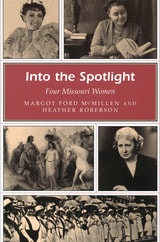
Into the Spotlight
Four Missouri WomenMargot Ford McMillen & Heather Roberson
University of Missouri Press, 2004
Sacred Sun, also called Mohongo, was a Native American of the Osage tribe in Missouri. In 1827, her people lost their land, their sacred places, and many of their traditions. Seeking answers to the dilemma faced by her people, and possibly aid from the French, she journeyed to Europe with a group of prominent Osage and a French entrepreneur. The harrowing events she experienced there would shape the woman she became when she returned to the Osage tribe, which had been forced to move to Oklahoma and was still struggling to survive.
Emily Newell Blair was born into a successful southwest Missouri family. Although she was born at a time when the contributions of women in the workforce were quite limited, she was encouraged by her family to get an education and expand her skills in writing and speaking. When women did begin to pursue education and careers, Blair was at the forefront, working tirelessly to secure voting rights for women. Eventually, she was elected to the Democratic National Committee and later poured her energy into organizing Democratic women’s clubs.
Josephine Baker grew up in segregated turn-of-the-century St. Louis society, which determined human worth by the color of one’s skin. Her mixed ethnic background left Baker feeling isolated both from her own black family and from white society. Driven to develop her own unique style, she became a star of song and stage, toured Europe, served as a spy, and was a fervent civil rights and antiracism activist.
Elizabeth Virginia Wallace, known to her family as “Bess,” grew up in one of Missouri’s most prominent families. She married a neighborhood boy—considered unacceptable by her mother—who would go on to become President Harry Truman. Bess Truman, called “the boss” by her husband, worked side by side with him, editing his speeches and providing advice and guidance through innumerable crises during and after World War II.
Into the Spotlight provides valuable new insights into Missouri and American history, as well as women’s history, and will be a welcome addition to the Missouri Heritage Readers Series.