73 books match the query 'Modern (late 19th Century to 1945)' and 3 start with i
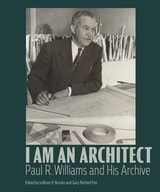
cover of I Am an Architect: Paul R. Williams and His Archive

I Am an Architect

Paul R. Williams and His Archive

LeRonn P. Brooks

J. Paul Getty Trust, The, 0

Discover the visionary legacy of the groundbreaking architect Paul R. Williams, FAIA, one of the most prolific Black architects of the 20th century.

Paul R. Williams (1894–1980), among the first Black members of the American Institute of Architects, was a defining force in shaping the city of Los Angeles and Southern California, yet his impact was undoubtedly global.

Threading together Williams’s biography, social histories of Los Angeles, and transformations in the profession, this richly researched monograph traces his remarkable career against the evolving landscape of Los Angeles and the wider architectural world.

  • Presents the first research-driven monograph on preeminent architect Paul R. Williams.
  • Features nearly 200 images, including many never-before published drawings, renderings, and archival materials.
  • Williams’s expansive oeuvre spans everything from early residential commissions in the 1920s to civic, religious, commercial, and cultural landmarks that came to define Los Angeles’s identity at midcentury.
  • Examines the intersection of race, space, and professional practice in twentieth-century American architecture.
  • Highlights Williams’s commitment to designing for Black communities and advancing social change through architecture.

Step into the world of a visionary who transformed cities and challenged barriers—this volume invites you to get to know Paul R. Williams and the enduring power of architecture to shape society.

This volume is published to accompany an exhibition on view at the Fisher Museum of Art at the University of Southern California from August 18, 2026, to March 13, 2027, Los Angeles County Museum of Art from November 15, 2026, to May 31, 2027, and Getty Research Institute at the Getty Center from December 15, 2026, to March 14, 2027.
[more]
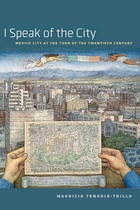
cover of I Speak of the City: Mexico City at the Turn of the Twentieth Century

I Speak of the City

Mexico City at the Turn of the Twentieth Century

Mauricio Tenorio-Trillo

University of Chicago Press, 2013
In this dazzling multidisciplinary tour of Mexico City, Mauricio Tenorio-Trillo focuses on the period 1880 to 1940, the decisive decades that shaped the city into what it is today. 
 
Through a kaleidoscope of expository forms, I Speak of the City connects the realms of literature, architecture, music, popular language, art, and public health to investigate the city in a variety of contexts: as a living history textbook, as an expression of the state, as a modernist capital, as a laboratory, and as language. Tenorio’s formal imagination allows the reader to revel in the free-flowing richness of his narratives, opening startling new vistas onto the urban experience.
 
From art to city planning, from epidemiology to poetry, this book challenges the conventional wisdom about both Mexico City and the turn-of-the-century world to which it belonged. And by engaging directly with the rise of modernism and the cultural experiences of such personalities as Hart Crane, Mina Loy, and Diego Rivera, I Speak of the City will find an enthusiastic audience across the disciplines.

[more]
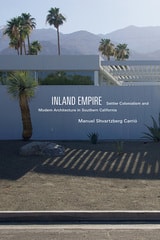
cover of Inland Empire: Settler Colonialism and Modern Architecture in Southern California

Inland Empire

Settler Colonialism and Modern Architecture in Southern California

Manuel Shvartzberg Carrió

Duke University Press, 2026

In Inland Empire, Manuel Shvartzberg Carrió examines how modernist architecture and urban design structured US settler colonialism and capitalist hegemony in the twentieth century. Focusing on Palm Springs’s settlement upon the Agua Caliente Reservation and other reservations in inland Southern California, he shows how architecture became a key technology for governing empire at the height of the state’s drive to terminate Native American sovereignty. Through extensive archival research and dialogue with Cahuilla, Kumeyaay, and other Tribal community members, Shvartzberg Carrió offers a new architectural history of modernism. Carefully placing the work of seminal California architects within the genealogy of manifest destiny, he demonstrates how their designs over settler and Native housing, prefabrication technologies, the logistics of migrant construction labor, community development plans, and environmental infrastructures offered new ways of managing Indigenous resistance—a spatial turn in Native American administration that constituted a veritable workshop for neoliberalization policies later sponsored globally by the United States. Charting Indigenous nations’ responses to these momentous challenges, Inland Empire details how they deployed novel modes of resistance grounded in Native architectural histories, spatial practices, and epistemologies of land.
[more]