Results by title
59 books match the query 'National characteristics, American, in literature' and 3 start with i
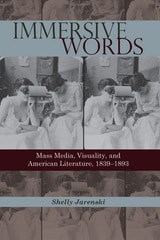
Immersive Words
Mass Media, Visuality, and American Literature, 1839–1893Shelly Jarenski
University of Alabama Press, 2015
In Immersive Words, Michelle Jarenski demonstrates that the contemporary challenge that visual images and virtual environments in cinema and photography, on the web, and in video games pose to reading and writing are not uniquely contemporary developments but equally exercised the imaginations, anxieties, and works of nineteenth-century authors.
The middle of the nineteenth century witnessed the emergence of numerous visual technologies and techniques: the daguerreotype, immersive exhibition spaces such as cycloramas and panoramas, mechanized tourism, and large-scale exhibitions and spectacles such as the World’s Fair. In closely argued chapters devoted to these four visual forms, Jarenski demonstrates that the popularity of these novelties catalyzed a shift by authors of the period beyond narratives that merely described images to ones that invoked aesthetic experiences.
Jarenski describes how Herman Melville adapts the aesthetic of the daguerreotype through his use of dramatic point-of-view and unexpected shifts that disorient readers. Frederick Douglass is shown to appropriate a panoramic aesthetic that severs spatial and temporal narratives from standard expectations. Jarenski traces how Nathaniel Hawthorne’s The Marble Faun found success as a travel guide to Rome, though intended as a work of serious fiction. Finally, Sarah Orne Jewett is shown to simulate the interactivity of the World Columbian Exposition to promote racialized and gendered forms of aesthetic communication. These techniques and strategies drawn from visual forms blur the just-so boundary critics and theorists have traditionally drawn between text and image.
In the mid-nineteenth century, the national identity of the United States remained fluid and hinged upon matters of gender, sexuality, and, crucially, race. Authors both reflected that evolving identity and contributed to its ongoing evolution. In demonstrating how the aesthetic and visual technologies of the nineteenth century changed the fundamental aesthetics of American literature, the importance of Immersive Words goes far beyond literary criticism.
[more]
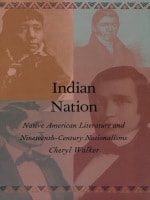
Indian Nation
Native American Literature and Nineteenth-Century NationalismsCheryl Walker
Duke University Press, 1997
Indian Nation documents the contributions of Native Americans to the notion of American nationhood and to concepts of American identity at a crucial, defining time in U.S. history. Departing from previous scholarship, Cheryl Walker turns the "usual" questions on their heads, asking not how whites experienced indigenous peoples, but how Native Americans envisioned the United States as a nation. This project unfolds a narrative of participatory resistance in which Indians themselves sought to transform the discourse of nationhood.
Walker examines the rhetoric and writings of nineteenth-century Native Americans, including William Apess, Black Hawk, George Copway, John Rollin Ridge, and Sarah Winnemucca. Demonstrating with unique detail how these authors worked to transform venerable myths and icons of American identity, Indian Nation chronicles Native American participation in the forming of an American nationalism in both published texts and speeches that were delivered throughout the United States. Pottawattomie Chief Simon Pokagon’s "The Red Man’s Rebuke," an important document of Indian oratory, is published here in its entirety for the first time since 1893.
By looking at this writing through the lens of the best theoretical work on nationality, postcoloniality, and the subaltern, Walker creates a new and encompassing picture of the relationship between Native Americans and whites. She shows that, contrary to previous studies, America in the nineteenth century was intercultural in significant ways.
[more]
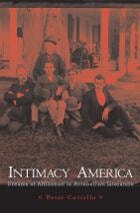
Intimacy in America
Dreams of Affiliation in Antebellum LiteraturePeter Coviello
University of Minnesota Press, 2005
Nineteenth-century America was a sprawling new nation unmoored from precedent and the mainstays of European nationalism. In their search for nationality, Americans sought coherence in a feeling of belonging shared among diverse and scattered strangers. Reading seminal works by Thomas Jefferson, Edgar Allan Poe, Herman Melville, Harriet Beecher Stowe, and Walt Whitman, Peter Coviello traces these writers' enthusiasms and their ambivalences about the dream of an intimate nationality, revealing how race and sexuality were used as vehicles for an assumed national coherence. As Coviello shows, race - and especially whiteness - functioned less as a form of identity than as a model of attachment and identification, a language of affiliation. Whiteness created an imaginary fraternity that symbolized citizenship, the ownership of property, and an affinity between strangers, which became entangled in the nation's evolving codes of sexuality. Bringing race theory and "white studies" into dialogue with questions of intimacy and affect, Coviello provides a practical rapprochement between historicist and psychoanalytic methodologies. Intimacy in America gives us a new perspective on the national meanings of race and sex in American literature, as well as on the still-current dream of American-ness as an impassioned relation to far-flung, anonymous others.
[more]