Results by title
75 books match the query 'Nigeria' and 5 start with i
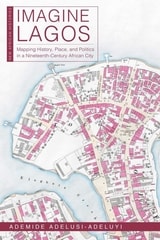
Imagine Lagos
Mapping History, Place, and Politics in a Nineteenth-Century African CityAdemide Adelusi-Adeluyi
Ohio University Press, 2024
Written from a digital humanities perspective, this book combines historical sources, maps, and a walking cartography to create new perspectives on the nineteenth-century history of Lagos, West Africa’s most populous city. What traces do people leave in the places where they live, and even where they die? This book addresses the spatial history of nineteenth-century Lagos, rebuilding its past as a series of encounters: between men and women, between past and present, between enslaved and free, between living and dead, and finally between land and lagoon. In Imagine Lagos, Ademide Adelusi-Adeluyi argues that the invention, destruction, and reinvention of spatial markers in Lagos—the streets, markets, roads, squares, palaces, and lagoons where these encounters occurred—was crucial to negotiations over identity, power, and freedom. Research for this book combines oral and archival sources from three countries with the experience of three summers of walking the streets of Lagos. Contrary to historical interpretations that render the physical city as a blank, featureless space in desperate need of constant repair, this book offers a variety of visual and textual narratives to push readers to imagine the old city. Throughout Imagine Lagos, historical maps join other texts—including colonial correspondence and reports, missionary letters, oríkì (Yoruba praise poetry), and newspaper articles—to create a complex collage of urban life in Lagos. Streets emerge as sites of historical memories, and Adelusi-Adeluyi’s maps of the mid-nineteenth-century city reveal and catalog layers of change. A focus on the city as a whole—as both a physical and social landscape—brings us closer than ever to understanding the lives of Lagosians between 1845 and 1872. In old Lagos, the streets keep their histories. The story maps and full-resolution maps for this book are available at https://newmapsoldlagos.com.
[more]
In Africa's Forest and Jungle
Six Years Among the YorubasRichard Henry Stone, edited by Betty Finklea Florey
University of Alabama Press, 2009
In Africa's Forest and Jungle is the memoir of Richard Henry Stone, a Civil War era Southern Baptist missionary, who served in what is now Nigeria during the late 1850s and again during the first years of the American Civil War. Stone published this work in 1899, when it became clear that age would prevent him from returning to Africa.
Stone served in Africa with his wife and successfully learned the Yoruba language. He was an intelligent, self-reflective, and reliable observer, making his works important sources of information on Yoruba society before the intervention of European colonialism. In Africa's Forest and Jungle is a rare account of West African culture, made all the more complete by the additional journal entries, letters, and photographs collected in this edition.
Stone served in Africa with his wife and successfully learned the Yoruba language. He was an intelligent, self-reflective, and reliable observer, making his works important sources of information on Yoruba society before the intervention of European colonialism. In Africa's Forest and Jungle is a rare account of West African culture, made all the more complete by the additional journal entries, letters, and photographs collected in this edition.
[more]
Indirect Subjects
Nollywood's Local AddressMatthew H. Brown
Duke University Press, 2021
In Indirect Subjects, Matthew H. Brown analyzes the content of the prolific Nigerian film industry's mostly direct-to-video movies alongside local practices of production and circulation to show how screen media play spatial roles in global power relations. Scrutinizing the deep structural and aesthetic relationship between Nollywood, as the industry is known, and Nigerian state television, Brown tracks how several Nollywood films, in ways similar to both state television programs and colonial cinema productions, invite local spectators to experience liberal capitalism not only as a form of exploitation but as a set of expectations about the future. This mode of address, which Brown refers to as “periliberalism,” sustains global power imbalances by locating viewers within liberalism but distancing them from its processes and benefits. Locating the wellspring of this hypocrisy in the British Empire's practice of indirect rule, Brown contends that culture industries like Nollywood can sustain capitalism by isolating ordinary African people, whose labor and consumption fuel it, from its exclusive privileges.
[more]
Invention Of Women
Making An African Sense Of Western Gender DiscoursesOyeronke Oyewumi
University of Minnesota Press, 1997
The “woman question,” this book asserts, is a Western one, and not a proper lens for viewing African society. A work that rethinks gender as a Western construction, The Invention of Women offers a new way of understanding both Yoruban and Western cultures. Author Oyeronke Oyewumi reveals an ideology of biological determinism at the heart of Western social categories-the idea that biology provides the rationale for organizing the social world. And yet, she writes, the concept of “woman,” central to this ideology and to Western gender discourses, simply did not exist in Yorubaland, where the body was not the basis of social roles.
Oyewumi traces the misapplication of Western, body-oriented concepts of gender through the history of gender discourses in Yoruba studies. Her analysis shows the paradoxical nature of two fundamental assumptions of feminist theory: that gender is socially constructed and that the subordination of women is universal. The Invention of Women demonstrates, to the contrary, that gender was not constructed in old Yoruba society, and that social organization was determined by relative age.
A meticulous historical and epistemological account of an African culture on its own terms, this book makes a persuasive argument for a cultural, context-dependent interpretation of social reality. It calls for a reconception of gender discourse and the categories on which such study relies. More than that, the book lays bare the hidden assumptions in the ways these different cultures think. A truly comparative sociology of an African culture and the Western tradition, it will change the way African studies and gender studies proceed.
[more]
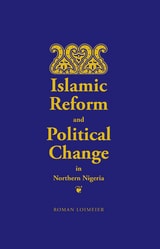
Islamic Reform and Political Change in Northern Nigeria
Roman Loimeier
Northwestern University Press, 2011
The 1970s and 1980s were times of political and religious turmoil in Nigeria, characterized by governmental upheaval, and aggressive confrontations between the Sufi brotherhoods and the Izala movement. In Islamic Reform and Political Change in Northern Nigeria, Roman Loimeier explores the intermeshing of religion in the struggle for political influence and preservation of the interests of Nigerian Muslims.
Loimeier's careful scholarship combines astute readings of the work of previous scholars--both published and unpublished--with archival material and the findings of his own fieldwork in Nigeria. His work fills a substantial gap in contemporary Nigerian studies. This book provides invaluable and essential reading for serious students of Nigerian politics and of Islamic movements in Africa.
Loimeier's careful scholarship combines astute readings of the work of previous scholars--both published and unpublished--with archival material and the findings of his own fieldwork in Nigeria. His work fills a substantial gap in contemporary Nigerian studies. This book provides invaluable and essential reading for serious students of Nigerian politics and of Islamic movements in Africa.
[more]