Results by title
91 books match the query 'Nordic Countries' and 5 start with i

Iceland
The First New SocietyRichard F. Tomasson
University of Minnesota Press, 1980
Iceland was first published in 1980. Minnesota Archive Editions uses digital technology to make long-unavailable books once again accessible, and are published unaltered from the original University of Minnesota Press editions.
"Iceland, as described by Tomasson, has a fascinating, often contradictory culture," writes Seymour Martin Lipset in his forward to this book, the first sociological account in English of modern Icelandic society and the forces that have shaped it. Richard F. Tomasson argues that Iceland can best be understood as an example of "a new society"—the first such pioneer community to be founded in historical times. To the author the most significant influences upon Icelandic culture and social structure are the continuities that have persisted in this island society for eleven centuries, since its origins as an isolated Viking colony.
Tomasson traces the ways in which Icelandic culture developed out of the medieval pre- Christian society—in its language, relations between the sexes, egalitarianism, and the high frequency of illegitimate births. He also points out areas of contradiction and discontinuity, noting that Iceland has been transformed in the twentieth century by modernization of the society and international influences upon the culture.
Among the topics Tomasson examines are the Icelanders' involvement in their history and national literary tradition; their social, political, and economic life; the high level of literacy; the pervasive tolerance of Icelanders in moral and religious matters; their values; and the use of alcohol. Readers interested in the Scandinavian countries and in the comparative study of societies will find Iceland a useful analysis of a significant and little known national culture.
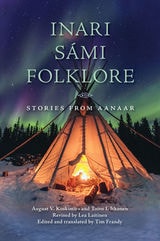
Inari Sámi Folklore
Stories from AanaarAugust V. Koskimies and Toivo I. Itkonen, revised by Lea Laitinen; Edited and translated by Tim Frandy
University of Wisconsin Press, 2020
First published in 1918 only in the Aanaar Sámi language and in Finnish, this anthology is now available in a centennial English-language edition for a global readership. Translator Tim Frandy has added biographies of the storytellers, maps and period photos, annotations, and a glossary. In headnotes that contextualize the stories, he explains such underlying themes as Aanaar conflicts with neighboring Sámi and Finnish communities, the collapse of the wild reindeer populations less than a century before, and the pre-Christian past in Aanaar. He introduces us to the bawdy humor of Antti Kitti, the didacticism of Iisakki Mannermaa, and the feminist leanings of Juho Petteri Lusmaniemi, emphasizing that folktales and proverbs are rooted in the experiences of individuals who are links in a living tradition.
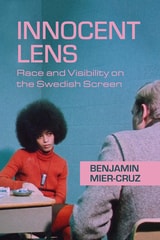
Innocent Lens
Race and Visibility on the Swedish ScreenBenjamin Mier-Cruz
University of Wisconsin Press, 2027
Sweden, like other Nordic countries, prides itself on being “colorblind” or immune to the kinds of racism found in, for example, the United States. In the 1960s and 1970s, white Swedish documentarians, in the fashion of early anthropologists, recorded racial tensions amid the US civil rights movement. More recently, in the twenty-first century, short films produced by Swedes of color have tackled racism and bigotry within Sweden.
Benjamin Mier-Cruz offers a comparative study of these two periods of Swedish documentary filmmaking. “Racially innocent” white documentarians of the mid-twentieth century developed an “aesthetics of altruism” predicated on Sweden’s assumed racial equalitarianism—a notion that their documentaries in turn helped create and maintain. In contemporary films, on the other hand, Swedes of color use the same filmic format to challenge not only their predecessors’ reductionist, pseudo-anthropological presentations but also Sweden’s purportedly colorblind ideology. Mier-Cruz’s close readings of films from both eras demonstrate the possibilities and limitations of the documentary form and the ways in which it is motivated by politics and activism.
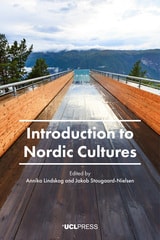
Introduction to Nordic Cultures
Edited by Annika Lindskog and Jakob Stougaard-Nielsen
University College London, 2020
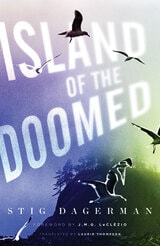
Island of the Doomed
Stig Dagerman
University of Minnesota Press, 2012
In the summer of 1946, while secluded in August Strindberg’s small cabin in the Stockholm archipelago, Stig Dagerman wrote Island of the Doomed. This novel was unlike any other yet seen in Sweden and would establish him as the country’s brightest literary star. To this day it is a singular work of fiction—a haunting tale that oscillates around seven castaways as they await their inevitable death on a desert island populated by blind gulls and hordes of iguanas. At the center of the island is a poisonous lagoon, where a strange fish swims in circles and devours anything in its path. As we are taken into the lives of each castaway, it becomes clear that Dagerman’s true subject is the nature of horror itself.
Island of the Doomed is a chilling profile of terror and guilt and a stunning exploration—written under the shadow of the Nuremberg Trials—of the anxieties of a generation in the postwar nuclear age.