Results by title
337 books match the query 'North America' and 20 start with i

I The Song
Jill M Soens
University of Utah Press, 1999
Built on early transcriptions of Native American “songs” and arranged by subject, these poems are informed by additional context that enables readers to appreciate more fully their imagery, their cultural basis, and the moment that produced them. They let us look at our continent through the eyes of a wide range of people: poets, hunters, farmers, holy men and women, and children. This poetry achieved its vividness, clarity, and intense emotional powers partly because the singers made their poems for active use as well as beauty, and also because they made them for singing or chanting rather than isolated reading.
Most striking, classical North American Indian poetry brings us flashes of timeless vision and absolute perception: a gull’s wing red over the dawn; snow-capped peaks in the moonlight; a death song. Flowing beneath them is a powerful current: the urge to achieve a selfless attention to the universe and a determination to see and delight in the universe on its own terms.

Ice Age Peoples of North America
Robonson Bonnichsen
Oregon State University Press, 1999

Icelanders in North America
The First SettlersJonas Thor
University of Manitoba Press, 2002
Icelandic Heritage in North America
Birna Arnbjörnsdóttir
University of Manitoba Press, 2023
In Good Relation
History, Gender, and Kinship in Indigenous FeminismsSarah Nickel
University of Manitoba Press, 2020
Inconstant Companions
Archaeology and North American Indian Oral TraditionsRonald J. Mason
University of Alabama Press, 2008
Indian Life on the Northwest Coast of North America as seen by the Early Explorers and Fur Traders during the Last Decades of the Eighteenth Century
Erna Gunther
University of Chicago Press, 1972
Drawing on a wide range of evidence, this volume is a carefully researched investigation into the ethnohistory of the Pacific Northwest during the period of European exploration of the region. The book supplements the archeological evidence from the area with a detailed investigation of the journals, diaries, and sketchbooks of Russian, Spanish, and English explorers and traders who reached the region, as well as artifacts that those explorers and traders obtained on their expeditions and that are now held in museums worldwide. In doing so, Gunther's research extends anthropological study of the region a century earlier, and sheds light on the understudied tribal cultures of the Haida and the Tlingit. The volume contains splendid reproductions of contemporary drawings, and appendices mapping the museum locations of artifacts and describing the processes of native technology.

Indian Tales of North America
An Anthology for the Adult ReaderEdited by Tristam P. Coffin
University of Texas Press, 1961
Indian Voices
Listening to Native AmericansOwings, Alison
Rutgers University Press, 2012
In Indian Voices, Alison Owings takes readers on a fresh journey across America, east to west, north to south, and around again. Owings's most recent oral history—engagingly written in a style that entertains and informs—documents what Native Americans say about themselves, their daily lives, and the world around them.
Young and old from many tribal nations speak with candor, insight, and (unknown to many non-Natives) humor about what it is like to be a Native American in the twenty-first century. Through intimate interviews many also express their thoughts about the sometimes staggeringly ignorant, if often well-meaning, non-Natives they encounter—some who do not realize Native Americans still exist, much less that they speak English, have cell phones, use the Internet, and might attend powwows and power lunches.
Indian Voices, an inspiring and important contribution to the literature about the original Americans, will make every reader rethink the past—and present—of the United States.
Indians Playing Indian
Multiculturalism and Contemporary Indigenous Art in North AmericaMonika Siebert
University of Alabama Press, 2015
Explores how American Indian artists have responded to the pervasive misunderstanding of indigenous peoples as cultural minorities in the United States and Canada
Contemporary indigenous peoples in North America confront a unique predicament. While they are reclaiming their historic status as sovereign nations, mainstream popular culture continues to depict them as cultural minorities similar to other ethnic Americans. These depictions of indigenous peoples as “Native Americans” complete the broader narrative of America as a refuge to the world’s immigrants and a home to contemporary multicultural democracies, such as the United States and Canada. But they fundamentally misrepresent indigenous peoples, whose American history has been not of immigration but of colonization.
Monika Siebert’s Indians Playing Indian first identifies this phenomenon as multicultural misrecognition, explains its sources in North American colonial history and in the political mandates of multiculturalism, and describes its consequences for contemporary indigenous cultural production. It then explores the responses of indigenous artists who take advantage of the ongoing popular interest in Native American culture and art while offering narratives of the political histories of their nations in order to resist multicultural incorporation.
Each chapter of Indians Playing Indian showcases a different medium of contemporary indigenous art—museum exhibition, cinema, digital fine art, sculpture, multimedia installation, and literary fiction—and explores specific rhetorical strategies artists deploy to forestall multicultural misrecognition and recover political meanings of indigeneity. The sites and artists discussed include the National Museum of the American Indian in Washington, DC; filmmakers at Inuit Isuma Productions; digital artists/photographers Dugan Aguilar, Pamela Shields, and Hulleah Tsinhnahjinnie; sculptor Jimmie Durham; and novelist LeAnne Howe.
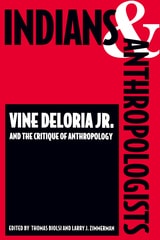
Indians and Anthropologists
Vine Deloria, Jr., and the Critique of AnthropologyThomas Biolsi
University of Arizona Press, 1997
CONTENTS
Introduction: What's Changed, What Hasn't, Thomas Biolsi & Larry J. Zimmerman
Part One--Deloria Writes Back
Vine Deloria, Jr., in American Historiography, Herbert T. Hoover
Growing Up on Deloria: The Impact of His Work on a New Generation of Anthropologists, Elizabeth S. Grobsmith
Educating an Anthro: The Influence of Vine Deloria, Jr., Murray L. Wax
Part Two--Archaeology and American Indians
Why Have Archaeologists Thought That the Real Indians Were Dead and What Can We Do about It?, Randall H. McGuire
Anthropology and Responses to the Reburial Issue, Larry J. Zimmerman
Part Three-Ethnography and Colonialism
Here Come the Anthros, Cecil King
Beyond Ethics: Science, Friendship and Privacy, Marilyn Bentz
The Anthropological Construction of Indians: Haviland Scudder Mekeel and the Search for the Primitive in Lakota Country, Thomas Biolsi
Informant as Critic: Conducting Research on a Dispute between Iroquoianist Scholars and Traditional Iroquois, Gail Landsman
The End of Anthropology (at Hopi)?, Peter Whiteley
Conclusion: Anthros, Indians and Planetary Reality, Vine Deloria, Jr.
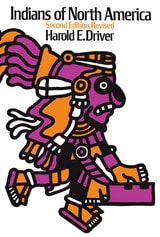
Indians of North America
Harold E. Driver
University of Chicago Press, 1969
For this second edition, Harold Driver made extensive revisions in chapter content and organization, incorporating many new discoveries and interpretations in archeology and related fields. He also revised several of the maps and added more than 100 bibliographical items. Since the publication of the first edition, there has been an increased interest in the activities of Indians in the twentieth century; accordingly, the author placed much more emphasis on this period.

Indigenizing Philosophy through the Land
A Trickster Methodology for Decolonizing Environmental Ethics and Indigenous FuturesBrian Burkhart
Michigan State University Press, 2019
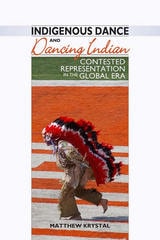
Indigenous Dance and Dancing Indian
Contested Representation in the Global EraMatthew Krystal
University Press of Colorado, 2020
Considering four genres of dance in which indigenous people are represented--K'iche Maya traditional dance, powwow, folkloric dance, and dancing sports mascots--the book addresses both the ideational and behavioral dimensions of identity. Each dance is examined as a unique cultural expression in individual chapters, and then all are compared in the conclusion, where striking parallels and important divergences are revealed. Ultimately, Krystal describes how dancers and audiences work to construct and consume satisfying and meaningful identities through dance by either challenging social inequality or reinforcing the present social order.
Detailed ethnographic work, thorough case studies, and an insightful narrative voice make Indigenous Dance and Dancing Indian a substantial addition to scholarly literature on dance in the Americas. It will be of interest to scholars of Native American studies, social sciences, and performing arts.

Indigenous Environmental Justice
Edited by Karen Jarratt-Snider and Marianne O. Nielsen
University of Arizona Press, 2020
With focused essays on important topics such as the uranium mining on Navajo and Hopi lands, the Dakota Access Pipeline dispute on the Standing Rock Indian Reservation, environmental cleanup efforts in Alaska, and many other pertinent examples, this volume offers a timely view of the environmental devastation that occurs in Indian Country. It also serves to emphasize the importance of self-determination and sovereignty in victories of Indigenous environmental justice.
The book explores the ongoing effects of colonization and emphasizes Native American tribes as governments rather than ethnic minorities. Combining elements of legal issues, human rights issues, and sovereignty issues, Indigenous Environmental Justice creates a clear example of community resilience in the face of corporate greed and state indifference.

Indigenous Knowledge and the Environment in Africa and North America
David M. Gordon
Ohio University Press, 2012
Indigenous knowledge has become a catchphrase in global struggles for environmental justice. Yet indigenous knowledges are often viewed, incorrectly, as pure and primordial cultural artifacts. This collection draws from African and North American cases to argue that the forms of knowledge identified as “indigenous” resulted from strategies to control environmental resources during and after colonial encounters.
At times indigenous knowledges represented a “middle ground” of intellectual exchanges between colonizers and colonized; elsewhere, indigenous knowledges were defined through conflict and struggle. The authors demonstrate how people claimed that their hybrid forms of knowledge were communal, religious, and traditional, as opposed to individualist, secular, and scientific, which they associated with European colonialism.
Indigenous Knowledge and the Environment offers comparative and transnational insights that disturb romantic views of unchanging indigenous knowledges in harmony with the environment. The result is a book that informs and complicates how indigenous knowledges can and should relate to environmental policy-making.
Contributors: David Bernstein, Derick Fay, Andrew H. Fisher, Karen Flint, David M. Gordon, Paul Kelton, Shepard Krech III, Joshua Reid, Parker Shipton, Lance van Sittert, Jacob Tropp, James L. A. Webb, Jr., Marsha Weisiger
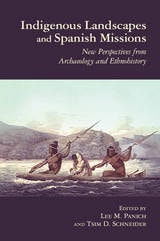
Indigenous Landscapes and Spanish Missions
New Perspectives from Archaeology and EthnohistoryEdited by Lee M. Panich and Tsim D. Schneider
University of Arizona Press, 2014
Offering thoughtful arguments and innovative perspectives, the editors organized the book around three interrelated themes. The first section explores power, politics, and belief, recognizing that Spanish missions were established within indigenous landscapes with preexisting tensions, alliances, and belief systems. The second part, addressing missions from the perspective of indigenous inhabitants, focuses on their social, economic, and historical connections to the surrounding landscapes. The final section considers the varied connections between mission communities and the world beyond the mission walls, including examinations of how mission neophytes, missionaries, and colonial elites vied for land and natural resources.
Indigenous Landscapes and Spanish Missions offers a holistic view on the consequences of missionization and the active negotiation of missions by indigenous peoples, revealing cross-cutting perspectives into the complex and contested histories of the Spanish borderlands. This volume challenges readers to examine deeply the ways in which native peoples negotiated colonialism not just inside the missions themselves but also within broader indigenous landscapes. This book will be of interest to archaeologists, historians, tribal scholars, and anyone interested in indigenous encounters with colonial institutions.

Indigenous Perspective to Climate and Environment
Darren Parry
University of Utah Press, 2024

Intestine Enemies
Robert Emmett Curran
Catholic University of America Press, 2017
It's About Time
A History of Archaeological Dating in North AmericaStephen E Nash
University of Utah Press, 2008