Results by title
126 books match the query 'People with disabilities' and 4 start with i

In the Province of the Gods
Kenny Fries
University of Wisconsin Press, 2021
Kenny Fries embarks on a journey of profound self-discovery as a disabled foreigner in Japan, a society historically hostile to difference. As he visits gardens, experiences Noh and butoh, and meets artists and scholars, he also discovers disabled gods, one-eyed samurai, blind chanting priests, and A-bomb survivors. When he is diagnosed as HIV positive, all his assumptions about Japan, the body, and mortality are shaken, and he must find a way to reenter life on new terms.
[more]
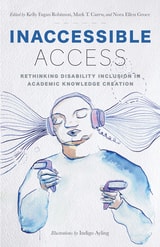
Inaccessible Access
Rethinking Disability Inclusion in Academic Knowledge CreationKelly Fagan Robinson
Rutgers University Press, 2025
Inaccessible Access ethnographically addresses barriers to inclusion within knowledge-making. It focuses on the social, environmental, communicative, and epistemological barriers that people with disabilities confront and embody throughout the course of their learning and living and in the specific context of their higher education institutions and in research. It is presented by a neurodiverse, disabled, and non-cis cohort of authors, all of whom acknowledge a continuum of (in)access that is available to each contributor contingent on their inherent intersectionalities and alterities. The authors and editors of this book foreground the work that has yet to be done on recognizing the value of nonnormative ways of approaching, being in, and knowing research and higher education, particularly in cases where disablity-centered epistemologies are sidelined in confrontation with institutional norms, even within existing discourses concerning equality and alterity.
[more]
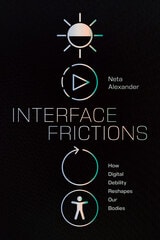
Interface Frictions
How Digital Debility Reshapes Our BodiesNeta Alexander
Duke University Press, 2025
In Interface Frictions, Neta Alexander explores how ubiquitous design features in digital platforms reshape, condition, and break our bodies. She shows that while features such as refresh, playback speed, autoplay, and night mode are convenient, they can lead to “digital debility”—the slow and often invisible ways that technologies may harm human bodies. These features all assume an able-bodied user and at the same time push users to ignore their bodily limitations like the need for rest, nourishment, or movement. Building on the lived experiences of people with disabilities, Alexander explores alternative design solutions that arise from a multisensorial approach to communication. She demonstrates what can be gained from centering the nonaverage user, such as blind people who pioneered ways to control the playback speed of media, and Netflix subscribers with invisible disabilities like PTSD who successfully pushed the company to redesign its previews autoplay feature. Drawing on artworks, video games, and creative hacking by users with disabilities, Alexander challenges our understanding of media consumption, the attention economy, and the digital interface.
[more]
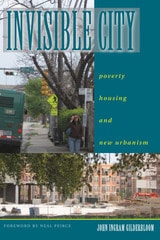
Invisible City
Poverty, Housing, and New UrbanismBy John Ingram Gilderbloom
University of Texas Press, 2008
A legendary figure in the realms of public policy and academia, John Gilderbloom is one of the foremost urban-planning researchers of our time, producing groundbreaking studies on housing markets, design, location, regulation, financing, and community building. Now, in Invisible City, he turns his eye to fundamental questions regarding housing for the elderly, the disabled, and the poor. Why is it that some locales can offer affordable, accessible, and attractive housing, while the large majority of cities fail to do so? Invisible City calls for a brave new housing paradigm that makes the needs of marginalized populations visible to policy makers.Drawing on fascinating case studies in Houston, Louisville, and New Orleans, and analyzing census information as well as policy reports, Gilderbloom offers a comprehensive, engaging, and optimistic theory of how housing can be remade with a progressive vision. While many contemporary urban scholars have failed to capture the dynamics of what is happening in our cities, Gilderbloom presents a new vision of shelter as a force that shapes all residents.
[more]