Results by title
68 books match the query 'Performance art' and 4 start with i
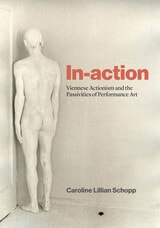
In-action
Viennese Actionism and the Passivities of Performance ArtCaroline Lillian Schopp
University of Chicago Press, 2025
Viennese Actionism represents a notorious case within art history, often cited but little studied, especially in the United States. By carefully looking at the unsettling performances that define this movement, Caroline Lillian Schopp offers a vital corrective to the narrative. Schopp observes that contrary to the reception of their graphic violence, many performances explore passivity, vulnerability, and dependence in gestures of “in-action.” Viennese Actionism registers hesitations about the liberatory ethos of the 1960s, amplified by Austria’s marginalized postwar social and artistic culture. In dialogue with feminist theory, In-action assembles a vocabulary for performance art without the standards of self-assertion, emancipation, and expressive action that continue to inform how art and politics are understood today.
Decentering the traditional focus on the male protagonists of Viennese Actionism—Günter Brus, Otto Muehl, Hermann Nitsch, and Rudolf Schwarzkogler—Schopp draws attention to women who performed with them, including Anna Brus, Hanel Koeck, and Ingrid Wiener. Doing so brings into view how these performances scrutinize intimate relationships like marriages, partnerships, and friendships, as well as the conventions of traditional artistic media such as painting and tapestry.
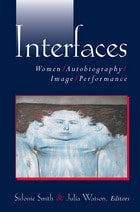
Interfaces
Women, Autobiography, Image, PerformanceSidonie Smith and Julia Watson, Editors
University of Michigan Press, 2002
Editors Sidonie Smith and Julia Watson have been at the vanguard of the study of women's self-representation, and here have collected leading critics' and scholars' thoughts on artistic fusions of the visual and autobiographical. Marianne Hirsch, Linda Hutcheon, Linda Kauffman, Nellie McKay, Marjorie Perloff, Lee Quinby, and the other contributors offer new insights into the work of such artists as Laurie Anderson, Judy Chicago, Frida Kahlo, Orlan, and Cindy Sherman. From a painter's diary to a performance artist's ritualized enactments of kitchen domesticity, the many narratives of the self arising from these artists' negotiations of the visual and textual prove to be goldmines for analysis.
Art historians, artists, critics, literary scholars in women's studies, and anyone interested in the forms and implications of depicting the self will enjoy this richly illustrated collection.
Sidonie Smith is Professor of English, University of Michigan. Julia Watson is Associate Professor of Comparative Studies, The Ohio State University. They also edited Reading Autobiography: A Guide for Interpreting Life Narratives and Women, Autobiography, Theory: A Reader.
Interplay of Things
Religion, Art, and Presence TogetherAnthony B. Pinn
Duke University Press, 2021
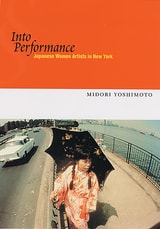
Into Performance
Japanese Women Artists in New YorkYoshimoto, Midori
Rutgers University Press, 2005
The 1960s was a time of incredible freedom and exploration in the art world, particularly in New York City, which witnessed the explosion of New Music, Happenings, Fluxus, New Dance, pop art, and minimalist art. Also notable during this period, although often overlooked, is the inordinate amount of revolutionary art that was created by women.
Into Performance fills a critical gap in both American and Japanese art history as it brings to light the historical significance of five women artists-Yoko Ono, Yayoi Kusama, Takako Saito, Mieko Shiomi, and Shigeko Kubota. Unusually courageous and self-determined, they were among the first Japanese women to leave their country-and its male-dominated, conservative art world-to explore the artistic possibilities in New York. They not only benefited from the New York art scene, however, they played a major role in the development of international performance and intermedia art by bridging avant garde movements in Tokyo and New York.
This book traces the pioneering work of these five women artists and the socio-cultural issues that shaped their careers. Into Performance also explores the transformation of these artists' lifestyle from traditionally confined Japanese women to internationally active artists. Yoshimoto demonstrates how their work paved the way for younger Japanese women artists who continue to seek opportunities in the West today.