160 books match the query 'Poverty & Homelessness' and 3 start with i
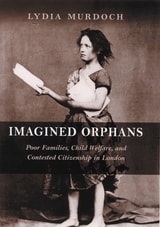
cover of Imagined Orphans: Poor Families, Child Welfare, and Contested Citizenship in London

Imagined Orphans

Poor Families, Child Welfare, and Contested Citizenship in London

Murdoch, Lydia

Rutgers University Press, 2006

With his dirty, tattered clothes and hollowed-out face, Oliver Twist is the enduring symbol of the young indigent spilling out of orphanages and haunting the streets of late-nineteenth-century London. Although poor children were often portrayed as real-life Oliver Twists—either orphaned or abandoned by unworthy parents—they in fact frequently maintained contact and were eventually reunited with their families.

In Imagined Orphans, Lydia Murdoch focuses on this discrepancy between the representation and the reality of children’s experiences within welfare institutions—a discrepancy that she argues stems from conflicts over middle- and working-class notions of citizenship that arose in the 1870s and persisted until the First World War. Reformers’ efforts to depict poor children as either orphaned or endangered by abusive or “no-good” parents fed upon the poor’s increasing exclusion from the Victorian social body. Reformers used the public’s growing distrust and pitiless attitude toward poor adults to increase charity and state aid to the children.

With a critical eye to social issues of the period, Murdoch urges readers to reconsider the complex situations of families living in poverty. While reformers’ motivations seem well intentioned, she shows how their methods solidified the public’s antipoor sentiment and justified a minimalist welfare state that engendered a cycle of poverty. As they worked to fashion model citizens, reformers’ efforts to protect and care for children took on an increasingly imperial cast that would continue into the twentieth century.
[more]
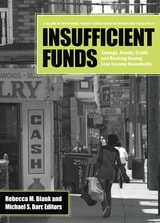
cover of Insufficient Funds: Savings, Assets, Credit, and Banking Among Low-Income Households

Insufficient Funds

Savings, Assets, Credit, and Banking Among Low-Income Households

Rebecca M. Blank

Russell Sage Foundation, 2009
One in four American adults doesn’t have a bank account. Low-income families lack access to many of the basic financial services middle-class families take for granted and are particularly susceptible to financial emergencies, unemployment, loss of a home, and uninsured medical problems. Insufficient Funds explores how institutional constraints and individual decisions combine to produce this striking disparity and recommends policies to help alleviate the problem. Mainstream financial services are both less available and more expensive for low-income households. High fees, minimum-balance policies, and the relative scarcity of banks in poor neighborhoods are key factors. Michael Barr reports the results of an in-depth study of financial behavior in 1,000 low- and moderate-income families in metropolitan Detroit. He finds that most poor households have bank accounts, but combine use of mainstream services with alternative options such as money orders, pawnshops, and payday lenders. Barr suggests that a tax credit for banks serving primarily disadvantaged customers could facilitate greater equality in the private financial sector. Drawing on evidence from behavioral economics, Sendhil Mullainathan and Eldar Shafir show that low-income individuals exhibit many of the same patterns and weaknesses in financial decision making as middle-class individuals and could benefit from many of the same financial aids. They argue that savings programs that automatically enroll participants and require them to actively opt out in order to leave the program could drastically increase savings ability. Ronald Mann demonstrates that significant changes in the credit market over the past fifteen years have allowed companies to expand credit to a larger share of low-income families. Mann calls for regulations on credit card companies that would require greater disclosure of actual interest rates and fees. Raphael Bostic and Kwan Lee find that while home ownership has risen dramatically over the past twenty years, elevated risks for low-income families—such as foreclosure—may well outweigh the benefits of owning a home. The authors ultimately argue that if we want to demand financial responsibility from low-income households, we have an obligation to assure that these families have access to the banking, credit, and savings institutions that are readily available to higher-income families. Insufficient Funds highlights where and how access is blocked and shows how government policy and individual decisions could combine to eliminate many of these barriers in the future.
[more]
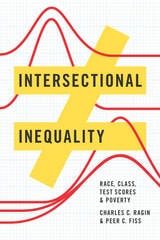
cover of Intersectional Inequality: Race, Class, Test Scores, and Poverty

Intersectional Inequality

Race, Class, Test Scores, and Poverty

Charles C. Ragin and Peer C. Fiss

University of Chicago Press, 2016

For over twenty-five years, Charles C. Ragin has developed Qualitative Comparative Analysis and related set-analytic techniques as a means of bridging qualitative and quantitative methods of research. Now, with Peer C. Fiss, Ragin uses these impressive new tools to unravel the varied conditions affecting life chances.

Ragin and Fiss begin by taking up the controversy regarding the relative importance of test scores versus socioeconomic background on life chances, a debate that has raged since the 1994 publication of Richard Herrnstein and Charles Murray’s TheBell Curve. In contrast to prior work, Ragin and Fiss bring an intersectional approach to the evidence, analyzing the different ways that advantages and disadvantages combine in their impact on life chances. Moving beyond controversy and fixed policy positions, the authors propose sophisticated new methods of analysis to underscore the importance of attending to configurations of race, gender, family background, educational achievement, and related conditions when addressing social inequality in America today.
[more]