Results by title
471 books match the query 'Power' and 14 start with i
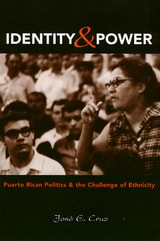
Identity And Power
Puerto Rican Politics and the Challenge of EthnicityJosé E. Cruz
Temple University Press, 1998
The activities of the Puerto Rican Political Action Committee from 1983 to 1991 illustrate the power of ethnic mobilization and strategy in an urban setting. Cruz examines their insistence on their right to be included in the political process in the context of both a typical mid-sized American city and the unique attributes of Hartford's predominantly white-collar population. At the same time, this study acknowledges the limitations of the exercise of such power in the political process.
Through extensive interviews Cruz brings to light the variety of ways in which politicians and political activists themselves view their own activities and achievements. This group of Puerto Rican activists attempted to penetrate the power structure of Hartford. Though their success was limited, their work constitutes a springboard for further change.
Identity Papers
Literacy and Power in Higher Educationedited by Bronwyn T. Williams
Utah State University Press, 2006
How do definitions of literacy in the academy, and the pedagogies that reinforce such definitions, influence and shape our identities as teachers, scholars, and students? The contributors gathered here reflect on those moments when the dominant cultural and institutional definitions of our identities conflict with our other identities, shaped by class, race, gender, sexual orientation, location, or other cultural factors.
These writers explore the struggle, identify the sources of conflict, and discuss how they respond personally to such tensions in their scholarship, teaching, and administration. They also illustrate how writing helps them and their students compose alternative identities that may allow the connection of professional identities with internal desires and senses of self. They emphasize how identity comes into play in education and literacy and how institutional and cultural power is reinforced in the pedagogies and values of the writing classroom and writing profession.
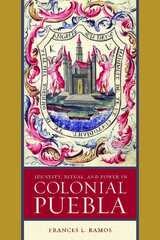
Identity, Ritual, and Power in Colonial Puebla
Frances L. Ramos
University of Arizona Press, 2012
With Ramos as a guide, we are not only dazzled by the trappings of power—the silk canopies, brocaded robes, and exploding fireworks—but are also witnesses to the public spectacles through which municipal councilmen consolidated local and imperial rule. By sponsoring a wide variety of carefully choreographed rituals, the municipal council made locals into audience, participants, and judges of the city’s tumultuous political life. Public rituals encouraged residents to identify with the Roman Catholic Church, their respective corporations, the Spanish Empire, and their city, but also provided arenas where individuals and groups could vie for power.
As Ramos portrays the royal oath ceremonies, funerary rites, feast-day celebrations, viceregal entrance ceremonies, and Holy Week processions, we have to wonder who paid for these elaborate rituals—and why. Ramos discovers and decodes the intense debates over expenditures for public rituals and finds them to be a central part of ongoing efforts of councilmen to negotiate political relationships. Even with the Spanish Crown’s increasing disapproval of costly public ritual and a worsening economy, Puebla’s councilmen consistently defied all attempts to diminish their importance.
Ramos innovatively employs a wealth of source materials, including council minutes, judicial cases, official correspondence, and printed sermons, to illustrate how public rituals became pivotal in the shaping of Puebla’s complex political culture.
Ideology and Power in the Middle East
Studies in Honor of George LenczowskiPeter J. Chelkowski and Robert J. Pranger, eds.
Duke University Press, 1988
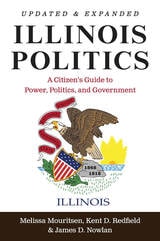
Illinois Politics
A Citizen's Guide to Power, Politics, and GovernmentMelissa Mouritsen, Kent D. Redfield, and James D. Nowlan
University of Illinois Press, 2024
Shifting demographics. Downstate versus Chicago. Billionaires and bribery. Even veteran observers need a roadmap to track Illinois’ ever-changing political landscape. Melissa Mouritsen, Kent D. Redfield, and James D. Nowlan provide an up-to-date primer on Prairie State politics, government, and policies. Features include:
- Discussions of recent events like the 2015-2017 budget disaster, the response to COVID-19, and the fall of longtime House Speaker Michael Madigan;
- New chapters on corruption, social policies, and the political rules of the game;
- Perspectives on the nuts-and-bolts of campaign funding, the ways political actors acquire power or influence, and many other topics;
- Close examinations of complex issues like the state’s increased polarization and its ongoing fiscal recovery.
Fully revised and expanded, <i>Illinois Politics</i> blends detailed information with expert analysis to offer an essential resource for citizens, students, and public servants alike.
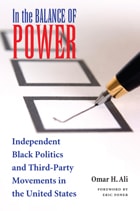
In the Balance of Power
Independent Black Politics and Third-Party Movements in the United StatesOmar H. Ali
Ohio University Press, 2008
Historically, most black voters in the United States have aligned themselves with one of the two major parties: the Republican Party from the time of the Civil War to the New Deal and, since the New Deal—and especially since the height of the modern civil rights movement—the Democratic Party. However, as In the Balance of Power convincingly demonstrates, African Americans have long been part of independent political movements and have used third parties to advance some of the most important changes in the United States, notably the abolition of slavery, the extension of voting rights, and the enforcement of civil rights.
Since the early nineteenth century, there has been an undercurrent of political independence among African Americans. They helped develop the Liberty Party in the 1840s and have continued to work with third parties to challenge the policies of the two major parties. But despite the legal gains of the modern civil rights movement, elements of Jim Crow remain deeply embedded in our electoral process.
In the Balance of Power presents a history and analysis of African American third-party movements that can help us better understand the growing diversity among black voters today.
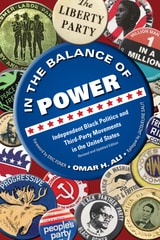
In the Balance of Power
Independent Black Politics and Third-Party Movements in the United StatesOmar H. Ali
Ohio University Press, 2020
REVISED AND EXPANDED EDITION
Reveals the multiple independent political tactics and strategies that African Americans have used to expand democracy and uphold civil and political rights since the founding of the nation.
This new edition of Ali’s groundbreaking narrative includes an epilogue by independent political analyst and leader Jacqueline Salit. New material addresses the historic presidencies of both Barack Obama and Donald Trump, as well as the rising tide of independent and anti-party sentiments.
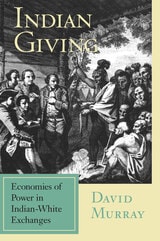
Indian Giving
Economies of Power in Indian-White ExchangesDavid Murray
University of Massachusetts Press, 2000
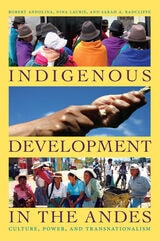
Indigenous Development in the Andes
Culture, Power, and TransnationalismRobert Andolina, Nina Laurie, and Sarah A. Radcliffe
Duke University Press, 2009
The authors argue that this reconfiguration of development policy and practice permits Ecuadorian and Bolivian indigenous groups to renegotiate their relationship to development as subjects who contribute and participate. Yet it also recasts indigenous peoples and their cultures as objects of intervention and largely fails to address fundamental concerns of indigenous movements, including racism, national inequalities, and international dependencies. Andean indigenous peoples are less marginalized, but they face ongoing dilemmas of identity and agency as their fields of action cross national boundaries and overlap with powerful institutions. Focusing on the encounters of indigenous peoples with international development as they negotiate issues related to land, water, professionalization, and gender, Indigenous Development in the Andes offers a comprehensive analysis of the diverse consequences of neoliberal development, and it underscores crucial questions about globalization, governance, cultural identity, and social movements.

Indigenous Intellectuals
Knowledge, Power, and Colonial Culture in Mexico and the AndesGabriela Ramos and Yanna Yannakakis, eds.
Duke University Press, 2014
Contributors. Elizabeth Hill Boone, Kathryn Burns, John Charles, Alan Durston, María Elena Martínez, Tristan Platt, Gabriela Ramos, Susan Schroeder, John F. Schwaller, Camilla Townsend, Eleanor Wake, Yanna Yannakakis
Innocence And Power
Individualism in Twentieth-century AmericaEdited by Gordon H. Mills
University of Texas Press, 1965
America believes in individualism—but what is individualism? This question leads into unexpected areas of life and thought. It touches upon almost every intellectual discipline concerned with human life. Any answer, to be taken seriously, must recognize this complexity. A broad understanding of the meaning of individualism can be reached only through the insight of many workers in many different fields.
This volume brings together seven of the United States' most distinguished scholars, representing the fields of anthropology, economics, government, history, literature, and philosophy. The trend of their thinking can be suggested by a few excerpts from their essays:
• "An individual divorced from a cultural milieu would not be a human being; he would be a mere hominid."—Leslie A. White
• "The trouble is that 'individual' is a stop-thought word. It numbs the mind, so that once it has been uttered, inquiry stops."—Clarence E. Ayres
• "Not even an individual's perfections are his alone; like his imperfections, they are group-made."— Paul A. Samuelson
• "The twentieth century has witnessed the emergence of a new kind of American individualism, the individualism of nonconformity, which actually challenges the compulsive democracy of the Lockean individualism by which the nation has centrally and historically lived."—Louis Hartz
• "The individualism of the American frontier was an individualism of personal self-reliance and of hardihood and stamina rather than an individualism of intellectual independence and personal self-expression."—David M. Potter
• "The present conditions in which the self must be preserved are radically different from those of a generation, even a decade ago. . . . The dogmatics of present self-assertion are defined and pursued in an existential circumstance."—Frederick J. Hoffman
• "Individuality means creativity, and 'laws of creativity,' other than statistical ones, are, I hold, a contradiction in terms."—Charles Hartshorne

Intangible Materialism
The Body, Scientific Knowledge, and the Power of LanguageRonald Schleifer
University of Minnesota Press, 2009
Taking as his point of departure Norbert Weiner’s statement that information is basic to understanding materialism in our era, Ronald Schleifer shows how discoveries of modern physics have altered conceptions of matter and energy and the ways in which both information theory and the study of literature can enrich these conceptions. Expanding the reductive notion of “the material” as simply matter and energy, he formulates a new, more inclusive idea of materialism.
Schleifer’s project attempts to bridge the divisions between the humanities and the sciences and to create a nonreductive materialism for the information age. He presents a materialistic account of human bodily experience by delving into language and literature that powerfully represents our faces, voices, hands, and pain. For example, he examines the material resources of poetic “literariness” as it is revealed in the condition of Tourette’s syndrome. Schleifer also investigates gestures of the hand in the formation of sociality, and he studies pain as both a physiological and phenomenological experience.
This ambitious work explores physiological analyses, evolutionary explanations, and semiotic descriptions of materialism to reveal how aspects of physical existence discover meaning in experience.

Intimate Enemies
Landowners, Power, and Violence in ChiapasAaron Bobrow-Strain
Duke University Press, 2007
Weaving together ethnography, archival research, and cultural history, Bobrow-Strain argues that prior to the upheavals of 1994 landowners were already squeezed between increasingly organized indigenous activism and declining political and economic support from the Mexican state. He demonstrates that indigenous mobilizations that began in 1994 challenged not just the economy of estate agriculture but also landowners’ understandings of progress, masculinity, ethnicity, and indigenous docility. By scrutinizing the elites’ responses to land invasions in relation to the cultural politics of race, class, and gender, Bobrow-Strain provides timely insights into policy debates surrounding the recent global resurgence of peasant land reform movements. At the same time, he rethinks key theoretical frameworks that have long guided the study of agrarian politics by engaging political economy and critical human geography’s insights into the production of space. Describing how a carefully defended world of racial privilege, political dominance, and landed monopoly came unglued, Intimate Enemies is a remarkable account of how power works in the countryside.
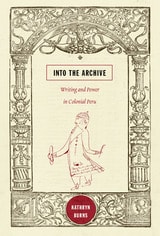
Into the Archive
Writing and Power in Colonial PeruKathryn Burns
Duke University Press, 2010
Kathryn Burns argues that the archive itself must be historicized. Using the case of colonial Cuzco, she examines the practices that shaped document-making. Notaries were businessmen, selling clients a product that conformed to local “custom” as well as Spanish templates. Clients, for their part, were knowledgeable consumers, with strategies of their own for getting what they wanted. In this inside story of the early modern archive, Burns offers a wealth of possibilities for seeing sources in fresh perspective.