Results by title
89 books match the query 'Religion & Science' and 5 start with i
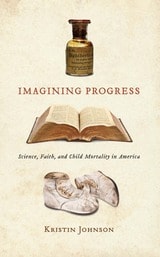
Imagining Progress
Science, Faith, and Child Mortality in AmericaKristin Johnson
University of Alabama Press, 2024
Explores the intellectual history of how Americans imagined science, faith, and human improvement through the most wrenching of experiences—the deaths of children.
Offering fascinating examples from the works of diverse writers and thinkers such as Benjamin Franklin, Frederick Douglass, Mark Twain, W. E. B. Du Bois, Elizabeth Cady Stanton, and Harriet Shelton Dover, Kristin Johnson traces the history of Americans’ complicated faith in science and the various triumphs and tragedies that faith has inspired. Imagining Progress reveals many of the complex factors involved in the polarized state of contemporary American attitudes toward science, scientists, public health, medicine, and science policy.
Humankind has always wrestled with the existence of suffering, how to respond to suffering, whom to care for, and in what ways. For two centuries, many American ministers, physicians, and scientists believed that an omnipotent and omniscient God created the world such that people might relieve suffering through ingenuity and learning. Others responded to the new worldview introduced by the scientific revolution as a threat to the divine order. In Imagining Progress, Johnson traces the history of Americans’ evolving relationship with science and religion at “one of its most dramatic places”—the bedsides of dying children. It’s here, in the crucible of parental despair, that she illuminates diverging assumptions about God, nature, and history.
From Cotton Mather’s campaign for smallpox inoculation to battles over teaching evolution in the 1920s, Johnson adroitly weaves an interdisciplinary history of medicine, science, theology, and activism. She follows a wide cast of characters from across theological, scientific, and political spectrums. What emerges is a kaleidoscopic portrait of diverse, often contradictory hopes and anxieties inspired by new theories of nature and human existence. Johnson also discerns a problematic pattern of invoking science both to ameliorate the suffering of some children while ignoring the suffering of others.
In Search of Divine Reality
Science as a Source of InspirationLothar Schäfer
University of Arkansas Press, 1997
Intelligibility of Nature
A William A. Wallace ReaderWilliam A. Wallace
Catholic University of America Press, 2022
Is God The Only Reality
Science Points Deeper Meaning Of UniverseJohn Marks Templeton
Templeton Press, 2012
Is Progress Speeding Up
Multiplying Multitudes Of BlessingsJohn Marks Templeton
Templeton Press, 1998
This book is a thought-provoking view of the progress of humankind in the last century. In spite of the pessimism that prevails in the media, people are better fed, better clothed, better housed, and better educated than at any previous time.
The facts within the book provide documentation for a positive outlook toward our nutrition and health, living standards and working conditions, political and economic freedoms, educational facilities, ability to communicate, ease of movement, increasing leisure, and, most important, our ability to get along with one another and with our Creator. The statistics, charts, and photographs that illustrate this book enhance the reassuring and uplifting view of the state of the world and where it is going.
“His analysis gives us a refreshing balance to the negative, sometimes cynical, views in the media that tend to portray the worst rather than the best in human civilization.” —Jimmy Carter
“After reading Sir John Templeton's latest book, I believe more than ever that we are living in the most exciting time in history. Despite the challenges we face, his demonstration of mankind's progress gives all of us great hopes and high expectations for our next century and the new millennium.” —Jack Kemp, former HUD secretary, director of Empower America