Results by title
1095 books match the query 'Rhetoric' and 32 start with i
I Hope I Join the Band
Narrative, Affiliation, and Antiraciset RhetoricFrankie Condon
Utah State University Press, 2012
"Both from the Right and from the Left, we are stymied in talking well with one another about race and racism, by intransigent beliefs in our own goodness as well as by our conviction that such talk is useless. . . . White antiracist epistemology needs to begin not with our beliefs, but with our individual and collective awakening to that which we do not know."
Drawing on scholarship across disciplines ranging from writing and rhetoric studies to critical race theory to philosophy, I Hope I Join the Band examines the limits and the possibilities for performative engagement in antiracist activism. Focusing particularly on the challenges posed by raced-white identity to performativity, and moving between narrative and theoretical engagement, thebook names and argues for critical shifts in the understandings and rhetorical practices that attend antiracist activism.
I the People
The Rhetoric of Conservative Populism in the United StatesPaul Elliott Johnson
University of Alabama Press, 2022
WINNER OF THE NATIONAL COMMUNICATION ASSOCIATION'S 2023 HOCHMUTH-NICHOLS AWARD
A definitive rhetorical history of conservative populism, exposing how identity, victimhood, and populist appeals have shaped—and constrained—modern American conservatism.
I The People: The Rhetoric of Conservative Populism in the United States examines a variety of texts—ranging from speeches and campaign advertisements to news reports and political pamphlets—to outline the populist character of conservatism in the United States. Paul Elliott Johnson focuses on key inflection points in the development of populist conservatism, including its manifestation in the racially charged presidential election of 1964, its consolidation at the height of Ronald Reagan’s reelection campaign in 1984, and its character in successive moments that saw its fortunes wax and wane, including 1994, the Obama era, and the rise of Donald J. Trump. theorizing conservative populism as a rhetorical form, Johnson advances scholarship about populism away from a binary ideological framework while offering a useful lens for contextualizing scholarship on American conservatism. I The People emphasizes that the populist roots of conservative hegemony exercise a powerful constraining force on conservative intellectuals, whose power to shape and control the movement to which they belong is circumscribed by the form of its public-facing appeals.
The study also reframes scholarly understandings of the conservative tradition’s seeming multiplicity, especially the tendency to suggest an abiding conservative unease regarding capitalism, showing how racist hostility underwrote a compromise with an increasingly economized understanding of humanity. Johnson also contests the narrative that conservatives learned to practice identity politics from social progressives. From the beginning, conservatism’s public vernacular was a white and masculine identity politics reliant on a rhetoric of victimhood, whether critiquing the liberal Cold War consensus or President Barack Obama.
I-Writing
The Politics and Practice of Teaching First-Person WritingKaren Surman Paley
Southern Illinois University Press, 2001
In this ethnographic study of the teaching of writing, Karen Surman Paley reveals the social significance of first-person writing and the limitations of a popular taxonomy of composition studies. Paley looks critically at the way social constructionists have created an “Other” in the field of composition studies and named it “expressivist.”
Paley demonstrates the complexity of approaches to teaching writing through an ethnographic study of two composition faculty at Boston College, a programthat some would say is “expressivist.” She prompts her colleagues to consider how family experiences shape the way students feel about and treat people of races, religions, genders, and sexual preferences other than their own. Finally, she suggests to the field of composition that practitioners spend less time shoring up taxonomies of the field and more time sharing pedagogies.

If at First You Don't Succeed?
Writing, Rhetoric, and the Question of FailureSteven J. Corbett
University Press of Colorado, 2025

Imagining China
Rhetorics of Nationalism in an Age of GlobalizationStephen J. Hartnett
Michigan State University Press, 2017

Impersonating Animals
Rhetoric, Ecofeminism, and Animal Rights LawS. Marek Muller
Michigan State University Press, 2020
Impolite Periodicals
Reading for Rudeness in the Eighteenth CenturyEmrys D. Jones
Bucknell University Press, 2026
With an afterword by Manushag N. Powell.
Published by Bucknell University Press. Distributed worldwide by Rutgers University Press.
Improvisations
Methods and Methodologies in Lifespan Writing ResearchRyan J. Dippre
University Press of Colorado, 2025

In the Name of the Father
The Rhetoric of the New Southern Baptist ConventionCarl L. Kell and L. Raymond Camp. Foreword by Kenneth Chafin
Southern Illinois University Press, 1999
In the Name of the Father: The Rhetoric of the New Southern Baptist Conventionbegins with an analysis of the 1979 Southern Baptist Convention, the watershed convention where moderate forces fell before the powerful oratory of the ultraconservative faction, which has remained in power ever since. Communication professors Carl L. Kell and L. Raymond Camp investigate the rhetorical shift from moderate to ultraconservative in the Southern Baptist Convention, the largest denomination in the South and the largest Protestant denomination in the United States.
Drawing on sermons delivered at national conventions from 1979 to the present, Kell and Camp outline the discourses of fundamentalism, inerrancy, and exclusion. These discourses, the authors assert, point to the SBC leaders’ call for a return to times before feminism and tolerance of varying sexual orientations allegedly brought chaos to society and shook believers from their theological foundations.
In the Wake of Violence
Image & Social ReformCheryl R. Jorgensen-Earp
Michigan State University Press, 2008
How acts of violence are rhetorically "managed" by social movements: In the Wake of Violence explores the immediate and longer term aftermath of violence committed by independent radicals involved in single-issue movements. Cheryl R. Jorgensen-Earp explores several specific incidents in recent history—the arson of a Vail ski resort by environmentalists, the murder of Dr. John Britton by an antiabortion activist, and the torching of a University of California research laboratory by animal rights activists among them—to discover how the perpetrators of the violence and the majority of reformers involved in their movements rhetorically framed the violent act for a potentially outraged public.
In the Wake of Violence, claims Jorgensen-Earp, the perpetrators are often forthcoming with both explanations for and a defense of their actions, casting themselves as righteous actors or martyrs for a cause. However, ardent reformers within the same cause might look with genuine revulsion at the actions of their own radical wing. This study claims that the nonviolent majority in single-issue reform movements employs a predictable constellation of rhetorical strategies to manage the impact of radical fringe violence. The primary goal of this rhetoric is to avoid a backlash against the larger movement by a public alienated by violent acts.
In examining specific rhetorical responses by the nonviolent majority in antiabortion, animal welfare, environmental reform, abolition, and women’s suffrage movements, Jorgensen-Earp considers a wide range of discourse types—from newspaper articles, interviews, and editorials to private letters; from editorial cartoons to the homemade signs of movement activists; and from speeches to modern Internet sites. She discovers that the image restoration techniques brought to bear for a reform cause are similar to those employed by a corporation accused of wrongdoing. Ultimately, she finds that the majority of proponents of the causes she examines believe that the violence can or will be condoned and that it must be rhetorically mitigated.
Inconvenient Strangers
Transnational Subjects and the Politics of CitizenshipShui-yin Sharon Yam
The Ohio State University Press, 2019
Inconvenient Strangers: Transnational Subjects and the Politics of Citizenship draws attention to how intersecting networks of power—particularly race and ethnicity, gender, and social class—marginalize transnational subjects who find themselves outside a dominant citizenship that privileges familiarity and socioeconomic and racial superiority. In this study of how neoliberal ideas limit citizenship for marginalized populations in Hong Kong, Shui-yin Sharon Yam examines how three transnational groups—mainland Chinese maternal tourists, Southeast Asian migrant domestic workers, and South Asian permanent residents—engage with the existing citizenry and gain recognition through circulating personal narratives.
Coupling transnational feminist studies with research on emotions, Yam analyzes court cases, interviews, social media discourse, and the personal narratives of Hong Kong’s marginalized groups to develop the concept of deliberative empathy—critical empathy that prompts an audience to consider the structural sources of another’s suffering while deliberating one’s own complicity in it. Yam argues that storytelling and familial narratives can promote deliberative empathy among the audience as both a political and ethical response—carrying the affective power to jolt the dominant citizenry out of their usual xenophobic attitudes and ultimately prompt them to critically consider the human conditions they share with the marginalized and move them toward more ethical coalitions.

Indigenous Activism in the Midwest
Refusal, Resurgence, and Resisting Settler ColonialismMargret McCue-Enser
Michigan State University Press, 2025
Indigenous Genres of the Human
Locating the Intersections of Indigeneity and LatinidadGabriela Raquel Ríos
University of Arizona Press, 2026
Addressing different genres of human and what contemporary indigeneity and reclaiming indigeneity looks like across Latin American contexts, chapters in this work examine digital bruja poetry, Aymara women’s Lucha Libre in Bolivia, Raramuri dance in Mexico, and Indigenous Khipu in the Andes. The author weaves her own story of being from southern Texas and traveling to Mexico throughout the book.
Bridging Sylvia Wynter’s theory of “genres of the human” with critical Latinx indigeneity studies, Chicana/o/x studies, decolonial theory, and rhetorical new materialisms, this book challenges readers to rethink what it means to be human, Indigenous, and Chicanx in the wake of colonial violence. Rather than reinforcing binaries defined by settler colonialism, Ríos proposes a framework that centers community knowledge and grounded practices. Her work opens space for dialogue, listening, and healing, emphasizing that reclaiming indigeneity requires attention to the stories, movements, and rhetorical practices that emerge from within communities themselves.

Indigenous Voices in Digital Spaces
Cindy Tekobbe
Utah State University Press, 2024
Tekobbe’s methods for analyzing and understanding Indigenous knowledges online center Indigenous storytelling and “thick” (broad, deep, and complex) Indigenous meaning-making. Employing this thickness to interpret Indigenous knowledge ways resists the settler-colonial logics that tend to flatten complex Indigenous concepts into one-note representations of racial stereotypes. Native Americans’ use of social media and digital platforms to support social movements uniquely constructs Indigenous identities as living, producing, and culture-making people, which confronts the commonplace, one-dimensional narrative that Indigenous North Americans either live in isolation or are people of history resigned to the long-forgotten past. Tekobbe’s methods are applicable to additional online research to break through Western paradigms of oppositional critique, the colonial power matrix embedded in hierarchical and taxonomical classification systems, and participant objectification.
Indigenous Voices in Digital Spaces offers new methodological and epistemological opportunities to explore digital communities and technologies, problematizing conventional Western critique. This book is useful to instructors in Indigenous studies, internet studies, digital literacies, cultural studies, and communications, as well as Indigenous and internet studies researchers.

Inscrutable Eating
Asian Appetites and the Rhetorics of Racial ConsumptionJennifer Lin LeMesurier
The Ohio State University Press, 2023
“You are what you eat,” but what if you’re seen as a rat eater, bat lover, or MSG user? In Inscrutable Eating, Jennifer Lin LeMesurier considers how everyday assumptions about Asian food influence the perception of Asian and Asian American identity within the US racial landscape, demonstrating that beliefs about how certain people eat are inseparable from attitudes that support hierarchies around race, gender, and sexuality. Drawing on rhetorical theory, affect theory, and Asian American studies, LeMesurier analyzes messages in US popular culture about Asian eating to develop the concept of gut orientations: rhetorically dominant ways of interacting with food that scale upward to feelings of desire and disgust toward social groups. Looking at examples from fears around MSG to uproar over wet markets as the source of COVID-19, she argues that these “gut” reactions establish certain racial views as common-sense truths rather than cultural biases, reinforcing dominant norms about what belongs on whose plate, or who belongs at what table. In demystifying marginalizing discourse around food and eating, LeMesurier shows how exposing the tacit, felt ideas of consumption is necessary to contest broader forms of discrimination.
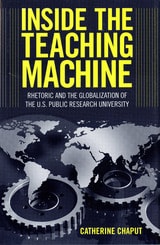
Inside the Teaching Machine
Rhetoric and the Globalization of the U.S. Public Research UniversityCatherine Chaput
University of Alabama Press, 2008
An incisive critique of the corporatized university, tracing the entanglement of academic missions with economic, political, and cultural systems.
Advocates of higher education have long contended that universities should operate above the crude material negotiations of economics and politics. Such arguments, ignore the historical reality that the American university system emerged through, and in service to, a capitalist political economy that unevenly combines corporate, state, and civil interests.
As the corporatization of U.S. universities becomes nearly impossible to deny, the common response from many academics has been a superior stand against the contamination of the professional ideal by tainted corporate interests. Inside the Teaching Machine proposes a correction to this view through the lens of historical materialism.
Chaput argues that the U.S. public research university has always been a vital component of the capitalist political economy. While conventional narratives of public higher education emphasize civic preparation and upward mobility, Chaput demonstrates that supposedly egalitarian policies like the Morrill Land-Grant Act and the G.I. Bill served the changing interests of capitalism much as education, creating a professional class that supports the capitalist political economy. Chaput also focuses on the relationship between American universities and globalization, showing how the trend toward professionalization contributes to the production of surplus value, and the ways that the American university model circulates outside the United States. Chaput concludes by advocating rhetorical strategies for the professional who opposes the capitalist logic of the global university system, proposing concrete options for engaging and redirecting globalization within the university system.

Insiders, Outliers
Centering Adult Student Writers at an HBCUCollie Fulford
Rutgers University Press, 2025
Winner of the 2026 Outstanding Book Award in the Monograph category from the Conference on College Composition and Communication
Insiders, Outliers invites readers into the lives of adult HBCU students for whom college is one meaningful activity among many. Although adults over the age of twenty-four comprise a quarter of all undergraduates, they are institutionally segregated and only partially served by a US higher education system that remains organized around traditional-aged learners. Even as such students are regarded as a market for postsecondary institutions, they are routinely marginalized by institutional barriers. Students’ stories of their personal, professional, community, and academic writing experiences illuminate a critical need for more age-inclusive practices across academia. Their cases also offer new conceptual models of writing as an ethical and emotional practice that fuels changes for individuals and the people and institutions that they care about—including higher education. What adult students reveal about writing across their life domains has powerful implications for conceptualizing writing as a complex form of agency and for teaching writing across the curriculum.
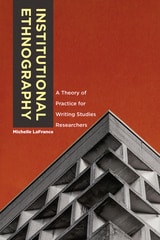
Institutional Ethnography
A Theory of Practice for Writing Studies ResearchersMichelle LaFrance
Utah State University Press, 2019
In this book, Michelle LaFrance introduces the theories, rhetorical frames, and methods that ground and animate institutional ethnography. Three case studies illustrate key aspects of the methodology in action, tracing the work of writing assignment design in a linked gateway course, the ways annual reviews coordinate the work of faculty and writing center administrators and staff, and how the key term “information literacy” socially organizes teaching in a first-year English program. Through these explorations of the practice of ethnography within sites of writing and writing instruction, LaFrance shows that IE is a methodology keenly attuned to the material relations and conditions of work in twenty-first-century writing studies contexts, ideal for both practiced and novice ethnographers who seek to understand the actualities of social organization and lived experience in the sites they study.
Institutional Ethnography expands the field’s repertoire of research methodologies and offers the grounding necessary for work with the IE framework. It will be invaluable to writing researchers and students and scholars of writing studies across the spectrum—composition and rhetoric, literacy studies, and education—as well as those working in fields such as sociology and cultural studies.
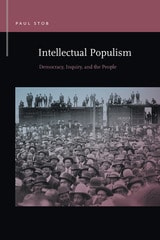
Intellectual Populism
Democracy, Inquiry, and the PeoplePaul Stob
Michigan State University Press, 2020
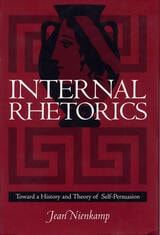
Internal Rhetorics
Toward a History and Theory of Self-PersuasionJean Nienkamp
Southern Illinois University Press, 2001
Since its early history in Greek culture, traditional rhetorical study has focused primarily on persuasive language used in the public sphere. There has been little study, however, of what Jean Nienkamp calls internal rhetoric, which “occurs between one aspect of the self and another” inside one’s mind. Nienkamp opens the study of internal rhetoric by discussing how the concept developed alongside traditional classical and modern rhetorical theory.
Nienkamp shows how we talk to ourselves, or more specifically, how we talk ourselves into things: justifications, actions, opinions, theories. She explains that just because we see ourselves as divided, as torn in different directions by conflicting desires, duties, and social mores, it does not mean that we are fragmented, nor does it mean that we are split into discrete identities that neither interrelate nor interact.
In this groundbreaking study, Nienkamp identifies two major aspects of internal rhetoric: “the conscious ‘art’ of cultivated internal rhetoric” and “the unconscious ‘nature’ of primary internal rhetoric.” Selecting a small number of figures from the history of rhetoric—including Isocrates, Plato, Aristotle, Francis Bacon, Lord Shaftesbury, Richard Whately, Kenneth Burke, Chaim Perelman and Lucie Olbrechts-Tyteca, George Herbert Mead, and Lev Vygotsky—Nienkamp argues for a “version of the rhetorical self that takes into account both the ways we are formed by and formulate internal and external rhetorics and the ways our physical bodies act as a contributing scene—an agora—for internal rhetoric.”
International Students in First-Year Writing
A Journey Through Socio-Academic SpaceMegan M. Siczek
University of Michigan Press, 2018
This study raises questions about how to support international students:
- In what ways can it inform our practices and policies relative to the internationalization of education and the development of global perspectives and competencies?
- What does it reveal that could impact daily instruction of L2 writing, particularly when it comes to international students’ need to meet the expectations of “university-level writing” in U.S. institutions of higher education?
- On an individual level, what can we learn from these students and about ourselves as a result of our interactions?
Internationalization of US Writing Programs
Shirley K Rose
Utah State University Press, 2018
The Internationalization of US Writing Programs illuminates the role writing programs and WPAs play in defining goals, curriculum, placement, assessment, faculty development, and instruction for international student populations. The volume offers multiple theoretical approaches to the work of writing programs and illustrates a wide range of well-planned writing program–based empirical research projects.
As of 2016, over 425,000 international students were enrolled as undergraduates in US colleges and universities, part of a decade-long trend of increasing numbers of international students coming to the United States for both undergraduate and graduate degrees. Writing program administrators and writing teachers across the country are beginning to recognize this changing demographic as a useful catalyst for change in writing programs, which are tasked with preparing all students, regardless of initial level of English proficiency, for academic and professional writing.
The Internationalization of US Writing Programs is the first collection to focus specifically on this crucial aspect of the roles and responsibilities of WPAs, who are leading efforts to provide all students on their campuses, regardless of nationality or first language, with competencies in writing that will serve them in the academy and beyond.
Contributors: Jonathan Benda, Michael Dedek, Christiane Donahue, Chris W. Gallagher, Kristi Girdharry, Tarez Samra Graban, Jennifer E. Haan, Paula Harrington, Yu-Kyung Kang, Neal Lerner, David S. Martins, Paul Kei Matsuda, Heidi A. McKee, Libby Miles, Susan Miller-Cochran, Matt Noonan, Katherine Daily O’Meara, Carolina Pelaez-Morales, Stacey Sheriff, Gail Shuck, Christine M. Tardy, Stanley Van Horn, Daniel Wilber, Margaret Willard-Traub
Interpreting Sacred Ground
The Rhetoric of National Civil War Parks and BattlefieldsJ. Christian Spielvogel
University of Alabama Press, 2013
A rhetorical analysis of Civil War battlefields and parks, and the ways various commemorative traditions—and their ideologies of race, reconciliation, emancipation, and masculinity—compete for dominance.
The National Park Service (NPS) is known for its role in the preservation of public sites deemed to have historic, cultural, and natural significance. In Interpreting Sacred Ground, J. Christian Spielvogel studies the NPS’s secondary role as an interpreter or creator of meaning at such sites, specifically Gettysburg National Military Park, Harpers Ferry National Historical Park, and Cold Harbor Visitor Center.
Spielvogel studies in detail the museums, films, publications, tours, signage, and other media at these sites, and he studies and analyzes how they shape the meanings that visitors are invited to construct. Though the NPS began developing interpretive exhibits in the 1990s that highlighted slavery and emancipation as central facets to understanding the war, Spielvogel argues that the NPS in some instances preserves outmoded narratives of white reconciliation and heroic masculinity, obscuring the race-related causes and consequences of the war as well as the war’s savagery.
The challenges the NPS faces in addressing these issues are many, from avoiding unbalanced criticism of either the Union or the Confederacy, to foregrounding race and violence as central issues, preserving clear and accurate renderingsof battlefield movements and strategies, and contending with the various public constituencies with their own interpretive stakes in the battle for public memory.
Spielvogel concludes by arguing for the National Park Service’s crucial role as a critical voice in shaping twentieth-first-century Civil War public memory and highlights the issues the agency faces as it strives to maintain historical integrity while contending with antiquated renderings of the past.
Interrogating Gendered Pathologies
Erin A. Clark
Utah State University Press, 2020
These chapters engage common narratives about the ways in which gender in healthcare is secondary and highlights the stories of people who have battled to prioritize their own bodies through extraordinary difficulties. Employing a multiplicity of voices, the book represents a number of different perspectives on what it might look like to return health and medical data to embodied experience, to consider the effects of gendered and intersectional biomedical norms on lived realities, and to subvert the power of institutions in ways that move us toward biomedical justice.
This collection contributes to the burgeoning field of health and medical rhetorics by rhetorically and theoretically intervening in what are often seen as objective and neutral decisions related to the body and to scientific and medical data about bodies. Interrogating Gendered Pathologies will be of interest to feminist scholars in the field of rhetoric and writing studies, specifically those in the rhetorics of health and medicine, as well as scholars of technical communication, feminist studies, gender studies, technoscience studies, and bioethics.
Contributors: Leslie Anglesey, Mary Assad, Beth Boser, Lillian Campbell, Marleah Dean, Lori Beth De Hertogh, Leandra Hernandez, Elizabeth Horn-Walker, Caitlin Leach, Jordan Liz, Miriam Mara, Cathryn Molloy, Kerri Morris, Maria Novotny, Sage Perdue, Colleen Reilly
Interruptions
The Fragmentary Aesthetic in Modern LiteratureGerald L. Bruns
University of Alabama Press, 2018
A history of fragmentary—or interrupted—writing in avant-garde poetry and prose by a renowned literary critic.
In Interruptions: The Fragmentary Aesthetic in Modern Literature, Gerald L. Bruns explores the effects of parataxis, or fragmentary writing as a device in modern literature. Bruns focuses on texts that refuse to follow the traditional logic of sequential narrative. He explores numerous examples of self-interrupting composition, starting with Friedrich Schlegel's inaugural theory and practice of the fragment as an assertion of the autonomy of words, and their freedom from rule-governed hierarchies.
Bruns opens the book with a short history of the fragment as a distinctive feature of literary modernism in works from Gertrude Stein to Paul Celan to present-day authors. The study progresses to the later work of Maurice Blanchot and Samuel Beckett, and argues, controversially, that Blanchot's writings on the fragment during the 1950s and early 1960s helped to inspire Beckett’s turn toward paratactic prose.
The study also extends to works of poetry, examining the radically paratactic arrangements of two contemporary British poets, J. H. Prynne and John Wilkinson, focusing chiefly on their most recent, and arguably most abstruse, works. Bruns also offers a close study of the poetry and poetics of Charles Bernstein.
Interruptions concludes with two chapters about James Joyce. First, Bruns tackles the language of Finnegans Wake, namely the break-up of words themselves, its reassembly into puns, neologisms, nonsense, and even random strings of letters. Second, Bruns highlights the experience of mirrors in Joyce’s fiction, particularly in Dubliners, Portrait of the Artist as a Young Man, and Ulysses, where mirrored reflections invariably serve as interruptions, discontinuities, or metaphorical displacements and proliferations of self-identity.

Intertextuality and the 24-Hour News Cycle
A Day in the Rhetorical Life of Colin Powell's U.N. AddressJohn Oddo
Michigan State University Press, 2014
Inventing Place
Writing Lone Star RhetoricsEdited by Casey Boyle and Jenny Rice
Southern Illinois University Press, 2018
Divided into five sections corresponding to Texas regions, essays consider aesthetics, buildings, environment, food and alcohol, private and public memory, and race and class. Among the topics covered by contributors are the Imagine Austin urban planning initiative; the terroir of Texas barbecue; the racist past of Grand Saline, Texas; Denton, Texas, and authenticity as rhetorical; negative views of Texas and how the state (or any place) is subject to reinvention; social, historical, and economic networks of place and their relationship to the food we eat; and Texas gun culture and working-class character.
Invention as a Social Act
Karen Burke LevFevre. Foreword by Frank D'Angelo
Southern Illinois University Press, 1986
The act of inventing relates to the process of inquiry, to creativity, to poetic and aesthetic invention.
Building on the work of rhetoricians, philosophers, linguists, and theorists in other disciplines, Karen Burke LeFevre challenges a widely-held view of rhetorical invention as the act of an atomistic individual. She proposes that invention be viewed as a social act, in which individuals interact dialectically with society and culture in distinctive ways.
Even when the primary agent of invention is an individual, invention is pervasively affected by relationships of that individual to others through language and other socially shared symbol systems. LeFevre draws implications of a view of invention as a social act for writers, researchers, and teachers of writing.
Invention, Copyright, and Digital Writing
Martine Courant Rife
Southern Illinois University Press, 2013
This is the first empirical, mixed-methods study of copyright issues that speaks to writing specialists and legal scholars about the complicated intersections of rhetoric, technology, copyright law, and writing for the Internet. Martine Courant Rife opens up new conversations about how invention and copyright work together in the composing process for digital writers and how this relationship is central to contemporary issues in composition pedagogy and curriculum.
In this era of digital writing and publishing, composition and legal scholars have identified various problems with writers’ processes and the law’s construction of textual ownership, such as issues of appropriation, infringement, and fair use within academic and online contexts. Invention, Copyright, and Digital Writing unpacks digital writers’ complex perceptions of copyright, revealing how it influences what they choose to write and how it complicates their work. Rife uses quantitative and qualitative approaches and focuses on writing as a tool and a technology-mediated activity, arguing the copyright problem is about not law but invention and the attendant issues of authorship.
Looking at copyright and writing through a rhetorical lens, Rife leverages the tools and history of rhetoric to offer insights into how some of our most ancient concepts inform our understanding of the problems copyright law creates for writers. In this innovative study that will be of interest to professional and technical writers, scholars and students of writing and rhetoric, and legal professionals, Rife offers possibilities for future research, teaching, curriculum design, and public advocacy in regard to composition and changing copyright laws.
Inventive Intercourse
From Rhetorical Conflict to the Ethical Creation of Novel TruthStephen R. Yarbrough
Southern Illinois University Press, 2006
Applying interactionist discourse theory to show how we create novel beliefs
Inventive Intercourse: From Rhetorical Conflict to the Ethical Creation of Novel Truth offers a theory of discursive interaction, illustrating how we can understand human communication without resorting to the notion of language. Using the perspective of interactionist discourse theory, author Stephen Yarbrough investigates how we create novel beliefs, beliefs we could not have inferred from our established beliefs.
The volume considers a central dilemma of post-modern thought: If language is a system of conventions and rules that limit what we can say and think, how can we deliberately produce anything truly novel? While postmodernism concludes that linguistic and conceptual change within our incommensurable worlds is driven by contingency and blind mechanical forces, Yarbrough argues that this view is wrong because the notion that language mediates our perception is wrong.
Beginning with philosopher Donald Davidson’s assertion that "there is no such thing as language" in the sense of a system of conventions and rules, Yarbrough develops an interactionist theory of discourse and uses it to revise the major elements of Aristotelian rhetoric to explain how we deliberately invent novel concepts that we come to believe.
Yarbrough suggests that all conceptual change is initiated by a shift in our ethical apperception of elements of a situation and that an ethical change will have emotional consequences. Changes in our emotional responses to things will change the ways we interact with them, he says, and changes in our interaction with things will create new technical relations which we can communicate to others only by altering our habitual shared way of using signs, metaphors, and other tropes.
Investment Citizenship
Rhetoric and Affect Beyond Late NeoliberalismBlake Abbott
Michigan State University Press, 2027
This book maps the development of a social and rhetorical phenomenon called investment citizenship: a mode of citizen-subjectivity articulated primarily through financial and affective investments. Investment citizenship is both a marker of personal identity and a complex, interwoven set of rhetorics, forces, actions, and assumptions that articulate the role of investment in social life. To that end, it examines three rhetorical couplets—investment and citizenship, financial investment and affective investment, to invest and to be invested—directly and through several cultural phenomena implicated by the emergence of investment rhetoric, such as US government policy, consumerism, ownership, education, and financial planning. Taken together, these couplets both extend and challenge late neoliberalism through the various invocations and implications of investment citizenship that reconfigure the relationship between the individual and society.
Invoking the Invisible Hand
Social Security and the Privatization DebatesRobert Asen
Michigan State University Press, 2009
In Invoking the Invisible Hand Robert Asen scrutinizes contemporary debates over proposals to privatize Social Security. Asen argues that a rights-based rhetoric employed by Social Security's original supporters enabled advocates of privatization to align their proposals with the widely held belief that Social Security functions simply as a return on a worker's contributions and that it is not, in fact, a social insurance program.
By analyzing major debates over a preeminent American institution, Asen reveals the ways in which language is deployed to identify problems for public policy, craft policy solutions, and promote policies to the populace. He shows how debate participants seek to create favorable contexts for their preferred policies and how they connect these policies to idealized images of the nation.