386 books match the query 'Russia' and 16 start with i
cover of Icon and Devotion: Sacred Spaces in Imperial Russia

Icon and Devotion

Sacred Spaces in Imperial Russia

Oleg Tarasov

Reaktion Books, 2002

Icon and Devotion offers the first extensive presentation in English of the making and meaning of Russian icons. The craft of icon-making is set into the context of forms of worship that emerged in the Russian Orthodox Church in the mid-seventeenth century. Oleg Tarasov shows how icons have held a special place in Russian consciousness because they represented idealized images of Holy Russia. He also looks closely at how and why icons were made. Wonder-working saints and the leaders of such religious schisms as the Old Believers appear in these pages, which are illustrated in halftones with miniature paintings, lithographs and engravings never before published in the English-speaking world.

By tracing the artistic vocabulary, techniques and working methods of icon painters, Tarasov shows how icons have been integral to the history of Russian art, influenced by folk and mainstream currents alike. As well as articulating the specifically Russian piety they invoke, he analyzes the significance of icons in the cultural life of modern Russia in the context of popular prints and poster design.
[more]
cover of Icons Axed, Freedoms Lost: Russian Desecularization and a Ukrainian Alternative

Icons Axed, Freedoms Lost

Russian Desecularization and a Ukrainian Alternative

Vyacheslav Karpov

Rutgers University Press, 2025
In Icons Axed, Freedoms Lost, Vyacheslav Karpov and Rachel L. Schroeder demonstrate how Russia went from persecuting believers to jailing critics of religion and why, in contrast, religious pluralism and tolerance have solidified in Ukraine. Offering a richly documented history of cultural and political struggles that surrounded desecularization—the resurgence of religion’s societal role—from the end of the USSR to the Russo-Ukrainian war, they show Russian critics of desecularization adhered to artistic provocations, from axing icons to “punk-prayers” in cathedrals, and how Orthodox activists, in turn, responded by vandalizing controversial exhibits and calling on the state to crush “the enemies of the Church.” Putin’s solidifying tyranny heard their calls and criminalized insults to religious feelings. Meanwhile, Ukraine adhered to its pluralistic legacies. Its churches refused to engage in Russian-style culture wars, sticking instead to forgiveness and forbearance. Icons Axed, Freedoms Lost offers original theoretical and methodological perspectives on desecularization applicable far beyond the cases of Russia and Ukraine.
 
[more]
cover of Ignacy Paderewski: Poland

Ignacy Paderewski

Poland

Anita Prazmowska

Haus Publishing, 2009

The thirteenth of President Wilson's Fourteen Points of 1918 read: "An independent Polish state should be erected which should include the territories inhabited by indisputably Polish populations, which should be assured a free and secure access to the sea, and whose political and economic independence and territorial integrity should be guaranteed by international covenant." Ever since the Third Partition in 1795 brought Polish independence to an end, nationalists had sought the restoration of their country, and the Paris Peace Conference of 1919 did indeed produce the modern Polish state. The Western Allies saw a revived Poland as both a counter to German power and a barrier to the westward expansion of the Bolshevik Revolution in Russia—a role the Polish army fulfilled by defeating a Soviet invasion in 1920. But caught between two powers and composed of territory taken from both of them, Poland was vulnerable, and in 1939 it was divided up between the Soviet Union and Nazi Germany following the Molotov-Ribbentrop Pact. The highest profile Polish representative at the Conference was the pianist and politician Ignacy Paderewski (1860-1941), the "most famous Pole in the world", whose image had done much to promote the Polish cause in the West. But he was joined by the altogether less romantic figure of Roman Dmowski (1864-1939), whose anti-Semitic reputation Paderewski took pains to distance himself from when seeking support in the United States.
[more]
cover of Illiberal Vanguard: Populist Elitism in the United States and Russia

Illiberal Vanguard

Populist Elitism in the United States and Russia

Alexandar Mihailovic

University of Wisconsin Press, 2023

Recent years have witnessed a growing affinity between increasingly radicalized right-wing movements in the United States and Russia, countries that only recently viewed each other as intractable foes. In Illiberal Vanguard: Populist Elitism in the United States and Russia, Alexandar Mihailovic untangles this confluence, considering ethnonationalist movements in both countries and their parallel approaches to gender, race, and performative identity. Rather than probe specific points of possible contact or political collusion, Mihailovic unveils the mirrored styles of thought that characterize far-right elitism in two erstwhile enemy nations.

Mihailovic investigates notable right-wing actors like Steve Bannon and Alexander Dugin and targets of right-wing ire such as globalization, LGBTQ+ activism, and mobilizations to remove controversial statues (that honor Confederate generals and Soviet leaders, for instance), but the argument extends beyond the specifics. How and why are radical right-wing movements developing along such similar trajectories in two nominally oppositional countries? How do religious sectarianism, the construction of whiteness, and institutionalized homophobia support each other in this transnational, informal, but powerful allegiance? Despite their appeals to populism and flamboyant theatrics, Mihailovic argues, much of the answer can be found in the mutual desire to justify and organize an illiberal vanguard of elite intellectuals, one that supports and advocates for a new authoritarianism. 

[more]
cover of Imitations of Life: Two Centuries of Melodrama in Russia

Imitations of Life

Two Centuries of Melodrama in Russia

Louise McReynolds and Joan Neuberger, eds.

Duke University Press, 2002

Imitations of Life views Russian melodrama from the eighteenth century to today as an unexpectedly hospitable forum for considering social issues. The contributors follow the evolution of the genre through a variety of cultural practices and changing political scenarios. They argue that Russian audiences have found a particular type of comfort in this mode of entertainment that invites them to respond emotionally rather than politically to social turmoil.
Drawing on a wide variety of sources, including plays, lachrymose novels, popular movies, and even highly publicized funerals and political trials, the essays in Imitations of Life argue that melodrama has consistently offered models of behavior for times of transition, and that contemporary televised versions of melodrama continue to help Russians cope with national events that they understand implicitly but are not yet able to articulate. In contrast to previous studies, this collection argues for a reading that takes into account the subtle but pointed challenges to national politics and to gender and class hierarchies made in melodramatic works from both the nineteenth and twentieth centuries. Collectively, the contributors shift and cross borders, illustrating how the cultural dismissal of melodrama as fundamentally escapist and targeted primarily at the politically disenfranchised has subverted the drama’s own intrinsically subversive virtues.
Imitations of Life will interest students and scholars of contemporary Russia, and Russian history, literature, and theater.

Contributors. Otto Boele, Julie Buckler, Julie Cassiday, Susan Costanzo, Helena Goscilo, Beth Holmgren, Lars Lih, Louise McReynolds, Joan Neuberger, Alexander Prokhorov, Richard Stites

[more]
cover of Imperial Decline: Russia’s Changing Role in Asia

Imperial Decline

Russia’s Changing Role in Asia

Stephen J. Blank and Alvin Z. Rubinstein, eds.

Duke University Press, 1997

This collection of essays by a distinguished group of international scholars is the first to analyze current Russian policies in China, Japan, and the two Koreas. Although Russia was a rising power in Asia a century ago, historical and political events since then have diverted attention from this potential site of development.
The essays in Imperial Decline describe the major changes that have occurred in Russia’s relations with China, Japan, and South Korea under Boris Yeltin’s presidency, speculating about both Russia’s future in the region and the impact this future could have on relations with the United States. Contributors to this volume demonstrate how incoherent taxation and investment, uncoordinated and contradictory economic policies, runaway inflation and currency instability, and problems of defense now constrain the possibility of Russia expanding its economic influence in the region. This book is essential for students and scholars of international relations, foreign policy, and Russian history.

Contributors. Stephen J. Blank, Bruce A. Elleman, Harry Gelman, Hongchan Chun , Rajan Menon, Alvin Z. Rubinstein, Oles M. Smolansky, Henry Trofimenko, Charles E. Ziegler
[more]
cover of Imperial Designs, Postimperial Extremes: Studies in Interdisciplinary and Comparative History of Russia and Eastern Europe

Imperial Designs, Postimperial Extremes

Studies in Interdisciplinary and Comparative History of Russia and Eastern Europe

Andrei Cusco

Central European University Press, 2023

Anchored in the Russian Empire, but not limited to it, the eight studies in this volume explore the nineteenth-century imperial responses to the challenge of modernity, the dramatic disruptions of World War I, the radical scenarios of the interwar period and post-communist endgames at the different edges of Eurasia. The book continues and amplifies the historiographic momentum created by Alfred J. Rieber’s long and fruitful scholarly career.

First, the volume addresses the attempts of Russian imperial rulers and elites to overcome the economic backwardness of the empire with respect to the West. The ensuing rivalry of several interest groups (entrepreneurs, engineers, economists) created new social forms in the subsequent rounds of modernization. The studies explore the dynamics of the metamorphoses of what Rieber famously conceptualized as a “sedimentary society” in the pre-revolutionary and early Soviet settings.

Second, the volume also expands and dwells on the concept of frontier zones as dynamic, mutable, shifting areas, characterized by multi-ethnicity, religious diversity, unstable loyalties, overlapping and contradictory models of governance, and an uneasy balance between peaceful co-existence and bloody military clashes. In this connection, studies pay special attention to forced and spontaneous migrations, and population politics in modern Eurasia.
[more]
cover of Imperial Rule

Imperial Rule

Alfred J. Rieber

Central European University Press, 2004
Renowned academics compare major features of imperial rule in the 19th century, reflecting a significant shift away from nationalism and toward empires in the studies of state building. The book responds to the current interest in multi-unit formations, such as the European Union and the expanded outreach of the United States. National historical narratives have systematically marginalized imperial dimensions, yet empires play an important role. This book examines the methods discerned in the creation of the Habsburg Monarchy, the Ottoman Empire, the Hohenzollern rule and Imperial Russia. It inspects the respective imperial elites in these empires, and it details the role of nations, religions and ideologies in the legitimacy of empire building, bringing the Spanish Empire into the analysis. The final part of the book focuses on modern empires, such as the German "Reich." The essays suggest that empires were more adaptive and resilient to change than is commonly thought.
[more]
cover of Imperial Russia and the Struggle for Latin American Independence, 1808–1828

Imperial Russia and the Struggle for Latin American Independence, 1808–1828

By Russell H. Bartley

University of Texas Press, 1978

This study, the first of its kind in English, examines Russian responses to the independence movement in Latin America during the early nineteenth century. From a strictly presentist perspective, the investigation of this subject contributes to the historiography of colonialism and of Latin America's relations with the major world powers. In addition, it rounds out the story of foreign interests in the emancipation of Spanish and Portuguese America, while at the same time shedding new light on the history of Russian overseas expansion.

The study probes the major determinants of Russian responses to the struggle for independence of colonial Latin America and evaluates, from a European perspective, the actual impact of tsarist policy on the course of those historic events. Drawing on a wide range of printed materials and on hitherto unused manuscript sources from the archives and libraries of Spain, Portugal, Brazil, and the USSR, it isolates Russian New World objectives during the first decades of the nineteenth century and relates those objectives to the formulation of tsarist policy toward the insurgent Iberian colonies.

[more]
cover of Importing the European Army: The Introduction of European Military Techniques and Institutions in the Extra-European World, 1600-1914

Importing the European Army

The Introduction of European Military Techniques and Institutions in the Extra-European World, 1600-1914

David B. Ralston

University of Chicago Press, 1996

In a study that extends well beyond military history, David B. Ralston documents the ways in which five different countries—Russia, the Ottoman Empire, Egypt, China, and Japan—refashioned their armed forces along European lines during the three centuries after 1600. The appropriation of Western military institutions in countries outside of Europe was, Ralston argues, the major force driving these countries to adopt European administrative, economic, and cultural modes.

Following the same format in his discussion of each country, Ralston makes this central theme in world history easily accessible to students while offering scholars a sophisticated understanding of the exact nature of the changes brought about by Europeanizing military reforms.

David B. Ralston, associate professor of history at the Massachusetts Institute of Technology, is the author of The Army of the Republic.
[more]
cover of In the Jaws of the Crocodile: A Soviet Memoir

In the Jaws of the Crocodile

A Soviet Memoir

Emil Draitser

University of Wisconsin Press, 2021

Emil Draitser dreamed of becoming a writer. Born to a working-class Jewish family in the USSR on the eve of World War II, he came of age during the Brezhnev era, often considered the nadir of Soviet culture. Bored with an engineering job, he found refuge in writing, attracting the attention of a Moscow editor who encouraged him to try his hand at satire. He spent the next decade contributing to Crocodile, the major Party-sponsored magazine known for its sharp-tongued essays and caustic cartoons. After he got in trouble for criticizing an important Soviet official, he began weighing the heavy decision of whether to emigrate.

In this captivating memoir, Draitser explores what it means to be a satirist in a country lacking freedom of expression. His experience provides a window into the lives of a generation of artists who were allowed to poke fun and make readers laugh, as long as they toed a narrow, state-approved line. In the Jaws of the Crocodile also includes several of Draitser’s wry pieces translated into English for the first time.
[more]
cover of In the Shadow of Russia: Reform in Kazakahstan and Uzbekistan

In the Shadow of Russia

Reform in Kazakahstan and Uzbekistan

Pamela Blackmon

Michigan State University Press, 2011

In the twenty years since the dissolution of the Soviet Union, the fifteen new independent republics have embarked on unprecedented transitions from command economies into market-oriented economies.
Important motivating factors for their reform efforts included issues of geographic and economic proximity to Europe and the influence of the pre-Soviet era histories in those countries. In the Shadow of Russia builds upon the conceptual frameworks that include geography and policy choices about economic integration in an analysis of the reform efforts of Kazakhstan and Uzbekistan.
Blackmon's book addresses such central questions as: How and in what areas has a republic's previous level of integration with Soviet-era Russia influenced its present economic orientation? What are the contributing factors that explain the differences in how leaders ( of a similar regime type) developed economic reform policies? To answer these questions, the author utilizes information from both the economic and the political literature on post-communist transitions, as well from political speeches.
[more]
cover of Inferno in Chechnya: The Russian-Chechen Wars, the Al Qaeda Myth, and the Boston Marathon Bombings

Inferno in Chechnya

The Russian-Chechen Wars, the Al Qaeda Myth, and the Boston Marathon Bombings

Brian Glyn Williams

University Press of New England, 2015
In 2013, the United States suffered its worst terrorist bombing since 9/11 at the annual running of the Boston Marathon. When the culprits turned out to be U.S. residents of Chechen descent, Americans were shocked and confused. Why would members of an obscure Russian minority group consider America their enemy? Inferno in Chechnya is the first book to answer this riddle by tracing the roots of the Boston attack to the Caucasus Mountains of southern Russia. Brian Glyn Williams describes the tragic history of the bombers’ war-devastated homeland—including tsarist conquest and two bloody wars with post-Soviet Russia that would lead to the rise of Vladimir Putin—showing how the conflict there influenced the rise of Europe’s deadliest homegrown terrorist network. He provides a historical account of the Chechens’ terror campaign in Russia, documents their growing links to Al Qaeda and radical Islam, and describes the plight of the Chechen diaspora that ultimately sent two Chechens to Boston. Inferno in Chechnya delivers a fascinating and deeply tragic story that has much to say about the historical and ethnic roots of modern terrorism.
[more]
cover of Inherited Empire in East European Architectural Conservation: Appropriating Ottoman, Habsburg and Russian/Soviet Past

Inherited Empire in East European Architectural Conservation

Appropriating Ottoman, Habsburg and Russian/Soviet Past

Cosmin Minea

Central European University Press, 2026
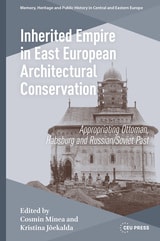
Rather than a mere technical matter, the restoration of built monuments is a process through which societies promote their vision of history and cultural identity. The reasons why many monuments survive to this day are to be found in the nineteenth century, when modern practices of heritage preservation began. This book addresses the emergence and practices of architectural conservation in the case of the heterogeneous, disputed, fragmented and controversial heritage of Eastern and Central Europe from ca. 1800 to 1990. Thirteen chapters, an introduction and an afterword, follow the transformation and preservation of monuments, many of which are little known internationally, and their present legacy, from Georgia to Estonia, from Dalmatia and Galicia to the Russian Far North. With a focus on regions within and around the former Habsburg, Ottoman, Russian and Soviet empires, the volume contributes to decolonising this field of historical research by investigating the imperial and post-imperial architectural legacies, including how they enforced social, racial or ethnic inequalities.
[more]
cover of Ionel Bratianu: Romania

Ionel Bratianu

Romania

Keith Hitchins

Haus Publishing, 2011

At the beginning of 1918 the British War Cabinet endorsed the view of the Prime Minister, David Lloyd George, that after the war "Austria-Hungary should be in a position to exercise a powerful influence in south-east Europe." These reassuring professions were the essence of hypocrisy, since the Allies had already given away, at least on paper, large chunks of Austro-Hungarian territory as bribes to potential allies. In 1916 Romania was promised the whole of Transylvania, the Banat - both components of historic Hungary - and the Bukovina in return for her entry into the war. These promises persuaded the Romanian Prime Minister Ion Bratianu (1864-1927) to intervene in the war on the side of the Allies in 1916. He lead the Romanian delegation to the Paris Peace Conference, where he insisted on those promises to be fulfilled. His often-strained relations with the Big Four and the Supreme Council were further eroded when Romania invaded Hungary. Romania, however, in the end signed and adhered to the Treaty of Saint-Germain-en-Laye with Austria, Neuilly-sur-Seine with Bulgaria, the Treaty of Paris (1920), the Treaty of Trianon with Hungary, and the minorities treaty.
[more]
cover of It Will Be Fun and Terrifying: Nationalism and Protest in Post-Soviet Russia

It Will Be Fun and Terrifying

Nationalism and Protest in Post-Soviet Russia

Fabrizio Fenghi

University of Wisconsin Press, 2021

The National Bolshevik Party, founded in the mid-1990s by Eduard Limonov and Aleksandr Dugin, began as an attempt to combine radically different ideologies. In the years that followed, Limonov, Dugin, and the movements they led underwent dramatic shifts. The two leaders eventually became political adversaries, with Dugin and his organizations strongly supporting Putin’s regime while Limonov and his groups became part of the liberal opposition.
To illuminate the role of these right-wing ideas in contemporary Russian society, Fabrizio Fenghi examines the public pronouncements and aesthetics of this influential movement. He analyzes a diverse range of media, including novels, art exhibitions, performances, seminars, punk rock concerts, and even protest actions. His interviews with key figures reveal an attempt to create an alternative intellectual class, or a “counter-intelligensia.” This volume shows how certain forms of art can transform into political action through the creation of new languages, institutions, and modes of collective participation.
[more]