Results by title
857 books match the query 'Schools' and 30 start with i
Idealism and Liberal Education
James O. Freedman
University of Michigan Press, 2001
Imagination in Teaching and Learning
The Middle School YearsKieran Egan
University of Chicago Press, 1992
stimulated and developed in education. Yet, few teachers
understand what imagination is or how it lends itself to
practical methods and techniques that can be used easily in
classroom instruction. In this book, Kieran Egan—winner of
the prestigious Grawemeyer Award for his work on
imagination—takes up where his Teaching as Story Telling
left off, offering practical help for teachers who want to
engage, stimulate, and develop the imaginative and learning
processes of children between the ages of eight to fifteen.
This book is not about unusually imaginative students and
teachers. Rather, it is about the typical student's
imaginative life and how it can be stimulated in learning,
how the average teacher can plan to achieve this aim, and how
the curriculum can be structured to help achieve this aim.
Slim and determinedly practical, this book contains a wealth
of concrete examples of curriculum design and teaching
techniques structured to appeal specifically to children in
their middle school years.

Implicit/Explicit
Stephanie Gioia
A2RU Intervals, 2018
Play reveals which elements of an institution’s reappointment, tenure, and promotion practices are explicitly addressed in policy and which remain tacit, and helps players recognize the cultural biases present in institutional norms, processes, and policies when they are not made explicit. Additionally, the color-coded cards helps participants identify the roles and processes that are most relevant to them.
Improvement by Design
The Promise of Better SchoolsDavid K. Cohen, Donald J. Peurach, Joshua L. Glazer, Karen E. Gates, and Simona Goldin
University of Chicago Press, 2013
The authors identify four critical puzzles that the successful programs were able to solve: design, implementation, improvement, and sustainability. Pinpointing the specific solutions that clearly improved instruction, they identify the key elements that all successful reform programs share. Offering urgently needed guidance for state and local school systems as they attempt to respond to future reform proposals, Improvement by Design gets America one step closer to truly successful education systems.
Improving Learning and Mental Health in the College Classroom
Robert Eaton
West Virginia University Press, 2023
How teachers can help combat higher education’s mental health crisis.
Mental health challenges on college campuses were a huge problem before COVID-19, and now they are even more pronounced. But while much has been written about higher education’s mental health crisis, very little research focuses on the role played by those on campus whose influence on student well-being may well be greatest: teachers. Drawing from interviews with students and the scholarship of teaching and learning, this book helps correct the oversight, examining how faculty can—instead of adding to their own significant workloads or duplicating counselors’ efforts—combat student stress through adjustments to the work they already do as teachers.
Improving Learning and Mental Health in the College Classroom provides practical tips that reduce unnecessary discouragement. It demonstrates how small improvements in teaching can have great impacts in the lives of students with mental health challenges, while simultaneously boosting learning for all students.
In Defense of Disciplines
Interdisciplinarity and Specialization in the Research UniversityJerry A. Jacobs
University of Chicago Press, 2014
Drawing on diverse sources of data, Jacobs offers a new theory of liberal arts disciplines such as biology, economics, and history that identifies the organizational sources of their dynamism and breadth. Illustrating his thesis with a wide range of case studies including the diffusion of ideas between fields, the creation of interdisciplinary scholarly journals, and the rise of new fields that spin off from existing ones, Jacobs turns many of the criticisms of disciplines on their heads to mount a powerful defense of the enduring value of liberal arts disciplines. This will become one of the anchors of the case against interdisciplinarity for years to come.
In the Company of Scholars
The Struggle for the Soul of Higher EducationBy Julius G. Getman
University of Texas Press, 1992
"I began this book to articulate my sense of disappointment and alienation from the status I had fought so hard to achieve." A remarkable admission from an alumnus of Harvard Law School who has held tenured professorships in the law schools of Yale and Stanford and has taught in the law schools of Harvard and Chicago.
In this personal reflection on the status of higher education, Julius Getman probes the tensions between status and meaning, elitism and egalitarianism, that challenge the academy and academics today. He shows how higher education creates a shared intellectual community among people of varied races and classes—while simultaneously dividing people on the basis of education and status.
In the course of his explorations, Getman touches on many of the most current issues in higher education today, including the conflict between teaching and research, challenges to academic freedom, the struggle over multiculturalism, and the impact of minority and feminist activism. Getman presents these issues through relevant, often humorous anecdotes, using his own and others' experiences in coping with the constantly changing academic landscape.
Written from a liberal perspective, the book offers another side of the story told in such works as Allan Bloom's The Closing of the American Mind and Roger Kimball's Tenured Radicals.
Inaccessible Access
Rethinking Disability Inclusion in Academic Knowledge CreationKelly Fagan Robinson
Rutgers University Press, 2025
Inclusive Teaching
Strategies for Promoting Equity in the College ClassroomKelly A. Hogan
West Virginia University Press, 2022
Award-winning teachers offer practical tips for addressing inequities in the college classroom and for making all students feel welcome and included.
In a book written by and for college teachers, Kelly Hogan and Viji Sathy provide tips and advice on how to make all students feel welcome and included. They begin with a framework describing why explicit attention to structure enhances inclusiveness in both course design and interactions with and between students. Inclusive Teaching then provides practical ways to include more voices in a series of contexts: when giving instructions for group work and class activities, holding office hours, communicating with students, and more. The authors finish with an opportunity for the reader to reflect on what evidence to include in a teaching dossier that demonstrates inclusive practices.
The work of two highly regarded specialists who have delivered over a hundred workshops on inclusive pedagogy and who contribute frequently to public conversations on the topic, Inclusive Teaching distills state-of-the-art guidance on addressing privilege and implicit bias in the college classroom. It seeks to provide a framework for individuals and communities to ask, Who is being left behind and what can teachers do to add more structure?
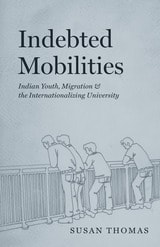
Indebted Mobilities
Indian Youth, Migration, and the Internationalizing UniversitySusan Thomas
University of Chicago Press, 2024
As states have reduced funding to public universities, many of those institutions have turned to overseas students as a vital, alternative source of revenue. Students from India have especially been seen as among the most desirable populations, as they’re typically fluent in English and overwhelmingly enroll in professional fields deemed critical to the knowledge economy. The large numbers of these youth migrating for their education tend to be viewed as a shining example of the value of the contemporary global university and how it enables ambitious people to secure opportunities not available to them in their home nation.
However, a deeper examination of these young people’s encounters reveals a more complicated story than glossy brochures and paeans to American higher education would suggest. Indebted Mobilities draws on Susan Thomas’s close shadowing of a group of middle-class Indian migrant men who attended a public university in New York just as the institution sought to “internationalize” its campus in the wake of ongoing withdrawal of state funding. Thomas takes the reader along with the young men as they study, work, and socialize, pursuing the successful futures they believed to be promised when they migrated for an American education. All the while, they must face their marginalization as they become enmeshed in the fraught inclusion politics of contemporary university life in the United States. At the heart of these encounters is these students’ relationship to debt—not just material ones that include student loans, but moral and affective debts as well. This indebtedness, which keeps them tied to both India and the United States, is meaningful to how Indian middle-class men make sense of their experiences as student-migrants. These youth long to be modern “men of the world.” Yet Thomas illuminates how the complex realities that arise for them, informed by the logic of US exceptionalism, force a reckoning with their anxieties about successful masculinities and the precarity of being drawn into the global knowledge economy as indebted migrants.

Indigenous Motherhood in the Academy
Robin Zape-tah-hol-ah Minthorn
Rutgers University Press, 2022
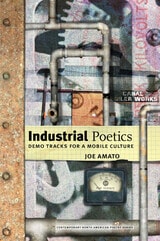
Industrial Poetics
Demo Tracks for a Mobile CultureJoe Amato
University of Iowa Press, 2006
Through a dizzying array of references to subjects ranging from engineering to poetry, on-the-job experiences in academia and industry, conflicts between working-class and intellectual labor, the privatization of universities, and the contradictions of the modern environment, Joe Amato’s Industrial Poetics mounts a boisterous call for poetry communities to be less invested in artistic self-absorption and more concerned about social responsibility.
As Amato focuses on the challenges faced by American poets in creating a poetry that speaks to a public engineered into complacency by those industrial technologies, practices, and patterns of thought that we cannot seem to do without, he brings readers face to face with the conflicting realities of U.S. intellectual, academic, and poetic culture.
Formally adventurous and rhetorically lively, Industrial Poetics is best compared with the intellectually exploratory, speculative, risky, polemical work of other contemporary poet-critics including Kathleen Fraser, Joan Retallack, Bruce Andrews, Susan Howe, and Allen Grossman. Amato uses an exhilarating range of structural and rhetorical strategies: conventionally developed argument, abruptly juxtaposed aphorisms, personal narrative, manifesto-like polemic, and documentary reportage. With a critic’s sharply analytical mind, a poet’s verve, and a working-class intellectual’s sense of social justice, Amato addresses the many nonliterary institutions and environments in which poetry is inextricably embedded.
By connecting poetry to industry in a lively demonstration against the platitudes and habitudes of the twentieth century, Amato argues for a reenergized and socially forceful poetics—an industrial poetics, rough edges and all. Jed Rasula writes, “I can't say I pay much attention to talk radio, but this is what I imagine it might be like if the deejay were really smart, enviably well read, yet somehow retained the snarling moxie of the AM format.”
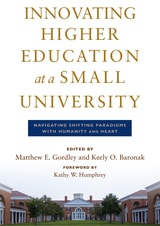
Innovating Higher Education at a Small University
Navigating Shifting Paradigms with Humanity and HeartMatthew E. Gordley
Rutgers University Press, 2027
Higher education is at a moment of real uncertainty. Colleges and universities are being asked to respond to changing student needs, financial pressure, and growing questions about value and purpose. Innovating Higher Education at a Small University offers a grounded and hopeful response to these challenges. Through a series of real, lived case studies, the book shows how one small, mission driven institution is rethinking how it teaches, partners, and serves its community. Spanning interdisciplinary work across teacher preparation, literacy, healthcare, and the arts, the chapters highlight what becomes possible when faculty and leaders are trusted to innovate with intention and care. Each chapter shares not only what was built, but also what was learned along the way, offering clear insights that others can adapt to their own contexts. Not a book about abstract trends or emerging technologies, it is grounded in program design, relationships, and project implementation. It is a book about people doing the work, and a reminder that meaningful change in higher education is already happening in places willing to lead with both humanity and purpose.
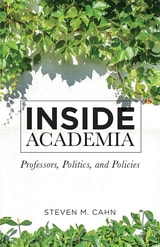
Inside Academia
Professors, Politics, and PoliciesCahn, Steven M
Rutgers University Press, 2019
Inside Academia uses real cases to illustrate how faculty members, deans, and provosts often do not serve the best interests of schools or students. Yet the book also highlights efforts of those who have committed themselves and their institutions to the pursuit of academic excellence.
Inside the Teaching Machine
Rhetoric and the Globalization of the U.S. Public Research UniversityCatherine Chaput
University of Alabama Press, 2008
An incisive critique of the corporatized university, tracing the entanglement of academic missions with economic, political, and cultural systems.
Advocates of higher education have long contended that universities should operate above the crude material negotiations of economics and politics. Such arguments, ignore the historical reality that the American university system emerged through, and in service to, a capitalist political economy that unevenly combines corporate, state, and civil interests.
As the corporatization of U.S. universities becomes nearly impossible to deny, the common response from many academics has been a superior stand against the contamination of the professional ideal by tainted corporate interests. Inside the Teaching Machine proposes a correction to this view through the lens of historical materialism.
Chaput argues that the U.S. public research university has always been a vital component of the capitalist political economy. While conventional narratives of public higher education emphasize civic preparation and upward mobility, Chaput demonstrates that supposedly egalitarian policies like the Morrill Land-Grant Act and the G.I. Bill served the changing interests of capitalism much as education, creating a professional class that supports the capitalist political economy. Chaput also focuses on the relationship between American universities and globalization, showing how the trend toward professionalization contributes to the production of surplus value, and the ways that the American university model circulates outside the United States. Chaput concludes by advocating rhetorical strategies for the professional who opposes the capitalist logic of the global university system, proposing concrete options for engaging and redirecting globalization within the university system.

Insiders, Outliers
Centering Adult Student Writers at an HBCUCollie Fulford
Rutgers University Press, 2025
Winner of the 2026 Outstanding Book Award in the Monograph category from the Conference on College Composition and Communication
Insiders, Outliers invites readers into the lives of adult HBCU students for whom college is one meaningful activity among many. Although adults over the age of twenty-four comprise a quarter of all undergraduates, they are institutionally segregated and only partially served by a US higher education system that remains organized around traditional-aged learners. Even as such students are regarded as a market for postsecondary institutions, they are routinely marginalized by institutional barriers. Students’ stories of their personal, professional, community, and academic writing experiences illuminate a critical need for more age-inclusive practices across academia. Their cases also offer new conceptual models of writing as an ethical and emotional practice that fuels changes for individuals and the people and institutions that they care about—including higher education. What adult students reveal about writing across their life domains has powerful implications for conceptualizing writing as a complex form of agency and for teaching writing across the curriculum.
Institutional Literacies
Engaging Academic IT Contexts for Writing and CommunicationStuart A. Selber
University of Chicago Press, 2020
Institutional Literacies argues that writing and communication teachers and program directors should collaborate more closely and engage more deeply with IT staff as technology projects are planned, implemented, and expanded. Teachers need to both analyze how their institutions approach information technologies and intervene in productive ways as active university citizens with relevant expertise. To help them do so, the book offers a three-part heuristic, reflecting the reality that academic IT units are complex and multilayered, with historical, spatial, and textual dimensions. It discusses six ways teachers can intervene in the academic IT work of their own institutions: maintaining awareness, using systems and services, mediating for audiences, participating as user advocates, working as designers, and partnering as researchers. With these strategies in hand, educators can be proactive in helping institutional IT approaches align with the professional values and practices of writing and communication programs.
Integrations
The Struggle for Racial Equality and Civic Renewal in Public EducationLawrence Blum and Zoë Burkholder
University of Chicago Press, 2021
Integrations focuses on multiple marginalized groups in American schooling: African Americans, Native Americans, Latinxs, and Asian Americans. The authors show that in order to grapple with integration in a meaningful way, we must think of integration in the plural, both in its multiple histories and in the many possible definitions of and courses of action for integration. Ultimately, the authors show, integration cannot guarantee educational equality and justice, but it is an essential component of civic education that prepares students for life in our multiracial democracy.
Intellectual Property on Campus
Students' Rights and ResponsibilitiesTyAnna K. Herrington
Southern Illinois University Press, 2010
What issues arise when students’ uses of intellectual materials are legally challenged, and how does the academic context affect them? What happens when users of intellectual property, either within or outside the academic structure, violate students’ rights to their intellectual products? In Intellectual Property on Campus, TyAnna K. Herrington addresses these concerns and more, clearing up the confusion often surrounding intellectual property law and its application in an academic setting. Filled with practical information and simple yet thorough explanations, this enlightening volume provides educators and students with a solid basis for understanding the broader impacts of legal and ethical dilemmas involving intellectual materials.
Herrington provides insight for students into how complex concepts such as patent, trademark, copyright, fair use, and plagiarism affect their work. She outlines the potential effects of the choices students make, as well as the benefits and limitations of legal protection for intellectual property, including the thorny issues of authorship and authority under the 1976 Copyright Act. Herrington also explores the topic of student collaboration—now very common on college campuses—and how it affects intellectual property issues and legal relationships, as well as the impact of new technologies, such as blogs, on student work in educational environments.
Intellectual Property on Campus also provides useful information for administrators and educators. In particular, Herrington investigates the possible ramifications of their pedagogical and policy choices, and examines in depth the responsibility of instructors to treat students’ intellectual property legally, ethically, and conscientiously. Cautioning educators about the limitations on their control over intellectual materials in an academic setting, Herrington encourages teachers to minimize their influence over student works, instead giving pupils more freedom to control their own creations.
The volume also investigates the rights, responsibilities, and limitations for users of intellectual property, as opposed to creators, especially as related to student or instructor use of copyrighted materials. Discussed in detail are such issues as fair use and the TEACH Act, as well as the often-intertwined areas of plagiarism, authorship, and copyright. In addition, Herrington addresses recent cultural developments regarding the use and creation of intellectual property by students and instructors.
Written in a jargon-free style that is easy to understand, Intellectual Property on Campus gives students, instructors, and administrators the information they need to navigate the intricate landscape of law and integrity in the realm of academic creation.
Intentional Tech
Principles to Guide the Use of Educational Technology in College TeachingDerek Bruff
West Virginia University Press, 2019
Chalkboards and projectors are familiar tools for most college faculty, but when new technologies become available, instructors aren’t always sure how to integrate them into their teaching in meaningful ways. For faculty interested in supporting student learning, determining what’s possible and what’s useful can be challenging in the changing landscape of technology.
Arguing that teaching and learning goals should drive instructors’ technology use, not the other way around, Intentional Tech explores seven research-based principles for matching technology to pedagogy. Through stories of instructors who creatively and effectively use educational technology, author Derek Bruff approaches technology not by asking “How to?” but by posing a more fundamental question: “Why?”

Intercollegiate Athletics and the American University
A University President's PerspectiveJames J. Duderstadt
University of Michigan Press, 2003
Interdisciplining Digital Humanities
Boundary Work in an Emerging FieldJulie Thompson Klein
University of Michigan Press, 2015
Intermediate Horizons
Book History and Digital HumanitiesEdited by Mark Vareschi and Heather Wacha
University of Wisconsin Press, 2024
Integrating intermedial practices and assessments, the editors and contributors explore issues surrounding the access to and materiality of digitized materials, and the challenge of balancing preservation of traditional archival materials with access. They offer an assessment in our present moment of the early visions of book history and DH projects. In revisiting these projects, they ask us to shift our thinking on the promises and perils of archival and creative work in different media. Taken together, this volume reconsiders the historical intersections of book history and DH and charts a path for future scholarship across disciplinary boundaries.
International and Language Education for a Global Future
Fifty Years of U.S. Title VI and Fulbright-Hays ProgramsDavid S. Wiley
Michigan State University Press, 2010
The contributions to this book address the role that the U.S. Department of Education Title VI and Fulbright-Hays programs have played in building the largest and highest quality infrastructure in the world for training in languages and other aspects of foreign area knowledge. The volume celebrates the 50th anniversary of the Title VI and associated Fulbright-Hays programs, which have established more than 150 centers of excellence for modern foreign language and area studies and international business education in more than 60 U.S. universities.
The authors review the history of the programs, including their founding and their cumulative impacts on internationalizing the American university at the graduate and undergraduate levels. They review how programs for foreign research, technology for foreign information access, and undergraduate programs have built the foundations of U.S. language-learning materials for use in college courses and government with improved language-learning pedagogies, erected the most distinguished library holdings on foreign countries, supported in-depth research abroad in virtually every nation, and created capacity to teach more than 200 less commonly taught languages.
Intersectionality and Higher Education
Identity and Inequality on College CampusesW. Carson Byrd
Rutgers University Press, 2019
Investigating Interdisciplinary Collaboration
Theory and Practice across DisciplinesFrickel, Scott
Rutgers University Press, 2016
Chapter 10 is available Open Access here (https://www.ncbi.nlm.nih.gov/books/NBK395883)
Investing Wisely
Informed Approaches to Designing and Implementing Allocation Systems for Graduate AssistantshipsRoger B. Sidje, Joan M. Barth, Ellary A. Draper, Matthew J. Jenny, Daniel L. Riches, and Dean M. Townsley
University of Alabama Press, 2026
Investing in Graduate Education Through Data, Equity, and Purpose.
Investing Wisely: Informed Approaches to Designing and Implementing Allocation Systems for Graduate Assistantships tackles one of the most consequential and least understood challenges in higher education: how universities can distribute graduate assistantships fairly, strategically, and transparently. Drawing on a multiyear effort at the University of Alabama, the authors introduce DIASGA™ (Designing and Implementing Allocation Systems for Graduate Assistantships), a practical framework for aligning graduate funding with institutional priorities, departmental needs, and student success. Through real-world experience, the book demonstrates how institutions can move beyond inherited funding patterns and build adaptive systems capable of responding to changing academic realities.
The book proposes a distinctive blend of rigorous analysis and practical guidance. The authors reveal the hidden complexities behind graduate funding decisions, challenging simplistic allocation formulas based on enrollment or credit-hour production. Instead, they advocate a data-informed, collaborative process grounded in departmental expertise, institutional values, and continuous assessment. Featuring case studies, implementation strategies, funding models, committee structures, and lessons learned from both successes and setbacks, Investing Wisely offers an unusually candid account of organizational change and resource allocation in higher education.
This book will be invaluable to provosts, deans, graduate school leaders, department chairs, faculty administrators, and higher education policymakers. It will also appeal to scholars of university governance, institutional effectiveness, and academic planning who seek practical approaches to balancing equity, accountability, and strategic investment. Whether your institution is reconsidering graduate funding practices or simply striving to make better-informed decisions, Investing Wisely provides a thoughtful roadmap for investing in graduate education with clarity, fairness, and purpose.
This book is freely available in open access format thanks to TOME (Toward an Open Monograph Ecosystem) - a collaboration of the Association of American Universities, the Association of University Presses, and the Association of Research Libraries - and the generous support of Virginia Tech. This Open Access publication can be accessed by visiting the University of Alabama Libraries Repository at https://ir.ua.edu/handle/123456789/18409.

Invisible Hawkeyes
African Americans at the University of Iowa during the Long Civil Rights EraLena M. Hill and Michael D. Hill
University of Iowa Press, 2016
By examining the quieter collisions between Iowa’s polite midwestern progressivism and African American students’ determined ambition, Invisible Hawkeyes focuses attention on both local stories and their national implications. By looking at the University of Iowa and a smaller midwestern college town like Iowa City, this collection reveals how fraught moments of interracial collaboration, meritocratic advancement, and institutional insensitivity deepen our understanding of America’s painful conversion into a diverse republic committed to racial equality.
SUBJECTS COVERED
Edison Holmes Anderson, George Overall Caldwell, Elizabeth Catlett, Fanny Ellison, Oscar Anderson Fuller, Michael Harper, James Alan McPherson, Herbert Franklin Mells, Herbert Nipson, Thomas Pawley, William Oscar Smith, Mitchell Southall, Margaret Walker
CONTRIBUTORS
Dora Martin Berry, Richard M. Breaux, Kathleen A. Edwards, Lois Eichaker, Brian Hallstoos, Lena M. Hill, Michael D. Hill, Dianna Penny, Donald W. Tucker, Ted Wheeler

Is a Single Teachable Indian Past Possible Today?
Janaki Nair
Seagull Books, 2024
More than ever before, the school history textbook in India has become an embattled object and the subject of many contestations from both above and below. It is vulnerable not only to the political vagaries of governments but also to the exclusive claims of myriad communities and groups to their sense of the past. What is the future of India’s textbook, arguably the most important repository of the country’s national past? Is a single teachable past even possible any longer?
In this essay, Janaki Nair uses the Indian predicament to discuss the possibility of building up a “historical temper” in the Indian classroom. Sharing examples from her unique position as a professional historian with sustained experience in the field of pedagogy, Nair invites reflections on the prospect of cultivating a historical temper that can help the teacher equip students to grapple with history.
Ivy and Industry
Business and the Making of the American University, 1880-1980Christopher Newfield
Duke University Press, 2003
Newfield views management as neither inherently good nor bad, but rather as a challenge to and tool for negotiating modern life. In Ivy and Industry he integrates business and managerial philosophies from Taylorism through Tom Peters’s “culture of excellence” with the speeches and writings of leading university administrators and federal and state education and science policies. He discusses the financial dependence on industry and government that was established in the university’s early years and the equal influence of liberal arts traditions on faculty and administrators. He describes the arrival of a managerial ethos on campus well before World War II, showing how managerial strategies shaped even fields seemingly isolated from commerce, like literary studies. Demonstrating that business and the humanities have each had a far stronger impact on higher education in the United States than is commonly thought, Ivy and Industry is the dramatic story of how universities have approached their dual mission of expanding the mind of the individual while stimulating economic growth.