Results by title
111 books match the query 'Science Fiction' and 3 start with i
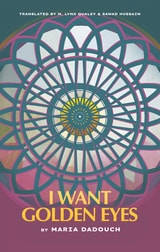
I Want Golden Eyes
Maria Dadouch; translated by M. Lynx Qualey and Sawad Hussain
University of Texas Press, 2025
A girl must save herself and her family after discovering her society's secrets in this sci-fi novel in translation.
I Want Golden Eyes is set on the Comoros Islands at the end of this century in a futuristic city called Quartzia, the home of a genetically privileged minority called the Golden Eyes. The rest of the population, the Limiteds, live in a cavity called the Hive beneath the city. Dalia is a sixteen-year-old girl who lives in the Hive but works with her family in Quartzia at Professor Adam’s house, where she cleans, her sister grows organic food in the garden, and her deaf father works as the cook.
Because books are forbidden in the Hive, Dalia secretly borrows math texts from the professor’s library and smuggles them to read in the Hive. When Professor Adam, who is famous for engineering embryos with enhanced genes, discovers Dalia’s crime, he enslaves her for two years in his library. Dalia seeks to flee the city with her family after overhearing the professor being ordered to design genetic traits for the president’s expected baby and realizes that Golden Eyes are not privileged by nature’s selection, as she was led to believe, but by authority and money.
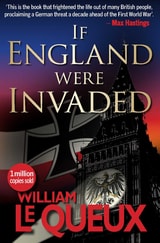
If England Were Invaded
William Le Queux
Bodleian Library Publishing, 2014
Eight years before the onset of World War I, as national hysteria over the possibility of German spies in England reached its peak, journalist and prolific spy novelist William Le Queux penned The Invasion of 1910. Although it has since faded from public memory, at the time of its serialization, the novel was a tremendous success, selling more than one million copies and even inspiring an unauthorized, abridged German-language edition that altered the book’s ending.
If England Were Invaded restores this major work of “invasion literature” to print. Le Queux constructs a catastrophic scenario in which the German army has invaded England in a surprise attack on the coast. The story chillingly chronicles a war fought on the British homeland, with detailed accounts of battles involving real locations and real defense experts of the time. Throughout, Le Queux brings to life the domestic realities of a nation at war, from food shortages and failing financial institutions to the ever-present threat of espionage. One by one, strategic cities and counties in the novel—Birmingham, Manchester, and Suffolk—are abandoned to the German army until it stands poised to “advance upon and crush the complex city which is the pride and home of every Englishman—London.”
A truly entertaining read—complete with campaign maps and fictional proclamations from Kaiser Wilhelm II—If England Were Invaded also offers an incredible cautionary tale about a country that was not prepared for an attack and, in doing so, it shines a light on the common hopes and fears in England at the beginning of the twentieth century.

Intersections
Fantasy and Science FictionEdited by George E. Slusser and Eric S. Rabkin
Southern Illinois University Press, 1987
These 17 essays from the seventh annual J. Lloyd Eaton Conference examine the relationship between fantasy and science fiction.
They propose that fantasy and science fiction are not isolated commercial literary forms, but instead are literary forms worthy of the recognition reserved for traditional literature. Discussion of genre identification ranges from the standard forms of literary criticism embodied in Aristotle’s mimesis and poesis to innovative and possibly controversial points of view such as a theory of humor, a philosophy of time, and a detailed analysis of Dr. Seuss’s Cat in the Hat.
The essays provide not only a detailed study of literary elements but also the historical treatment of the material, its commercial use, and its relationship to similar literary forms such as the gothic tale and horror fiction. While few of the essayists agree with one another, they all contribute creative insights to the debate.