Results by title
151 books match the query 'Sign Language' and 13 start with i

In Silence
Growing Up Hearing in a Deaf WorldRuth Sidransky
Gallaudet University Press, 2006
Inside her family’s apartment, Sidransky knew a warm, secure place. She recalls her earliest memories of seeing words fall from her parents’ hands. She remembers her father entertaining the family endlessly with his stories, and her mother’s story of tying a red ribbon to herself and her infant daughter to know when she needed anything in the night.
Outside the apartment, the cacophonous hearing world greeted Sidransky’s family with stark stares of curiosity as though they were “freaks.” Always upbeat, her proud father still found it hard to earn a living. When Sidransky started school, she was placed in a class for special needs children until the principal realized that she could hear and speak.
Sidransky portrays her family with deep affection and honesty, and her frank account provides a living narrative of the Deaf experience in pre- and post-World War II America. In Silence has become an invaluable chronicle of a special time and place that will affect all who read it for years to come.
Indian Sign Language
A Linguistic Analysis of Its GrammarSamar Sinha
Gallaudet University Press, 2017
Samar Sinha presents pioneering research into the grammatical properties of Indian Sign Language (ISL), a language used by members of the Deaf community in India. This detailed and well-illustrated study describes the grammar of ISL and is supplemented by comparative and theoretical analyses in the core areas of sublexical structure, morphology, and syntax. Sinha offers a field-based, comprehensive analysis that covers topics such as
o sign formation parameters
o syllable structure
o sonority hierarchy
o semantics of space
o pluralization strategies
o phi-features
o indexing and localization
o agreement
o word order
He provides a description of the Indian Deaf community that serves to frame his analysis of ISL and highlights the need for greater awareness and acknowledgment of the language and its users. The lack of research on ISL in Indian academia has slowed efforts toward the standardization of ISL and the development of pedagogical materials. This work adds to the growing understanding of natural human language in general and ISL in particular. It also contributes to the empowerment of the Deaf community in India and will strengthen the efforts carried out by d/Deaf activists and researchers.
Innovative Practices for Teaching Sign Language Interpreters
Cynthia B. Roy
Gallaudet University Press, 2000
Researchers now understand interpreting as an active process between two languages and cultures, with social interaction, sociolinguistics, and discourse analysis as more appropriate theoretical frameworks. Roy’s penetrating new book acts upon these new insights by presenting six dynamic teaching practices to help interpreters achieve the highest level of skill.
Jeffrey Davis illustrates the translation skills that form the basis for teaching consecutive and simultaneous interpreting to help students understand the intended meaning of the source message, and also the manner in which listeners understand it. Rico Peterson demonstrates the use of recall protocols, which can be used to teach metacognitive skills and to assess the student’s sign language comprehension. Finally, Janice Humphrey details the use of graduation portfolios, a valuable assessment tool used by faculty to determine a student’s level of competency. These imaginative techniques in Innovative Practices promise gains in sign language interpreting that will benefit teachers, students, and clients alike in the very near future.
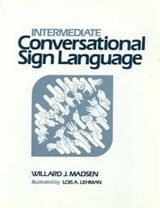
Intermediate Conversational Sign Language
Willard J Madsen
Gallaudet University Press, 1982
This fully illustrated text offers a unique approach to using American Sign Language (ASL) and English in a bilingual setting. Each of the 25 lessons involve sign language conversation using colloquialisms that are prevalent in informal conversations. Each lesson includes equivalent expressions in English, plus:
- Glossed Vocabulary Review
- Translation Exercises from ASL to English to ASL
- Grammatical Notes
- Substitution Drills
- Suggested Activities
The text also includes practice tests, a bibliography, and a glossed alphabetical index.
International Perspectives on Sign Language Interpreter Education
Jemina Napier
Gallaudet University Press, 2009
The Fourth Volume in the Interpreter Education Series
From the moment the World Association of Sign Language Interpreters (WASLI) was established in 2005, an overwhelming wave of requests from around the world arrived seeking information and resources for educating and training interpreters. This new collection provides those answers with an international overview on interpreter training from experts in Austria, Australia, Brazil, Canada, Fiji, Finland, Ireland, Japan, Kenya, Kosovo, the Netherlands, New Zealand, Scotland, Sweden, and the United States. Whether from income-rich or income-poor countries, the 31 contributors presented here provide insights on how sign language interpreter training has developed in each nation, and also how trainers have dealt with the difficulties that they encountered.
Many of the contributors relate the movement away from ad hoc short courses sponsored by Deaf communities. They mark the transition from the early struggles of trainers against the stigmatization of sign languages to full-time degree programs in institutions of higher education funded by their governments. Others investigate how culture, religion, politics, and legislation affect the nurturing of professional sign language interpreters, and they address the challenges of extending training opportunities nationally through the use of new technology. Together, these diverse perspectives offer a deeper understanding and comparison of interpreter training issues that could benefit the programs in every nation.
International Perspectives on Sign Language Translator and Interpreter Education
Jemina Napier
Gallaudet University Press, 2024
Each chapter, authored collaboratively by deaf and hearing educators, surveys general interpreter education and training, examines the status of the profession for both deaf and hearing practitioners, and addresses specific challenges faced within the different national frameworks. Contributors also discuss ongoing and future trends, including the impact of the Covid-19 pandemic on educational practices.
This volume disseminates extensive knowledge on sign language translator and interpreter education, covering established programs as well as ad hoc training, and highlighting effective teaching pedagogies and structured classroom strategies. Contributors emphasize a holistic approach to the field, integrating SLTI education, the current profession, future practitioners, and deaf communities. Although the state of the field varies widely around the world depending on the national context, this volume reveals a shared goal of advancing professional standards and improving the provision of service to deaf people worldwide.
International Sign
Linguistic, Usage, and Status IssuesRachel Rosenstock
Gallaudet University Press, 2015
Editors Rachel Rosenstock and Jemina Napier have assembled an international group of renowned linguists and interpreters to examine various aspects of International Sign. Their contributions are divided into three parts: International Sign as a Linguistic System; International Sign in Action—Interpreting, Translation, and Teaching; and International Sign Policy and Language Planning. The chapters cover a range of topics, including the morphosyntactic and discursive structures of interpreted IS, the interplay between conventional linguistic elements and nonconventional gestural elements in IS discourse, how deaf signers who use different signed languages establish communication, Deaf/hearing IS interpreting teams and how they sign depicting verbs, how best to teach foundation-level IS skills, strategies used by IS interpreters when interpreting from IS into English, and explorations of the best ways to prepare interpreters for international events.
The work of the editors and contributors in this volume makes International Sign the most comprehensive, research-based analysis of a young but growing field in linguistics and interpretation.
Interpreter Education in the Digital Age
Innovation, Access, and ChangeSuzanne Ehrlich
Gallaudet University Press, 2015
Initiatives described in this collection range from the implementation of on-demand interpreting using iPad technology to create personalized, small-group, multidimensional models suited to digital media for 160 languages; introducing students to interpreting in a 3D world through an IVY virtual environment; applying gaming principles to interpreter education; assessing the amenability of the digital pen in the hybrid mode of interpreting; developing multimedia content for both open access and structured interpreter education environments; to preparing interpreting students for interactions in social media forums, and more. Interpreter Education in the Digital Age provides a context for the application of technologies in interpreter education from an international viewpoint across languages and modalities.
Interpreting in Legal Settings
Debra Russell
Gallaudet University Press, 2009
The work of interpreters in legal settings, whether they are spoken or signed language interpreters, is filled with enormous complexity and challenges. This engrossing volume presents six, data-based studies from both signed and spoken language interpreter researchers on a diverse range of topics, theoretical underpinnings, and research methodologies.
In the first chapter, Ruth Morris analyzes the 1987 trial of Ivan (John) Demjanjuk in Jerusalem, and reveals that what might appear to be ethical breaches often were no more than courtroom dynamics, such as noise and overlapping conversation. Waltraud Kolb and Franz Pöchhacker studied 14 asylum appeals in Austria and found that interpreters frequently aligned themselves with the adjudicators. Bente Jacobsen presents a case study of a Danish-English interpreter whose discourse practices expose her attempts to maintain, mitigate, or enhance face among the participants.
In the fourth chapter, Jemina Napier and David Spencer investigate the effectiveness of interpreting in an Australian courtroom to determine if deaf citizens should participate as jurors. Debra Russell analyzed the effectiveness of preparing sign language interpreter teams for trials in Canada and found mixed results. The final chapter presents Zubaidah Ibrahim-Bell’s research on the inadequate legal services in Malaysia due to the fact that only seven sign interpreters are available. Taken together, these studies point to a “coming of age” of the field of legal interpreting as a research discipline, making Interpreting in Legal Settings an invaluable, one-of-a-kind acquisition.
Interpreting in Multilingual, Multicultural Contexts
Rachel Locker McKee
Gallaudet University Press, 2010
The Seventh Volume in the Studies in Interpretation Series
Nineteen international authorities contribute their research and findings to Interpreting in Multilingual, Multicultural Contexts, probing the complex nature of interpreted interaction involving Deaf and hearing people of diverse linguistic and cultural backgrounds. They also analyze the contextualized interpreting practices and considerations that transpire from this diversity.
In three parts, this trenchant collection shows how Deaf and hearing people use language in fluctuating ways to connect with each other. The chapters in Part 1 — Expanding Frontiers: ASL-English-Spanish Interpreting in the United States — consider sign language interpreting at the border between Baja California and the state; trilingual video relay service (VRS) interpreting; and constructing a valid, reliable trilingual interpreting testing instrument. Part 2 — Mediating Indigenous Voices — explores how to construct roles in a Maori Deaf trilingual context; considerations for interpreting signed languages of American Indian Communities; and interpreting for indigenous Deaf clients in far north Queensland, Australia.
In the final section, Part 3 — Globalizing: Interpreting in International Contexts — protocols for interpreting in multilingual international conferences are analyzed. The last chapter describes the arduousness of sign language interpreting in multilingual, international settings. It acts as a fitting conclusion to this examination of the challenges to the sociolinguistic repertoire of interpreters mediating across multiplex combinations of culture and language.
Interpreting in the Zone
How the Conscious and Unconscious Function in InterpretationJack Hoza
Gallaudet University Press, 2016
Jack Hoza’s newest research examines the components that enable interpreters to perform successfully, looking at literature in interpretation, cognitive science, education, psychology, and neuroscience, as well as reviewing the results of two qualitative studies he conducted. He seeks to uncover what it means to interpret in the zone by understanding exactly how the brain works in interpretation scenarios. He explores a range of dichotomies that influence interpretation outcomes, such as:
- Intuition vs. rational thought
- Left brain vs. right brain
- Explicit vs. implicit learning
- Novice vs. master
- Spoken vs. signed languages
- Emotion vs. reasoning
Interpreting in the Zone shows that cognitive research can help us better understand the intricacies of the interpreting process and has implications for how to approach the interpreting task. This resource will be of value to both the interpreter-in-training as well as the seasoned practitioner.
Investigations in Healthcare Interpreting
Brenda Nicodemus
Gallaudet University Press, 2014
Investigations in Healthcare Interpreting consists of ten chapters contributed by a broad array of international scholars. They address topics as diverse as the co-construction of medical conversation between interlocutors, healthcare interpretation in Ireland, and how interpreters make requests for clarification in their work. Using a variety of methodological approaches including ethnography, questionnaires, observation, and diary accounts, these scholars report on trials of simultaneous video interpreting in Austrian hospitals; direct, interpreted, and translated healthcare information for Australian deaf people; the interpretation of medical interview questions from English into ASL; and specialized psychological/psychiatric diagnostic tests for deaf and hard of hearing clients. Researchers, practitioners, and students, as well as all healthcare professionals, will find this volume to be an invaluable resource.

It’s Not What You Sign, It’s How You Sign It
Politeness in American Sign LanguageJack Hoza
Gallaudet University Press, 2007
The general stereotype regarding interaction between American Sign Language and English is a model of oversimplification: ASL signers are direct and English speakers are indirect. Jack Hoza’s study It’s Not What You Sign, It’s How You Sign It: Politeness in American Sign Language upends this common impression through an in-depth comparison of the communication styles between these two language communities. Hoza investigates relevant social variables in specific contexts and explores the particular linguistic strategies ASL signers and English speakers employ when they interact in these contexts.
It’s Not What You Sign, It’s How You Sign It is framed within politeness theory, an apt model to determine various interpretations of what speakers or signers mean in respect to the form of that which they say or sign. The variations reveal how linguistic and cultural differences intersect in ways that are often misinterpreted or overlooked in cross-cultural communication. To clarify these cross-linguistic differences, this volume explores two primary types of politeness and the linguistic strategies used by English speakers and ASL signers to express politeness concerns in face-to-face interaction. Hoza’s final analysis leads to a better understanding of the rich complexity of the linguistic choices of these language groups.