Results by title
279 books match the query 'Slavery' and 6 start with i
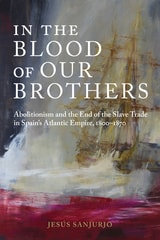
In the Blood of Our Brothers
Abolitionism and the End of the Slave Trade in Spain's Atlantic Empire, 1800–1870Jesús Sanjurjo
University of Alabama Press, 2021
FINALIST FOR THE PAUL E. LOVEJOY BOOK PRIZE
Unraveling the complex politics behind the end of the slave trade in Spain's Atlantic Empire.
Throughout the nineteenth century, very few people in Spain campaigned to stop the slave trade and did even less to abolish slavery. Even when some supported abolition, the reasons that moved them were not always humanitarian, liberal, or egalitarian. How abolitionist ideas were received, shaped, and transformed during this period has been ripe for study. Jesús Sanjurjo’s In the Blood of Our Brothers: Abolitionism and the End of the Slave Trade in Spain’s Atlantic Empire, 1800–1870 provides a comprehensive theory of the history, the politics, and the economics of the persistence and growth of the slave trade in the Spanish empire even as other countries moved toward abolition.
Sanjurjo privileges the central role that British activists and diplomats played in advancing the abolitionist cause in Spain. In so doing, he brings to attention the complex and uneven development of abolitionist and antiabolitionist discourses in Spain’s public life, from the beginning of the nineteenth century to the end of the transatlantic trade. His delineation of the ideological and political tension between Spanish liberalism and imperialism is crucial to formulating a fuller explanation of the reasons for the failure of anti–slave trade initiatives from 1811 to the 1860s. Slave trade was tied to the notion of inviolable property rights, and slavery persisted and peaked following three successful liberal revolutions in Spain.
Visit https://inthebloodofourbrothers.com/ for more information.
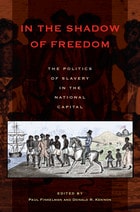
In the Shadow of Freedom
The Politics of Slavery in the National CapitalPaul Finkelman
Ohio University Press, 2011
Few images of early America were more striking, and jarring, than that of slaves in the capital city of the world’s most important free republic. Black slaves served and sustained the legislators, bureaucrats, jurists, cabinet officials, military leaders, and even the presidents who lived and worked there. While slaves quietly kept the nation’s capital running smoothly, lawmakers debated the place of slavery in the nation, the status of slavery in the territories newly acquired from Mexico, and even the legality of the slave trade in itself.
This volume, with essays by some of the most distinguished historians in the nation, explores the twin issues of how slavery made life possible in the District of Columbia and how lawmakers in the district regulated slavery in the nation.
Contributors: David Brion Davis, Mary Beth Corrigan, A. Glenn Crothers, Jonathan Earle, Stanley Harrold, Mitch Kachun, Mary K. Ricks, James B. Stewart, Susan Zaeske, David Zarefsky
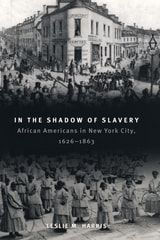
In the Shadow of Slavery
African Americans in New York City, 1626-1863Leslie M. Harris
University of Chicago Press, 2003
In 1991 in lower Manhattan, a team of construction workers made an astonishing discovery. Just two blocks from City Hall, under twenty feet of asphalt, concrete, and rubble, lay the remains of an eighteenth-century "Negro Burial Ground." Closed in 1790 and covered over by roads and buildings throughout the nineteenth and twentieth centuries, the site turned out to be the largest such find in North America, containing the remains of as many as 20,000 African Americans. The graves revealed to New Yorkers and the nation an aspect of American history long hidden: the vast number of enslaved blacks who labored to create our nation's largest city.
In the Shadow of Slavery lays bare this history of African Americans in New York City, starting with the arrival of the first slaves in 1626, moving through the turbulent years before emancipation in 1827, and culminating in one of the most terrifying displays of racism in U.S. history, the New York City Draft Riots of 1863. Drawing on extensive travel accounts, autobiographies, newspapers, literature, and organizational records, Leslie M. Harris extends beyond prior studies of racial discrimination by tracing the undeniable impact of African Americans on class, politics, and community formation and by offering vivid portraits of the lives and aspirations of countless black New Yorkers.
Written with clarity and grace, In the Shadow of Slavery is an ambitious new work that will prove indispensable to historians of the African American experience, as well as anyone interested in the history of New York City.
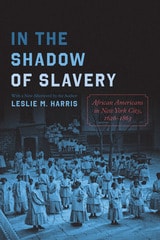
In the Shadow of Slavery
African Americans in New York City, 1626-1863Leslie M. Harris
University of Chicago Press, 2024
The popular understanding of the history of slavery in America almost entirely ignores the institution’s extensive reach in the North. But the cities of the North were built by—and became the home of—tens of thousands of enslaved African Americans, many of whom would continue to live there as free people after Emancipation.
In the Shadow of Slavery reveals the history of African Americans in the nation’s largest metropolis, New York City. Leslie M. Harris draws on travel accounts, autobiographies, newspapers, literature, and organizational records to extend prior studies of racial discrimination. She traces the undeniable impact of African Americans on class distinctions, politics, and community formation by offering vivid portraits of the lives and aspirations of countless black New Yorkers. This new edition includes an afterword by the author addressing subsequent research and the ongoing arguments over how slavery and its legacy should be taught, memorialized, and acknowledged by governments.

In the Wake
On Blackness and BeingChristina Sharpe
Duke University Press, 2016
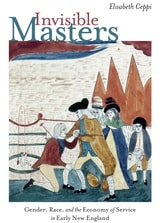
Invisible Masters
Gender, Race, and the Economy of Service in Early New EnglandElisabeth Ceppi
Dartmouth College Press, 2018