247 books match the query 'South Africa' and 9 start with i
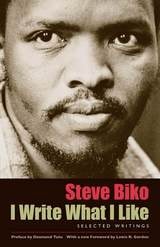
cover of I Write What I Like: Selected Writings

I Write What I Like

Selected Writings

Steve Biko

University of Chicago Press, 2002

"The most potent weapon in the hands of the oppressor is the mind of the oppressed." Like all of Steve Biko's writings, those words testify to the passion, courage, and keen insight that made him one of the most powerful figures in South Africa's struggle against apartheid. They also reflect his conviction that black people in South Africa could not be liberated until they united to break their chains of servitude, a key tenet of the Black Consciousness movement that he helped found.

I Write What I Like contains a selection of Biko's writings from 1969, when he became the president of the South African Students' Organization, to 1972, when he was prohibited from publishing. The collection also includes a preface by Archbishop Desmond Tutu; an introduction by Malusi and Thoko Mpumlwana, who were both involved with Biko in the Black Consciousness movement; a memoir of Biko by Father Aelred Stubbs, his longtime pastor and friend; and a new foreword by Professor Lewis Gordon.

Biko's writings will inspire and educate anyone concerned with issues of racism, postcolonialism, and black nationalism.
[more]
cover of Illegible Will: Coercive Spectacles of Labor in South Africa and the Diaspora

Illegible Will

Coercive Spectacles of Labor in South Africa and the Diaspora

Hershini Bhana Young

Duke University Press, 2017
In Illegible Will Hershini Bhana Young engages with the archive of South African and black diasporic performance to examine the absence of black women's will from that archive. Young argues for that will's illegibility, given the paucity of materials outlining the agency of black historical subjects. Drawing on court documents, novels, photographs, historical records, websites, and descriptions of music and dance, Young shows how black will can be conjured through critical imaginings done in concert with historical research. She critically imagines the will of familiar subjects such as Sarah Baartman and that of obscure figures such as the eighteenth-century slave Tryntjie of Madagascar, who was executed in 1713 for attempting to poison her mistress. She also investigates the presence of will in contemporary expressive culture, such as the Miss Landmine Angola beauty pageant, placing it in the long genealogy of the freak show. In these capacious case studies Young situates South African performance within African diasporic circuits of meaning throughout Africa, North America, and South Asia, demonstrating how performative engagement with archival absence can locate that which was never recorded.
[more]
cover of Imagined Liberation: Xenophobia, Citizenship, and Identity in South Africa, Germany, and Canada

Imagined Liberation

Xenophobia, Citizenship, and Identity in South Africa, Germany, and Canada

Heribert Adam

Temple University Press, 2015

On a spectrum of hostility towards migrants, South Africa ranks at the top, Germany in the middle and Canada at the bottom. South African xenophobic violence by impoverished slum dwellers is directed against fellow Africans. “Foreign” Africans are blamed for a high crime rate and most other maladies of an imagined liberation.

Why would a society that liberated itself in the name of human rights turn against people who escaped human rights violations or unlivable conditions at home? What happened to the expected African solidarity? Why do former victims become victimizers?

With porous borders, South Africa is incapable of upholding the blurred distinction between endangered refugees and economic migrants. Imagined Liberation asks what xenophobic societies can learn from other immigrant societies, such as Canada, that avoided the backlash against multiculturalism in Europe. Heribert Adam and Kogila Moodley stress an innovative teaching of political literacy that makes citizens aware as to why they hate.
[more]
cover of In Township Tonight!: South Africa's Black City Music and Theatre, Second Edition

In Township Tonight!

South Africa's Black City Music and Theatre, Second Edition

David B. Coplan

University of Chicago Press, 2008

David B. Coplan’s pioneering social history of black South Africa’s urban music, dance, and theatre established itself as a classic soon after its publication in 1985. As the first substantial history of black performing arts in South Africa, In Township Tonight! was championed by a broad range of scholars and treasured by fans of South African music. Now completely revised, expanded, and updated, this new edition takes account of developments over the last thirty years while reflecting on the massive changes in South African politics and society since the end of the apartheid era.

In vivid detail, Coplan comprehensively explores more than three centuries of the diverse history of South Africa’s black popular culture, taking readers from indigenous musical traditions into the world of slave orchestras, pennywhistlers, clergyman-composers, the gumboot dances of mineworkers, and touring minstrelsy and vaudeville acts. This up-to-date edition of a landmark work will be welcomed by scholars of ethnomusicology and African studies, world music fans, and anyone concerned with South Africa and its development.
[more]
cover of In Whose Image?: Political Islam and Urban Practices in Sudan

In Whose Image?

Political Islam and Urban Practices in Sudan

T. Abdou Maliqalim Simone

University of Chicago Press, 1994

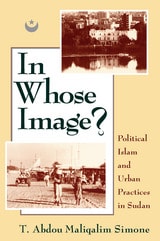
A Muslim scholar with extensive experience in Africa, T. Abdou Maliqalim Simone was recruited by the Islamic fundamentalist Shari‘a Movement in Sudan to act as consultant for its project to unite Muslims and non-Muslims in Khartoum's shanty towns. Based on his interviews with hundreds of individuals during this time, plus extensive historical and archival research, In Whose Image? is a penetrating examination of the use of Islam as a tool for political transformation.

Drawing a detailed portrait of political fundamentalism during the 1985-89 period of democratic rule in the Sudan, Simone shows how the Shari‘a Movement attempted to shape a viable social order by linking religious integrity and economic development, where religious practice was to dominate all aspects of society and individuals' daily lives. However, because Sudanese society is remarkably diverse ethnically and religiously, this often led to conflict, fragmentation, and violence in the name of Islam.

Simone's own Islamic background leads him to deplore the violence and the devastating psychological, economic, and cultural consequences of one form of Islamic radicalism, while holding to hope that a viable form of this inherently political religion can in fact be applied. As a counterpoint, he ends with a discussion of South Africa's Call of Islam, which seeks political unity through a more tolerant interpretation of Islam.

As an introduction to religious discourse in Africa, this book will be widely read by students and scholars throughout African Studies, Religious Studies, Anthropology, and Political Science.

[more]
cover of In the Company of Diamonds: De Beers, Kleinzee, and the Control of a Town

In the Company of Diamonds

De Beers, Kleinzee, and the Control of a Town

Peter Carstens

Ohio University Press, 2001

After the 1925 discovery of diamonds in the semi-desert of the northwest coast of South Africa, De Beers Consolidated Mines Ltd. virtually proclaimed its dominion over the whole region. In the town of Kleinzee, the company owns all the real estate and infrastructure, and controls and administers both the town and the industry.

Peter Carstens’s In the Company of Diamonds draws a stark and startling portrait of this closed community, one that analyzes the power and hegemonic techniques used to acquire that power and maintain it.

As a prototypical company town, Kleinzee is subordinated to the industry and will of the owners. Employees and workers are variously differentiated and ordered according to occupation, ethnic variation, and other social criteria, a pattern reflected most markedly in the allocation of housing. Managers live in large, ranch-style houses, while contract workers are lodged in single-sex compounds.

As a community type, company towns like Kleinzee are not entirely unique, and Professor Carstens successfully draws a number of structural parallels with other closed and incomplete social formations such as Indian reservations, military bases, colleges, prisons, and mental hospitals.
[more]
cover of Incognegro: A Memoir of Exile and Apartheid

Incognegro

A Memoir of Exile and Apartheid

Frank B. Wilderson III

Duke University Press, 2008
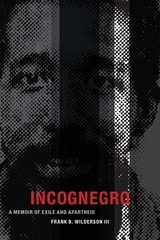
In 1995, a South African journalist informed Frank Wilderson, one of only two American members of the African National Congress (ANC), that President Nelson Mandela considered him "a threat to national security." Wilderson was asked to comment. Incognegro is that "comment." It is also his response to a question posed five years later in a California university classroom: "How come you came back?" Although Wilderson recollects his turbulent life as an expatriate during the furious last gasps of apartheid, Incognegro is at heart a quintessentially American story. During South Africa's transition, Wilderson taught at universities in Johannesburg and Soweto by day. By night, he helped the ANC coordinate clandestine propaganda, launch psychological warfare, and more. In this mesmerizing political memoir, Wilderson's lyrical prose flows from unspeakable dilemmas in the red dust and ruin of South Africa to his return to political battles raging quietly on US campuses and in his intimate life. Readers will find themselves suddenly overtaken by the subtle but resolute force of Wilderson's biting wit, rare vulnerability, and insistence on bearing witness to history no matter the cost.
[more]
cover of Indenture Aesthetics: Afro-Indian Femininities and the Queer Limits of South African Blackness

Indenture Aesthetics

Afro-Indian Femininities and the Queer Limits of South African Blackness

Jordache A. Ellapen

Duke University Press, 2025
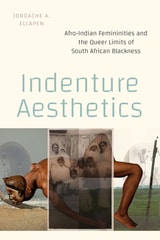
In Indenture Aesthetics, Jordache A. Ellapen examines the visual and performance art practices of feminist, queer, femme, and gender-nonconforming Afro-Indian and South African black artists to understand the paradoxes of freedom in contemporary South Africa. Tracing the afterlife of apartheid-era racial categories and revisiting Bantu Stephen Biko’s Black Consciousness, Ellapen theorizes South African blackness through the Indian Ocean World, showing how the development of an Afro-Indian identity after generations of indentured labor and segregation troubles persistent racial hierarchies. Staging unexpected encounters between artists such as Sharlene Khan, Mohau Modisakeng, Lebohang Kganye, and Reshma Chhiba, he analyzes how their works challenge these racial categories to create new imaginaries of freedom. Situated in a context in which the authentic (hetero)normative black subject of the post-apartheid state is bracketed from other formulations of blackness, these artists' aesthetic practices, alongside those of other artists like Ellapen himself, disrupt desires for national belonging and catalyze alternative and transgressive politics and subjects. By rethinking the relationship between blackness, Afro-Indianness, and Africanness, Ellapen highlights the role of the aesthetic in crafting a blueprint for coalitional building across difference in contemporary South Africa.
[more]
cover of Internal Frontiers: African Nationalism and the Indian Diaspora in Twentieth-Century South Africa

Internal Frontiers

African Nationalism and the Indian Diaspora in Twentieth-Century South Africa

Jon Soske

Ohio University Press, 2017

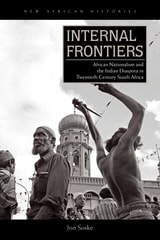
In this ambitious new history of the antiapartheid struggle, Jon Soske places India and the Indian diaspora at the center of the African National Congress’s development of an inclusive philosophy of nationalism. In so doing, Soske combines intellectual, political, religious, urban, and gender history to tell a story that is global in reach while remaining grounded in the everyday materiality of life under apartheid.

Even as Indian independence provided black South African intellectuals with new models of conceptualizing sovereignty, debates over the place of the Indian diaspora in Africa (the “also-colonized other”) forced a reconsideration of the nation’s internal and external boundaries. In response to the traumas of Partition and the 1949 Durban Riots, a group of thinkers in the ANC, centered in the Indian Ocean city of Durban and led by ANC president and Nobel Peace Prize winner Albert Luthuli, developed a new philosophy of nationhood that affirmed South Africa’s simultaneously heterogeneous and fundamentally African character.

Internal Frontiers is a major contribution to postcolonial and Indian Ocean studies and charts new ways of writing about African nationalism.

[more]