Results by title
461 books match the query 'Teaching' and 16 start with i
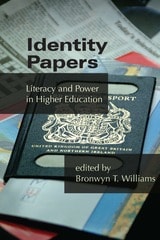
Identity Papers
Literacy and Power in Higher Educationedited by Bronwyn T. Williams
Utah State University Press, 2006
How do definitions of literacy in the academy, and the pedagogies that reinforce such definitions, influence and shape our identities as teachers, scholars, and students? The contributors gathered here reflect on those moments when the dominant cultural and institutional definitions of our identities conflict with our other identities, shaped by class, race, gender, sexual orientation, location, or other cultural factors.
These writers explore the struggle, identify the sources of conflict, and discuss how they respond personally to such tensions in their scholarship, teaching, and administration. They also illustrate how writing helps them and their students compose alternative identities that may allow the connection of professional identities with internal desires and senses of self. They emphasize how identity comes into play in education and literacy and how institutional and cultural power is reinforced in the pedagogies and values of the writing classroom and writing profession.

Illustrative Learning Experiences
University High School in ActionEmma Birkmaier
University of Minnesota Press, 1952
Imagination in Teaching and Learning
The Middle School YearsKieran Egan
University of Chicago Press, 1992
stimulated and developed in education. Yet, few teachers
understand what imagination is or how it lends itself to
practical methods and techniques that can be used easily in
classroom instruction. In this book, Kieran Egan—winner of
the prestigious Grawemeyer Award for his work on
imagination—takes up where his Teaching as Story Telling
left off, offering practical help for teachers who want to
engage, stimulate, and develop the imaginative and learning
processes of children between the ages of eight to fifteen.
This book is not about unusually imaginative students and
teachers. Rather, it is about the typical student's
imaginative life and how it can be stimulated in learning,
how the average teacher can plan to achieve this aim, and how
the curriculum can be structured to help achieve this aim.
Slim and determinedly practical, this book contains a wealth
of concrete examples of curriculum design and teaching
techniques structured to appeal specifically to children in
their middle school years.
Implementing Collaborative Writing Tasks in Multilingual Classrooms
Mimi Li and Neomy Storch
University of Michigan Press, 2025
With clear visuals and concrete examples of different types of collaborative writing tasks—including multimodal writing and collaborative reading for writing tasks—the book invites readers to consider the kind of decisions that need to be taken when implementing collaborative writing (e.g., group size, how to allocate students) and when assessing collaborative writing. In connecting frontier pedagogical knowledge to practice, Implementing Collaborative Writing Tasks in Multilingual Classrooms will help educators to implement collaborative writing activities in their various contexts.
Throughout the book, readers will find:
- Research-informed, pedagogy-oriented lessons on why and how to implement and assess collaborative writing in multilingual classrooms.
- Cutting-edge pedagogical knowledge that distinguishes the different modes of implementing collaborative writing (e.g., face-to-face, via computer-mediated communication, and a hybrid approach).
- Key practical suggestions for teachers.
- Tips on how to incorporate artificial intelligence in collaborative writing activities.
- Recommendations for further research that can be helpful for practitioners, teacher educators, or graduate students.
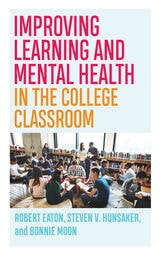
Improving Learning and Mental Health in the College Classroom
Robert Eaton
West Virginia University Press, 2023
How teachers can help combat higher education’s mental health crisis.
Mental health challenges on college campuses were a huge problem before COVID-19, and now they are even more pronounced. But while much has been written about higher education’s mental health crisis, very little research focuses on the role played by those on campus whose influence on student well-being may well be greatest: teachers. Drawing from interviews with students and the scholarship of teaching and learning, this book helps correct the oversight, examining how faculty can—instead of adding to their own significant workloads or duplicating counselors’ efforts—combat student stress through adjustments to the work they already do as teachers.
Improving Learning and Mental Health in the College Classroom provides practical tips that reduce unnecessary discouragement. It demonstrates how small improvements in teaching can have great impacts in the lives of students with mental health challenges, while simultaneously boosting learning for all students.
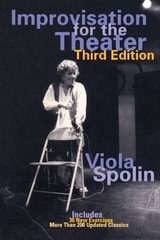
Improvisation for the Theater
A Handbook of Teaching and Directing TechniquesViola Spolin
Northwestern University Press, 1999
The thoroughly revised third edition of the bible of improvisational theater.
Viola Spolin's improvisational techniques changed the very nature and practice of modern theater. The first two editions of Improvisation for the Theater sold more than 100,000 copies and inspired actors, directors, teachers, and writers in theater, television, film. These techniques have also influenced the fields of education, mental health, social work, and psychology.
The revised edition features:
- 30 new exercises, including introductions (Slow/Fast/Normal; Extended Sound; Mirror Speech; Unrelated Conversation)
- More than 200 updated classic exercises
- new section of traditional theater games for warm-up use
- “Paul Sills' Sayings of Viola Spolin”
- New glossary of side-coaching phrases, with definitions of their meaning and value
- Alphabetical list of all games and exercises
Improvisation for the Theater
A Handbook of Teaching and Directing TechniquesViola Spolin
Northwestern University Press, 1983
In Force, Drive, Desire, Rudolf Bernet develops a philosophical foundation of psychoanalysis focusing on human drives. Rather than simply drawing up a list of Freud’s borrowings from Schopenhauer and Nietzsche, or Lacan’s from Hegel and Sartre, Bernet orchestrates a dialogue between philosophy and psychoanalysis that goes far beyond what these eminent psychoanalysts knew about philosophy. By relating the writings of Freud, Lacan, and other psychoanalysts to those of Aristotle, Leibniz, Schopenhauer, Nietzsche, Husserl, Heidegger, and, more tacitly, Bergson and Deleuze, Bernet brings to light how psychoanalysis both prolongs and breaks with the history of Western metaphysics and philosophy of nature.
Rereading the long history of metaphysics (or at least a few of its key moments) in light of psychoanalytic inquiries into the nature and function of drive and desire also allows for a rewriting of the history of philosophy. Specifically, it allows Bernet to bring to light a different history of metaphysics, one centered less on Aristotelian substance (ousia) and more on the concept of dunamis—a power or potentiality for a realization toward which it strives with all its might. Relating human drives to metaphysical forces also bears fruit for a renewed philosophy of life and subjectivity.
Inclusive Teaching
Strategies for Promoting Equity in the College ClassroomKelly A. Hogan
West Virginia University Press, 2022
Award-winning teachers offer practical tips for addressing inequities in the college classroom and for making all students feel welcome and included.
In a book written by and for college teachers, Kelly Hogan and Viji Sathy provide tips and advice on how to make all students feel welcome and included. They begin with a framework describing why explicit attention to structure enhances inclusiveness in both course design and interactions with and between students. Inclusive Teaching then provides practical ways to include more voices in a series of contexts: when giving instructions for group work and class activities, holding office hours, communicating with students, and more. The authors finish with an opportunity for the reader to reflect on what evidence to include in a teaching dossier that demonstrates inclusive practices.
The work of two highly regarded specialists who have delivered over a hundred workshops on inclusive pedagogy and who contribute frequently to public conversations on the topic, Inclusive Teaching distills state-of-the-art guidance on addressing privilege and implicit bias in the college classroom. It seeks to provide a framework for individuals and communities to ask, Who is being left behind and what can teachers do to add more structure?
Instructor Guide for Speechcraft
Discourse Pronunciation for Academic CommunicationWayne B. Dickerson
University of Michigan Press, 2027
Instructor Guide for Speechcraft helps shoulder time-consuming, non-teaching tasks so that instructors can focus on working directly with their students. Four-part lesson plans are adaptable for instructors who want to insert critical pronunciation topics into a non-pronunciation ESL/EFL course. To aid in professional development, each lesson plan includes a commentary on the order of topics in the syllabus and common student questions. Appendices provide pre- and post-tests to make sure that instructors have the resources they need to teach confidently. In addition to the 232 audio recordings for the textbook, instructors can access 37 additional recordings that can be used for class preparation or for in-class progress checks. With the Instructor Guide for Speechcraft, teachers will be able to help their students achieve the clear, intelligible speech they need to pursue their studies in their chosen discipline, to serve as international teaching assistants, and to interact well in their chosen professions.
Intellectual Freedom Manual, Eleventh Edition
Erin Office for Intellectual Freedom
American Library Association, 2026
When someone faces a difficult intellectual freedom (IF) issue, they usually don’t have time to wade through dense text to find the answers they need. Designed as a real-world reference, OIF’s Intellectual Freedom Manual provides trusted, comprehensive guidance for every library worker, from the volunteer to the director, in plain language. Whether you’re developing or reviewing policies, on-boarding new staff or trustees, responding to challenges and controversies, or studying librarianship, you’ll find this a vital tool, with features such as
- contributions that center the voices of Black, Indigenous, and other People of Color (BIPOC) and LGBTQIA+ people, who are often targeted by censorship efforts;
- chapters that begin with an overview explaining the big ideas and offering reflection questions;
- an introduction to IF and why it matters, drawing on ALA's core IF documents and supported with adaptable policy worksheets;
- information and best practice guidance on key topics such as access, children and youth, censorship and internet filtering, collection development and management, copyright, meeting rooms and exhibit spaces, library programming, politics and religion, privacy, and visits and requests from law enforcement;
- stories from real people whose lives have been impacted by IF, showing how library policies shape culture, protect staff and users, and affect real people;
- concise breakdowns of IF issues from legal experts, helping you understand the laws and how they apply in real situations;
- practical advice on advocating for IF, getting help when challenges arise, lobbying, and working with your elected officials;
- a thorough index to help you quickly find the information you need; and
- a helpful glossary and selected bibliography of additional resources.
Intentional Tech
Principles to Guide the Use of Educational Technology in College TeachingDerek Bruff
West Virginia University Press, 2019
Chalkboards and projectors are familiar tools for most college faculty, but when new technologies become available, instructors aren’t always sure how to integrate them into their teaching in meaningful ways. For faculty interested in supporting student learning, determining what’s possible and what’s useful can be challenging in the changing landscape of technology.
Arguing that teaching and learning goals should drive instructors’ technology use, not the other way around, Intentional Tech explores seven research-based principles for matching technology to pedagogy. Through stories of instructors who creatively and effectively use educational technology, author Derek Bruff approaches technology not by asking “How to?” but by posing a more fundamental question: “Why?”
International Practices in Special Education
Debates and ChallengesMargret A. Winzer
Gallaudet University Press, 2011
Margret A. Winzer and Kas Mazurek combine two disciplines in this collection, comparative and international studies and special education, to explore the ways that diverse nations respond to persons who are exceptional. Their learned contributors also explore the changing parameters of special education, employing comparative studies theories and methods to document, explore, discuss, and analyze social and educational inclusion.
International Practices in Special Education: Debates and Challenges travels the world to examine the progress of special education, from inclusive reform in Canada, “education for all” in the United Kingdom, the reform-restructure-renew movement in Poland to the journey from awareness to action in the United States. Chapters describe the challenges and opportunities in the United Arab Emirates; conflicts regarding educational welfare in South Korea; new perspectives on special needs and inclusive education in Japan; facing inclusion in India; making the invisibles visible in Pakistan; problems and prospects in Nigeria; special needs education in Ethiopia; and the developments, prospects, and demands of special education in a rising China. “One step forward, two steps backward” describes Israel’s special education issues. Germany’s special education receives an international perspective; and education policy and pedagogy for students with disabilities in Australia, completes the analyses in this remarkable, comprehensive work of scholarship.
Internationalizing a School of Education
Integration and Infusion in PracticeJohn Schwille
Michigan State University Press, 2016
Interrogating Privilege
Reflections of a Second Language EducatorStephanie Vandrick
University of Michigan Press, 2013
Interrogating Privilege is a welcome combination of personal essays and academic research, blending theory, analysis, and narrative to explore the function and consequences of privilege in second language education.
While teachers’ focus on the learning process and class goals are quite important, there is not enough attention paid to the types of privilege—or lack thereof—that individuals bring to the classroom. Through chapters that can either stand alone or be read together, with topics such as gender, age, and colonialism (the author is the daughter of missionary parents) in second language teaching, this book seeks to address the experiences of teachers, scholars, and students as “whole persons” and to observe the workings of identity and privilege in the educational setting.
Introduction to Engineering Design
A Conceptual OverviewKenneth Alfano
Michigan Publishing Services, 2025
Engineering design courses are often project-oriented, and rightly so, given that the process is best understood through some amount of experience. But a conceptual foundation is likewise critical for this subject. It helps enable experiential learning to relate the broad context of design process elements to the specific context of a given project. Further, engineering students tend to start out more acquainted with thinking about math and science subjects, where there is often one way – or at least a clear best way – to a “right” answer. The design process, by marked contrast, is largely qualitative and open-ended. Relatedly, it can (perhaps ironically) aid early learners to point out how varied and inconsistent the usage can be for some terminology – so the book does so at times, to help preempt confusion down the road.
In addition to being a text for an introductory college course, the book can also serve as a supplemental or reference text for later courses or on the job, or simply a general overview for those curious about the subject.
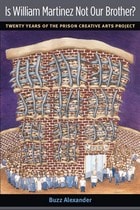
Is William Martinez Not Our Brother?
Twenty Years of the Prison Creative Arts ProjectBuzz Alexander
University of Michigan Press, 2010
Praise for the Prison Creative Arts Project:
"I cannot overstate how profoundly my experience with the Prison Creative Arts Project has shaped my life. It began my engagement with prison issues, developed both my passion and my understanding of them, and I continue to draw on both as I seek to contribute to a more rational, humane and just criminal justice system. PCAP prepared me to adapt to any situation, to take risks, to collaborate with people very different from myself in a manner infused with total respect."
---Jesse Jannetta, researcher, Justice Policy Center, the Urban Institute
"PCAP provided me with an emotional education that I would not have received otherwise. PCAP continually opens the doors to the stark reality of our criminal justice system as well as our society's ability to right the wrongs of that system and provide justice to millions of men, women, and children . . . PCAP showed me the power I, and the individuals around me, have to make a difference."
---Anne Bowles, Policy and Outreach Associate, Institute for Higher Education Policy
"PCAP looks beyond past mistakes and personal shortcomings to find the beauty and creative energies that help to heal the hurts we've done to others. They have not forgotten that we are human too! . . . Their program has given me a way to reach people that I would otherwise never reach. For that, I owe PCAP everything. They are my lifeline that I cling to."
---Bryan Picken, incarcerated artist
Prisons are an invisible, but dominant, part of American society: the United States incarcerates more people than any other nation in the world. In Michigan, the number of prisoners rose from 3,000 in 1970 to more than 50,000 by 2008, a shift that Buzz Alexander witnessed firsthand when he came to teach at the University of Michigan.
Is William Martinez Not Our Brother? describes the University of Michigan's Prison Creative Arts Project (PCAP), a pioneering program founded in 1990 that provides university courses, a nonprofit organization, and a national network for incarcerated youth and adults in Michigan juvenile facilities and prisons.
By giving incarcerated individuals an opportunity to participate in the arts, PCAP enables them to withstand and often overcome the conditions and culture of prison, the policies of an incarcerating state, and the consequences of mass incarceration.
Buzz Alexander is Arthur F. Thurnau Professor of English Language and Literature, College of Literature, Science, and the Arts, at the University of Michigan and was Carnegie National Professor of the Year in 2005.
Cover image: Overcrowded by Ronald Rohn