Results by title
660 books match the query 'Texas' and 12 start with i

Identified with Texas
The Lives of Governor Elisha Marshall Pease and Lucadia Niles PeaseElizabeth Whitlow
University of North Texas Press, 2022
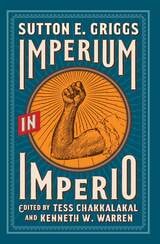
Imperium in Imperio
Sutton E. Griggs
West Virginia University Press, 2022
A new critical edition of Sutton Griggs’s turn-of-the-twentieth-century novel, which continues to shed light on understandings of Black politics.
Sutton E. Griggs’s first novel, originally published in 1899, paints a searing picture of the violent enforcement of disfranchisement and Jim Crow racial segregation. Based on events of the time, including US imperial policies, revolutionary movements, and racial protests, Imperium in Imperio introduces the fictional Belton Piedmont and Bernard Belgrave as “future leaders of their race” and uses these characters to make sense of the violence that marked the dawn of the twentieth century. Taking on contemporary battles over separatism and integration, Griggs’s novel continues to play a crucial role in understandings of Black politics.
Edited and introduced by Tess Chakkalakal and Kenneth W. Warren, this new critical edition offers not only an incisive biographical and historical introduction to the novel and its author but also a wealth of references that make the events and characters of Griggs’s Imperium in Imperio, and its aftermath, accessible to readers today.
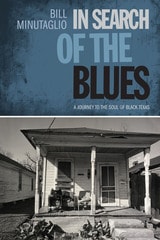
In Search of the Blues
A Journey to the Soul of Black TexasBy Bill Minutaglio
University of Texas Press, 2010
The rich, complex lives of African Americans in Texas were often neglected by the mainstream media, which historically seldom ventured into Houston's Fourth Ward, San Antonio's East Side, South Dallas, or the black neighborhoods in smaller cities. When Bill Minutaglio began writing for Texas newspapers in the 1970s, few large publications had more than a token number of African American journalists, and they barely acknowledged the things of lasting importance to the African American community. Though hardly the most likely reporter—as a white, Italian American transplant from New York City—for the black Texas beat, Minutaglio was drawn to the African American heritage, seeking its soul in churches, on front porches, at juke joints, and anywhere else that people would allow him into their lives. His nationally award-winning writing offered many Americans their first deeper understanding of Texas's singular, complicated African American history.
This eclectic collection gathers the best of Minutaglio's writing about the soul of black Texas. He profiles individuals both unknown and famous, including blues legends Lightnin' Hopkins, Amos Milburn, Robert Shaw, and Dr. Hepcat. He looks at neglected, even intentionally hidden, communities. And he wades into the musical undercurrent that touches on African Americans' joys, longings, and frustrations, and the passing of generations. Minutaglio's stories offer an understanding of the sweeping evolution of music, race, and justice in Texas. Moved forward by the musical heartbeat of the blues and defined by the long shadow of racism, the stories measure how far Texas has come . . . or still has to go.

In the Governor's Shadow
The True Story of Ma and Pa FergusonCarol O'Keefe Wilson
University of North Texas Press, 2014

Indians of the Rio Grande Delta
Their Role in the History of Southern Texas and Northeastern MexicoBy Martín Salinas
University of Texas Press, 1990
Indians of the Rio Grande Delta is the first single-volume source on these little-known peoples. Working from innumerable primary documents in various Texan and Mexican archives, Martin Salinas has compiled data on more than six dozen named groups that inhabited the area in the sixteenth through the eighteenth centuries. Depending on available information, he reconstructs something of their history, geographical range and migrations, demography, language, and culture. He also offers general information on various unnamed groups of Indians, on the lifeways of the indigenous peoples, and on the relations between the Indian groups and the colonial Spanish missions in the region.
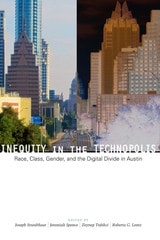
Inequity in the Technopolis
Race, Class, Gender, and the Digital Divide in AustinEdited by Joseph Straubhaar, Jeremiah Spence, Zeynep Tufekci, and Roberta G. Lentz
University of Texas Press, 2012
Over the past few decades, Austin, Texas, has made a concerted effort to develop into a “technopolis,” becoming home to companies such as Dell and numerous start-ups in the 1990s. It has been a model for other cities across the nation that wish to become high-tech centers while still retaining the livability to attract residents. Nevertheless, this expansion and boom left poorer residents behind, many of them African American or Latino, despite local and federal efforts to increase lower-income and minority access to technology.
This book was born of a ten-year longitudinal study of the digital divide in Austin—a study that gradually evolved into a broader inquiry into Austin’s history as a segregated city, its turn toward becoming a technopolis, what the city and various groups did to address the digital divide, and how the most disadvantaged groups and individuals were affected by those programs.
The editors examine the impact of national and statewide digital inclusion programs created in the 1990s, as well as what happened when those programs were gradually cut back by conservative administrations after 2000. They also examine how the city of Austin persisted in its own efforts for digital inclusion by working with its public libraries and a number of local nonprofits, and the positive impact those programs had.
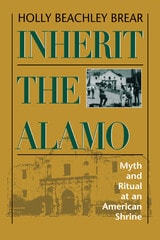
Inherit the Alamo
Myth and Ritual at an American ShrineBy Holly Beachley Brear
University of Texas Press, 1994
Long overshadowed by the towering buildings of downtown San Antonio, the modest little Alamo still evokes tremendous feeling among Texans and, indeed, many other Americans. For Anglo Texans, the Alamo is the "Cradle of Texas Liberty" and a symbolic confirmation of Manifest Destiny. For Hispanic Texans, however, the Alamo has increasingly become a stolen symbol, its origin as a Spanish mission forgotten, its famous defeat used to exclude Hispanics from an honorable place in Texas history.
In this important new book, Holly Beachley Brear explores in fascinating detail what the Alamo means to the numerous groups that lay claim to its heritage. She shows how Alamo myths often diverge from the historical facts—and why. She decodes the agendas of various groups, including the Daughters of the Republic of Texas (who maintain the Alamo buildings and grounds), the Order of the Alamo, the Texas Cavaliers, and LULAC. And she probes attempts by individuals and groups to rewrite the Alamo myth to include more positive roles for themselves, as she explains the value in laying claim to the Alamo's past.
With new perspectives on all the sacred icons of the Alamo and the Fiesta that celebrates (one version of) its history each year, Inherit the Alamo is guaranteed to challenge stereotypes and offer new understanding of the Alamo's ongoing role in shaping Texas and American history and mythology. It will be of interest to a wide popular and scholarly audience.
Insurgent Politics in the Lone Star State
Remembering the Antiwar Movement in Austin, Texas, 1967–1973Martin J. Murray
University of North Texas Press, 2025
Inventing Place
Writing Lone Star RhetoricsEdited by Casey Boyle and Jenny Rice
Southern Illinois University Press, 2018
Divided into five sections corresponding to Texas regions, essays consider aesthetics, buildings, environment, food and alcohol, private and public memory, and race and class. Among the topics covered by contributors are the Imagine Austin urban planning initiative; the terroir of Texas barbecue; the racist past of Grand Saline, Texas; Denton, Texas, and authenticity as rhetorical; negative views of Texas and how the state (or any place) is subject to reinvention; social, historical, and economic networks of place and their relationship to the food we eat; and Texas gun culture and working-class character.
Invisible in Austin
Life and Labor in an American CityEdited by Javier Auyero with an afterword by Loïc Wacquant
University of Texas Press, 2015
Austin, Texas, is renowned as a high-tech, fast-growing city for the young and creative, a cool place to live, and the scene of internationally famous events such as SXSW and Formula 1. But as in many American cities, poverty and penury are booming along with wealth and material abundance in contemporary Austin. Rich and poor residents lead increasingly separate lives as growing socioeconomic inequality underscores residential, class, racial, and ethnic segregation.
In Invisible in Austin, the award-winning sociologist Javier Auyero and a team of graduate students explore the lives of those working at the bottom of the social order: house cleaners, office-machine repairers, cab drivers, restaurant cooks and dishwashers, exotic dancers, musicians, and roofers, among others. Recounting their subjects’ life stories with empathy and sociological insight, the authors show us how these lives are driven by a complex mix of individual and social forces. These poignant stories compel us to see how poor people who provide indispensable services for all city residents struggle daily with substandard housing, inadequate public services and schools, and environmental risks. Timely and essential reading, Invisible in Austin makes visible the growing gap between rich and poor that is reconfiguring the cityscape of one of America’s most dynamic places, as low-wage workers are forced to the social and symbolic margins.
Iranians in Texas
Migration, Politics, and Ethnic IdentityBy Mohsen M. Mobasher
University of Texas Press, 2012
Thousands of Iranians fled their homeland when the 1978–1979 revolution ended the fifty-year reign of the Pahlavi Dynasty. Some fled to Europe and Canada, while others settled in the United States, where anti-Iranian sentiment flared as the hostage crisis unfolded. For those who chose America, Texas became the fourth-largest settlement area, ultimately proving to be a place of paradox for any Middle Easterner in exile. Iranians in Texas culls data, interviews, and participant observations in Iranian communities in Houston, Dallas, and Austin to reveal the difficult, private world of cultural pride, religious experience, marginality, culture clashes, and other aspects of the lives of these immigrants.
Examining the political nature of immigration and how the originating and receiving countries shape the prospects of integration, Mohsen Mobasher incorporates his own experience as a Texas scholar born in Iran. Tracing current anti-Muslim sentiment to the Iranian hostage crisis, two decades before 9/11, he observes a radically negative shift in American public opinion that forced thousands of Iranians in the United States to suddenly be subjected to stigmatization and viewed as enemies. The book also sheds light on the transformation of the Iranian family in exile and some of the major challenges that second-generation Iranians face in their interactions with their parents.
Bringing to life a unique population in the context of global politics, Iranians in Texas overturns stereotypes while echoing diverse voices.
Iranians in Texas
Migration, Politics, and Ethnic IdentityMohsen Mostafavi MobasherForeword by Nestor Rodriguez
University of Texas Press, 2025
An exploration of the link between politics of migration, prospects of integration, and ethnic identity among Iranian immigrants and their descendants in the United States, spanning from the 1970s to the present day.
Thousands of Iranians fled their homeland when the 1978–1979 revolution ended the fifty-year reign of the Pahlavi dynasty. Some fled to Europe and Canada, while others settled in the United States, where anti-Iranian sentiment flared as the hostage crisis unfolded. For those who chose America, Texas became the fourth-largest settlement area. Iranians in Texas culls data, interviews, and participant observations in Iranian communities in Houston, Dallas, and Austin to reveal the difficult, private world of cultural pride, religious experience, marginality, culture clashes, and other aspects of the lives of these immigrants.
Examining the political nature of immigration between Iran and the United States and social, cultural, and economic life for Iranian immigrants and their American-born children, Mohsen Mostafavi Mobasher incorporates his own experience as a Texas scholar born in Iran. In this revised edition, two new chapters and a new introduction and conclusion provide updates on what has happened in the Obama, Trump, and Biden administrations, including the Iran nuclear deal and resulting controversy, the Muslim ban, and the global protests over the death of twenty-two-year-old Mahsa Amini for not wearing a hijab. Bringing to life a unique immigrant population in the context of global politics, Iranians in Texas overturns stereotypes and echoes diverse voices.