Results by title
57 books match the query 'Victorian Era (1837-1901)' and 3 start with i
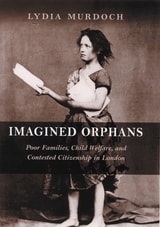
Imagined Orphans
Poor Families, Child Welfare, and Contested Citizenship in LondonMurdoch, Lydia
Rutgers University Press, 2006
With his dirty, tattered clothes and hollowed-out face, Oliver Twist is the enduring symbol of the young indigent spilling out of orphanages and haunting the streets of late-nineteenth-century London. Although poor children were often portrayed as real-life Oliver Twists—either orphaned or abandoned by unworthy parents—they in fact frequently maintained contact and were eventually reunited with their families.
In Imagined Orphans, Lydia Murdoch focuses on this discrepancy between the representation and the reality of children’s experiences within welfare institutions—a discrepancy that she argues stems from conflicts over middle- and working-class notions of citizenship that arose in the 1870s and persisted until the First World War. Reformers’ efforts to depict poor children as either orphaned or endangered by abusive or “no-good” parents fed upon the poor’s increasing exclusion from the Victorian social body. Reformers used the public’s growing distrust and pitiless attitude toward poor adults to increase charity and state aid to the children.
With a critical eye to social issues of the period, Murdoch urges readers to reconsider the complex situations of families living in poverty. While reformers’ motivations seem well intentioned, she shows how their methods solidified the public’s antipoor sentiment and justified a minimalist welfare state that engendered a cycle of poverty. As they worked to fashion model citizens, reformers’ efforts to protect and care for children took on an increasingly imperial cast that would continue into the twentieth century.
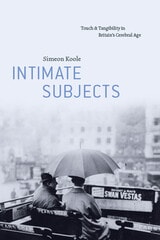
Intimate Subjects
Touch and Tangibility in Britain's Cerebral AgeSimeon Koole
University of Chicago Press, 2024
When, where, and who gets to touch and be touched, and who decides? What do we learn through touch? How does touch bring us closer together or push us apart? These are urgent contemporary questions, but they have their origins in late nineteenth- and early twentieth-century Britain, when new urban encounters compelled intense discussion of what touch was, and why it mattered. In this vividly written book, Simeon Koole excavates the history of these concerns and reveals how they continue to shape ideas about “touch” in the present.
Intimate Subjects takes us to the bustling railway stations, shady massage parlors, all-night coffee stalls, and other shared spaces where passengers, customers, vagrants, and others came into contact, leading to new understandings of touch. We travel in crammed subway cars, where strangers negotiated the boundaries of personal space. We visit tea shops where waitresses made difficult choices about autonomy and consent. We enter classrooms in which teachers wondered whether blind children could truly grasp the world and labs in which neurologists experimented on themselves and others to unlock the secrets of touch. We tiptoe through London’s ink-black fogs, in which disoriented travelers became newly conscious of their bodies and feared being accosted by criminals. Across myriad forgotten encounters such as these, Koole shows, touch remade what it meant to be embodied—as well as the meanings of disability, personal boundaries, and scientific knowledge.
With imagination and verve, Intimate Subjects offers a new way of theorizing the body and the senses, as well as a new way of thinking about embodiment and vulnerability today.
Intimate Subjects
Touch and Tangibility in Britain's Cerebral AgeSimeon Koole
University of Chicago Press, 2024
This is an auto-narrated audiobook version of this book.
The queer recluse, the shambling farmer, the clannish hill folk—white rural populations have long disturbed the American imagination, alternately revered as moral, healthy, and hardworking, and feared as antisocial or socially uncouth. In Peculiar Places, Ryan Lee Cartwright examines the deep archive of these contrary formations, mapping racialized queer and disability histories of white social nonconformity across the rural twentieth-century United States.
Sensationalized accounts of white rural communities’ aberrant sexualities, racial intermingling, gender transgressions, and anomalous bodies and minds, which proliferated from the turn of the century, created a national view of the perversity of white rural poverty for the American public. Cartwright contends that these accounts, extracted and estranged from their own ambivalent forum of community gossip, must be read in kind: through a racialized, materialist queercrip optic of the deeply familiar and mundane. Taking in popular science, documentary photography, news media, documentaries, and horror films, Peculiar Places orients itself at the intersections of disability studies, queer studies, and gender studies to illuminate a racialized landscape both profoundly ordinary and familiar.