Results by title
349 books match the query 'Violence' and 7 start with i

Imposing Order without Law
American Expansion to the Eastern Sierra, 1850–1865Michael J. Makley
University of Nevada Press, 2022
In the 1850s, early Euro-American settlers established two remote outposts on the slopes of the eastern Sierra Nevada, both important way stations on the central emigrant trail. The Carson Valley settlement was located on the western edge of the Utah Territory, while the Honey Lake Valley hamlet, 120 miles north, fell within California’s boundaries but was separated from the rest of the state by the formidable mountain range. Although these were some of the first white communities established in the region, both areas had long been inhabited by Indigenous Americans. Carson Valley had been part of Washoe Indian territory, and Honey Lake Valley was a section of Northern Paiute land.
Michael Makley explores the complexities of this turbulent era, when the pioneers’ actions set the stage for both valleys to become part of national incorporation. With deft writing and meticulously researched portrayals of the individuals involved, including the Washoe and Northern Paiute peoples, Imposing Order Without Law focuses on the haphazard evolution of “frontier justice” in these remote outposts. White settlers often brought with them their own ideas of civil order. Makley’s work contextualizes the extralegal acts undertaken by the settlers to enforce edicts in their attempt to establish American communities.
Makley’s book reveals the use and impact of group violence, both within the settlements and within the Indigenous peoples’ world, where it transformed their lives.
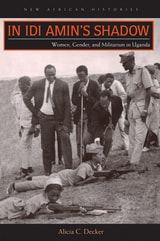
In Idi Amin’s Shadow
Women, Gender, and Militarism in UgandaAlicia C. Decker
Ohio University Press, 2014
Finalist for the 2015 Aidoo-Snyder Prize
In Idi Amin’s Shadow is a rich social history examining Ugandan women’s complex and sometimes paradoxical relationship to Amin’s military state. Based on more than one hundred interviews with women who survived the regime, as well as a wide range of primary sources, this book reveals how the violence of Amin’s militarism resulted in both opportunities and challenges for women. Some assumed positions of political power or became successful entrepreneurs, while others endured sexual assault or experienced the trauma of watching their brothers, husbands, or sons “disappeared” by the state’s security forces. In Idi Amin’s Shadow considers the crucial ways that gender informed and was informed by the ideology and practice of militarism in this period. By exploring this relationship, Alicia C. Decker offers a nuanced interpretation of Amin’s Uganda and the lives of the women who experienced and survived its violence.
Each chapter begins with the story of one woman whose experience illuminates some larger theme of the book. In this way, it becomes clear that the politics of military rule were highly relevant to women and gender relations, just as the politics of gender were central to militarism. By drawing upon critical security studies, feminist studies, and violence studies, Decker demonstrates that Amin’s dictatorship was far more complex and his rule much more strategic than most observers have ever imagined.
In the Shadow of Violence
The Politics of Armed GroupsKlaus Schlichte
Campus Verlag, 2009
As civil wars and insurgencies rage around the globe, Klaus Schlichte’s In the Shadow of Violence addresses a crucial question: why do some groups succeed in violently seizing and holding power while others fail? What makes for a successful non-state armed force? Arguing that success rests on the ability of these groups to transform the power of violence into legitimate domination, both inside their ranks and in the larger society, Schlichte explores the techniques and strategies they employ—and the long shadow of violence they must overcome along the way.

In the Wake of Violence
Image & Social ReformCheryl R. Jorgensen-Earp
Michigan State University Press, 2008
How acts of violence are rhetorically "managed" by social movements: In the Wake of Violence explores the immediate and longer term aftermath of violence committed by independent radicals involved in single-issue movements. Cheryl R. Jorgensen-Earp explores several specific incidents in recent history—the arson of a Vail ski resort by environmentalists, the murder of Dr. John Britton by an antiabortion activist, and the torching of a University of California research laboratory by animal rights activists among them—to discover how the perpetrators of the violence and the majority of reformers involved in their movements rhetorically framed the violent act for a potentially outraged public.
In the Wake of Violence, claims Jorgensen-Earp, the perpetrators are often forthcoming with both explanations for and a defense of their actions, casting themselves as righteous actors or martyrs for a cause. However, ardent reformers within the same cause might look with genuine revulsion at the actions of their own radical wing. This study claims that the nonviolent majority in single-issue reform movements employs a predictable constellation of rhetorical strategies to manage the impact of radical fringe violence. The primary goal of this rhetoric is to avoid a backlash against the larger movement by a public alienated by violent acts.
In examining specific rhetorical responses by the nonviolent majority in antiabortion, animal welfare, environmental reform, abolition, and women’s suffrage movements, Jorgensen-Earp considers a wide range of discourse types—from newspaper articles, interviews, and editorials to private letters; from editorial cartoons to the homemade signs of movement activists; and from speeches to modern Internet sites. She discovers that the image restoration techniques brought to bear for a reform cause are similar to those employed by a corporation accused of wrongdoing. Ultimately, she finds that the majority of proponents of the causes she examines believe that the violence can or will be condoned and that it must be rhetorically mitigated.
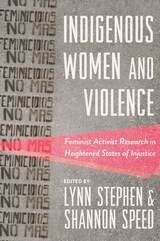
Indigenous Women and Violence
Feminist Activist Research in Heightened States of InjusticeEdited by Lynn Stephen and Shannon Speed
University of Arizona Press, 2021
Indigenous Women and Violence is built on engaging case studies that highlight the individual and collective struggles that Indigenous women face from the racial and gendered oppression that structures their lives. Gendered violence has always been a part of the genocidal and assimilationist projects of settler colonialism, and it remains so today. These structures—and the forms of violence inherent to them—are driving criminalization and victimization of Indigenous men and women, leading to escalating levels of assassination, incarceration, or transnational displacement of Indigenous people, and especially Indigenous women.
This volume brings together the potent ethnographic research of eight scholars who have dedicated their careers to illuminating the ways in which Indigenous women have challenged communities, states, legal systems, and social movements to promote gender justice. The chapters in this book are engaged, feminist, collaborative, and activism focused, conveying powerful messages about the resilience and resistance of Indigenous women in the face of violence and systemic oppression.
Contributors: R. Aída Hernández-Castillo, Morna Macleod, Mariana Mora, María Teresa Sierra, Shannon Speed, Lynn Stephen, Margo Tamez, Irma Alicia Velásquez Nimatuj

Intimate Enemies
Landowners, Power, and Violence in ChiapasAaron Bobrow-Strain
Duke University Press, 2007
Weaving together ethnography, archival research, and cultural history, Bobrow-Strain argues that prior to the upheavals of 1994 landowners were already squeezed between increasingly organized indigenous activism and declining political and economic support from the Mexican state. He demonstrates that indigenous mobilizations that began in 1994 challenged not just the economy of estate agriculture but also landowners’ understandings of progress, masculinity, ethnicity, and indigenous docility. By scrutinizing the elites’ responses to land invasions in relation to the cultural politics of race, class, and gender, Bobrow-Strain provides timely insights into policy debates surrounding the recent global resurgence of peasant land reform movements. At the same time, he rethinks key theoretical frameworks that have long guided the study of agrarian politics by engaging political economy and critical human geography’s insights into the production of space. Describing how a carefully defended world of racial privilege, political dominance, and landed monopoly came unglued, Intimate Enemies is a remarkable account of how power works in the countryside.

Irish Peasants
Violence and Political Unrest, 1780–1914Samuel Clark
University of Wisconsin Press, 1983
"The strength of this volume cannot be conveyed by an itemisation of its contents; for what it provides is an incisive commentary on the newly-recognised landmarks of Irish agrarian history in the modern period. . . . The importance, even indispensability, of this achievement is compounded by exemplary editing."—Roy Foster, London Times Literary Supplement
"As a whole, the volume demonstrates the wealth, complexity, and sophistication of Irish rural studies. The book is essential reading for anyone involved in modern Irish history. It will also serve as an excellent introduction to this rich field for scholars of other peasant communities and all interested in problems of economic and political developments."—American Historical Review
"A milestone in the evolution of Irish social history. There is a remarkable consistency of style and standard in the essays. . . . This is truly history from the grassroots."—Timothy P. O'Neill, Studia Hibernica