Results by title
22279 books match the query 'Social Science' and 851 start with i
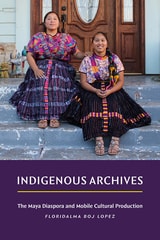
Indigenous Archives
The Maya Diaspora and Mobile Cultural ProductionFloridalma Boj Lopez
Duke University Press, 2026
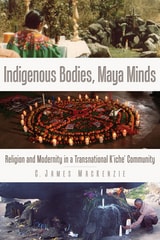
Indigenous Bodies, Maya Minds
Religion and Modernity in a Transnational K'iche' CommunityC. James MacKenzie
University Press of Colorado, 2016
Indigenous Bodies, Maya Minds examines tension and conflict over ethnic and religious identity in the K’iche’ Maya community of San Andrés Xecul in the Guatemalan Highlands and considers how religious and ethnic attachments are sustained and transformed through the transnational experiences of locals who have migrated to the United States.
Author C. James MacKenzie explores the relationship among four coexisting religious communities within Highland Maya villages in contemporary Guatemala—costumbre, traditionalist religion with a shamanic substrate; “Enthusiastic Christianity,” versions of Charismaticism and Pentecostalism; an “inculturated” and Mayanized version of Catholicism; and a purified and antisyncretic Maya Spirituality—with attention to the modern and nonmodern worldviews that sustain them. He introduces a sophisticated set of theories to interpret both traditional religion and its relationship to other contemporary religious options, analyzing the relation among these various worldviews in terms of the indigenization of modernity and the various ways modernity can be apprehended as an intellectual project or an embodied experience.
Indigenous Bodies, Maya Minds investigates the way an increasingly plural religious landscape intersects with ethnic and other identities. It will be of interest to Mesoamerican and Mayan ethnographers, as well as students and scholars of cultural anthropology, indigenous cultures, globalization, and religion.
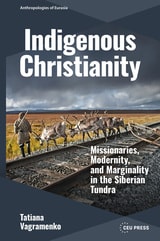
Indigenous Christianity
Missionaries, Modernity, and Marginality in the Siberian TundraTatiana Vagramenko
Central European University Press, 2026
Nenets nomads, long shaped by Russian colonialism and Soviet modernization, experienced sweeping conversions in the mid-1990s, culminating in the creation of a tundra church tied to a radical evangelical movement. Amid Putin’s tightening control—when indigenous peoples and minority faiths faced renewed surveillance and harassment—the book follows Nenets and missionaries whose encounters across the tundra sparked tensions between converts and non-converts, faith and state. Through stories of hope, loss, and resilience, it reveals how global evangelical Christianity intersects with local traditions, reshaping kinship, belonging, and modernity in the Siberian tundra.
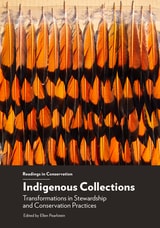
Indigenous Collections
Transformations in Stewardship and Conservation PracticesEllen Pearlstein
J. Paul Getty Trust, The, 0
A critical survey of the values, challenges, implications, history, and future of conserving Indigenous collections globally.
Once the exclusive realm of non-Indigenous curators and conservators, the care of Indigenous works in museums is now largely carried out either in collaboration with or by community members—a significant change from the colonial origins of museum collections and conservation practice.
This volume brings together over 100 readings—by Indigenous and non-Indigenous authors from around the world—that trace the development of the conservation of Indigenous collections. The writers provide a wide range of expertise, from archaeology and ethnography to law, and include community leaders, anthropologists, and art historians, as well as conservators and curators.
The book begins with an examination of the changes in terminology that reflect trust and respect, Indigenous care practices that predate the emergence of museums, and the impact of policy and legislation on Indigenous art and artifacts. Other readings explore the challenges associated with managing large, complex collections and the changes that resulted from addressing them: the development of specialized technical approaches, the incorporation of intangible heritage in conservation agendas, and a broadening view of what conservation means and how to practice it. Indigenous Collections concludes by looking at new approaches to museums—managed by or jointly with the people most closely connected to the holdings—and to the future, through innovations in conservation education.
Indigenous Communalism
Belonging, Healthy Communities, and Decolonizing the CollectiveCarolyn Smith-Morris
Rutgers University Press, 2020
Told in vibrant detail, the narrative of the book conveys the importance of communalism as a value system present in all human groups and one at the center of Indigenous survival. Carolyn Smith-Morris draws on her work among the Akimel O'odham and the Wiradjuri to show how communal work and culture help these communities form distinctive Indigenous bonds. The results are not only a rich study of Indigenous relational lifeways, but a serious inquiry to the continuing acculturative atmosphere that Indigenous communities struggle to resist. Recognizing both positive and negative sides to the issue, she asks whether there is a global Indigenous communalism. And if so, what lessons does it teach about healthy communities, the universal human need for belonging, and the potential for the collective to do good?
Indigenous Critical Reflections on Traditional Ecological Knowledge
Lara A. Jacobs
Oregon State University Press, 2025
With more than fifty contributors, Indigenous Critical Reflections on Traditional Ecological Knowledge offers important perspectives by Indigenous Peoples on Traditional Ecological Knowledge and Indigenous value systems. The book aims to educate and inspire readers about the importance of decolonizing how Indigenous Knowledges are considered and used outside of Native communities.
By including the work of Indigenous storytellers, poets, and scholars from around the globe, editor Lara Jacobs and chapter authors effectively explore the Indigenous value systems—relationships, reciprocity, and responsibility—that are fundamental to Indigenous Knowledge systems and cultures. Indigenous languages and positionality statements are featured for each of the contributors to frame their cultural and geographical background and to allow each Indigenous voice to lead discussions and contribute critical discourse to the literature on Indigenous Knowledges and value systems. By creating space for each of these individual voices, this volume challenges colonial extraction norms and highlights the importance of decolonial methods in understanding and protecting Indigenous Knowledges.
Indigenous Critical Reflections on Traditional Ecological Knowledge is an essential resource for students, academics, members of Tribal, state, and federal governments, Indigenous communities, and non-Indigenous allies as well as a valuable addition to environmental and Indigenous studies collections.
Contributors include: Melinda M. Adams, Joe Anderson, Coral Avery, Andrew Kalani Carlson, Kathryn Champagne, Brandie Makeba Cross, Joanna M. DeMeyer, Jonathan James Fisk, Pat Gonzales-Rogers, Celina Gray, Rhode Grayson, Zena Greenawald, Jennifer Grenz, Joy Harjo, Mandi Harris, Jessica Hernandez, Victor Hernandez, David Iniguez, Michelle M. Jacob, Lara A. Jacobs, Lydia L. Jennings, Eileen Jimenez, Stephanie Kelley, David G. Lewis, Tomás A. Madrigal, Tara McAllister, Lauren Wendelle Yowelunh McLester-Davis, Angeles Mendoza, Kat Milligan-McClellan, Todd A. Mitchell swəlítub, Don Motanic, ‘Alohi Nakachi, Kaikea Nakachi, Kobe , Natachu, Ululani Kekahiliokalani Brigitte Russo Oana, Jennifer R. O’Neal, Lily Painter, Britt Postoak, Leasi Vanessa Lee Raymond, Anamaq Margaret H. C. Rudolf, Oral Saulters, Sam Schimmel, Paulette Steeves, Joni Tobacco, Angelo Villagomez, Vivi Vold, Margaret Palaghicon Von Rotz, Luhui Whitebear, Joseph Gazing Wolf, Monique Wynecoop, and Cherry YEW Yamane.
Indigenous Cultural and Environmental Heritage
Social Action and Solidarity for Indigenous RightsEdited by Paulette Steeves and Ranjan Datta
University of Arizona Press, 2027
This volume brings together a powerful chorus of Indigenous scholars and settler allies to illuminate the enduring connections between cultural heritage, environmental stewardship, and Indigenous sovereignty. With cases from communities across the Americas, Asia, Africa, and the Arctic, this interdisciplinary volume centers Indigenous knowledge systems and lived experiences. Contributors challenge colonial narratives that have long obscured or erased Indigenous histories, practices, and rights. Contributors also demonstrate how cultural and environmental heritage functions not only as a site of memory but also as a vital framework for resilience, governance, and sustainable futures.
From land-based knowledge and oral traditions to climate adaptation and sacred ecological stewardship, the essays highlight Indigenous-led pathways toward justice and renewal in the face of ongoing environmental and cultural dispossession. Urgent and forward-looking, this volume offers essential insights for scholars, students, and practitioners committed to centering Indigenous voices, supporting community-led action, and reimagining more just and inclusive approaches to heritage and environmental care.
Contributors
Ranjan Datta
Tom Dooley
Esther Jónsdóttir
Matias Kachepa Elisa
Jean Kayira
Malidadi Langa
Makoto Mochida
Paul Edward Montgomery Ramirez
Jairo Saw Munduruku
Rani Muthukrishnan
George Nicholas
Sandra Oseguera
Masaki Sashima
Yuka Shichiza
William Singer III
Rajmoni Singha
Paulette Steeves
Patiphol Yodsurang
Indigenous Dance and Dancing Indian
Contested Representation in the Global EraMatthew Krystal
University Press of Colorado, 2020
Considering four genres of dance in which indigenous people are represented--K'iche Maya traditional dance, powwow, folkloric dance, and dancing sports mascots--the book addresses both the ideational and behavioral dimensions of identity. Each dance is examined as a unique cultural expression in individual chapters, and then all are compared in the conclusion, where striking parallels and important divergences are revealed. Ultimately, Krystal describes how dancers and audiences work to construct and consume satisfying and meaningful identities through dance by either challenging social inequality or reinforcing the present social order.
Detailed ethnographic work, thorough case studies, and an insightful narrative voice make Indigenous Dance and Dancing Indian a substantial addition to scholarly literature on dance in the Americas. It will be of interest to scholars of Native American studies, social sciences, and performing arts.
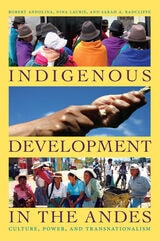
Indigenous Development in the Andes
Culture, Power, and TransnationalismRobert Andolina, Nina Laurie, and Sarah A. Radcliffe
Duke University Press, 2009
The authors argue that this reconfiguration of development policy and practice permits Ecuadorian and Bolivian indigenous groups to renegotiate their relationship to development as subjects who contribute and participate. Yet it also recasts indigenous peoples and their cultures as objects of intervention and largely fails to address fundamental concerns of indigenous movements, including racism, national inequalities, and international dependencies. Andean indigenous peoples are less marginalized, but they face ongoing dilemmas of identity and agency as their fields of action cross national boundaries and overlap with powerful institutions. Focusing on the encounters of indigenous peoples with international development as they negotiate issues related to land, water, professionalization, and gender, Indigenous Development in the Andes offers a comprehensive analysis of the diverse consequences of neoliberal development, and it underscores crucial questions about globalization, governance, cultural identity, and social movements.
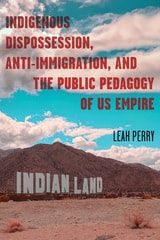
Indigenous Dispossession, Anti-Immigration, and the Public Pedagogy of US Empire
Leah Perry
The Ohio State University Press, 2024
From the founding of the United States, enduringly consequential debates over Indigeneity and immigration have occurred on the battlefield and in Congress, in courtrooms, at territorial borders, and in mainstream culture. In Indigenous Dispossession, Anti-Immigration, and the Public Pedagogy of US Empire, Leah Perry traces the ways that the US created its empire through public pedagogies—which she defines as policy and media discourses—surrounding Indigenous dispossession, gendered state violence, and racialized immigration. These pedagogies have propelled the expansion of US empire, including the redrawing of the US as a neoliberal democracy. Perry argues that by changing the discourse around gender, race, immigration, and Indigeneity, the United States has continued its imperial project through different eras, always predicated on Indigenous dispossession.
In exploring crucial components of empire, such as welfare, eugenics, disability, sexual violence, foodways, queerness, and policing, Perry interrogates violence against Indigenous peoples and against immigrants, examining these not independently—as is so often the case—but as co-constitutive. Indigenous Dispossession, Anti-Immigration, and the Public Pedagogy of US Empire thus intervenes in and fills a gap in immigration studies, Indigenous studies, race and ethnic studies, gender and sexuality studies, and US history.

Indigenous Ecocinema
Decolonizing Media EnvironmentsSalma Monani
West Virginia University Press, 2024
This absorbing text is the first book-length exploration foregrounding the environmental dimensions of cinema made by Indigenous peoples, including a particularly fascinating discussion on how Indigenous cinema’s ecological entanglements are a crucial and complementary aspect of its agenda of decolonialism.
Indigenous Economics
Sustaining Peoples and Their LandsRonald L. Trosper
University of Arizona Press, 2022
What does “development” mean for Indigenous peoples? Indigenous Economics lays out an alternative path showing that conscious attention to relationships among humans and the natural world creates flourishing social-ecological economies.
Economist Ronald L. Trosper draws on examples from North and South America, Aotearoa/New Zealand, and Australia to argue that Indigenous worldviews centering care and good relationships provide critical and sustainable economic models in a world under increasing pressure from biodiversity loss and climate change. He explains the structure of relational Indigenous economic theory, providing principles based on his own and others’ work with tribal nations and Indigenous communities. Trosper explains how sustainability is created at every level when relational Indigenous economic theory is applied—micro, meso, and macro.
Good relationships support personal and community autonomy, replacing the individualism/collectivism dichotomy with relational leadership and entrepreneurship. Basing economies on relationships requires changing governance from the top-down approaches of nation-states and international corporations; instead, each community creates its own territorial relationships, creating plurinational relational states. This book offers an important alternative to classic economic theory. In Indigenous Economics, support for Indigenous communities’ development and Indigenous peoples’ well-being go hand-in-hand.
Publication of this book is made possible in part by the Alfred P. Sloan Foundation Program in Public Understanding of Science.
Indigenous Environmental Justice
Edited by Karen Jarratt-Snider and Marianne O. Nielsen
University of Arizona Press, 2020
With focused essays on important topics such as the uranium mining on Navajo and Hopi lands, the Dakota Access Pipeline dispute on the Standing Rock Indian Reservation, environmental cleanup efforts in Alaska, and many other pertinent examples, this volume offers a timely view of the environmental devastation that occurs in Indian Country. It also serves to emphasize the importance of self-determination and sovereignty in victories of Indigenous environmental justice.
The book explores the ongoing effects of colonization and emphasizes Native American tribes as governments rather than ethnic minorities. Combining elements of legal issues, human rights issues, and sovereignty issues, Indigenous Environmental Justice creates a clear example of community resilience in the face of corporate greed and state indifference.
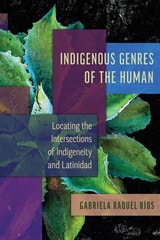
Indigenous Genres of the Human
Locating the Intersections of Indigeneity and LatinidadGabriela Raquel Ríos
University of Arizona Press, 2026
Addressing different genres of human and what contemporary indigeneity and reclaiming indigeneity looks like across Latin American contexts, chapters in this work examine digital bruja poetry, Aymara women’s Lucha Libre in Bolivia, Raramuri dance in Mexico, and Indigenous Khipu in the Andes. The author weaves her own story of being from southern Texas and traveling to Mexico throughout the book.
Bridging Sylvia Wynter’s theory of “genres of the human” with critical Latinx indigeneity studies, Chicana/o/x studies, decolonial theory, and rhetorical new materialisms, this book challenges readers to rethink what it means to be human, Indigenous, and Chicanx in the wake of colonial violence. Rather than reinforcing binaries defined by settler colonialism, Ríos proposes a framework that centers community knowledge and grounded practices. Her work opens space for dialogue, listening, and healing, emphasizing that reclaiming indigeneity requires attention to the stories, movements, and rhetorical practices that emerge from within communities themselves.
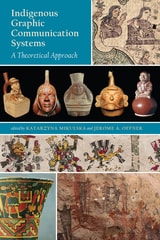
Indigenous Graphic Communication Systems
A Theoretical ApproachKatarzyna Mikulksa
University Press of Colorado, 2025
By examining case studies from across the Americas, the authors pursue an enhanced understanding of Native American graphic communication systems and how the study of graphic expression can provide insight into ancient cultures and societies, expressed in indigenous words. Focusing on examples from Central Mexico and the Andes, the authors explore the overlap among writing, graphic expression, and orality in indigenous societies, inviting reevaluation of the Western notion that writing exists only to record language (the spoken chain of speech) as well as accepted beliefs of Western alphabetized societies about the accuracy, durability, and unambiguous nature of their own alphabetized texts. The volume also addresses the rapidly growing field of semasiography and relocates it more productively as one of several underlying operating principles in graphic communication systems.
Indigenous Graphic Communication Systems reports new results and insights into the meaning of the rich and varied content of indigenous American graphic expression and culture as well as into the societies and cultures that produce them. It will be of great interest to Mesoamericanists, students, and scholars of anthropology, archaeology, art history, ancient writing systems, and comparative world history.
The research for and publication of this book have been supported in part by the National Science Centre of Poland (decision no. NCN-KR-0011/122/13) and the Houston Museum of Natural Science.
Contributors:
Angélica Baena Ramírez, Christiane Clados, Danièle Dehouve, Stanisław Iwaniszewski, Michel R. Oudijk, Katarzyna Szoblik, Loïc Vauzelle, Gordon Whittaker, Janusz Z. Wołoszyn, David Charles Wright-Carr
Indigenous Health and Justice
Edited by Karen Jarratt-Snider and Marianne O. Nielsen
University of Arizona Press, 2024
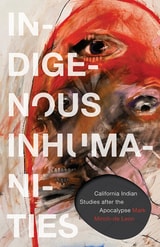
Indigenous Inhumanities
California Indian Studies after the ApocalypseMark Minch-de Leon
University of Minnesota Press, 2025
Reclaiming power and prophecy through California Indian intellectual resurgence and anticolonial resistance
Mark Minch-de Leon explores the anticolonial dimensions of California Indian intellectual and cultural resurgence in the aftermath of apocalypse in this compelling reexamination of Indigenous art, literature, and theory. Centering on a reinterpretation of the Ghost Dance, a ceremony first practiced in the nineteenth century, as a collective demonstration of prophecy and resilience, Indigenous Inhumanities envisions an expanded poetics of resistance through a reconfigured relationship to death and the dead. By dismantling the colonial frameworks of inclusion, recognition, and representation that reinforce settler-state power, Minch-de Leon shows how storytelling can be reclaimed as both research and as a tool for decolonization.
Taking up critical issues that the state has used to discipline California Indian relations to ancestors, such as the politics of human remains repatriation and the discourse around California Indian genocide, Minch-de Leon centers Indigenous knowledge and social systems while challenging legal and political definitions of violence, power, and the human. Rich case studies showcase the evocative art of Frank Day, the poetry of Tommy Pico, and the writings of Deborah Miranda, highlighting how these creators advance Indigenous theory and disrupt settler categories.
By refusing reconciliation and embracing Indigenous frameworks of radical relationality and the “inhuman” (what lies outside of human control), Minch-de Leon presents a bold vision of Indigenous antihumanist survival and resurgence. Indigenous Inhumanities illuminates the path toward decolonial futures by following the radical turn the ancestors made toward the powers of the dead to bring an end to the colonial world.
Retail e-book files for this title are screen-reader friendly with images accompanied by short alt text and/or extended descriptions.
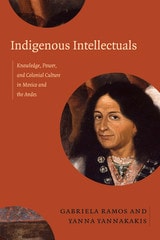
Indigenous Intellectuals
Knowledge, Power, and Colonial Culture in Mexico and the AndesGabriela Ramos and Yanna Yannakakis, eds.
Duke University Press, 2014
Contributors. Elizabeth Hill Boone, Kathryn Burns, John Charles, Alan Durston, María Elena Martínez, Tristan Platt, Gabriela Ramos, Susan Schroeder, John F. Schwaller, Camilla Townsend, Eleanor Wake, Yanna Yannakakis
Indigenous Interfaces
Spaces, Technology, and Social Networks in Mexico and Central AmericaEdited by Jennifer Gómez Menjívar and Gloria Elizabeth Chacón; Foreword by Arturo Arias
University of Arizona Press, 2019
Indigenous Interfaces provides the first thorough examination of indigeneity at the interface of cyberspace. Correspondingly, it examines the impact of new media on the struggles for self-determination that Indigenous peoples undergo in Mexico and Central America. The volume’s contributors highlight the fresh approaches that Mesoamerica’s Indigenous peoples have given to new media—from YouTubing Maya rock music to hashtagging in Zapotec. Together, they argue that these cyberspatial activities both maintain tradition and ensure its continuity. Without considering the implications of new technologies, Indigenous Interfaces argues, twenty-first-century indigeneity in Mexico and Central America cannot be successfully documented, evaluated, and comprehended.
Indigenous Interfaces rejects the myth that indigeneity and information technology are incompatible through its compelling analysis of the relationships between Indigenous peoples and new media. The volume illustrates how Indigenous peoples are selectively and strategically choosing to interface with cybertechnology, highlights Indigenous interpretations of new media, and brings to center Indigenous communities who are resetting modes of communication and redirecting the flow of information. It convincingly argues that interfacing with traditional technologies simultaneously with new media gives Indigenous peoples an edge on the claim to autonomous and sovereign ways of being Indigenous in the twenty-first century.
Contributors
Arturo Arias
Debra A. Castillo
Gloria Elizabeth Chacón
Adam W. Coon
Emiliana Cruz
Tajëëw Díaz Robles
Mauricio Espinoza
Alicia Ivonne Estrada
Jennifer Gómez Menjívar
Sue P. Haglund
Brook Danielle Lillehaugen
Paul Joseph López Oro
Rita M. Palacios
Gabriela Spears-Rico
Paul Worley
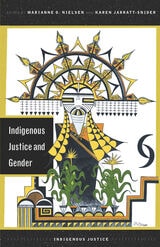
Indigenous Justice and Gender
Edited by Marianne O. Nielsen and Karen Jarratt-Snider
University of Arizona Press, 2023
This new volume offers a broad overview of topics pertaining to gender-related health, violence, and healing. Employing a strength-based approach (as opposed to a deficit model), the chapters address the resiliency of Indigenous women and two-spirit people in the face of colonial violence and structural racism.
The book centers the concept of “rematriation”—the concerted effort to place power, peace, and decision making back into the female space, land, body, and sovereignty—as a decolonial practice to combat injustice. Chapters include such topics as reproductive health, diabetes, missing and murdered Indigenous women, Indigenous women in the academy, and Indigenous women and food sovereignty.
As part of the Indigenous Justice series, this book provides an overview of the topic, geared toward undergraduate and graduate classes.
Contributors
Alisse Ali-Joseph
Michèle Companion
Mary Jo Tippeconnic Fox
Brooke de Heer
Lomayumtewa K. Ishii
Karen Jarratt-Snider
Lynn C. Jones
Anne Luna-Gordinier
Kelly McCue
Marianne O. Nielsen
Linda M. Robyn
Melinda S. Smith
Jamie Wilson
Indigenous Kinship, Colonial Texts, and the Contested Space of Early New England
Marie Balsley Taylor
University of Massachusetts Press, 2023
New England history often treats Indigenous people as minor or secondary actors within the larger colonial story. Focusing on those Native Americans who were sachems, or leaders, in local tribes when Europeans began arriving, Marie Balsley Taylor reframes stories of Indigenous and British interactions and illuminates the vital role that Indigenous kinship and diplomacy played in shaping the textual production of English colonial settlers in New England from the 1630s until King Philip’s War.
Taylor argues that genres like the conversion narrative, the post-sermon question and answer session, and scientific treatise—despite being written in English for European audiences—were jointly created by Indigenous sachems and settlers to facilitate interaction within the contested space of colonial New England. Analyzing the writings of Thomas Shepard, John Eliot, John Winthrop Jr., and Daniel Gookin and the relationships these English Protestants formed with Indigenous leaders like Wequash, Cutshamekin, Cassacinamon, and Waban, this innovative study offers a new approach to early American literature—indicating that Native thought and culture played a profound role in shaping the words and deeds of colonial writers.

Indigenous Knowledge and the Environment in Africa and North America
David M. Gordon
Ohio University Press, 2012
Indigenous knowledge has become a catchphrase in global struggles for environmental justice. Yet indigenous knowledges are often viewed, incorrectly, as pure and primordial cultural artifacts. This collection draws from African and North American cases to argue that the forms of knowledge identified as “indigenous” resulted from strategies to control environmental resources during and after colonial encounters.
At times indigenous knowledges represented a “middle ground” of intellectual exchanges between colonizers and colonized; elsewhere, indigenous knowledges were defined through conflict and struggle. The authors demonstrate how people claimed that their hybrid forms of knowledge were communal, religious, and traditional, as opposed to individualist, secular, and scientific, which they associated with European colonialism.
Indigenous Knowledge and the Environment offers comparative and transnational insights that disturb romantic views of unchanging indigenous knowledges in harmony with the environment. The result is a book that informs and complicates how indigenous knowledges can and should relate to environmental policy-making.
Contributors: David Bernstein, Derick Fay, Andrew H. Fisher, Karen Flint, David M. Gordon, Paul Kelton, Shepard Krech III, Joshua Reid, Parker Shipton, Lance van Sittert, Jacob Tropp, James L. A. Webb, Jr., Marsha Weisiger
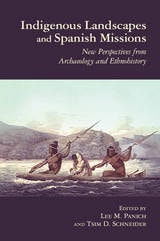
Indigenous Landscapes and Spanish Missions
New Perspectives from Archaeology and EthnohistoryEdited by Lee M. Panich and Tsim D. Schneider
University of Arizona Press, 2014
Offering thoughtful arguments and innovative perspectives, the editors organized the book around three interrelated themes. The first section explores power, politics, and belief, recognizing that Spanish missions were established within indigenous landscapes with preexisting tensions, alliances, and belief systems. The second part, addressing missions from the perspective of indigenous inhabitants, focuses on their social, economic, and historical connections to the surrounding landscapes. The final section considers the varied connections between mission communities and the world beyond the mission walls, including examinations of how mission neophytes, missionaries, and colonial elites vied for land and natural resources.
Indigenous Landscapes and Spanish Missions offers a holistic view on the consequences of missionization and the active negotiation of missions by indigenous peoples, revealing cross-cutting perspectives into the complex and contested histories of the Spanish borderlands. This volume challenges readers to examine deeply the ways in which native peoples negotiated colonialism not just inside the missions themselves but also within broader indigenous landscapes. This book will be of interest to archaeologists, historians, tribal scholars, and anyone interested in indigenous encounters with colonial institutions.
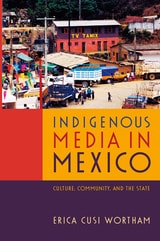
Indigenous Media in Mexico
Culture, Community, and the StateErica Cusi Wortham
Duke University Press, 2013
Drawing on her in-depth ethnographic research among indigenous mediamakers in Mexico, Wortham traces their shifting relationship with Mexican cultural agencies; situates their work within a broader, hemispheric network of indigenous media producers; and complicates the notion of a unified, homogeneous indigenous identity. Her analysis of projects from community-based media initiatives in Oaxaca to the transnational Chiapas Media Project highlights variations in cultural identity and autonomy based on specific histories of marginalization, accommodation, and resistance.
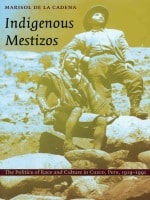
Indigenous Mestizos
The Politics of Race and Culture in Cuzco, Peru, 1919-1991Marisol de la Cadena
Duke University Press, 2000
De la Cadena’s ethnographically and historically rich study examines how indigenous citizens of the city of Cuzco have been conceived by others as well as how they have viewed themselves and places these conceptions within the struggle for political identity and representation. Demonstrating that the terms Indian and mestizo are complex, ambivalent, and influenced by social, legal, and political changes, she provides close readings of everyday concepts such as marketplace identity, religious ritual, grassroots dance, and popular culture, as well as of such common terms as respect, decency, and education. She shows how Indian has come to mean an indigenous person without economic and educational means—one who is illiterate, impoverished, and rural. Mestizo, on the other hand, has come to refer to an urban, usually literate, and economically successful person claiming indigenous heritage and participating in indigenous cultural practices. De la Cadena argues that this version of de-Indianization—which, rather than assimilation, is a complex political negotiation for a dignified identity—does not cancel the economic and political equalities of racism in Peru, although it has made room for some people to reclaim a decolonized Andean cultural heritage.
This highly original synthesis of diverse theoretical arguments brought to bear on a series of case studies will be of interest to scholars of cultural anthropology, postcolonialism, race and ethnicity, gender studies, and history, in addition to Latin Americanists.
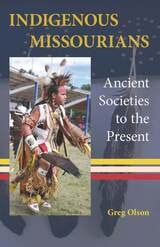
Indigenous Missourians
Ancient Societies to the PresentGreg Olson
University of Missouri Press, 2023
The history of Indigenous people in present-day Missouri is far more nuanced, complex, and vibrant than the often-told tragic stories of conflict with white settlers and forced Indian removal would lead us to believe. In this path-breaking narrative, Greg Olson presents the Show Me State’s Indigenous past as one spanning twelve millennia of Native presence, resilience, and evolution. While previous Missouri histories have tended to include Indigenous people only during periods when they constituted a threat to the state’s white settlement, Olson shows us the continuous presence of Native people that includes the present day.
Beginning thousands of years before the state of Missouri existed, Olson recounts how centuries of inventiveness and adaptability enabled Native people to create innovations in pottery, agriculture, architecture, weaponry, and intertribal diplomacy. Olson also shows how the resilience of Indigenous people like the Osages allowed them to thrive as fur traders, even as settler colonialists waged an all-out policy of cultural genocide against them.
Though the state of Missouri claimed to have forced Indigenous people from its borders after the 1830s, Olson uses U.S. Census records and government rolls from the allotment period to show that thousands remained. In the end, he argues that, with a current population of 27,000 Indigenous people, Missouri remains very much a part of Indian Country, and that Indigenous history is Missouri history.
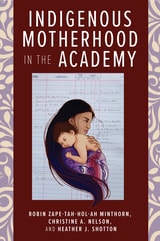
Indigenous Motherhood in the Academy
Robin Zape-tah-hol-ah Minthorn
Rutgers University Press, 2022
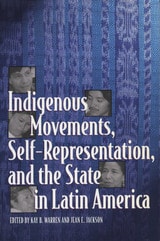
Indigenous Movements, Self-Representation, and the State in Latin America
Edited by Kay B. Warren and Jean E. Jackson
University of Texas Press, 2003
Throughout Latin America, indigenous peoples are responding to state violence and pro-democracy social movements by asserting their rights to a greater measure of cultural autonomy and self-determination. This volume's rich case studies of movements in Colombia, Guatemala, and Brazil weigh the degree of success achieved by indigenous leaders in influencing national agendas when governments display highly ambivalent attitudes about strengthening ethnic diversity.
The contributors to this volume are leading anthropologists and indigenous activists from the United States and Latin America. They address the double binds of indigenous organizing and "working within the system" as well as the flexibility of political tactics used to achieve cultural goals outside the scope of state politics. The contributors answer questions about who speaks for indigenous communities, how indigenous movements relate to the popular left, and how conflicts between the national indigenous leadership and local communities play out in specific cultural and political contexts. The volume sheds new light on the realities of asymmetrical power relations and on the ways in which indigenous communities and their representatives employ Western constructions of subjectivity, alterity, and authentic versus counterfeit identity, as well as how they manipulate bureaucratic structures, international organizations, and the mass media to advance goals that involve distinctive visions of an indigenous future.

Indigenous Narratives of Territory and Creation
Hemispheric PerspectivesPenelope Kelsey and Leila Gómez, special issue editors
Duke University Press, 2020
Contributors. Amber Meadow Adams, Alexandre Belmonte, Enrique Manuel Bernales Albites, Andrew Cowell, Ella Deloria, Leila Gómez, Sarah Hernandez, Penelope Kelsey, José Antonio Mazzotti, Javier Muñoz-Díaz, Craig Perez, Cheryl Savageau, Ángel Tuninetti, Christopher T. Vecsey
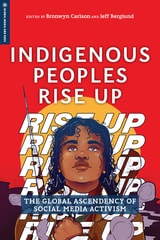
Indigenous Peoples Rise Up
The Global Ascendency of Social Media ActivismBronwyn Carlson
Rutgers University Press, 2021
Including a range of international indigenous voices from the US, Canada, Australia, Aotearoa (New Zealand) and Africa, the book takes an interdisciplinary approach, bridging Indigenous studies, media studies, and social justice studies. Including examples like Idle No More in Canada, Australian Recognise!, and social media campaigns to maintain Maori language, Indigenous Peoples Rise Up serves as one of the first studies of Indigenous social media use and activism.
Indigenous Peoples and Borders
Sheryl Lightfoot and Elsa Stamatopoulou, editors
Duke University Press, 2024
Contributors. Tone Bleie, Andrea Carmen, Jacqueline Gillis, Rauna Kuokkanen, Elifuraha Laltaika, Sheryl Lightfoot, David Bruce MacDonald, Toa Elisa Maldonado Ruiz, Binalakshmi “Bina” Nepram, Melissa Z. Patel, Manoel B. do Prado Junior, Hana Shams Ahmed, Elsa Stamatopoulou, Liubov Suliandziga, Rodion Sulyandziga, Yifat Susskind, Erika M. Yamada
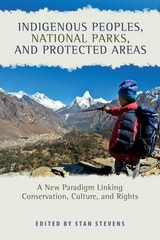
Indigenous Peoples, National Parks, and Protected Areas
A New Paradigm Linking Conservation, Culture, and RightsEdited by Stan Stevens
University of Arizona Press, 2014
Indigenous Peoples, National Parks, and Protected Areas integrates wide-ranging, multidisciplinary intellectual perspectives with detailed analyses of new kinds of protected areas in diverse parts of the world. Eleven geographers and anthropologists contribute nine substantive fieldwork-based case studies. Their contributions offer insights into experience with new conservation approaches in an array of countries, including Australia, Canada, Guatemala, Honduras, Nepal, Nicaragua, Peru, South Africa, and the United States.
This book breaks new ground with its in-depth exploration of changes in conservation policies and practices—and their profound ramifications for Indigenous peoples, protected areas, and social reconciliation.
Indigenous Political Ecology
Clint Carroll
University of Minnesota Press, 2027
Advancing Indigenous and allied voices to address urgent environmental questions at the crossroads of Indigenous and settler state sovereignty
Authored by a group of majority Indigenous scholars from across Canada and the United States, this collection enacts a radical intervention into colonial impulses in traditional political ecology scholarship and its examination of state power in environmental conflicts. Centering the human–nature relationality of Indigenous cosmologies, this book confronts the terms by which land and water degradation, climate change, and other disastrous effects of extractive capitalism are understood.
Drawing on family histories, storytelling, autoethnography, and community-grounded research, Indigenous Political Ecology showcases a deeply self-reflexive examination of intergenerational struggles over land rights and attempts to resist settler colonial dynamics, including struggles over knowledge itself. Contributors recount the fraught history of Bears Ears National Monument, decades of Seminole-led efforts to restore the Everglades ecosystem, the creation of land education programs advancing Cherokee sovereignty, the impact of mining development on Mushkegowuk homelands in the Ring of Fire, and many other ongoing stories in which the “ecological” and “political” are being redefined.
Through its collectively led efforts and transdisciplinary approach, Indigenous Political Ecology models a new type of environmental scholarship that considers its modes of production integral to its contributors’ broader ethical and political commitments. Rooted in Indigenous sovereignty and self-determination, this groundbreaking volume sets forth a powerful blueprint for a more just and sustainable path through the field of political ecology.
Contributors: Nicholas A. Brown, Jessica R. Catellino, Andrew Curley, Michelle Daigle, Jean Dennison, Ashley Nichole Lewis, Beth Rose Middleton Manning, Teresa Montoya, Dana E. Powell, Kyle Powys Whyte, Jen Rose Smith, Lisa Wilson.
Retail e-book files for this title are screen-reader friendly with images accompanied by short alt text and/or extended descriptions.
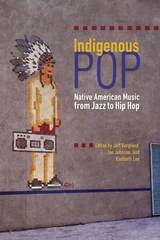
Indigenous Pop
Native American Music from Jazz to Hip HopEdited by Jeff Berglund, Jan Johnson, and Kimberli Lee
University of Arizona Press, 2016
From Joe Shunatona and the United States Indian Reservation Orchestra to Jim Pepper, from Buffy Saint-Marie to Robbie Robertson, from Joy Harjo to Lila Downs, Indigenous Pop vividly addresses the importance of Native musicians and popular musical genres, establishing their origins and discussing what they represent.
Arranged both chronologically and according to popular generic forms, the book gives Indigenous pop a broad new meaning. In addition to examining the transitive influences of popular music on Indigenous expressive forms, the contributors also show ways that various genres have been shaped by what some have called the “Red Roots” of American-originated musical styles. This recognition of mutual influence extends into the ways of understanding how music provides methodologies for living and survival.
Each in-depth essay in the volume zeros in on a single genre and in so doing exposes the extraordinary whole of Native music. This book showcases the range of musical genres to which Native musicians have contributed and the unique ways in which their engagement advances the struggle for justice and continues age-old traditions of creative expression.
Indigenous Reparations and Settler Colonial Reckoning
Re-Braiding Rights and Redress in CanadaPauline Wakeham
University of Minnesota Press, 2026
How Indigenous communities are transforming the idea and practice of reparations through their laws and leadership
In recent decades, a growing number of Indigenous groups across Canada have initiated movements for colonial reparations. Too often, the settler state has responded by attempting to enfold their work into a narrative of reconciliation that consigns colonialism to “sad chapters” of history. In this book, Pauline Wakeham calls attention to the ways that Indigenous reparations movements exceed state reconciliatory frameworks and prompt a deeper reckoning with the enduring structures of settler colonialism.
To expose and redress colonial injustices, Indigenous reparations movements draw upon long local traditions of political organizing as well as transformations on the global stage since World War II. As international law formulated new instruments regarding gross human rights violations, atrocity crimes, and the reparative obligations of states, colonized peoples across the world have sought to mobilize these mechanisms in their struggles for decolonization and reparations. While international law has provided strategic tools for this work, the colonial foundations of the field continue to limit how it conceptualizes and shapes access to justice. Indigenous Reparations and Settler Colonial Reckoning traces the specific implications for Indigenous nations whose land is occupied by settler states—nations whose legal orders remain subordinated to both settler “domestic” and international legal systems.
Amid this complex multijurisdictional terrain, how are Indigenous peoples carving out space to articulate their own visions of justice? To answer this question, Wakeham learns from the Inuit-led Qikiqtani Truth Commission as well as reparations movements for residential schools and the High Arctic Relocations of 1953 and 1955. These movements offer powerful lessons about the importance of centering Indigenous leadership and laws in redress processes, thereby connecting reparations to the living enactment of Indigenous rights.
Retail e-book files for this title are screen-reader friendly with images accompanied by short alt text and/or extended descriptions.
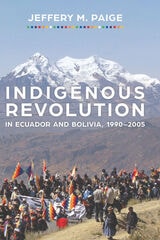
Indigenous Revolution in Ecuador and Bolivia, 1990–2005
Jeffery M. Paige
University of Arizona Press, 2020
Uprisings by indigenous peoples of Ecuador and Bolivia between 1990 and 2005 overthrew the five-hundred-year-old racial and class order inherited from the Spanish Empire. It started in Ecuador with the Great Indigenous Uprising, which was fought for cultural and economic rights. A few years later massive indigenous mobilizations began in Bolivia, culminating in 2005 with the election of Evo Morales, the first indigenous president.
Jeffrey M. Paige, an internationally recognized authority on the sociology of revolutionary movements, interviewed forty-five indigenous leaders who were actively involved in the uprisings. The leaders recount how peaceful protest and electoral democracy paved the path to power. Through the interviews, we learn how new ideologies of indigenous socialism drew on the deep commonalities between the communal dreams of their ancestors and the modern ideology of democratic socialism. This new discourse spoke to the people most oppressed by both withering racism and neoliberal capitalism.
Emphasizing mutual respect among ethnic groups (including the dominant Hispanic group), the new revolutionary dynamic proposes a communal worldview similar to but more inclusive than Western socialism because it adds indigenous cultures and nature in a spiritual whole. Although absent in the major revolutions of the past century, the themes of indigenous revolution—democracy, indigeneity, spirituality, community, and ecology—are critically important.
Paige’s interviews present the powerful personal experiences and emotional intensity of the revolutionary leadership. They share the stories of mass mobilization, elections, and indigenous socialism that created a new form of twenty-first-century revolution with far-reaching applications beyond the Andes.
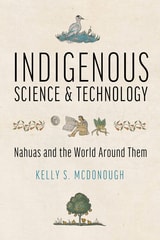
Indigenous Science and Technology
Nahuas and the World Around ThemKelly S. McDonough
University of Arizona Press, 2024
Winner 2025 Bryce Wood Book Award
This is a book about how Nahuas—native speakers of Nahuatl, the common language of the Aztec Empire and of more than 2.5 million Indigenous people today—have explored, understood, and explained the world around them in pre-invasion, colonial, and contemporary time periods. It is a deep dive into Nahua theoretical and practical inquiry related to the environment, as well as the dynamic networks in which Nahuas create, build upon, and share knowledges, practices, tools, and objects to meet social, political, and economic needs.
In this work, author Kelly S. McDonough addresses Nahua understanding of plants and animals, medicine and ways of healing, water and water control, alphabetic writing, and cartography. Interludes between the chapters offer short biographical sketches and interviews with contemporary Nahua scientists, artists, historians, and writers, accompanied by their photos. The book also includes more than twenty full-color images from sources including the Florentine Codex, a sixteenth-century collaboration between Indigenous and Spanish scholars considered the most comprehensive extant source on the pre-Hispanic and early colonial Aztec (Mexica) world.
In Mexico today, the terms “Indigenous” and “science and technology” are rarely paired together. When they are, the latter tend to be framed as unrecoverable or irreparably damaged pre-Hispanic traditions, relics confined to a static past. In Indigenous Science and Technology, McDonough works against such erroneous and racialized discourses with a focus on Nahua environmental engagements and relationalities, systems of communication, and cultural preservation and revitalization. Attention to these overlooked or obscured knowledges provides a better understanding of Nahua culture, past and present, as well as the entangled local and global histories in which they were—and are—vital actors.
Indigenous Textual Cultures
Reading and Writing in the Age of Global EmpireTony Ballantyne, Lachy Paterson, and Angela Wanhalla, editors
Duke University Press, 2020
Contributors. Noelani Arista, Tony Ballantyne, Alban Bensa, Keith Thor Carlson, Evelyn Ellerman, Isabel Hofmeyr, Emma Hunter, Arini Loader, Adrian Muckle, Lachy Paterson, Laura Rademaker, Michael P. J. Reilly, Bruno Saura, Ivy T. Schweitzer, Angela Wanhalla
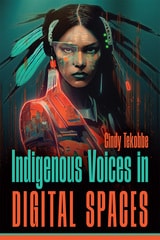
Indigenous Voices in Digital Spaces
Cindy Tekobbe
Utah State University Press, 2024
Tekobbe’s methods for analyzing and understanding Indigenous knowledges online center Indigenous storytelling and “thick” (broad, deep, and complex) Indigenous meaning-making. Employing this thickness to interpret Indigenous knowledge ways resists the settler-colonial logics that tend to flatten complex Indigenous concepts into one-note representations of racial stereotypes. Native Americans’ use of social media and digital platforms to support social movements uniquely constructs Indigenous identities as living, producing, and culture-making people, which confronts the commonplace, one-dimensional narrative that Indigenous North Americans either live in isolation or are people of history resigned to the long-forgotten past. Tekobbe’s methods are applicable to additional online research to break through Western paradigms of oppositional critique, the colonial power matrix embedded in hierarchical and taxonomical classification systems, and participant objectification.
Indigenous Voices in Digital Spaces offers new methodological and epistemological opportunities to explore digital communities and technologies, problematizing conventional Western critique. This book is useful to instructors in Indigenous studies, internet studies, digital literacies, cultural studies, and communications, as well as Indigenous and internet studies researchers.
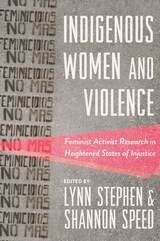
Indigenous Women and Violence
Feminist Activist Research in Heightened States of InjusticeEdited by Lynn Stephen and Shannon Speed
University of Arizona Press, 2021
Indigenous Women and Violence is built on engaging case studies that highlight the individual and collective struggles that Indigenous women face from the racial and gendered oppression that structures their lives. Gendered violence has always been a part of the genocidal and assimilationist projects of settler colonialism, and it remains so today. These structures—and the forms of violence inherent to them—are driving criminalization and victimization of Indigenous men and women, leading to escalating levels of assassination, incarceration, or transnational displacement of Indigenous people, and especially Indigenous women.
This volume brings together the potent ethnographic research of eight scholars who have dedicated their careers to illuminating the ways in which Indigenous women have challenged communities, states, legal systems, and social movements to promote gender justice. The chapters in this book are engaged, feminist, collaborative, and activism focused, conveying powerful messages about the resilience and resistance of Indigenous women in the face of violence and systemic oppression.
Contributors: R. Aída Hernández-Castillo, Morna Macleod, Mariana Mora, María Teresa Sierra, Shannon Speed, Lynn Stephen, Margo Tamez, Irma Alicia Velásquez Nimatuj
Indigenous Women and Work
From Labor to ActivismEdited by Carol Williams
University of Illinois Press, 2012
Indigenous and Popular Thinking in América
Rodolfo Kusch
Duke University Press, 2010
Indigenous and Popular Thinking in América is a record of Kusch's attempt to immerse himself in the indigenous ways of knowing and being. At first glance, his methodology resembles ethnography. He speaks with and observes indigenous people and mestizos in Peru, Bolivia, and Argentina. He questions them about their agricultural practices and economic decisions; he observes rituals; he asks women in the market the meaning of indigenous talismans; he interviews shamans; he describes the spatial arrangement and the contents of shrines, altars, and temples; and he reproduces diagrams of archaeological sites, which he then interprets at length. Yet he does not present a "them" to a putative "us." Instead, he offers an inroad to a way of thinking and being that does not follow the logic or fit into the categories of Western social science and philosophy. In his introduction, Walter D. Mignolo discusses Kusch's work and its relation to that of other twentieth-century intellectuals, Argentine history, and contemporary scholarship on the subaltern and decoloniality.
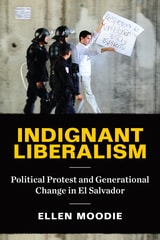
Indignant Liberalism
Political Protest and Generational Change in El SalvadorEllen Moodie
University of Texas Press, 2026
Documenting the rise and disillusionment of El Salvador’s postwar activists in the face of populist authoritarian politics.
The conclusion of El Salvador’s long civil war, in 1992, was supposed to bring about equality and political freedom. Leftist insurgents laid down arms, and the government formally embraced liberal ideals. Yet today, El Salvador is ruled by an authoritarian president who was reelected via unconstitutional means. What went wrong?
Anthropologist and journalist Ellen Moodie embedded with indignados—young middle-class protestors, demanding that the government live up to its liberal commitments—to better understand the course of political change since the civil war. Yet the “post-postwar” generation is only the latest demographic disappointed with liberalism in practice. Moodie examines a nineteenth-century “racial liberalism” that saw descendants of colonists “civilizing” Indigenous people while dispossessing them of lands and mobilizing them for labor. Today, the failure to make good on the promises of postwar liberalism has inspired robust support for strongman Nayib Bukele. Moodie argues that El Salvador’s case, though inflected by local concerns, is not unique. Rather, it is another stark demonstration of how liberalism’s imaginary social contract gives rise to populist authoritarianism.

Indirect Action
Schizophrenia, Epilepsy, AIDS, and the Course of Health ActivismLisa Diedrich
University of Minnesota Press, 2016
The experience of illness (both mental and physical) figures prominently in the critical thought and activism of the 1960s and 1970s, though it is largely overshadowed by practices of sexuality. Lisa Diedrich explores how and why illness was indeed so significant to the social, political, and institutional transformation beginning in the 1960s through the emergence of AIDS in the United States. A rich intervention—both theoretical and methodological, political and therapeutic—Indirect Action illuminates the intersection of illness, thought, and politics.
Not merely a revision of the history of this time period, Indirect Action expands the historiographical boundaries through which illness and health activism in the United States have been viewed. Diedrich explores the multiplicity illness–thought–politics through an array of subjects: queering the origin story of AIDS activism by recalling its feminist history; exploring health activism and the medical experience; analyzing psychiatry and self-help movements; thinking ecologically about counterpractices of generalism in science and medicine; and considering the experience and event of epilepsy and the witnessing of schizophrenia.
Indirect Action places illness in the leading role in the production of thought during the emergence of AIDS, ultimately showing the critical interconnectedness of illness and political and critical thought.

Indirect Subjects
Nollywood's Local AddressMatthew H. Brown
Duke University Press, 2021

Indiscreet Fantasies
Iberian Queer CinemaAndrés Lema-Hincapié
Bucknell University Press, 2021
Published by Bucknell University Press. Distributed worldwide by Rutgers University Press.
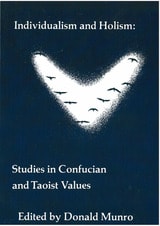
Individualism and Holism
Studies in Confucian and Taoist ValuesDonald J. Munro, Editor
University of Michigan Press, 1985
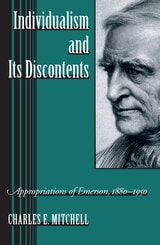
Individualism and Its Discontents
Appropriations of Emerson, 1880-1950Charles E. Mitchell
University of Massachusetts Press, 1997
The work of Ralph Waldo Emerson has long been synonymous with the American ideals of self-reliance and individualism. Like those ideals, it has come to mean different things, at different times, to different people. Emerson has been identified as the source of both the best and worst in the American intellectual tradition, his authority invoked by back-to-the-landers and industrial capitalists, the philosopher Nietzsche, as well as the promoters of Nike footwear.
This book explores the intertwined history of Emerson and individualism. Charles E. Mitchell begins by examining those who regarded Emersonian individualism with ambivalence or hostility, focusing on the comments of such diverse figures as Henry James, Sr., Oliver Wendell Holmes, Van Wyck Brooks, and H.L. Mencken. He then offers an alternative view as reflected in the work of William James, John Dewey, W.E.B. Du Bois, and William Carlos Williams. Each of these figures embraced Emerson’s claim for the sanctity of the individual and wove it into a social vision that sought to reconcile the paradox at the heart of American life: a simultaneous devotion to the community and the individual, tradition and innovation, order and freedom.
While indirectly answering Emerson’s more fervent critics, James, Dewey, Du Bois, and Williams also constructed a vibrant tradition of their own, one that offers guidance as Americans continue to struggle with these competing claims.

Individuality Incorporated
Indians and the Multicultural ModernJoel Pfister
Duke University Press, 2004

Indonesian Buddhist Bronzes in the Making of Maritime Asia
Mathilde Mechling
National University of Singapore Press, 2027
Studies bronze icons of Hindu and Buddhist deities to better understand the flow of ideas across the sea routes of Maritime Asia in the first millennium.
While the great temples of Southeast Asia have inspired research in the past, the careful study of their smaller and more portable counterparts—bronze icons of Hindu and Buddhist deities—gives us a more dynamic understanding of the movement of beliefs and practices across Asia. These sacred images—found across Java, Sumatra, Kalimantan, and Sulawesi—rank alongside monumental temple complexes like Borobudur as among the most significant artistic and religious achievements of the region. Yet they have too often been treated as mere antiquities, prized for their beauty but stripped of their deeper historical meaning.
Mechling recovers what these bronzes can actually tell us. By tracing their distribution patterns alongside their artistic style, iconography, fabrication techniques, and metal compositions, she reconstructs the shared cults, ritual practices, and technological relationships that linked communities across the western Indonesian archipelago and beyond from the sixth to the tenth century. The picture that emerges overturns a long-held scholarly paradigm—inherited from the colonial era—of passive Southeast Asian reception of Indian cultural influence. In its place, Indonesian Buddhist Bronzes in the Making of Maritime Asia reveals a world of multi-directional exchange among active, cosmopolitan participants whose networks of creativity and devotion shaped one of history's most dynamic cultural crossroads.