Results by title
28164 books match the query 'History' and 997 start with i
Indo-European Sacred Space
Vedic and Roman CultRoger D. Woodard
University of Illinois Press, 2006
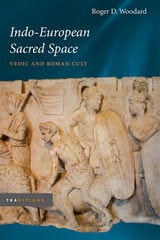
Looking closely at the organization of Roman religious activity, especially as regards sacrifices, festivals, and the hierarchy of priests, Woodard sheds new light on issues including the presence of the god Terminus in Jupiter's Capitoline temple, the nature of the Roman suovetaurilia, the Ambarvalia and its relationship to the rites of the Fratres Arvales, and the identification of the "Sabine" god Semo Sancus. Perhaps most significantly, this work also presents a novel and persuasive resolution to the long standing problem of "agrarian Mars."
Indonesian Notebook
A Sourcebook on Richard Wright and the Bandung ConferenceBrian Russell Roberts and Keith Foulcher, editors
Duke University Press, 2016
Induction
Socrates to PopperJohn P. McCaskey
University of Chicago Press, 2026
Charts the historical development of induction and challenges contemporary understandings of the concept and its foundations.
The problem of induction continues to vex and beguile. How can we reliably draw universal conclusions from limited observations? In Induction, John P. McCaskey steps back and rethinks long-held assumptions, tracing the ideas of Socrates and Aristotle in ancient Greece to those of Karl Popper in the twentieth century.
This comprehensive account does not look at how people of the past answered the questions we ask today. Instead, it asks: How did they understand the very meaning of the words epagōgē in Greek, inductio in Latin, istiqrāʾ in Arabic, Induktion in German, and induction in English? McCaskey’s careful treatment of texts in their context dispels many long-standing myths, and importantly, he introduces us to a now-unfamiliar way to think about what induction is—a way in which there simply is no “problem of induction.” McCaskey reveals that the problem was one of our own making and that an accurate history may help us recover old ways—and thereby introduce new ways—to think about the whole idea. A must-read for philosophers, historians of ideas, and anyone interested in the scientific method.
Industrial Sexuality
Gender, Urbanization, and Social Transformation in EgyptBy Hanan Hammad
University of Texas Press, 2016
Sara A. Whaley Book Prize, National Women's Studies Association, 2017
AMEWS Book Award, Journal of Middle Eastern Studies, 2017
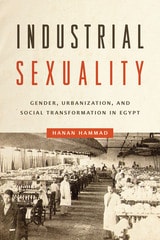
Millions of Egyptian men, women, and children first experienced industrial work, urban life, and the transition from peasant-based and handcraft cultures to factory organization and hierarchy in the years between the two world wars. Their struggles to live in new places, inhabit new customs, and establish and abide by new urban norms and moral and gender orders underlie the story of the making of modern urban life—a story that has not been previously told from the perspective of Egypt’s working class.
Reconstructing the ordinary urban experiences of workers in al-Mahalla al-Kubra, home of the largest and most successful Egyptian textile factory, Industrial Sexuality investigates how the industrial urbanization of Egypt transformed masculine and feminine identities, sexualities, and public morality. Basing her account on archival sources that no researcher has previously used, Hanan Hammad describes how coercive industrial organization and hierarchy concentrated thousands of men, women, and children at work and at home under the authority of unfamiliar men, thus intensifying sexual harassment, child molestation, prostitution, and public exposure of private heterosexual and homosexual relationships. By juxtaposing these social experiences of daily life with national modernist discourses, Hammad demonstrates that ordinary industrial workers, handloom weavers, street vendors, lower-class landladies, and prostitutes—no less than the middle and upper classes—played a key role in shaping the Egyptian experience of modernity.

Industrial Strength Bluegrass
Southwestern Ohio's Musical LegacyEdited by Fred Bartenstein and Curtis W. Ellison
University of Illinois Press, 2021
Revelatory and multifaceted, Industrial Strength Bluegrass shares the inspiring story of a bluegrass hotbed and the people who created it.
Contributors: Fred Bartenstein, Curtis W. Ellison, Jon Hartley Fox, Rick Good, Lily Isaacs, Ben Krakauer, Mac McDivitt, Nathan McGee, Daniel Mullins, Joe Mullins, Larry Nager, Phillip J. Obermiller, Bobby Osborne, and Neil V. Rosenberg.
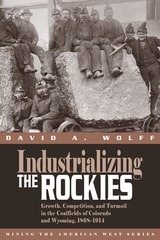
Industrializing the Rockies
Growth, Competition, and Turmoil in the Coalfields of Colorado and Wyoming, 1868-1914David A. Wolff
University Press of Colorado, 2014
In Industrializing the Rockies, David A. Wolff places these deadly conflicts and strikes in the context of the Western coal industry from its inception in 1868 to the age of maturity in the early twentieth century. The result is the first book-length study of the emergence of coalfield labor relations and a general overview of the role of coal mining in the American West.
Wolff examines the coal companies and the owners' initial motivations for investment and how these motivations changed over time. He documents the move from speculation to stability in the commodities market, and how this was reflected in the development of companies and company towns.
Industrializing the Rockies also examines the workers and their workplaces: how the miners and laborers struggled to maintain mining as a craft and how the workforce changed, ethnically and racially, eventually leading to the emergence of a strong national union. Wolff shines light on the business of coal mining detailing the market and economic forces that influenced companies and deeply affected the lives of the workers.
Industry and the Creative Mind
The Eccentric Writer in American Literature and Entertainment, 1790-1860Sandra Tomc
University of Michigan Press, 2012
Industry and the Creative Mind takes a radically new look at the figure of the eccentric, alienated writer in American literature and entertainment from 1790 to 1860. Traditional scholarship takes for granted that the eccentric writer, modeled by such Romantic beings as Lord Byron and brought to life for American audiences by the gloomy person of Edgar Allan Poe, was a figure of rebellion against the excesses of modern commercial culture and industrial life. By contrast, Industry and the Creative Mind argues that in the United States myths of writerly moodiness, alienation, and irresponsibility predated the development of a commercial arts and entertainment industry and instead of forming a site of rebellion from this industry formed a bedrock for its development. Looking at the careers of a number of early American writers---Joseph Dennie, Nathaniel Parker Willis, Edgar Allan Poe, Fanny Fern, as well as a host of now forgotten souls who peopled the twilight worlds of hack fiction and industrial literature---this book traces the way in which early nineteenth-century American arts and entertainment systems incorporated writerly eccentricity in their "logical" economic workings, placing the mad, rebellious writer at the center of the industry's productivity and success.

Industry, the State, and Public Policy in Mexico
By Dale Story
University of Texas Press, 1986
The industrialization process in Mexico began before that of any other nation in Latin America except Argentina, with the most rapid expansion of new industrial firms occurring in the 1930s and 1940s, and import substitution in capital goods evident as early as the late 1930s. Though Mexico’s trade relations have always been dependent on the United States, successive Mexican presidents in the postwar period attempted to control the penetration of foreign capital into Mexican markets.
In Industry, the State, and Public Policy in Mexico, Dale Story, recognizing the significance of the Mexican industrial sector, analyzes the political and economic role of industrial entrepreneurs in postwar Mexico. He uses two original data sets—industrial production data for 1929–1983 and a survey of the political attitudes of leaders of the two most important industrial organizations in Mexico—to address two major theoretical arguments relating to Latin American development: the meaning of late and dependent development and the nature of the authoritarian state. Story accepts the general relevance of these themes to Mexico but asserts that the country is an important variant of both.
With regard to the authoritarian thesis, the Mexican authoritarian state has demonstrated some crucial distinctions, especially between popular and elite sectors. The incorporation of the popular sector groups has closely fit the characteristics of authoritarianism, but the elite sectors have operated fairly independently of state controls, and the government has employed incentives or inducements to try to win their cooperation.
In short, industrialists have performed important functions, not only in accumulating capital and organizing economic enterprises but also by bringing together the forces of social change. Industrial entrepreneurs have emerged as a major force influencing the politics of growth, and the public policy arena has become a primary focus of attention for industrialists since the end of World War II.
Inequality in Early America
Carla Gardina Pestana
Dartmouth College Press, 2015

Inequality, Crime, and Resistance in New York City
Timothy P. R. Weaver
Temple University Press, 2025
Weaver brings these clashes to the fore by showing how New York City politics has been shaped by these conflicting orders. He examines the transformation of the city’s political economy in the aftermath of the 1975 fiscal crisis through neoliberal real estate development and privatization, the conservative rise of law-and-order politics in the 1970s to 1990s, and the efforts of the city’s egalitarians to respond to each of these shifts through social movements such as Occupy and Black Lives Matter.
Inequality, Crime, and Resistance in New York City belies glib assumptions about the city’s liberal character. Weaver reveals the metropolis not as a homogenous political whole, but as a site in which the victories and defeats of rival political forces change the terms of local citizenship for the millions of residents who call the city home.
In the series Political Lessons from American Cities
Inextricably Bonded
Israeli Arab and Jewish Writers Re-Visioning CultureRachel Feldhay Brenner
University of Wisconsin Press, 2003
Despite the tragic reality of the continuing Israeli-Arab conflict and deep-rooted beliefs that the chasm between Israeli Jews and Israeli Arabs is unbridgeable, this book affirms the bonds between the two communities. Rachel Feldhay Brenner demonstrates that the literatures of both ethnic groups defy the ideologies that have obstructed dialogue between the two peoples.
Brenner argues that literary critics have ignored the variety and the dissent in the novels of both Arab and Jewish writers in Israel, giving them interpretations that embrace the politics of exclusion and conform with Zionist ideology. Brenner offers insightful new readings that compare fiction by Jewish writers Amos Oz, A.B. Yehoshua, David Grossman, and others with fiction written in Hebrew by such Arab-Israeli writers as Atallah Mansour, Emile Habiby, and Anton Shammas. This parallel analysis highlights the moral and psychological dilemmas faced by both the Jewish victors and the Arab vanquished, and Brenner suggests that the hope for release from the historical trauma lies—on both sides—in reaching an understanding with and of the adversary.
Drawing upon the theories of Walter Benjamin, Jacques Lacan, Sigmund Freud, Emanuel Levinas, and others, Inextricably Bonded is an innovative and illuminating examination of literary dissent from dominant ideology.

Infamous Desire
Male Homosexuality in Colonial Latin AmericaEdited by Pete Sigal
University of Chicago Press, 2003
Inference and Representation
A Study in Modeling ScienceMauricio Suárez
University of Chicago Press, 2024
Mauricio Suárez develops a conception of representation that delivers a compelling account of modeling practice. He begins by discussing the history and methodology of model building, charting the emergence of what he calls the modeling attitude, a nineteenth-century and fin de siècle development. Prominent cases of models, both historical and contemporary, are used as benchmarks for the accounts of representation considered throughout the book. After arguing against reductive naturalist theories of scientific representation, Suárez sets out his own account: a case for pluralism regarding the means of representation and minimalism regarding its constituents. He shows that scientists employ a variety of modeling relations in their representational practice—which helps them to assess the accuracy of their representations—while demonstrating that there is nothing metaphysically deep about the constituent relation that encompasses all these diverse means.
The book also probes the broad implications of Suárez’s inferential conception outside scientific modeling itself, covering analogies with debates about artistic representation and philosophical thought over the past several decades.

Inferno in Chechnya
The Russian-Chechen Wars, the Al Qaeda Myth, and the Boston Marathon BombingsBrian Glyn Williams
University Press of New England, 2015

Infested
How the Bed Bug Infiltrated Our Bedrooms and Took Over the WorldBrooke Borel
University of Chicago Press, 2015
In Infested, Borel introduces readers to the biological and cultural histories of these amazingly adaptive insects, and the myriad ways in which humans have responded to them. She travels to meet with scientists who are rearing bed bug colonies—even by feeding them with their own blood (ouch!)—and to the stages of musicals performed in honor of the pests. She explores the history of bed bugs and their apparent disappearance in the 1950s after the introduction of DDT, charting how current infestations have flourished in direct response to human chemical use as well as the ease of global travel. She also introduces us to the economics of bed bug infestations, from hotels to homes to office buildings, and the expansive industry that has arisen to combat them.
Hiding during the day in the nooks and seams of mattresses, box springs, bed frames, headboards, dresser tables, wallpaper, or any clutter around a bed, bed bugs are thriving and eager for their next victim. By providing fascinating details on bed bug science and behavior as well as a captivating look into the lives of those devoted to researching or eradicating them, Infested is sure to inspire at least a nibble of respect for these tenacious creatures—while also ensuring that you will peek beneath the sheets with prickly apprehension.
Infinite Repertoire
On Dance and Urban Possibility in Postsocialist GuineaAdrienne J. Cohen
University of Chicago Press, 2021

Infinity Net
The Autobiography of Yayoi KusamaYayoi Kusama
University of Chicago Press, 2011
In 1957, encouraged by Georgia O’Keeffe, artist Yayoi Kusama left Japan for New York City to become a star. By the time she returned to her home country in 1973, she had established herself as a leader of New York’s avant-garde movement, known for creating happenings and public orgies to protest the Vietnam War and for the polka dots that had become a trademark of her work. Her sculptures, videos, paintings, and installations are to this day included in major international exhibitions.
Influences
Art, Optics, and Astrology in the Italian RenaissanceMary Quinlan-McGrath
University of Chicago Press, 2013

Influenza and Inequality
One Town's Tragic Response to the Great Epidemic of 1918Patricia J. Fanning
University of Massachusetts Press, 2010
By 1918, Norwood was a small, ethnically diverse, industrialized, and stratified community. Ink, printing, and tanning factories were owned by wealthy families who lived privileged lives. These industries attracted immigrant laborers who made their homes in several ethnic neighborhoods and endured prejudice and discrimination at the hands of native residents. When the epidemic struck, the immigrant neighborhoods were most affected; a fact that played a significant role in the town's response—with tragic results.
This close analysis of one town's struggle illuminates how even well-intentioned elite groups may adopt and implement strategies that can exacerbate rather than relieve a medical crisis. It is a cautionary tale that demonstrates how social behavior can be a fundamental predictor of the epidemic curve, a community's response to crisis, and the consequences of those actions.
Informal Cities
Histories of Governance and Inequality in Latin Europe, Latin America, and Colonial North AfricaEdited by Charlotte Vorms and Brodwyn Fischer
University of Chicago Press, 2025
An empirically rich reconstruction of how informality became an intrinsic part of urban life across three continents.
Over a quarter of the world’s urban population lives in informal settlements. While informality as a concept has been widely debated, we still know very little about the phenomenon’s urban history or how that history has shaped the evolution of world cities. Spotlighting the historical processes that have created and sustained urban informality for more than a century, editors Charlotte Vorms and Brodwyn Fischer and this volume’s contributors reveal informality as an intrinsic feature of urbanity, shaping not only cities across the globe but also deeper processes of state formation, socioeconomic stratification, and political struggle.
The volume brings together case studies spanning more than a hundred years, drawn from Latin America (Brazil, Chile, Venezuela, and Mexico), Northern Africa (Morocco and Algeria), and Latin Europe (France, Spain, and Italy). Together, they show that informality is neither a contemporary crisis nor a predicament unique to the Global South. Topics include the origins of informal settlements and their relationship with law and institutional power; grassroots efforts to legitimize shantytown communities; mass social movements for rights to the city; the role that shantytown removal campaigns played in populist politics, fascism, and colonialism; and the ways that informality perpetuated racial and ethnic inequalities. Informal Cities is an indispensable guide to the complex and fraught terrain of urban informality in its many historical guises.
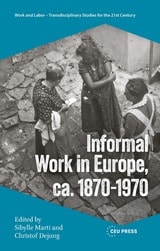
Informal Work in Europe, ca. 1870–1970
Sibylle Marti
Central European University Press, 2026

Information Fantasies
Precarious Mediation in Postsocialist ChinaXiao Liu
University of Minnesota Press, 2019
Winner of the Science Fiction Research Association Book Award
A groundbreaking, alternate history of information technology and information discourses
Although the scale of the information economy and the impact of digital media on social life in China today could pale that of any other country, the story of their emergence in the post-Mao sociopolitical environment remains untold. Information Fantasies offers a revisionist account of the emergence of the “information society,” arguing that it was not determined by the technology of digitization alone but developed out of a set of techno-cultural imaginations and practices that arrived alongside postsocialism.
Anticipating discussions on information surveillance, data collection, and precarious labor conditions today, Xiao Liu goes far beyond the current scholarship on internet and digital culture in China, questioning the limits of current new-media theory and history, while also salvaging postsocialism from the persistent Cold War structure of knowledge production.
Ranging over forgotten science fiction, unjustly neglected films, corporeal practices such as qigong, scientific journals, advertising, and cybernetic theories, Information Fantasies constructs an alternate genealogy of digital and information imaginaries—one that will change how we look at the development of the postsocialist world and the emergence of digital technologies.
Information Gathering in Classical Greece
Frank S. Russell
University of Michigan Press, 2000

Information and Experimental Knowledge
James Mattingly
University of Chicago Press, 2021
What is experimental knowledge, and how do we get it? While there is general agreement that experiment is a crucial source of scientific knowledge, how experiment generates that knowledge is far more contentious. In this book, philosopher of science James Mattingly explains how experiments function. Specifically, he discusses what it is about experimental practice that transforms observations of what may be very localized, particular, isolated systems into what may be global, general, integrated empirical knowledge. Mattingly argues that the purpose of experimentation is the same as the purpose of any other knowledge-generating enterprise—to change the state of information of the knower. This trivial-seeming point has a non-trivial consequence: to understand a knowledge-generating enterprise, we should follow the flow of information. Therefore, the account of experimental knowledge Mattingly provides is based on understanding how information flows in experiments: what facilitates that flow, what hinders it, and what characteristics allow it to flow from system to system, into the heads of researchers, and finally into our store of scientific knowledge.
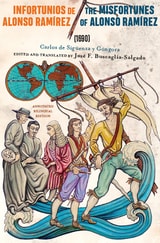
Infortunios de Alonso Ramirez / The Misfortunes of Alonso Ramirez (1690)
Annotated Bilingual EditionBuscaglia-Salgado, José F
Rutgers University Press, 2018

Infrastructural Development, Corruption, Xenophobia, and Colonization in Central and Southeastern Europe
Silvia Marton
Central European University Press, 2026
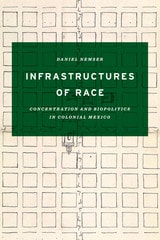
Infrastructures of Race
Concentration and Biopolitics in Colonial MexicoBy Daniel Nemser
University of Texas Press, 2017
Winner, Humanities Book Prize, Mexico Section of the Latin American Studies Association, 2018
Many scholars believe that the modern concentration camp was born during the Cuban war for independence when Spanish authorities ordered civilians living in rural areas to report to the nearest city with a garrison of Spanish troops. But the practice of spatial concentration—gathering people and things in specific ways, at specific places, and for specific purposes—has a history in Latin America that reaches back to the conquest. In this paradigm-setting book, Daniel Nemser argues that concentration projects, often tied to urbanization, laid an enduring, material groundwork, or infrastructure, for the emergence and consolidation of new forms of racial identity and theories of race.
Infrastructures of Race traces the use of concentration as a technique for colonial governance by examining four case studies from Mexico under Spanish rule: centralized towns, disciplinary institutions, segregated neighborhoods, and general collections. Nemser shows how the colonial state used concentration in its attempts to build a new spatial and social order, and he explains why the technique flourished in the colonies. Although the designs for concentration were sometimes contested and short-lived, Nemser demonstrates that they provided a material foundation for ongoing processes of racialization. This finding, which challenges conventional histories of race and mestizaje (racial mixing), promises to deepen our understanding of the way race emerges from spatial politics and techniques of population management.
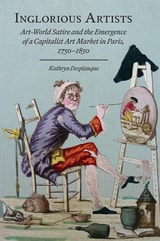
Inglorious Artists
Art World Satire and the Emergence of a Capitalist Art Market in Paris, 1750-1850Kathryn Desplanque
University of Delaware Press, 2025
This book is also freely available online as an open access digital edition.
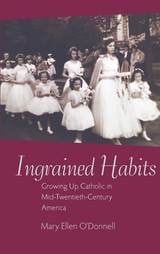
Ingrained Habits
Growing Up Catholic in Mid-Twentieth-Century AmericaMary Ellen O'Donnell
Catholic University of America Press, 2018

Ingrid Jonker
Poet under ApartheidLouise Viljoen
Ohio University Press, 2012
Nelson Mandela brought the poetry of Ingrid Jonker to the attention of South Africa and the wider world when he read her poem “Die kind” (The Child) at the opening of South Africa’s first democratic parliament on May 24, 1994. Though Jonker was already a significant figure in South African literary circles, Mandela’s reference contributed to a revival of interest in Jonker and her work that continues to this day.
Viljoen’s biography illuminates the brief and dramatic life of Jonker, who created a literary oeuvre—as searing in its intensity as it is brief—before taking her own life at the age of thirty-one. Jonker wrote against a background of escalating apartheid laws, violent repression of black political activists, and the banning of the African National Congress and the Pan Africanist Congress. Viljoen tells the story of Ingrid Jonker in the political and cultural context of her time, provides sensitive insights into her poetry, and considers the reasons for the enduring fascination with her life and death.
Her writings, her association with bohemian literary circles, and her identification with the oppressed brought her into conflict with her father, a politician in the white ruling party, and with other authority figures from her Afrikaner background. Her life and work demonstrate the difficulty and importance of artistic endeavor in a place of terrible conflict.
Inherent Vice
Bootleg Histories of Videotape and CopyrightLucas Hilderbrand
Duke University Press, 2009
Videotape not only radically changed how audiences accessed the content they wanted and loved but also altered how they watched it. Hilderbrand develops an aesthetic theory of analog video, an “aesthetics of access” most boldly embodied by bootleg videos. He contends that the medium specificity of videotape becomes most apparent through repeated duplication, wear, and technical failure; video’s visible and audible degeneration signals its uses for legal transgressions and illicit pleasures. Bringing formal and cultural analysis into dialogue with industrial history and case law, Hilderbrand examines four decades of often overlooked histories of video recording, including the first network news archive, the underground circulation of Superstar: The Karen Carpenter Story, a feminist tape-sharing network, and the phenomenally popular website YouTube. This book reveals the creative uses of videotape that have made essential content more accessible and expanded our understanding of copyright law. It is a politically provocative, unabashedly nostalgic ode to analog.
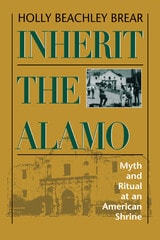
Inherit the Alamo
Myth and Ritual at an American ShrineBy Holly Beachley Brear
University of Texas Press, 1994
Long overshadowed by the towering buildings of downtown San Antonio, the modest little Alamo still evokes tremendous feeling among Texans and, indeed, many other Americans. For Anglo Texans, the Alamo is the "Cradle of Texas Liberty" and a symbolic confirmation of Manifest Destiny. For Hispanic Texans, however, the Alamo has increasingly become a stolen symbol, its origin as a Spanish mission forgotten, its famous defeat used to exclude Hispanics from an honorable place in Texas history.
In this important new book, Holly Beachley Brear explores in fascinating detail what the Alamo means to the numerous groups that lay claim to its heritage. She shows how Alamo myths often diverge from the historical facts—and why. She decodes the agendas of various groups, including the Daughters of the Republic of Texas (who maintain the Alamo buildings and grounds), the Order of the Alamo, the Texas Cavaliers, and LULAC. And she probes attempts by individuals and groups to rewrite the Alamo myth to include more positive roles for themselves, as she explains the value in laying claim to the Alamo's past.
With new perspectives on all the sacred icons of the Alamo and the Fiesta that celebrates (one version of) its history each year, Inherit the Alamo is guaranteed to challenge stereotypes and offer new understanding of the Alamo's ongoing role in shaping Texas and American history and mythology. It will be of interest to a wide popular and scholarly audience.

Inheritance of Loss
China, Japan, and the Political Economy of Redemption after EmpireYukiko Koga
University of Chicago Press, 2016
Inheritance of Loss chronicles these sites of colonial inheritance––tourist destinations, corporate zones, and mustard gas exposure sites––to illustrate attempts by ordinary Chinese and Japanese to reckon with their shared yet contested pasts. In her explorations of everyday life, Koga directs us to see how the violence and injustice that occurred after the demise of the Japanese Empire compound the losses that later generations must account for, and inevitably inherit.

Inheritance
Love, Loss, and the Legacy of the HolocaustCharlie Scheidt
Rutgers University Press, 2026
2026 Independent Publisher Book Awards (IPPY) Silver Medal in the Autobiography/Memoir II (Coming of Age/Family Legacy) category.
After his mother’s death, Charlie Scheidt discovered a trove of historic documents that set him on a decade-long journey to uncover his family’s hidden past during the Holocaust. Joined by Kat Rohrer, the granddaughter of a Nazi officer, Scheidt embarked on a quest to trace his family’s harrowing efforts to escape from Nazi-occupied Europe. As they investigated, they uncovered stories of survival and loss. Their journey takes them across generations and continents, revealing a legacy of love, loss, and resilience. Grappling with questions about the long-lasting effects of inherited trauma, the book asks whether it is possible to break free of a familial cycle. This memoir, rooted in his family’s escape and the lasting trauma that followed, is a powerful reflection on history’s enduring scars, the importance of remembrance, and healing across generations.
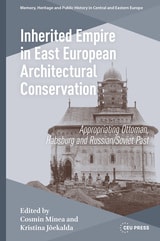
Inherited Empire in East European Architectural Conservation
Appropriating Ottoman, Habsburg and Russian/Soviet PastCosmin Minea
Central European University Press, 2026
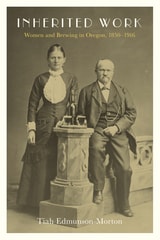
Inherited Work
Women and Brewing in Oregon, 1850–1916Tiah Edmunson-Morton
Oregon State University Press, 2027
Following the stories of twenty women connected to Oregon breweries before Prohibition, Inherited Work recognizes the overlooked contributions of the women who inherited, managed, and navigated Oregon’s brewing industry. At a time when recordkeeping and historical memory obscured their authority, these women were negotiating debt, managing workers, protecting property, arranging sales, supporting family wealth, and making strategic decisions about the future of their businesses.
Drawing on census records, probate files, property records, newspapers, court documents, and oral histories, Tiah Edmunson-Morton traces the legal and economic landscape of the time, demonstrating the conditions and decisions these women faced in managing their personal lives and livelihoods. From widows like Victoria Bauerlin, Johanna Behrens, and Mary Meller—who inherited not only property but also the financial terms that shaped what they could do next—to the matriarch of a brewing dynasty, Louisa Weinhard, Inherited Work reveals how their influence endured.
Today, women can be found throughout the industry as brewers and owners, as well as chemists, restaurant managers, bookkeepers, educators, graphic designers, and hop brokers. While their roles are more visible than they once were, the history of women in brewing remains incomplete. Who were these women? What did it mean to be part of the brewing industry at the turn of the century? And what changes when we bring their stories into the history of brewing?
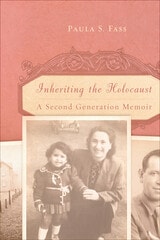
Inheriting the Holocaust
A Second-Generation MemoirPaula S. Fass
Rutgers University Press, 2011
Fass begins her journey through time and relationships when she travels to Poland and locates birth certificates of the murdered siblings she never knew. That journey to recover her family's story provides her with ever more evidence for the perplexing reliability of memory and its winding path toward historical reconstruction. In the end, Fass recovers parts of her family's history only to discover that Poland is rapidly re-imagining the role Jews played in the nation's past.
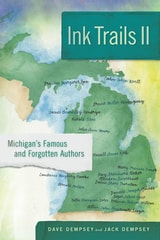
Ink Trails II
Michigan's Famous and Forgotten AuthorsDave Dempsey
Michigan State University Press, 2016
Exploring the hidden treasures of otherwise forgotten authors while also acknowledging the Michigan-set stories of giants like Hemingway, Dave and Jack Dempsey delve into the state’s literary heritage, as robust, diverse, and inexhaustible as the natural beauty of the place that nurtured it. This second volume of “ink trails” continues to tell the story of the remarkable writers, powerful words, and sublime nature of Michigan in the same well-researched and entertaining prose as the first.

Ink Trails
Michigan's Famous and Forgotten AuthorsDave Dempsey
Michigan State University Press, 2012
Long revered as the birthplace of many of the nation’s best-known authors, Michigan has also served as inspiration to countless others. In this entertaining and well-researched book—the first of its kind—the secrets, legends, and myths surrounding some of Michigan’s literary luminaries are explored. Which Michigan poet inspired a state law requiring teachers to assign at least one of his compositions to all students? Which young author emerged from the University of Michigan with a bestselling novel derided by some critics as “vulgar”? And from what Michigan city did Arthur Miller, Robert Frost, and Jane Kenyon draw vital inspiration? The answers to these questions and more are revealed in this rich literary history that highlights the diversity of those whose impact on letters has been indelible and distinctly Michiganian.

Ink
The Indelible J. Mayo WilliamsClifford R. Murphy
University of Illinois Press, 2024
<p>Vivid and engaging, <i>Ink</i> brings to light the extraordinary journey of a Black businessman and athlete.</p>

Inka Bodies and the Body of Christ
Corpus Christi in Colonial Cuzco, PeruCarolyn Dean
Duke University Press, 1999
As Dean clearly illustrates, the central rite of the festival—the taking of the Eucharist—symbolized both the acceptance of Christ and the power of the colonizers over the colonized. The most remarkable of Andean celebrants were those who appeared costumed as the vanquished Inka kings of Peru’s pagan past. Despite the subjugation of the indigenous population, Dean shows how these and other Andean nobles used the occasion of Corpus Christi as an opportunity to construct new identities through tinkuy, a native term used to describe the conjoining of opposites. By mediating the chasms between the Andean region and Europe, pagans and Christians, and the past and the present, these Andean elites negotiated a new sense of themselves. Dean moves beyond the colonial period to examine how these hybrid forms of Inka identity are still evident in the festive life of modern Cuzco.
Inka Bodies and the Body of Christ offers the first in-depth analysis of the culture and paintings of colonial Cuzco. This volume will be welcomed by historians of Peruvian culture, art, and politics. It will also interest those engaged in performance studies, religion, and postcolonial and Latin American studies.
Inka Settlement Planning
By John Hyslop
University of Texas Press, 1990
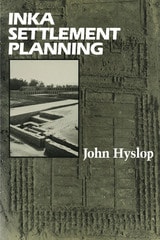
Before the Spanish conquest in the sixteenth century A.D., the Inka Empire stretched along the Pacific side of South America, all the way from Ecuador to northwest Argentina. Though today many Inka researchers focus on the imperial capital of Cuzco, Peru, and surrounding areas, ruins of Inka settlements abound throughout the vast territory of the former empire and offer many clues about how the empire was organized, managed, and defended. These outlying settlements, as well as those in the Cuzco area, form the basis for John Hyslop's detailed study Inka Settlement Planning.
Using extensive aerial photography and detailed site maps, Hyslop studies the design of several dozen settlements spread throughout the empire. In addition to describing their architecture and physical infrastructure, he gives special emphasis to the symbolic aspects of each site's design. Hyslop speculates that the settlement plans incorporate much iconography expressive of Inka ideas about the state, the cosmos, and relationships to non-Inka peoples—iconography perhaps only partially related to the activities that took place within the sites. And he argues that Inka planning concepts applied not only to buildings but also to natural features (stone outcrops, water sources, and horizons) and specialized landscaping (terracing).
Of interest to a wide readership in archaeology, architecture, urbanization, empire building, and Andean travel, Inka Settlement Planning charts one of Native America's greatest achievements.
Inland Empire
Settler Colonialism and Modern Architecture in Southern CaliforniaManuel Shvartzberg Carrió
Duke University Press, 2026
Inner Worlds
Interiority and Capitalist Modernity in JapanRichard M Reitan
University of Michigan Press, 2026
Inner Worlds examines the emergence and operation of representations of interiority—consciousness, “folk mind,” “spirit”—in Japan from its industrial revolution to the rise of fascism during the interwar period. These representations functioned to reproduce the capitalist system by containing its excesses. Thus, poverty in the 1880s was ostensibly the result of defects in one’s innate mental character. A degenerate “crowd mind” explained the strikes and riots of the early twentieth century. State subversion during the 1930s supposedly reflected an attenuated “folk spirit.” By locating the roots of capitalism’s excesses not within the socioeconomic order itself but within a defective interiority, ideologies of interiority operated to contain disruptions to Japan’s socioeconomic order, conceal its defects, and sustain the capitalist system. Inner Worlds reveals how interiority was constituted in ways consistent with both the demands of the emerging capitalist order of the late nineteenth century and the conditions that coalesced to form a fascist conjecture in the 1930s.
Innocence and Victimhood
Gender, Nation, and Women’s Activism in Postwar Bosnia-HerzegovinaElissa Helms
University of Wisconsin Press, 2013

Innocent Lens
Race and Visibility on the Swedish ScreenBenjamin Mier-Cruz
University of Wisconsin Press, 2027
Sweden, like other Nordic countries, prides itself on being “colorblind” or immune to the kinds of racism found in, for example, the United States. In the 1960s and 1970s, white Swedish documentarians, in the fashion of early anthropologists, recorded racial tensions amid the US civil rights movement. More recently, in the twenty-first century, short films produced by Swedes of color have tackled racism and bigotry within Sweden.
Benjamin Mier-Cruz offers a comparative study of these two periods of Swedish documentary filmmaking. “Racially innocent” white documentarians of the mid-twentieth century developed an “aesthetics of altruism” predicated on Sweden’s assumed racial equalitarianism—a notion that their documentaries in turn helped create and maintain. In contemporary films, on the other hand, Swedes of color use the same filmic format to challenge not only their predecessors’ reductionist, pseudo-anthropological presentations but also Sweden’s purportedly colorblind ideology. Mier-Cruz’s close readings of films from both eras demonstrate the possibilities and limitations of the documentary form and the ways in which it is motivated by politics and activism.

Innovation and the Communications Revolution
From the Victorian pioneers to broadband InternetJohn Bray
The Institution of Engineering and Technology, 2002
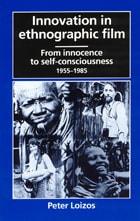
Innovation in Ethnographic Film
From Innocence to Self-Consciousness, 1955-1985Peter Loizos
University of Chicago Press, 1993
Loizos begins by reviewing works of John Marshall and Timothy Asch in the 1950s and moves through those of Jean Rouch, Robert Gardner, and many more recent filmmakers. He reveals a steady course of innovations along four dimensions: production technology, subject matter, strategies of argument, and ethnographic authentication. His analyses of individual films address questions of realism, authenticity, genre, authorial and subjective voice, and representation of the films' creators as well as their subjects.
Innovation in Ethnographic Film, as a systematic and iluminating review of developments in ethnographic film, will be an important resource for the growing number of anthropologists and other scholars who use such films as tools for research and teaching.
Innovation in the Italian Counter-Reformation
Shannon McHugh
University of Delaware Press, 2011
Published by University of Delaware Press. Distributed worldwide by Rutgers University Press.

Innovations in Teaching History
Eighteenth-Century Studies in Higher EducationEdited by Ruth Larsen, Alice Marples, and Matthew McCormack
University of London Press, 2024
The eighteenth century has been a notable recent growth area in historical studies and related disciplines and is key in university research and teaching. Although widely taught in history departments, the eighteenth century also presents challenges, including new students’ unfamiliarity with the period, the theoretical and interdisciplinary nature of the critical writings, and extensive online source material requiring digital skills for its evaluation.
Focusing on pedagogical innovation and current developments in the discipline, this collection of essays reflects on how we teach the history of the long eighteenth century, exploring current subfields such as histories of material culture, the senses, gender, crime, race, empire, and colonialism. It presents practical case studies showcasing how novel teaching methods can be employed in the classroom that promote active learning and invite students to think critically about the nature of their discipline. Methods covered include decolonizing the curriculum, digital history, transferable skills, engaging with objects, working in non-classroom settings, and multisensory approaches.
Grounded in real academic practice, this is a valuable guide for all history educators, whether specializing in the eighteenth century or beyond.