Results by title
5550 books match the query 'Biography & Autobiography' and 174 start with i
Immortal for Quite Some Time
Scott Abbott
University of Utah Press, 2016
Winner of the Utah Arts Council's Original Writing Competition Book Manuscript Prize in Creative Nonfiction
Winner of the 15 Bytes Book Award for Creative Nonfiction
“This is not a memoir. Rather, this is a fraternal meditation on the question: ‘Are we friends, my brother?’ The story is uncertain, the characters are in flux, the voices are plural, the photographs are as troubled as the prose. This is not a memoir.”
Thus Scott Abbott introduces the reader to his exploration of the life of his brother John, a man who died of AIDS in 1991 at the age of forty. Writing about his brother, he finds he is writing about himself and about the warm-hearted, educated, and homophobic LDS family that forged the core of his identity.
Images and quotations are interwoven with the reflections, as is a critical female voice that questions his assertions and ridicules his rhetoric. The book moves from the starkness of a morgue’s autopsy through familial disintegration and adult defiance to a culminating fraternal conversation. This exquisitely written work will challenge notions of resolution and wholeness.
Impact Zone
The Battle of the DMZ in Vietnam, 1967–1968Jim Brown
University of Alabama Press, 2004
In the heart of the DMZ, one Marine faced the war—and the truth behind it.
Impact Zone documents Marine First Lieutenant James S. Brown's intense battle experiences, including those at Khe Sanh and Con Thien, throughout his thirteen months of service on the DMZ during 1967-68. This high-action account also reflects Brown's growing belief that the Vietnam War was mis-fought due to the unproductive political leadership of President Johnson and his administration. Brown's naiveté developed into hardening skepticism and cynicism as he faced the harsh realities of war, though he still managed to retain a sense of honor, pride, and patriotism for his country.
Impact Zone is a distinctive book on the Vietnam War because it is told from the perspective of an artilleryman, and the increasingly dangerous events gain momentum as they progress from one adventure to the next. Impact Zone is not only an important historical document of the Vietnam conflict, but also a moving record of the personal and emotional costs of war.
Imperium in Imperio
Sutton E. Griggs
West Virginia University Press, 2022
A new critical edition of Sutton Griggs’s turn-of-the-twentieth-century novel, which continues to shed light on understandings of Black politics.
Sutton E. Griggs’s first novel, originally published in 1899, paints a searing picture of the violent enforcement of disfranchisement and Jim Crow racial segregation. Based on events of the time, including US imperial policies, revolutionary movements, and racial protests, Imperium in Imperio introduces the fictional Belton Piedmont and Bernard Belgrave as “future leaders of their race” and uses these characters to make sense of the violence that marked the dawn of the twentieth century. Taking on contemporary battles over separatism and integration, Griggs’s novel continues to play a crucial role in understandings of Black politics.
Edited and introduced by Tess Chakkalakal and Kenneth W. Warren, this new critical edition offers not only an incisive biographical and historical introduction to the novel and its author but also a wealth of references that make the events and characters of Griggs’s Imperium in Imperio, and its aftermath, accessible to readers today.
Imperium in Imperio
Tess Chakkalakal
University of Delaware Press, 0
Edited and introduced by Tess Chakkalakal and Kenneth W. Warren, this new critical edition offers not only an incisive biographical and historical introduction to the novel and its author but also a wealth of references that make the events and characters of Griggs’s Imperium in Imperio, and its aftermath, accessible to readers today.
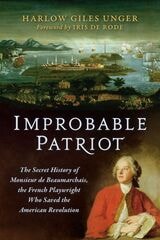
Improbable Patriot
The Secret History of Monsieur de Beaumarchais, the French Playwright Who Saved the American RevolutionHarlow Giles Unger
Brandeis University Press, 2026
In 1776, the playwright and inventor Pierre-Augustin Caron de Beaumarchais (1732–99) conceived an audacious plan to send aid to the American rebels. What’s more, he convinced King Louis XVI to bankroll the project and single-handedly carried it out. By war’s end, he had supplied Washington’s army with most of its weapons and powder, though he was never paid or acknowledged by the United States. To some, he was a dashing hero, a towering intellect who saved the American Revolution. To others, he was a pure rogue, a double-dealing adventurer who stopped at nothing to advance his fame and fortune. In fact, he was both, and more: an advisor to kings, an arms dealer, and an author of some of the most enduring works of the stage, including The Marriage of Figaro and The Barber of Seville. Now in paperback, Improbable Patriot introduces readers to an unrecognized power player in the Revolutionary War.
In Africa's Forest and Jungle
Six Years Among the YorubasRichard Henry Stone, edited by Betty Finklea Florey
University of Alabama Press, 2009
Stone served in Africa with his wife and successfully learned the Yoruba language. He was an intelligent, self-reflective, and reliable observer, making his works important sources of information on Yoruba society before the intervention of European colonialism. In Africa's Forest and Jungle is a rare account of West African culture, made all the more complete by the additional journal entries, letters, and photographs collected in this edition.
In America, I Discovered I Was European
NatáliaCorreia, Translated by Katharine F. Baker and Melo, Emanuel; Introduction by Onésimo T. Almeida
Tagus Press, 2025

In Byron's Footsteps
Tessa de Loo
Haus Publishing, 2010
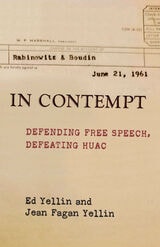
In Contempt
Defending Free Speech, Defeating HUACEd Yellin and Jean Fagan Yellin
University of Michigan Press, 2022
So began a decade of hardship for Ed and Jean Yellin and their three young children as the repressive weight of the U.S. government, caught up in the throes of McCarthyism, crashed down upon their careers, their daily household budget, and their relationships to colleagues, neighbors, and their country. In Contempt is a faithful, factual testament to the enduring quality of patriotic dissent in our evolving democracy—and a loving reconstruction of what it meant to be labeled “unAmerican” for defending the Constitution.
In Earshot of Water
Notes from the Columbia PlateauPaul Lindholdt
University of Iowa Press, 2011
p.MsoNormal, li.MsoNormal, div.MsoNormal { margin: 0in 0in 0.0001pt; font-size: 12pt; font-family: "Times New Roman"; }div.Section1 { page: Section1; }
Whether the subject is the plants that grow there, the animals that live there, the rivers that run there, or the people he has known there, Paul Lindholdt’s In Earshot of Water illuminates the Pacific Northwest in vivid detail. Lindholdt writes with the precision of a naturalist, the critical eye of an ecologist, the affection of an apologist, and the self-revelation and self-awareness of a personal essayist in the manner of Annie Dillard, Loren Eiseley, Derrick Jensen, John McPhee, Robert Michael Pyle, and Kathleen Dean Moore.
Exploring both the literal and literary sense of place, with particular emphasis on environmental issues and politics in the far Northwest, Lindholdt weds passages from the journals of Lewis and Clark, the log of Captain James Cook, the novelized memoir of Theodore Winthrop, and Bureau of Reclamation records growing from the paintings that the agency commissioned to publicize its dams in the 1960s and 1970s, to tell ecological and personal histories of the region he knows and loves.
In Lindholdt’s beautiful prose, America’s environmental legacies—those inherited from his blood relatives as well as those from the influences of mass culture—and illuminations of the hazards of neglecting nature’s warning signs blur and merge and reemerge in new forms. Themes of fathers and sons layer the book, as well—the narrator as father and as son—interwoven with a call to responsible social activism with appeals to reason and emotion. Like water itself, In Earshot of Water cascades across boundaries and blends genres, at once learned and literary.
In Fielding’s Wake
Jeremy Black
St. Augustine's Press, 2022
Fielding's epic comic novel, Tom Jones, is unforgettable for many reasons, but the author must be credited with an aptitude for documenting contemporary cultural history and his contribution to a new species of writing. Black's treatment of Fielding draws to the fore a man who was of his time but not confined to it. "Philosophy in practice encompassed his stance as a man of action as well as a reflective writer of genius." Fielding is shown to provide across the breadth of his work extensive and invaluable commentary on issues as diverse as law and order, marriage, women, and the interplay of urban and rural life. Black, an historian, is here a student of storytelling and recovers Fielding's rich descriptions of the human heart and call to defy the vices with which circumstances might taunt it.
Black has done a service along many fronts at once: the science of the novel and genre, the history of a people and the figure of a memorable writer.
In Gatsby's Shadow
The Story of Charles Macomb FlandrauLarry Haeg
University of Iowa Press, 2004
Flandrau, a model of style and worldly sophistication and destined, almost everyone agreed, for greatness, was among the most talented young writers of his generation. His short stories about Harvard in the 1890s were called “the first realistic description of undergraduate life in American colleges” and sold out of the first printing in a few weeks. From 1899 to 1902 Flandrau was among the most popular contributors to the Saturday Evening Post. Alexander Woollcott rated him the best essayist in America. And Viva Mexico!, Flandrau’s account of life on a Mexican coffee plantation, is a classic, perhaps the best travel book ever written by an American. Yet Flandrau turned his back on it all. Financially independent, he chose a solitary, epicurean life in St. Paul, Mexico, Majorca, Paris, and Normandy. In later years, he confined his writing to local newspaper pieces and letters to his small circle of family and friends.
Using excerpts from these newspaper columns and unpublished letters, Larry Haeg has painstakingly recreated the story of this urbane, talented, witty, lazy, enigmatic, supremely private man who never reached the peak of literary success to which his talent might have taken him.
This very readable biography provides a detailed and honest portrayal of Flandrau and his times. It will fascinate readers interested in writers’ life stories and scholars of American literature as well as general readers interested in midwestern literary history.
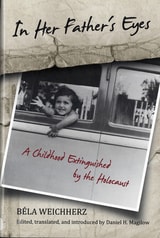
In Her Father's Eyes
A Childhood Extinguished by the HolocaustBéla Weichherz, Edited by Daniel H. Magilow
Rutgers University Press, 2008
In Her Father's Eyes is a moving tale about Jewish life and a father's profound love for his only child. By bridging prewar and wartime periods, the diary also provides a rich context for understanding the history from which the Holocaust emerged.
In Her Own Words
Conversations with Composers in the United StatesJennifer Kelly
University of Illinois Press, 2014
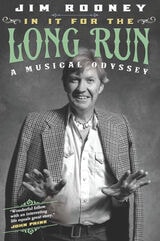
In It for the Long Run
A Musical OdysseyJim Rooney
University of Illinois Press, 2014
Inspired by the Hank Williams and Leadbelly recordings he heard as a teenager growing up outside of Boston, Jim Rooney began a musical journey that intersected with some of the biggest names in American music including Bob Dylan, James Taylor, Bill Monroe, Muddy Waters, and Alison Krauss. In It for the Long Run: A Musical Odyssey is Rooney's kaleidoscopic first-hand account of more than five decades of success as a performer, concert promoter, songwriter, music publisher, engineer, and record producer.
As witness to and participant in over a half century of music history, Rooney provides a sophisticated window into American vernacular music. Following his stint as a "Hayloft Jamboree" hillbilly singer in the mid-1950s, Rooney managed Cambridge's Club 47, a catalyst of the ‘60’s folk music boom. He soon moved to the Newport Folk Festival as talent coordinator and director where he had a front row seat to Dylan "going electric."
In the 1970s Rooney's odyssey continued in Nashville where he began engineering and producing records. His work helped alternative country music gain a foothold in Music City and culminated in Grammy nominations for singer-songwriters John Prine, Iris Dement, and Nanci Griffith. Later in his career he was a key link connecting Nashville to Ireland's folk music scene.
Writing songs or writing his memoir, Jim Rooney is the consummate storyteller. In It for the Long Run: A Musical Odyssey is his singular chronicle from the heart of Americana.
In My Father'S Study
Ben Orlove
University of Iowa Press, 1995
In 1921 Solomon Orlovski, a Russian Jew born in 1904, emigrated to America and transformed himself into Robert Orlove, a pattern maker in two senses of the term: during the day, he worked in the fur trade in New York and Chicago, making patterns for toys and hats; in his private life he became a self-taught artist who created prints, sketches, and collages in his study. More than sixty years later his son Ben—an anthropologist educated at Harvard and Berkeley—walked through the doorway of the deceased Robert's study and began to explore more than a half century of his father's experiences, thoughts, and emotions as well as his own very different life. His wry, sensitive combination of biography, memoir, and autobiography taps a remarkably rich vein of individual and collective experience in our diverse society.
Ben Orlove's dual narrative constitutes a family history of notable breadth and immediacy. By turns passionate and cool, dramatic and analytic, he excavates his father Robert's lifetime accumulation of diaries, letters, clippings, photographs, and artworks to create a convincing, deeply satisfying portrait that link both father and son.
In My Father’s Arms
A Son’s Story of Sexual AbuseWalter A. de Milly III
University of Wisconsin Press, 2012
Tragically, Walter's deeply troubled father would launch his family on a perilous journey into darkness. To the outside world, this man is a prominent businessman, a dignified Presbyterian, and a faithful husband; to Walter, he is an overwhelming, handsome monster. Whenever the two are together, young Walter becomes a sexual plaything for his father; father and son outings are turned into soul-obliterating nightmares.
Walter eventually becomes a successful businessman only to be stricken by another catastrophe: his father, at the age of seventy, is caught molesting a young boy. Walter is asked to confront his father. Walter convenes his family, and in a private conference with a psychiatrist, the father agrees to be surgically castrated.
De Milly's portraits of his relationships with his father and mother, and the confrontation that leads to his father's bizarre and irreversible voluntary "cure," are certain to be remembered long after the reader has set aside this powerful contribution to the literature of incest survival.
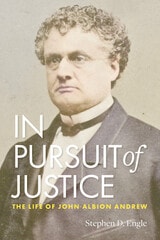
In Pursuit of Justice
The Life of John Albion AndrewStephen D. Engle
University of Massachusetts Press, 2023
Widely known as the “poor man’s lawyer” in antebellum Boston, John Albion Andrew (1818–1867) was involved in nearly every cause and case that advanced social and racial justice in Boston in the years preceding the Civil War. Inspired by the legacies of John Quincy Adams and Ralph Waldo Emerson, and mentored by Charles Sumner, Andrew devoted himself to the battle for equality. By day, he fought to protect those condemned to the death penalty, women seeking divorce, and fugitives ensnared by the Fugitive Slave Law. By night, he coordinated logistics and funding for the Underground Railroad as it ferried enslaved African Americans northward.
In this revealing and accessible biography, Stephen D. Engle traces Andrew’s life and legacy, giving this important, but largely forgotten, figure his due. Rising to national prominence during the Civil War years as the governor of Massachusetts, Andrew raised the African American regiment known as the Glorious 54th and rallied thousands of soldiers to the Union cause. Upon his sudden death in 1867, a correspondent for Harper’s Weekly wrote, “Not since the news came of Abraham Lincoln’s death were so many hearts truly smitten.”
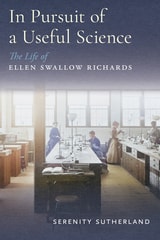
In Pursuit of a Useful Science
The Life of Ellen Swallow RichardsSerenity Sutherland
University of Massachusetts Press, 2027
Recovering the life of a woman who believed science could and should change the world
In May 1921, Marie Curie stood at Carnegie Hall and accepted a prize named for a woman she had never met. Ellen Swallow Richards had been dead for ten years, but her network of college-educated women had raised $2,000 to fund Curie’s research into the medical uses of radium. In Pursuit of a Useful Science offers a richly layered biography of Richards: the first woman to study and teach at MIT—a pioneer of nutrition science, water chemistry, sanitation, and what would now be called science communication.
At the heart of this book is Richards’s defining conviction that science should be useful—applied to the everyday problems of real people, from baking bread to safe drinking water to the management of sewage—and communicated clearly to the public. She tested nutrition science in a public kitchen, researched sewage treatment at a physical water treatment plant, and proved that women could study science without threat to their health at MIT’s Woman’s Laboratory. She published over one hundred works for public audiences, organized exhibits and lectures, and at the end of her life gathered her wide-ranging work into one of the first scientifically informed calls to protect the natural environment.
As Serenity Sutherland shows, Richards grappled with the gap between scientific authority and everyday practice, even as she rarely confronted how her own assumptions shaped the knowledge she advanced. Drawing on extensive archival sources, this study situates Richards within the expanding role of women in science and the rising cultural authority of scientific expertise in American life.
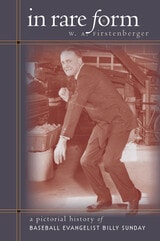
In Rare Form
A Pictorial History of Baseball Evangelist Billy SundayW. A. Firstenberger
University of Iowa Press, 2005
Through an organizational scheme that incorporates memorabilia from childhood (samplers, Civil War badges), baseball (Billy’s 1891 Philadelphia contract, scorecards), evangelism (cartoons, books such as Monkeys and Missing Links), social issues (KKK ads endorsing Sunday, his Women's Christian Temperance life membership certificate), life style (Arts and Crafts decorative pieces, extensive photos of the family's Mount Hood bungalow), and family relations (his personal possessions and those of his wife, Nell, and their children), In Rare Form brings together the inconsistencies between Sunday’s material world and his spiritual world.
Since Sunday might have objected to a materialistic analysis of his life, Firstenberger has allowed him a say: each section of the book begins with an apt quote from Sunday’s sermons and writings. Firstenberger also includes appendixes providing detailed information on Sunday’s revivals and speaking appearances, his 870,075 documented converts, the members of his evangelistic team, the overall structure of his family, and an extensive bibliography. Acknowledging Sunday’s faults and contradictions alongside his heroic accomplishments, the author presents a wryly insightful and innovative perspective on this larger-than-life figure.

In Search of Donna Reed
Jay Fultz
University of Iowa Press, 2001
But who was Donna Reed? Perhaps no celebrity of her symbolic importance is so little known. Moving from the backroads of Iowa to the mansions of Bel Air, Jay Fultz goes in search of the woman behind the image.
In Search of Donna Reed reveals a woman whose intelligence and force of character often put her at odds with the roles she portrayed both on and off screen. Reed, always angered by the treatment of women in Hollywood, turned political activist in middle age, confronting for the first time the arrogance of power. She was, said writer Barbara Avedon, a feminist before there was a feminist vocabulary. But she eludes any label.
This first biography of Donna Reed also contains the first extended discussion of her television show. The personal richness that Reed brought to her television role has been filtered out in the caricature perpetuated by pop critics. In the media "Donna Reed" is Donna Stone distorted as a female-manqué who wears pearls and high heels around the house. But Donna Reed's long hold on viewers depends on irreducible qualities that have nothing to do with this fixed image, as Fultz suggests.
He follows her development from Iowa farm girl to apprentice in Hollywood to mature juggler of the demands of family and career to antiwar activist. Drawing on Reed's letters and on interviews, Fultz looks for what was real in a very private person without discarding what is romantic in any pursuit of a public one. He shows why the rich and principled life of Donna Reed matters in this more cynical time.

In Search of Susanna
Suzanne L. Bunkers
University of Iowa Press, 1996
On a summer day in 1980 in Niederfeulen, Luxembourg, Suzanne Bunkers pored over parish records of her maternal ancestors, immigrants to the rural American Midwest in the mid 1800s. Suddenly, chance led her to the name Simmerl and to the missing piece in the genealogical puzzle that had brought her so far: Susanna Simmerl, Bunkers' paternal great-great-grandmother, who had given birth to an illegitimate daughter in 1856 before coming to America. Finding Susanna was the catalyst for Bunkers' intensely personal book, which blends history, memory, and imagination into a drama of two women's lives within their multigenerational family.

In Service to American Pharmacy
The Professional Life of William Procter Jr.Gregory J. Higby
University of Alabama Press, 1992
The story of the visionary pharmacist who helped build modern American pharmacy.
In Service to American Pharmacy: The Professional Life of William Procter Jr. by Gregory J. Higby is the definitive biography of William Procter Jr., widely recognized as the "Father of American Pharmacy." Through meticulous historical research, Higby chronicles Procter's extraordinary career and demonstrates how one individual's dedication helped transform pharmacy in the United States from a commercial trade into a respected healthcare profession during the nineteenth century.
The book follows Procter's contributions as a practicing pharmacist, pharmaceutical scientist, educator, editor, and organizational leader. It places his accomplishments within the broader evolution of American healthcare, tracing developments from the founding of the Philadelphia College of Pharmacy in 1821 through the emergence of professional standards, drug quality controls, pharmaceutical education, and meaningful pharmacy legislation. Higby shows how Procter's commitment to scientific rigor and public service helped establish many of the principles that continue to guide pharmacy practice today.
This book offers a valuable history of nineteenth-century medicine, science, and professionalization in America. Rich in historical context and scholarly insight, it illustrates the challenges and achievements involved in creating a modern profession dedicated to public health and pharmaceutical excellence. Essential for historians of medicine, pharmacy practitioners, and scholars of American science, this work highlights the enduring legacy of one of the most influential figures in healthcare history.
In Sierra Leone
Michael Jackson
Duke University Press, 2004
Though the Revolutionary United Front (R.U.F.) ostensibly fought its war (1991–2002) against corrupt government, the people of Sierra Leone were its victims. By the time the war was over, more than fifty thousand were dead, thousands more had been maimed, and over one million were displaced. Jackson relates the stories of political leaders and ordinary people trying to salvage their lives and livelihoods in the aftermath of cataclysmic violence. Combining these with his own knowledge of African folklore, history, and politics and with S. B.’s bittersweet memories—of his family’s rich heritage, his imprisonment as a political detainee, and his position in several of Sierra Leone’s post-independence governments—Jackson has created a work of elegiac, literary, and philosophical power.
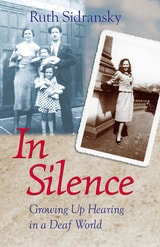
In Silence
Growing Up Hearing in a Deaf WorldRuth Sidransky
Gallaudet University Press, 2006
Inside her family’s apartment, Sidransky knew a warm, secure place. She recalls her earliest memories of seeing words fall from her parents’ hands. She remembers her father entertaining the family endlessly with his stories, and her mother’s story of tying a red ribbon to herself and her infant daughter to know when she needed anything in the night.
Outside the apartment, the cacophonous hearing world greeted Sidransky’s family with stark stares of curiosity as though they were “freaks.” Always upbeat, her proud father still found it hard to earn a living. When Sidransky started school, she was placed in a class for special needs children until the principal realized that she could hear and speak.
Sidransky portrays her family with deep affection and honesty, and her frank account provides a living narrative of the Deaf experience in pre- and post-World War II America. In Silence has become an invaluable chronicle of a special time and place that will affect all who read it for years to come.
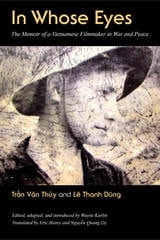
In Whose Eyes
The Memoir of a Vietnamese Filmmaker in War and PeaceTran Van Thuy
University of Massachusetts Press, 2016
Tran Van Thuy is a celebrated Vietnamese filmmaker of more than twenty award-winning documentaries. A cameraman for the People's Army of Vietnam during the Vietnam War, he went on to achieve international fame as the director of films that address the human costs of the war and its aftermath.
Thuy's memoir, when published in Vietnam in 2013, immediately sold out. In this translation, English-language readers are now able to learn in rich detail about the life and work of this preeminent artist. Written in a gentle and charming style, the memoir is filled with reflections on war, peace, history, freedom of expression, and filmmaking. Thuy also offers a firsthand account of the war in Vietnam and its aftermath from a Vietnamese perspective, adding a dimension rarely encountered in English-language literature.
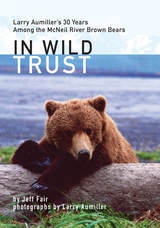
In Wild Trust
Larry Aumiller's Thirty Years Among the McNeil River Brown BearsJeff Fair
University of Alaska Press, 2017
This book celebrates Aumiller’s achievement, telling the story of his decades with the bears alongside his own remarkable photographs. As both professional wildlife managers and ordinary citizens alike continue to struggle to bridge the gap between humans and the wild creatures we’ve driven out, In Wild Trust is an inspiring account of what we can achieve.
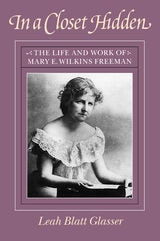
In a Closet Hidden
The Life and Work of Mary E. Wilkins FreemanLeah Blatt Glasser
University of Massachusetts Press, 1996
The first literary biography of a much-neglected American writer, this book explores the multiple tensions at the core of Mary E. Wilkins Freeman's life and work. A prolific short story writer and novelist, Freeman (1852–1930) developed a reputation as a local colorist who depicted the peculiarities of her native New England. Yet as Leah Blatt Glasser shows, Freeman was one of the first American authors to write extensively about the relationships women form outside of marriage and motherhood, the role of work in women's lives, the complexity of women's sexuality, and the interior lives of women who rebel rather than conform to patriarchal strictures.
In a Closet Hidden traces Freeman's evolution as a writer, showing how her own inner conflicts repeatedly found expression in her art. As Glasser demonstrates, Freeman's work examined the competing claims of creativity and convention, self-fulfillment and self-sacrifice, spinsterhood and marriage, lesbianism and heterosexuality.
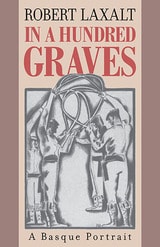
In a Hundred Graves
A Basque PortraitRobert Laxalt
University of Nevada Press, 2016
The Basques of Europe are legendary for the curtain of privacy they have always drawn around their world, shielding it from visitors from the outside. As a result, accounts of the inner workings of Basque village life are almost nonexistent. In this unique book, author Robert Laxalt has managed to penetrate the deep reserve of Basque village folk. Shepherds, troubadours, merchants, and smugglers, caught up in the panorama of daily life, parade before the reader. They are portrayed against a backdrop of green rugged mountains and stone buildings, typical of the Basque provinces in France and Spain. Laxalt, an American born of Basque parents, unveils the Basque character with warmth, wry humor, and above all, honesty.
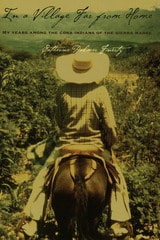
In a Village Far from Home
My Years among the Cora Indians of the Sierra MadreCatherine Palmer Finerty
University of Arizona Press, 2000
What do most career women do after a successful run on Madison Avenue? Catherine Finerty watched her friends settle into the country-club life. She opted instead for Mexico.
When the 60-year-old widow loaded up her car and headed south, what she found at the end of the road was far from what she expected. Finerty settled into a comfortable house just outside of Guadalajara and, although not a Catholic, she soon immersed herself in Franciscan volunteer work. It wasn't long before she found herself visiting small settlements hidden in the tropical mountains of western Mexico, and it was in Jesús María—so isolated that one could only get there by mule or small plane—that she found her new calling: the village nurse.
With its bugs and heat, no phones or running water, the tiny town was hardly a place to enjoy one's retirement years, but Finerty was quickly charmed by the community of Cora Indians and mestizos. Armed with modest supplies, a couple of textbooks, and common sense, she found herself delivering first aid, advising on public health, and administering injections. And in a place where people still believed in the power of shamans, providing health care sometimes required giving in to the magical belief that a hypodermic needle could cure anything.
Finerty's account of her eight years in Jesús María is both a compelling story of nursing under adverse conditions and a loving portrait of a people and their ways. She shares the joys and sorrows of this isolated world: religious festivals and rites of passage; the tragedy of illness and death in a place where people still rely on one another as much as medicine; a flash flood that causes such havoc that even less-than-pious village men attend Mass daily. And she introduces a cast of characters not unlike those in a novel: Padre Domingo and his airborne medical practice; the local bishop, who frowns on Finerty's slacks; Chela, a mestiza from whom she rents her modest two-room house (complete with scorpions); and the young Cora Indian woman Chuy, from whom she gains insight into her new neighbors.
Blending memoir and travel writing, In a Village Far from Home takes readers deep into the Sierra Madre to reveal its true treasure: the soul of a people.
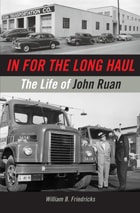
In for the Long Haul
The Life of John RuanWilliam B. Friedricks
University of Iowa Press, 2003
Driven by grit and determination during the Depression, John Ruan parlayed a one-truck business into Ruan Transportation Management Systems, one of the nation’s leading trucking, leasing, and logistics companies. The trucking business made John Ruan one of the wealthiest and most influential people in Iowa and was the foundation for his vast fortune which included interests in insurance, banking, financial services, international trade, and real estate.
In the 1970s and 80s, Ruan led Des Moines’s renaissance with the construction of the 36-story original Ruan Center, the Marriott Hotel tower, and the Two Ruan Center office complex. But his contributions reached far beyond the confines of Iowa. As a philanthropist, Ruan was a long-time sponsor of the World Food Prize, which recognizes the importance of a nutritious and sustainable food supply for all people.
Based on extensive interviews with Ruan, family members, business associates, friends, and colleagues, as well as privately held papers and archives, In for the Long Haul presents a discerning portrait of this hard-charging yet compassionate businessman.
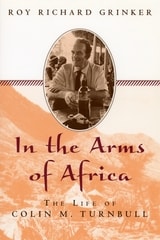
In the Arms of Africa
The Life of Colin TurnbullRoy Richard Grinker
University of Chicago Press, 2001
In this scrupulously researched biography, Roy Richard Grinker charts the rise and fall of this colorful and controversial man—from his Scottish family and British education to travels in Africa and his great love affair with Joe Towles. Grinker, noted for his own work on the Pygmies, herein gives readers a fascinating account of Turnbull's life and work.
Originally published by St. Martin's Press
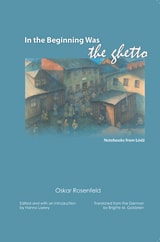
In the Beginning Was the Ghetto
Notebooks from LodzOskar Rosenfeld
Northwestern University Press, 2002
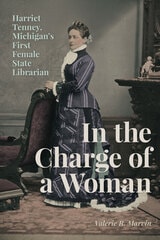
In the Charge of a Woman
Harriet Tenney, Michigan’s First Female State LibrarianValerie R. Marvin
Michigan State University Press, 2027
In 1869, at a moment when women were largely barred from public life and professional opportunities, Harriet Tenney stepped into Michigan’s State Capitol and made history. As the first woman to hold a full-time position in the State of Michigan’s government, she spent the next twenty-two years reshaping not only Michigan’s libraries, but the nation’s understanding of what women could achieve in public service.
Appointed and reappointed by seven governors from both political parties, Tenney built one of the country’s most respected state libraries. She dramatically expanded its collections, established professional standards that became models for libraries across the country, and mentored a generation of women librarians who followed in her path. She also founded Michigan’s first state museum, ensuring that historical artifacts, portraits, and documents would be preserved for future generations; today, tens of thousands of people each year visit and study the objects she collected and curated.
Tenney’s impact radiated far beyond the Capitol. Under her leadership, the state librarianship itself became recognized as a “woman’s position”—a remarkable shift in an era when women's work remained largely invisible. In Lansing, she founded the Woman’s Club as well as the Lansing Library and Literary Association, which evolved into the Capital Area District Library system.
In the Charge of a Woman not only tells the story of Tenney’s achievements in expanding the role of women in the workforce; it also illuminates domestic and political life in nineteenth-century Michigan, revealing how one woman navigated, and transformed, a world built to exclude her.
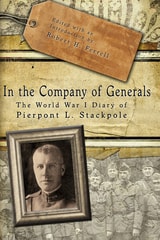
In the Company of Generals
The World War I Diary of Pierpont L. StackpoleEdited & Intro by Robert H. Ferrell
University of Missouri Press, 2009
Pierpont Stackpole was a Boston lawyer who in January 1918 became aide to Lieutenant General Hunter Liggett, soon to be commander of the first American corps in France. Stackpole’s diary, published here for the first time, is a major eyewitness account of the American Expeditionary Forces’ experience on the Western Front, offering an insider’s view into the workings of Liggett’s commands, his day-to-day business, and how he orchestrated his commands in trying and confusing situations.
Hunter Liggett did not fit John J. Pershing’s concept of the trim and energetic officer, but Pershing entrusted to him a corps and then an army command. Liggett assumed leadership of the U.S. First Army in mid-October of 1918, and after reorganizing, reinforcing, and resting, the battle-weary troops broke through the German lines in a fourth attack at the Meuse-Argonne—accomplishing what Pershing had failed to do in three previous attempts. The victory paved the way to armistice on November 11.
Liggett has long been a shadowy figure in the development of the American high command. He was “Old Army,” a veteran of Indian wars who nevertheless kept abreast of changes in warfare and more than other American officers was ready for the novelties of 1914–1918. Because few of his papers have survived, the diary of his aide—who rode in the general’s staff car as Liggett unburdened himself about fellow generals and their sometimes abysmal tactical notions—provides especially valuable insights into command within the AEF.
Stackpole’s diary also sheds light on other figures of the war, presenting a different view of the controversial Major General Clarence Edwards than has recently been recorded and relating the general staff’s attitudes about the flamboyant aviation figure Billy Mitchell. General Liggett built the American army in France, and the best measure of his achievement is this diary of his aide. That record stands here as a fascinating and authentic look at the Great War.

In the Company of Grace
A Veterinarian's Memoir of Trauma and HealingJody Lulich
University of Minnesota Press, 2023
The son of a Black mother and white father overcomes family trauma to find the courage of compassion in veterinary practice
Rising to accept a prestigious award, Jody Lulich wondered what to say. Explain how he’d been attracted to veterinary medicine? Describe how caring for helpless, voiceless animals in his own shame and pain provided a lifeline, a chance to heal himself as well? Lulich tells his story in In the Company of Grace, a memoir about finding courage in compassion and strength in healing—and power in finally confronting the darkness of his youth.
Lulich’s white father and Black mother met at a civil rights rally, but love was no defense against their personal demons. His mother’s suicide, in his presence when he was nine years old, and his sometimes brutal father’s subsequent withdrawal set Lulich on a course from the South Side of Chicago to the Tuskegee School of Veterinary Medicine in Alabama to an endowed chair at the University of Minnesota, forever searching for the approval and affection that success could not deliver. Though shadowed by troubling secrets, his memoir also features scenes of surprising light and promise—of the neighbors who take him in, a brother’s unlikely effort to save Christmas, his mother’s memories of the family’s charmed early days, bright moments (and many curious details) of veterinary practice. Most consequentially, at Tuskegee Lulich rents a room in the home of a seventy-five-year-old Black woman named Grace, whose wholehearted adoption of him—and her own stories of the Jim Crow era—finally gives him a sense of belonging and possibility.
Completing his book amid the furor over George Floyd’s murder, Lulich reflects on all the ways that race has shaped his life. In the Company of Grace is a moving testament to the power of compassion in the face of seemingly overwhelming circumstances.
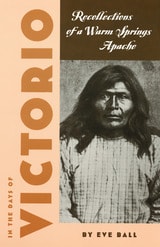
In the Days of Victorio
Recollections of a Warm Springs ApacheEve Ball; Narrated by James Kaywaykla
University of Arizona Press, 1970
"This volume contains a great deal of interesting information."—Journal of the West
"The Apache point of view [is] presented with great clarity."—Books of the Southwest
"A valuable addition to the southwestern frontier shelf and long will be drawn upon and used."—Journal of Arizona History
"A genuine contribution to the story of the Apache wars, and a very readable book as well."—Westerners Brand Book
"Shining through every page is the unquenchable spirit that was the Apache. Inured, indeed trained, to suffering, Apaches stood strong beside Victorio, Nana, and finally Geronimo in a vain attempt to maintain those things they held more dear than life itself—freedom, homeland, dignity as human beings. A warm and vital people, the Apaches had, and have, a great deal to offer."—Arizona and the West
In the Form of Bread
On Becoming HumanMary Jane Nealon
Four Way Books, 2026
In this collection of vignettes—heartbreaking and often humorous—Nealon explores caregiving as both sacred practice and human risk.
She looks back to her relationship with a father devastated by the early death of her brother; to tending men—some with AIDS, some drunk, some sober—living in Bowery flophouses; to confronting racism; to the quiet instruction of a dog who teaches attention by gazing back.
The essays ask what price we pay when we offer ourselves wholeheartedly to one another, and what it means to remain open to being more than human in a fractured world.
In the Future of Yesterday
A Life of Stefan ZweigRüdiger Görner
Haus Publishing, 2025
In the Future of Yesterday delves into Stefan Zweig’s considerable contribution to world literature, rooted in the Austro-Jewish tradition. His privileged social background saw him embrace European culture and cosmopolitanism. A world traveler from the outset, he liked to uproot himself, but whether he stayed in London, New York, or, eventually, in Brazil, his literary baggage continued to contain the flair of fin de siècle Vienna.
This biography re-examines Zweig’s influential time in England and offers new insights into his final years in the United States and Brazil. It discusses some of his prolific literary output in relation to his life and explores his political views on Europe, Zionism, and the world order in greater depth than previous appraisals of Zweig’s life.
The book also considers the many contradictions in Zweig’s views and attitudes, which included an initial, and surprising, leniency towards fascism. Most importantly, though, In the Future of Yesterday presents Zweig as a towering figure of a form of writing that was bursting with life and that was written in the knowledge that there can only be a future if we remain conscious of the past. In that sense, Zweig is a writer for our time.
In the Godfather Garden
The Long Life and Times of Richie "the Boot" BoiardoLinnett, Richard
Rutgers University Press, 2013
To the press and the police, this secretive Don insisted he was nothing more than a simple man who enjoyed puttering about in his beloved vegetable garden on his Livingston, New Jersey, estate. In reality, the Boot was a confidante and kingmaker of politicians, a friend of such celebrities as Joe DiMaggio and George Raft, an acquaintance of Joseph Valachi—who informed on the Boot in 1963—and a sworn enemy of J. Edgar Hoover.
The Boot prospered for more than half a century, remaining an active boss until the day he died at the age of ninety-three. Although he operated in the shadow of bigger Mafia names across the Hudson River (think Charles "Lucky" Luciano and Louis “Lepke” Buchalter, a cofounder of the Mafia killer squad Murder Inc. with Jacob “Gurrah” Shapiro), the Boot was equally as brutal and efficient. In fact, there was a mysterious place in the gloomy woods behind his lovely garden—a furnace where many thought the Boot took certain people who were never seen again.
Richard Linnett provides an intimate look inside the Boot’s once-powerful Mafia crew, based on the recollections of a grandson of the Boot himself and complemented by never-before-published family photos. Chronicled here are the Prohibition gang wars in New Jersey as well as the murder of Dutch Schultz, a Mafia conspiracy to assassinate Newark mayor Kenneth Gibson, and the mob connections to several prominent state politicians.
Although the Boot never saw the 1972 release of The Godfather, he appreciated the similarities between the character of Vito Corleone and himself, so much so that he hung a sign in his beloved vegetable garden that read “The Godfather Garden.” There’s no doubt he would have relished David Chase’s admission that his muse in creating the HBO series The Sopranos was none other than “Newark’s erstwhile Boiardo crew.”
In the Jaws of the Crocodile
A Soviet MemoirEmil Draitser
University of Wisconsin Press, 2021
In this captivating memoir, Draitser explores what it means to be a satirist in a country lacking freedom of expression. His experience provides a window into the lives of a generation of artists who were allowed to poke fun and make readers laugh, as long as they toed a narrow, state-approved line. In the Jaws of the Crocodile also includes several of Draitser’s wry pieces translated into English for the first time.
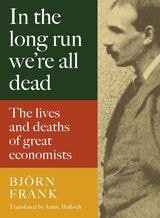
In the Long Run We're All Dead
The Lives and Deaths of Great EconomistsBjörn Frank
Haus Publishing, 2023
A fascinating and entertaining account of the lives of the most important economists of the past.
Until the late nineteenth century, economics couldn’t be studied at the university level; the field was the domain of well-educated figures whose radical curiosity drew them to a discipline that was little understood and often ridiculed. In the Long Run We’re All Dead tells the story of one of those figures in each of its thirteen chapters. Each of these extraordinary lives is worthy of fiction, and the manner of their deaths, oddly, often illuminates their work. Björn Frank shows us how these economists developed the theories for which they became famous and explains those ideas—utilitarianism, social costs, the endowment effect, and others—with reference to the lives of their creators in an engaging, irreverent, even comic style. Frank also takes daring leaps into speculation, considering how the principles of these long-gone economists might be applied to problems of today and of the future.
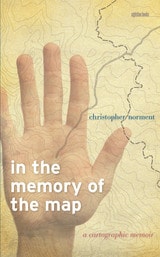
In the Memory of the Map
A Cartographic MemoirChristopher Norment
University of Iowa Press, 2012
Maps may have been the stuff of his dreams, but they sometimes drew him away from places where he should have remained firmly rooted. In the Memory of the Map explores the complex relationship among maps, memory, and experience—what might be called a “cartographical psychology” or “cartographical history.” Interweaving a personal narrative structured around a variety of maps, with stories about maps as told by scholars, poets, and fiction writers, this book provides a dazzlingly rich personal and intellectual account of what many of us take for granted.
A dialog between desire and the maps of his life, an exploration of the pleasures, utilitarian purposes, benefits, and character of maps, this rich and powerful personal narrative is the matrix in which Norment embeds an exploration of how maps function in all our lives. Page by page, readers will confront the aesthetics, mystery, function, power, and shortcomings of maps, causing them to reconsider the role that maps play in their lives.
In the Mirror
New and Selected Poems of Wong Phui NamWong Phui Nam
National University of Singapore Press, 2025
The poetry of Wong Phui Nam is foundational to Malaysian literature in English. While his early work is often cited in this regard, this edited collection of his poetry and critical essays makes it clear that his lifelong trajectory as a poet and critic is of deep interest. In the Mirror by Wong Phui Nam is a critical exploration of Malaysia's fractured post-colonial identity and literary landscapes.
Like many of his English-speaking peers at the University of Malaya, by the 1960s, Wong became disillusioned with the stark contradictions of writing in a colonial language while striving to build or maintain a national literary tradition. In 1969, when Malaysia's national cultural policy firmly emphasized the primacy of the Bahasa Malaysian language over English, Wong proclaimed, "I no longer wanted to write, at least not in a language I was told was a colonial leftover."
Over the years, however, he returned to poetry in English, often publishing privately. He came to believe that English was the language “most capable of representing our predicament,” given the spiritual and cultural vacuums left by colonialism's great ruptures in the region, and the ongoing neocolonial structure of the state and economy. His work challenges the reader to confront the realities of cultural displacement and the complexities of a multi-ethnic society grappling with its past and future.
This collection includes both recent works as well as some of his earlier achievements, starting with How the Hills are Distant, and also includes a foreword linking Wong's work with contemporary literary work in the region. An afterword by Wong's contemporary, Singaporean literary pioneer Edwin Thumboo, completes the volume.

In the Name of Editorial Freedom
125 Years at the Michigan DailyEdited by Stephanie Steinberg
University of Michigan Press, 2015
Search and browse the Bentley Historical Library's Michigan Daily Archive, https://digital.bentley.umich.edu/midaily. The free online archive contains stories from 23,000 issues published between 1891 and 2014.
--John U. Bacon, bestselling author of Three and Out: Rich Rodriguez and the Michigan Wolverines in the Crucible of College Football and Endzone: The Rise, Fall, and Return of Michigan Football
—Mary Sue Coleman, President Emerita at the University of Michigan
—James J. Duderstadt, President Emeritus at the University of Michigan
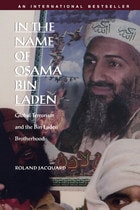
In the Name of Osama Bin Laden
Global Terrorism and the Bin Laden BrotherhoodRoland Jacquard
Duke University Press, 2002
International terrorism expert Roland Jacquard’s In the Name of Osama bin Laden presents a dramatic portrait of the world's most wanted terrorist and his extensive brotherhood--the network of people who operate “in his name.” Published originally in France the very week of September 11, as events in the United States shook the world, the book has become an international bestseller.
Jacquard details how bin Laden became an international emblem of fundamentalist, pan-Islamic, anti-U.S. fervor and the leader of a brotherhood so passionate that devotees who have never met him will act autonomously in his name. The author explains the global character of bin Laden’s organization, elaborating the extent of his sphere of influence in Europe and Asia. Jacquard reveals the construction of bin Laden’s networks—including a profile of his inner circle—and their collaboration with overlapping webs of banking, drug trafficking, religious, and terrorist organizations. He considers the brotherhood’s access to biological, chemical, and nuclear weapons and warns that, with or without bin Laden, this global terrorist force will remain a threat.
Now in English, this edition has been substantially updated in light of recent world events and expanded to include previously unpublished materials, featuring a new introduction and afterword. New documents include an April 2001 interview by the author with bin Laden; a September 24 proclamation by bin Laden to Muslims in Pakistan; and a key page from Dr. Ayman al-Zawahiri’s book justifying eternal jihad, which was smuggled out of Afghanistan in October 2001.
In the Open
Diary of a Homeless AlcoholicTimothy E. Donohue
University of Chicago Press, 1996
Donohue's experiences are brutal, but his perceptions are poetic. This account of an intelligent and sensitive man in the grip of alcoholism and homelessness challenges our perceptions of those on the margins of American contemporary life.
"Donohue recorded this often-moving account during a four-year period of homelessness caused by his alcoholism. . . . There are many brilliant observations here on a range of topics, including human nature, technology, and capitalism. . . . Donohue's life on the fringe also provides an inside look at the homeless system of overnight shelters, labor offices, and food stamp providers. But, somehow, in spite of all the negatives, a hopeful book emerges."—Booklist
"A startlingly original book. In this confessional age, Donohue's diary becomes a different sort of tell-all, a palimpsest that forces us to extract the author from his own writing. . . . Donohue comes to resemble Swift's Gulliver"—Nicholas Nesson, Boston Phoenix
"Donohue punctuates his account of 'domiciling within the black walls of a mosquito-infested night' with rambling metaphysical asides in the style of an eighteenth-century philosophe."—Molly McQuade, Lingua Franca
"Despite hunger, homelessness, dead-end jobs and abusive drinking, what is most striking about Donohue is his amazing optimism and endurance."—Patrick Markee, Nation
"Donohue is a gifted writer. . . . But what gives [his diary] the breath of life is that it is written by an artist."—Alec Wilkinson, Los Angeles Times Book Review
In the Province of the Gods
Kenny Fries
University of Wisconsin Press, 2021
In the Realms of Gold
Pioneering in African HistoryRoland Oliver
University of Wisconsin Press, 1997
In the Realms of Gold is Oliver’s account of his life and work. He writes in a deft and lively style about the circumstances of his early life that shaped his education and outlook: his childhood on a river houseboat in Kashmir, the influential teachers and friends met at Stowe and Cambridge, and his service in World War II as a cryptographer in British intelligence, where he met his first wife, Caroline Linehan. His interest in church history while at Cambridge led him to study the historical effects of Christian missionaries in Africa, and thus his career began.
The core of the book is Oliver’s account of his research travels throughout tropical Africa from the 1940s to the 1980s; his efforts to train and foster African graduate students to teach in African universities; his role in establishing conferences and journals to bring together the work of historians and archaeologists from Europe and Africa; his encounters with political and religious leaders, scholars, soldiers, and storytellers; and the political and economic upheavals of the continent that he witnessed.
In the Shadow of the Bear
A Michigan MemoirJim McGavran
Michigan State University Press, 2010
In the Shadow of the Bear chronicles the author's return, after a forty-year absence, to the site of his childhood summer vacations at Little Glen Lake in northwestern Lower Michigan's Leelanau peninsula.
The ancient Ojibwa legend that gave a name to the area's most striking geographical feature, the Sleeping Bear Sand Dunes, offers a way of understanding his mother's powerful but sometimes restless force of love and ambition in the family, as well as his father's quieter, often self-sacrificing love. Chapters devoted to the return to Leelanau, to each of his parents, and to his father's family culminate in the narrative of his daughter's 2005 Leelanau wedding.
Jim McGavran tells his story of self-discovery in prose that is alternatively frank and lyrical as he recaptures his bewildered yet enchanted boyhood self, filtered through his consciousness of longing and loss, lending the writing a particular poignancy.