763 books match the query 'Immigration & Emigration' and 68 start with i
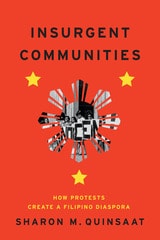
cover of Insurgent Communities: How Protests Create a Filipino Diaspora

Insurgent Communities

How Protests Create a Filipino Diaspora

Sharon M. Quinsaat

University of Chicago Press, 2024

Sociologist Sharon M. Quinsaat sheds new light on the formation of diasporic connections through transnational protests. 

When people migrate and settle in other countries, do they automatically form a diaspora? In Insurgent Communities, Sharon M. Quinsaat explains the dynamic process through which a diaspora is strategically constructed. Quinsaat looks to Filipinos in the United States and the Netherlands—examining their resistance against the dictatorship of Ferdinand Marcos, their mobilization for migrants’ rights, and the construction of a collective memory of the Marcos regime—to argue that diasporas emerge through political activism. Social movements provide an essential space for addressing migrants’ diverse experiences and relationships with their homeland and its history. A significant contribution to the interdisciplinary field of migration and social movements studies, Insurgent Communities illuminates how people develop collective identities in times of social upheaval.

 
[more]
cover of Intimacy Across Borders: Race, Religion, and Migration in the U.S. Midwest

Intimacy Across Borders

Race, Religion, and Migration in the U.S. Midwest

Jane Juffer

Temple University Press, 2013

Examining how encounters produced by migration lead to intimacies-ranging from sexual, spiritual, and neighborly to hateful and violent, Jane Juffer considers the significant changes that have occurred in small towns following an influx of Latinos to the Midwest.

Intimacy across Borders
situates the story of the Dutch Reformed Church in Iowa and South Africa within a larger analysis of race, religion, and globalization. Drawing on personal narrative, ethnography, and sociopolitical critique, Juffer shows how migration to rural areas can disrupt even the most thoroughly entrenched religious beliefs and transform the schools, churches, and businesses that form the heart of small-town America. Conversely, such face-to-face encounters can also generate hatred, as illustrated in the increasing number of hate crimes against Latinos and the passage of numerous anti-immigrant ordinances. 

Juffer demonstrates how Latino migration to new areas of the U.S. threatens certain groups because it creates the potential for new kinds of families—mixed race, mixed legal status, and transnational—that challenge the conservative definition of community based on the racially homogeneous, coupled, citizen family. 

[more]
cover of Intimate Inequalities: Performing Migrant Domestic Work

Intimate Inequalities

Performing Migrant Domestic Work

Ella Parry-Davies

Northwestern University Press, 2025

Mobilizing performance to amplify migrant domestic workers’ creative expertise
 
Intimate inequalities exist where the embodied and the everyday rub up against transnational structures of power. Ella Parry-Davies conducted collaborative research with migrant domestic workers from the Philippines living in the UK and Lebanon, where migration is regulated by employer sponsorship systems, to explore how they negotiate the intimacy of the family home and the attendant inequalities of laboring within it. Intimate Inequalities: Performing Migrant Domestic Work brings these conditions into focus while articulating a methodological inquiry into the dynamics of collaborative performance research. Parry-Davies examines site-specific soundwalks, recorded and coedited with domestic workers, which steer the book between church choirs in Beirut and activist gatherings in London, and from urban performances in Lebanon’s 2019 revolution to mutual aid organizing amid COVID-19 in the UK. Breaking with prevalent depictions of migrant domestic workers as voiceless and victimized, Intimate Inequalities mobilizes performance as both an analytic lens and a practical methodology, amplifying its subjects’ expertise while reckoning with the intimate yet unequal dynamics of research itself.

[more]
cover of Intimate Strangers: Shin Issei Women and Contemporary Japanese American Community, 1980-2020

Intimate Strangers

Shin Issei Women and Contemporary Japanese American Community, 1980-2020

Toyota, Tritia

Temple University Press, 2023

At the end of the twentieth century, many twenty-something Japanese women migrated to places like Southern California with few skills and an overall lack of human capital. These women, members of the shin Issei community, sought economic opportunities unavailable to them in their homeland. In Intimate Strangers, shin Issei women tell stories of precarity, inequality, and continuing marginality, first in Japan, where they were restricted by gendered social structures, and later in the United States, where their experiences were compounded by issues such as citizenship.

Intimate Strangers charts the experiences of shin Issei lives: their existence in Japan prior to migration, their motivations for moving to the United States, their settlement, and their growing awareness of their place in American society. Toyota chronicles how these resilient young women became active agents in circumventing social restrictions to fashion new lives of meaning. The Nikkei community (Americans of Japanese ancestry who were born in the United States) has been transformed by the inclusion of shin Issei, and Toyota describes the tensions around intergroup negotiations over race, identity, and the possibility of common belonging.

Intimate Strangers is a perceptive study of migration and community incorporation enacted around cultural differences and processes.

[more]
cover of Inventing Modern Adolescence: The Children of Immigrants in Turn-of-the-Century America

Inventing Modern Adolescence

The Children of Immigrants in Turn-of-the-Century America

Sarah E. Chinn

Rutgers University Press, 2008
The 1960s are commonly considered to be the beginning of a distinct "teenage culture" in America. But did this highly visible era of free love and rock 'n' roll really mark the start of adolescent defiance? In Inventing Modern Adolescence Sarah E. Chinn follows the roots of American teenage identity further back, to the end of the nineteenth and beginning of the twentieth centuries. She argues that the concept of the "generation gap"—a stereotypical complaint against American teens—actually originated with the division between immigrant parents and their American-born or -raised children. Melding a uniquely urban immigrant sensibility with commercialized consumer culture and a youth-oriented ethos characterized by fun, leisure, and overt sexual behavior, these young people formed a new identity that provided the framework for today's concepts of teenage lifestyle.Addressing the intersecting issues of urban life, race, gender, sexuality, and class consciousness, Inventing Modern Adolescence is an authoritative and engaging look at a pivotal point in American history and the intriguing, complicated, and still very pertinent teenage identity that emerged from it.
[more]
cover of Investing in the Homeland: Migration, Social Ties, and Foreign Firms

Investing in the Homeland

Migration, Social Ties, and Foreign Firms

Benjamin A.T. Graham

University of Michigan Press, 2019

Once viewed as a “brain drain,” migrants are increasingly viewed as a resource for promoting economic development back in their home countries. In Investing in the Homeland, Benjamin Graham finds that diasporans—migrants and their descendants—play a critical role in linking foreign firms to social networks in developing countries, allowing firms to flourish even in challenging political environments most foreign investors shun.

Graham’s analysis draws on new data from face-to-face interviews with the managers of over 450 foreign firms operating in two developing countries: Georgia and the Philippines. Diaspora-owned and diaspora-managed firms are better connected than other foreign firms and they use social ties to resolve disputes and influence government policy. At the same time, Graham shows that diaspora-affiliated firms are no more socially responsible than their purely foreign peers—at root, they are profit-seeking enterprises, not development NGOs. Graham identifies implications for policymakers seeking to capture the development potential of diaspora investment and for managers of multinational firms who want to harness diasporans as a source of sustained competitive advantage.
[more]
cover of Iranians in Texas: Migration, Politics, and Ethnic Identity

Iranians in Texas

Migration, Politics, and Ethnic Identity

By Mohsen M. Mobasher

University of Texas Press, 2012

Thousands of Iranians fled their homeland when the 1978–1979 revolution ended the fifty-year reign of the Pahlavi Dynasty. Some fled to Europe and Canada, while others settled in the United States, where anti-Iranian sentiment flared as the hostage crisis unfolded. For those who chose America, Texas became the fourth-largest settlement area, ultimately proving to be a place of paradox for any Middle Easterner in exile. Iranians in Texas culls data, interviews, and participant observations in Iranian communities in Houston, Dallas, and Austin to reveal the difficult, private world of cultural pride, religious experience, marginality, culture clashes, and other aspects of the lives of these immigrants.

Examining the political nature of immigration and how the originating and receiving countries shape the prospects of integration, Mohsen Mobasher incorporates his own experience as a Texas scholar born in Iran. Tracing current anti-Muslim sentiment to the Iranian hostage crisis, two decades before 9/11, he observes a radically negative shift in American public opinion that forced thousands of Iranians in the United States to suddenly be subjected to stigmatization and viewed as enemies. The book also sheds light on the transformation of the Iranian family in exile and some of the major challenges that second-generation Iranians face in their interactions with their parents.

Bringing to life a unique population in the context of global politics, Iranians in Texas overturns stereotypes while echoing diverse voices.
[more]
cover of Iranians in Texas: Migration, Politics, and Ethnic Identity

Iranians in Texas

Migration, Politics, and Ethnic Identity

Mohsen Mostafavi MobasherForeword by Nestor Rodriguez

University of Texas Press, 2025

An exploration of the link between politics of migration, prospects of integration, and ethnic identity among Iranian immigrants and their descendants in the United States, spanning from the 1970s to the present day.

Thousands of Iranians fled their homeland when the 1978–1979 revolution ended the fifty-year reign of the Pahlavi dynasty. Some fled to Europe and Canada, while others settled in the United States, where anti-Iranian sentiment flared as the hostage crisis unfolded. For those who chose America, Texas became the fourth-largest settlement area. Iranians in Texas culls data, interviews, and participant observations in Iranian communities in Houston, Dallas, and Austin to reveal the difficult, private world of cultural pride, religious experience, marginality, culture clashes, and other aspects of the lives of these immigrants.

Examining the political nature of immigration between Iran and the United States and social, cultural, and economic life for Iranian immigrants and their American-born children, Mohsen Mostafavi Mobasher incorporates his own experience as a Texas scholar born in Iran. In this revised edition, two new chapters and a new introduction and conclusion provide updates on what has happened in the Obama, Trump, and Biden administrations, including the Iran nuclear deal and resulting controversy, the Muslim ban, and the global protests over the death of twenty-two-year-old Mahsa Amini for not wearing a hijab. Bringing to life a unique immigrant population in the context of global politics, Iranians in Texas overturns stereotypes and echoes diverse voices.
[more]
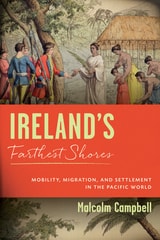
cover of Ireland's Farthest Shores: Mobility, Migration, and Settlement in the Pacific World

Ireland's Farthest Shores

Mobility, Migration, and Settlement in the Pacific World

Malcolm Campbell

University of Wisconsin Press, 2022

Irish people have had a long and complex engagement with the lands and waters encompassing the Pacific world. As the European presence in the Pacific intensified from the late eighteenth century, the Irish entered this oceanic space as beachcombers, missionaries, traders, and colonizers. During the nineteenth century, economic distress in Ireland and rapid population growth on the Pacific Ocean's eastern and western shores set in motion large-scale migration that exerted a deep political, social, and economic impact across the Pacific.

Malcolm Campbell examines the rich history of Irish experiences on land and at sea, offering new perspectives on migration and mobility in the Pacific world and of the Irish role in the establishment and maintenance of the British Empire. This volume investigates the extensive transnational connections that developed among Irish immigrants and their descendants across this vast and unique oceanic space, ties that illuminate how the Irish participated in the making of the Pacific world and how the Pacific world made them.
[more]
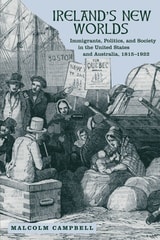
cover of Ireland's New Worlds: Immigrants, Politics, and Society in the United States and Australia, 1815–1922

Ireland's New Worlds

Immigrants, Politics, and Society in the United States and Australia, 1815–1922

Malcolm Campbell

University of Wisconsin Press, 2007

In the century between the Napoleonic Wars and the Irish Civil War, more than seven million Irish men and women left their homeland to begin new lives abroad. While the majority settled in the United States, Irish emigrants dispersed across the globe, many of them finding their way to another “New World,” Australia.
    Ireland’s New Worlds is the first book to compare Irish immigrants in the United States and Australia. In a profound challenge to the national histories that frame most accounts of the Irish diaspora, Malcolm Campbell highlights the ways that economic, social, and cultural conditions shaped distinct experiences for Irish immigrants in each country, and sometimes in different parts of the same country. From differences in the level of hostility that Irish immigrants faced to the contrasting economies of the United States and Australia, Campbell finds that there was much more to the experiences of Irish immigrants than their essential “Irishness.” America’s Irish, for example, were primarily drawn into the population of unskilled laborers congregating in cities, while Australia’s Irish, like their fellow colonialists, were more likely to engage in farming. Campbell shows how local conditions intersected with immigrants’ Irish backgrounds and traditions to create surprisingly varied experiences in Ireland’s new worlds. 
 
Outstanding Book, selected by the American Association of School Librarians, and Best Books for Special Interests, selected by the Public Library Association

“Well conceived and thoroughly researched . . . . This clearly written, thought-provoking work fulfills the considerable ambitions of comparative migration studies.”—Choice

 
 
[more]
cover of Irish Born, American Made: The Life and Myth of Captain John Egan

Irish Born, American Made

The Life and Myth of Captain John Egan

Ken Egan Jr.

University of Wisconsin Press, 2026

Born to poverty in the Irish county of Tipperary, John Egan participated in some of the most dramatic events of the nineteenth century, including mass migration to the United States during a catastrophic famine, the “opening” of Japan via gunboat diplomacy, Sherman’s March to the Sea, and homesteading in the Upper Midwest. In Irish Born, American Made, his great-grandson examines the processes by which a scorned British subject became a proud American citizen.

Although Egan’s life was filled with epic drama, the author does not shy away from unsavory truths, such as his ancestor’s doubts about the virtues of abolition or his enthusiastic participation in settling land appropriated from Indigenous peoples. Equally, Egan recognizes the real hardships his ancestor faced in assimilating to American society, from the prejudices of the ascendant Know-Nothing movement to the condescending caricatures of Irish soldiers by his Union compatriots during and after the Civil War. The result is both a moving reminder of the hardships of immigration and a timely reckoning with the imperfections of our forebears.

[more]
cover of Islam and Me: Narrating a Diaspora

Islam and Me

Narrating a Diaspora

Shirin Ramzanali Fazel

Rutgers University Press, 2023

Growing up in Mogadishu, Somalia, Shirin Ramzanali Fazel was immersed in the language and culture of Italy, Somalia’s former colonizer. Yet when she moved to Italy as a young mother in the 1970s, she discovered a country where immigrants and Muslims were viewed with a mixture of curiosity and suspicion­–where, even today, she and her children must seemingly prove they are Italian. 
 
In Islam and Me, Fazel tells her story and shares the experiences of other Muslim women living in Italy, revealing the wide variety of Muslim identities and the common prejudices they encounter. Looking at Italian school textbooks, newspapers, and TV programs, she invites us to change the way Muslim immigrants, and especially women, are depicted in both news reports and scholarly research. Islam and Me is a meditation on our multireligious, multiethnic, and multilingual reality, as well as an exploration of how we might reimagine national culture and identity so that they become more diverse, inclusive, and anti-racist. 
 
[more]
cover of Island Paradox: Puerto Rico in the 1990s

Island Paradox

Puerto Rico in the 1990s

Francisco Rivera-Batiz

Russell Sage Foundation, 1996
"One of the year's best books on Puerto Rico."—El Nuevo Dia, San Juan "[The authors] are highly regarded labor economists who have written extensively and intelligently in the past, and again in this volume, on Puerto Rican migration and labor markets... There isabundant statistical data and careful analysis, some of which challenges the conventional wisdom. Highly recommended." —Choice Island Paradox is the first comprehensive, census-based portrait of social and economic life in Puerto Rico. During its nearly fiftyyears as a U.S. commonwealth, the relationship between Puerto Rico's small, developing economy and the vastly larger, more industrialized United States has triggered profound changes in the island's industry and labor force. Puerto Rico has been deeply affected by the constant flow of its people to and from the mainland, and by the influx of immigrant workers from other nations. Distinguished economists Francisco Rivera-Batiz and Carlos Santiago provide the latest data on the socioeconomic status of Puerto Rico today, and examine current conditions within the context of the major trends of the past two decades. Island Paradox describes many improvements in Puerto Rico's standard of living, including rising per-capita income, longer life expectancies, greater educational attainment, and increased job prospects for women. But it also discusses the devastating surge in unemployment. Rapid urbanization and a vanishing agricultural sector have led to severe inequality, as family income has become increasingly dependent on education and geographic location. Although Puerto Rico's close ties to the United States were the major source of the island's economic growth prior to 1970, they have also been at the root of recent hardships. Puerto Rico's trade andbusiness transactions remain predominantly with the United States, but changes in federal tax, social, and budgetary policies, along with international agreements such as NAFTA, now threaten to alter the economic ties between the island and the mainland. Island Paradox reveals the social and family changes that have occurred among Puerto Ricans on the island and the mainland. The significant decline in the island's population growth is traced in part to women's increased pursuit of educational and employment opportunities before marrying. More children are being raised by singleparents, but this stems from a higher divorce rate and not a rise in teenage pregnancy. The widespread circular migration to and from the United States has had strong repercussions for the island's labor markets and social balance, leading to concerns about an island brain drain. The Puerto Rican population in the United States hasbecome increasingly diverse, less regionally concentrated and not, as some have claimed, in danger of becoming an underclass. Within a single generation Puerto Rico has experienced social and economic shifts of an unprecedented magnitude. Island Paradox charts Puerto Rico's economic fortunes, summarizes the major demographic trends, and identifies the issues that will have the strongest bearings on Puerto Rico's prospects for a successful future. A Volume in the Russell Sage Foundation Census Series
[more]
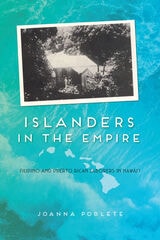
cover of Islanders in the Empire: Filipino and Puerto Rican Laborers in Hawai'i

Islanders in the Empire

Filipino and Puerto Rican Laborers in Hawai'i

JoAnna Poblete

University of Illinois Press, 2014

In the early 1900s, workers from new U.S. colonies in the Philippines and Puerto Rico held unusual legal status. Denied citizenship, they nonetheless had the right to move freely in and out of U.S. jurisdiction. As a result, Filipinos and Puerto Ricans could seek jobs in the United States and its territories despite the anti-immigration policies in place at the time.
 
JoAnna Poblete's Islanders in the Empire: Filipino and Puerto Rican Laborers in Hawai'i takes an in-depth look at how the two groups fared in a third new colony, Hawai'i. Using plantation documents, missionary records, government documents, and oral histories, Poblete analyzes how the workers interacted with Hawaiian government structures and businesses, how U.S. policies for colonial workers differed from those for citizens or foreigners, and how policies aided corporate and imperial interests.
 
A rare tandem study of two groups at work on foreign soil, Islanders in the Empire offers a new perspective on American imperialism and labor issues of the era.
[more]
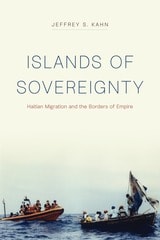
cover of Islands of Sovereignty: Haitian Migration and the Borders of Empire

Islands of Sovereignty

Haitian Migration and the Borders of Empire

Jeffrey S. Kahn

University of Chicago Press, 2018

In Islands of Sovereignty, anthropologist and legal scholar Jeffrey S. Kahn offers a new interpretation of the transformation of US borders during the late twentieth century and its implications for our understanding of the nation-state as a legal and political form. Kahn takes us on a voyage into the immigration tribunals of South Florida, the Coast Guard vessels patrolling the northern Caribbean, and the camps of Guantánamo Bay—once the world’s largest US-operated migrant detention facility—to explore how litigation concerning the fate of Haitian asylum seekers gave birth to a novel paradigm of offshore oceanic migration policing. Combining ethnography—in Haiti, at Guantánamo, and alongside US migration patrols in the Caribbean—with in-depth archival research, Kahn expounds a nuanced theory of liberal empire’s dynamic tensions and its racialized geographies of securitization. An innovative historical anthropology of the modern legal imagination, Islands of Sovereignty forces us to reconsider the significance of the rise of the current US immigration border and its relation to broader shifts in the legal infrastructure of contemporary nation-states across the globe.
 
[more]
cover of Issei Buddhism in the Americas

Issei Buddhism in the Americas

Edited by Duncan Ryuken Williams and Tomoe Moriya

University of Illinois Press, 2010
Rich in primary sources and featuring contributions from scholars on both sides of the Pacific, Issei Buddhism in the Americas upends boundaries and categories that have tied Buddhism to Asia and illuminates the social and spiritual role that the religion has played in the Americas. While Buddhists in Japan had long described the migration of the religion as traveling from India, across Asia, and ending in Japan, this collection details the movement of Buddhism across the Pacific to the Americas. Leading the way were pioneering, first-generation Issei priests and their followers who established temples, shared Buddhist teachings, and converted non-Buddhists in the late nineteenth and twentieth centuries. The book explores these pioneering efforts in the context of Japanese diasporic communities and immigration history and the early history of Buddhism in the Americas. The result is a dramatic exploration of the history of Asian immigrant religion that encompasses such topics as Japanese language instruction in Hawaiian schools, the Japanese Canadian community in British Columbia, the roles of Buddhist song culture, Tenriyko ministers in America, and Zen Buddhism in Brazil. Contributors are Michihiro Ama, Noriko Asato, Masako Iino, Tomoe Moriya, Lori Pierce, Cristina Rocha, Keiko Wells, Duncan Ryûken Williams, and Akihiro Yamakura.
[more]
cover of Issues in the Economics of Immigration

Issues in the Economics of Immigration

Edited by George J. Borjas

University of Chicago Press, 2000

The United States is now admitting nearly one million legal immigrants per year, while the flow of illegal aliens into the country continues to increase steadily. The debate over immigration policy has typically focused on three fundamental questions: How do immigrants perform economically relative to others? What effects do immigrants have on the employment opportunities of other workers? What kind of immigration policy is most beneficial to the host country? This authoritative volume represents a move beyond purely descriptive assessments of labor market consequences toward a more fully developed analysis of economic impacts across the social spectrum. Exploring the broader repercussions of immigration on education, welfare, Social Security, and crime, as well as the labor market, these papers assess dimensions not yet taken into account by traditional cost-benefit calculations.

This collection offers new insights into the kinds of economic opportunities and outcomes that immigrant populations might expect for themselves and future generations.
[more]
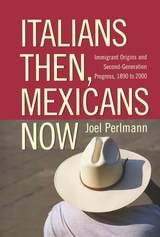
cover of Italians Then, Mexicans Now: Immigrant Origins and the Second-Generation Progress, 1890-2000

Italians Then, Mexicans Now

Immigrant Origins and the Second-Generation Progress, 1890-2000

Joel Perlmann

Russell Sage Foundation, 2005

According to the American dream, hard work and a good education can lift people from poverty to success in the "land of opportunity." The unskilled immigrants who came to the United States from southern, central, and eastern Europe in the late 19th and early 20th centuries largely realized that vision. Within a few generations, their descendants rose to the middle class and beyond. But can today's unskilled immigrant arrivals—especially Mexicans, the nation's most numerous immigrant group—expect to achieve the same for their descendants? Social scientists disagree on this question, basing their arguments primarily on how well contemporary arrivals are faring. In Italians Then, Mexicans Now, Joel Perlmann uses the latest immigration data as well as 100 years of historical census data to compare the progress of unskilled immigrants and their American-born children both then and now. The crucial difference between the immigrant experience a hundred years ago and today is that relatively well-paid jobs were plentiful for workers with little education a hundred years ago, while today's immigrants arrive in an increasingly unequal America. Perlmann finds that while this change over time is real, its impact has not been as strong as many scholars have argued. In particular, these changes have not been great enough to force today's Mexican second generation into an inner-city "underclass." Perlmann emphasizes that high school dropout rates among second-generation Mexicans are alarmingly high, and are likely to have a strong impact on the group's well-being. Yet despite their high dropout rates, Mexican Americans earn at least as much as African Americans, and they fare better on social measures such as unwed childbearing and incarceration, which often lead to economic hardship. Perlmann concludes that inter-generational progress, though likely to be slower than it was for the European immigrants a century ago, is a reality, and could be enhanced if policy interventions are taken to boost high school graduation rates for Mexican children. Rich with historical data, Italians Then, Mexicans Now persuasively argues that today's Mexican immigrants are making slow but steady socio-economic progress and may one day reach parity with earlier immigrant groups who moved up into the heart of the American middle class. Copublished with the Levy Economics Institute of Bard College
[more]