Results by title
4030 books match the query 'Language Arts & Disciplines' and 223 start with i
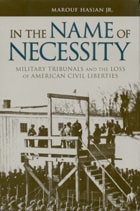
In the Name of Necessity
Military Tribunals and the Loss of American Civil LibertiesMarouf Hasian
University of Alabama Press, 2005
Examining how claims of necessity have reshaped American liberty in times of war.
Though the war on terrorism is said to have generated unprecedented military situations, arguments for the Patriot Act and military tribunals following 9/11 resemble many historical claims for restricting civil liberties, more often than not in the name of necessity.
Marouf Hasian Jr. examines the major legal cases that show how various generations have represented the need for military tribunals, and how officials historically have applied the term “necessity.” George Washington cited the necessity of martial discipline in executing the British operative Major André. Tribunals tried and convicted more than 200 Sioux warriors during the Dakota Wars. President Lincoln suspended habeas corpus for many civilian and military prisoners during the Civil War. Twentieth Century military and civilian leaders selectively drafted their own codes, leading to the execution of German saboteurs during World War II. Further, General MacArthur’s tribunal to investigate the wartime activities of Japanese General Yamashita raised the specter of “victor’s justice,” anticipating the outcry that attended the Nuremberg trials.
In those cases as in current debates about the prosecution of terrorists, Hasian argues that the past is often cited selectively, neglecting historical contexts and the controversies these cases engendered.

In the Name of the Father
The Rhetoric of the New Southern Baptist ConventionCarl L. Kell and L. Raymond Camp. Foreword by Kenneth Chafin
Southern Illinois University Press, 1999
In the Name of the Father: The Rhetoric of the New Southern Baptist Conventionbegins with an analysis of the 1979 Southern Baptist Convention, the watershed convention where moderate forces fell before the powerful oratory of the ultraconservative faction, which has remained in power ever since. Communication professors Carl L. Kell and L. Raymond Camp investigate the rhetorical shift from moderate to ultraconservative in the Southern Baptist Convention, the largest denomination in the South and the largest Protestant denomination in the United States.
Drawing on sermons delivered at national conventions from 1979 to the present, Kell and Camp outline the discourses of fundamentalism, inerrancy, and exclusion. These discourses, the authors assert, point to the SBC leaders’ call for a return to times before feminism and tolerance of varying sexual orientations allegedly brought chaos to society and shook believers from their theological foundations.
In the Other Direction Now
Dispatches from East AfricaNavid Kermani
Haus Publishing, 2026
More than a travelogue: a work of human depth and understanding that has much to teach those interested in contemporary global affairs and postcolonial realities.
Navid Kermani is an acclaimed writer already well known in the English-speaking world for his books Upheaval: The Refugee Trekthrough Europe and Along the Trenches: A Journey through Eastern Europe to Isfahan. His new book, In the Other Direction Now, continues his thoughtful documentation of global peripheries. Visiting southern Madagascar, the Comoros, Mozambique, Tanzania, Kenya, Ethiopia, and Sudan, Kermani examines how global fault lines converge, from postcolonial neglect and the devastating impact of climate change to the rising and often nefarious influence of China and the consequences of the Ukraine War.
Reflective, astute, and intellectually rigorous, Kermani’s empathetic yet unflinching perspective does not aim to interpret Africa for us, but to learn from it in all its variousness and multiplicity. Music emerges as a unifying thread—Christian hymns, Sufi dances, and Sudanese jazz become symbols of resilience and transformation, providing cultural links that bind communities across conflict, faith, and history and offering a counterpoint to colonial clichés and Western ignorance. These specific, grounded accounts of people and places contextualize global inequalities not as a product of some intrinsic African deficiency but as part of interconnected systems shaped by the Global North as much as by local governance and the legacy of colonialism.
In the Wake of Violence
Image & Social ReformCheryl R. Jorgensen-Earp
Michigan State University Press, 2008
How acts of violence are rhetorically "managed" by social movements: In the Wake of Violence explores the immediate and longer term aftermath of violence committed by independent radicals involved in single-issue movements. Cheryl R. Jorgensen-Earp explores several specific incidents in recent history—the arson of a Vail ski resort by environmentalists, the murder of Dr. John Britton by an antiabortion activist, and the torching of a University of California research laboratory by animal rights activists among them—to discover how the perpetrators of the violence and the majority of reformers involved in their movements rhetorically framed the violent act for a potentially outraged public.
In the Wake of Violence, claims Jorgensen-Earp, the perpetrators are often forthcoming with both explanations for and a defense of their actions, casting themselves as righteous actors or martyrs for a cause. However, ardent reformers within the same cause might look with genuine revulsion at the actions of their own radical wing. This study claims that the nonviolent majority in single-issue reform movements employs a predictable constellation of rhetorical strategies to manage the impact of radical fringe violence. The primary goal of this rhetoric is to avoid a backlash against the larger movement by a public alienated by violent acts.
In examining specific rhetorical responses by the nonviolent majority in antiabortion, animal welfare, environmental reform, abolition, and women’s suffrage movements, Jorgensen-Earp considers a wide range of discourse types—from newspaper articles, interviews, and editorials to private letters; from editorial cartoons to the homemade signs of movement activists; and from speeches to modern Internet sites. She discovers that the image restoration techniques brought to bear for a reform cause are similar to those employed by a corporation accused of wrongdoing. Ultimately, she finds that the majority of proponents of the causes she examines believe that the violence can or will be condoned and that it must be rhetorically mitigated.

In the Words of the Winners
The Newbery and Caldecott Medals 2001-2010American Library Association, 2011
Include
Julie Stivers
American Library Association, 2022
Include, part of a six-volume series on the Shared Foundations in AASL’s National School Library Standards, brings together a chorus of school librarians, scholars, and students representing a wide range of races, ethnicities, experiences, and identities. This book offers
- an understanding of why the concept of Include is paramount to school librarian practice, supported by key research to share and inspire the inclusion of learner and educator voices and experiences;
- an explanation of what it looks like to successfully integrate the Include Shared Foundation in terms of collection, space, and instruction;
- useable guidance that school librarians can confidently incorporate in their settings , including easy-to-implement ideas, inspiring stories, events, and transformation; and
- reflections, questions, and action steps to help readers move their practice forward.
Including Families of Children with Special Needs
A How-To-Do-It Manual for LibrariansSandra Feinberg
American Library Association, 2013
Inclusion, Diversity and Innovation in Translation Education
Edited by Alejandro Bolaños García-Escribano and Mazal Oaknín
University College London, 2024
In Inclusion, Diversity and Innovation in Translation Education, editors Alejandro Bolaños, García-Escribano, and Mazal Oaknín, emphasize the latest developments in literary and audiovisual translation education and teaching foreign languages while exploring the relevance of equality, diversity, and inclusion. They propose best practices and pieces of training, inviting readers to incorporate social issues affecting marginalized groups in their language and translation teaching practices.
Inclusive Leadership in Academic Libraries
Edited by Annie Bélanger, John Meier, and Jennifer DeVito
American Library Association, 2026
Libraries are forever in a state of change and evolution. We are affected by social movements, cultural norms, the political climate, and economic forces. Developing skills in inclusive leadership is one step toward fostering workspaces that are diverse, equitable, and able to effectively manage through change while holding true to our values as library workers.
Inclusive Leadership in Academic Libraries offers 26 chapters in three parts that explore what inclusive leadership is, the theories underlying it, and ways to incorporate it into your daily work.
- Setting the Stage: Introduces inclusive leadership and theoretical frameworks
- Concepts and Practices: Includes chapters on the themes and theories of inclusive leadership and case studies demonstrating them
- Living Into Inclusive Leadership: Puts inclusive leadership into practice and offers examples of how it’s been done in various academic libraries
Inclusive leadership incorporates empathy, acknowledges that every person brings different perspectives and skills to the workplace, and articulates that leaders exist at all levels. Inclusive Leadership in Academic Libraries will help you incorporate effective, equitable practices throughout your library. This book is also available as an open access edition.
Inclusive STEM
Transforming Disciplinary Writing Instruction for a Socially Just FutureHeather M. Falconer
University Press of Colorado, 2025
Inconvenient Strangers
Transnational Subjects and the Politics of CitizenshipShui-yin Sharon Yam
The Ohio State University Press, 2019
Inconvenient Strangers: Transnational Subjects and the Politics of Citizenship draws attention to how intersecting networks of power—particularly race and ethnicity, gender, and social class—marginalize transnational subjects who find themselves outside a dominant citizenship that privileges familiarity and socioeconomic and racial superiority. In this study of how neoliberal ideas limit citizenship for marginalized populations in Hong Kong, Shui-yin Sharon Yam examines how three transnational groups—mainland Chinese maternal tourists, Southeast Asian migrant domestic workers, and South Asian permanent residents—engage with the existing citizenry and gain recognition through circulating personal narratives.
Coupling transnational feminist studies with research on emotions, Yam analyzes court cases, interviews, social media discourse, and the personal narratives of Hong Kong’s marginalized groups to develop the concept of deliberative empathy—critical empathy that prompts an audience to consider the structural sources of another’s suffering while deliberating one’s own complicity in it. Yam argues that storytelling and familial narratives can promote deliberative empathy among the audience as both a political and ethical response—carrying the affective power to jolt the dominant citizenry out of their usual xenophobic attitudes and ultimately prompt them to critically consider the human conditions they share with the marginalized and move them toward more ethical coalitions.
Incubating Creativity at Your Library
A Sourcebook for Connecting with CommunitiesLaura Damon-Moore
American Library Association, 2019
Creativity needs a platform. As technology consultant David Weinberger puts it, “A platform provides resources that lets other people build things.” The library is an ideal platform, and in this book Batykefer and Damon-Moore, creators of the Library as Incubator Project, share the experiences of numerous creative library workers and artists who are making it happen. Their stories will show you how to move beyond merely responding to community needs towards actively building a platform with your community. And best of all, you don’t need to start from scratch—rather, you amplify what’s already working. Filled with ideas and initiatives that can be customized to suit your library and its community, this book
- discusses the four elements (Resources, Invitations, Partnerships & Engagement, and Staff) and the two lenses (Community-Led and Evaluation) of the Creative Library platform;
- outlines six steps for surveying your community’s artistic landscape;
- gives methods for expanding partnerships and connections with individuals and organizations through exploration, hands-on learning, and engagement with the community;
- shares perspectives on the “ideal library” from several artists, with three examples of artist-in-residence programs;
- offers examples of community invitations in action, such as the Pittsburgh Fiberarts Guild workshops on creating flowers using recycled materials;
- shows how to use “orphan photos” from your archives for creative inspiration;
- advises on using qualitative evaluations to effectively “weed” your initiatives; and
- shares tips for encouraging library staff to express their creativity, turning avocations into library initiatives like Handmade Crafternoons, the Yahara Music Library, or BOOKLESS.
By building on existing elements at your library and filling in the gaps with community-driven additions, your library can be a space that cultivates creativity in both its users and staff.
Indexes
A Chapter from "The Chicago Manual of Style," Eighteenth EditionThe University of Chicago Press Editorial Staff
University of Chicago Press, 2024
In this age of searchable text, the need for an index made with human input is sometimes questioned. But a good index can do what a plain search cannot: It gathers all the substantive terms and subjects of the work, sorts them alphabetically, provides cross-references to and from related terms, and includes specific page numbers or other locators or, for electronic formats, direct links to the text. This painstaking intellectual labor serves readers of any longer work, whether it is searchable or not. For searchable texts, an index provides insurance against fruitless queries and unintended results. In a word, a good index makes the text more accessible.
Most book indexes must be assembled swiftly between the time page proofs are issued and the time they are returned to the typesetter—usually about four weeks. An author preparing their own index will have to proofread as well as index the work in that short time span.
This insightful chapter-length booklet will guide both professionals and first-time indexers in assembling an index that will do justice to both the book and the reader.
Indexes
A Chapter from The Chicago Manual of StyleThe University of Chicago Press
University of Chicago Press, 1993
Indexes
A Chapter from The Chicago Manual of Style, 15th EditionUniversity of Chicago Press Staff
University of Chicago Press, 2003
Indexes
A Chapter from The Chicago Manual of Style, Seventeenth EditionThe University of Chicago Press Editorial Staff
University of Chicago Press, 2017
Indexing Books, Second Edition
Nancy C. Mulvany
University of Chicago Press, 2005
Like its predecessor, this edition of Indexing Books offers comprehensive, reliable treatment of indexing principles and practices relevant to authors and indexers alike. In addition to practical advice, the book presents a big-picture perspective on the nature and purpose of indexes and their role in published works. New to this edition are discussions of "information overload" and the role of the index, open-system versus closed-system indexing, electronic submission and display of indexes, and trends in software development, among other topics.
Mulvany is equally comfortable focusing on the nuts and bolts of indexing—how to determine what is indexable, how to decide the depth of an index, and how to work with publisher instructions—and broadly surveying important sources of indexing guidelines such as The Chicago Manual of Style, Sun Microsystems, Oxford University Press, NISO TR03, and ISO 999. Authors will appreciate Mulvany's in-depth consideration of the costs and benefits of preparing one's own index versus hiring a professional, while professional indexers will value Mulvany's insights into computer-aided indexing. Helpful appendixes include resources for indexers, a worksheet for general index specifications, and a bibliography of sources to consult for further information on a range of topics.
Indexing Books is both a practical guide and a manifesto about the vital role of the human-crafted index in the Information Age. As the standard indexing reference, it belongs on the shelves of everyone involved in writing and publishing nonfiction books.
Indian Country
Telling a Story in a Digital AgeVictoria L. LaPoe
Michigan State University Press, 2017
Indian Place Names in Alabama
William A. Read, and revised edition by James B. McMillan
University of Alabama Press, 1984
Learn the Secrets of Alabama’s Fascinating Place Names
In Place Names in Alabama, readers embark on a captivating journey through the linguistic and cultural heritage embedded in the state’s geography. This masterful reference work, compiled by a renowned linguist and historian, unveils the origins and meanings of hundreds of towns, rivers, creeks, and landmarks—many rooted in Native American languages, colonial history, and local folklore. From the bustling streets of Tuscaloosa, whose name means “Black Warrior,” to Mobile, rooted in the name of the indigenous Maubila people, this book reveals the deep cultural and linguistic layers that shape Alabama’s identity. Other fascinating examples are Talladega, which traces its name to a Muscogee word meaning “border town” and Opelika, derived from Creek for “large swamp.”
Indian Place Names in Alabama is scholarly yet accessible, ideal for historians, educators, genealogists, and curious readers. It is richly annotated and includes historical maps, archival citations, and linguistic insights. Its etymologies include place names of Indigenous, French, Spanish, and English origin. Whether you're tracing ancestral roots, exploring regional history, or simply intrigued by the names on a map, Indian Place Names in Alabama offers a treasure trove of discovery.
Indian Sign Language
A Linguistic Analysis of Its GrammarSamar Sinha
Gallaudet University Press, 2017
Samar Sinha presents pioneering research into the grammatical properties of Indian Sign Language (ISL), a language used by members of the Deaf community in India. This detailed and well-illustrated study describes the grammar of ISL and is supplemented by comparative and theoretical analyses in the core areas of sublexical structure, morphology, and syntax. Sinha offers a field-based, comprehensive analysis that covers topics such as
o sign formation parameters
o syllable structure
o sonority hierarchy
o semantics of space
o pluralization strategies
o phi-features
o indexing and localization
o agreement
o word order
He provides a description of the Indian Deaf community that serves to frame his analysis of ISL and highlights the need for greater awareness and acknowledgment of the language and its users. The lack of research on ISL in Indian academia has slowed efforts toward the standardization of ISL and the development of pedagogical materials. This work adds to the growing understanding of natural human language in general and ISL in particular. It also contributes to the empowerment of the Deaf community in India and will strengthen the efforts carried out by d/Deaf activists and researchers.
Indigenous Activism in the Midwest
Refusal, Resurgence, and Resisting Settler ColonialismMargret McCue-Enser
Michigan State University Press, 2025
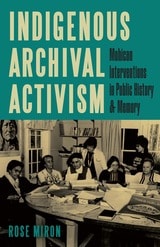
Indigenous Archival Activism
Mohican Interventions in Public History and MemoryRose Miron
University of Minnesota Press, 2024
Who has the right to represent Native history?
The past several decades have seen a massive shift in debates over who owns and has the right to tell Native American history and stories. For centuries, non-Native actors have collected, stolen, sequestered, and gained value from Native stories and documents, human remains, and sacred objects. However, thanks to the work of Native activists, Native history is now increasingly being repatriated back to the control of tribes and communities. Indigenous Archival Activism takes readers into the heart of these debates by tracing one tribe’s fifty-year fight to recover and rewrite their history.
Rose Miron tells the story of the Stockbridge-Munsee Mohican Nation and their Historical Committee, a group of mostly Mohican women who have been collecting and reorganizing historical materials since 1968. She shows how their work is exemplary of how tribal archives can be used strategically to shift how Native history is accessed, represented, written and, most importantly, controlled. Based on a more than decade-long reciprocal relationship with the Stockbridge-Munsee Mohican Nation, Miron’s research and writing is shaped primarily by materials found in the tribal archive and ongoing conversations and input from the Stockbridge-Munsee Historical Committee.
As a non-Mohican, Miron is careful to consider her own positionality and reflects on what it means for non-Native researchers and institutions to build reciprocal relationships with Indigenous nations in the context of academia and public history, offering a model both for tribes undertaking their own reclamation projects and for scholars looking to work with tribes in ethical ways.
Indigenous Genres of the Human
Locating the Intersections of Indigeneity and LatinidadGabriela Raquel Ríos
University of Arizona Press, 2026
Addressing different genres of human and what contemporary indigeneity and reclaiming indigeneity looks like across Latin American contexts, chapters in this work examine digital bruja poetry, Aymara women’s Lucha Libre in Bolivia, Raramuri dance in Mexico, and Indigenous Khipu in the Andes. The author weaves her own story of being from southern Texas and traveling to Mexico throughout the book.
Bridging Sylvia Wynter’s theory of “genres of the human” with critical Latinx indigeneity studies, Chicana/o/x studies, decolonial theory, and rhetorical new materialisms, this book challenges readers to rethink what it means to be human, Indigenous, and Chicanx in the wake of colonial violence. Rather than reinforcing binaries defined by settler colonialism, Ríos proposes a framework that centers community knowledge and grounded practices. Her work opens space for dialogue, listening, and healing, emphasizing that reclaiming indigeneity requires attention to the stories, movements, and rhetorical practices that emerge from within communities themselves.
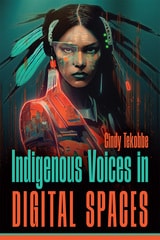
Indigenous Voices in Digital Spaces
Cindy Tekobbe
Utah State University Press, 2024
Tekobbe’s methods for analyzing and understanding Indigenous knowledges online center Indigenous storytelling and “thick” (broad, deep, and complex) Indigenous meaning-making. Employing this thickness to interpret Indigenous knowledge ways resists the settler-colonial logics that tend to flatten complex Indigenous concepts into one-note representations of racial stereotypes. Native Americans’ use of social media and digital platforms to support social movements uniquely constructs Indigenous identities as living, producing, and culture-making people, which confronts the commonplace, one-dimensional narrative that Indigenous North Americans either live in isolation or are people of history resigned to the long-forgotten past. Tekobbe’s methods are applicable to additional online research to break through Western paradigms of oppositional critique, the colonial power matrix embedded in hierarchical and taxonomical classification systems, and participant objectification.
Indigenous Voices in Digital Spaces offers new methodological and epistemological opportunities to explore digital communities and technologies, problematizing conventional Western critique. This book is useful to instructors in Indigenous studies, internet studies, digital literacies, cultural studies, and communications, as well as Indigenous and internet studies researchers.
Inference and Disputed Authorship
Frederick Mosteller and David L. Wallace
CSLI, 2013

Influencing Without Authority
Melanie Hawks
Assoc of College & Research Libraries, 2011
Influencing Without Authority
Melanie Hawks
Assoc of College & Research Libraries, 2011
Information Literacy Assessment
Standards-Based Tools and AssignmentsTeresa Y. Neely
American Library Association, 2006
Information Literacy Instruction Handbook
Christopher N. Cox
Assoc of College & Research Libraries, 2008
Information Literacy Instruction that Works
A Guide to Teaching by Discipline and Student PopulationPatrick Ragains
American Library Association, 2013
Information Literacy Programs in the Digital Age
Educating College and University Students OnlineAlice Daugherty
Assoc of College & Research Libraries, 2011
Information Literacy Programs in the Digital Age
Educating College and University Students OnlineAlice Daugherty
Assoc of College & Research Libraries, 2011
Information Literacy Standards for Student Learning
American Library Association, 1999
Information Literacy and Social Media
Empowered Student Engagement with the ACRL FrameworkMichele Santamaria
Assoc of College & Research Libraries, 2024
Information Literacy and Social Media: Empowered Student Engagement with the ACRL Framework provides librarians and non-librarian practitioners with ways to teach and learn with social media. It addresses how to broadly conceptualize information literacy teaching with social media and allay any student reluctance to using social media for academic purposes. It proposes how to map some of the ACRL threshold concepts onto specific social media platforms, including Facebook, X, Instagram, and TikTok, while providing general guidance for if and when those platforms change. There are eight concrete, cross-disciplinary lesson plans that factor in design, assessment, and student engagement. Finally, the book considers how up-and-coming platforms might empower students to be critical content creators and encourage librarians and faculty to support and create new information literacy initiatives on their campuses.
Information Literacy and Social Media demonstrates how to engage students with and through social media platforms and teach them to embrace their role as information creators through engagement with the ACRL Framework for Information Literacy for Higher Education. This is the step that they must take to truly be metaliterate in the creative and ethical ways that make information literacy an essential college competency.
Information Literacy
Research and Collaboration across DisciplinesBarbara d'Angelo
University Press of Colorado, 2017
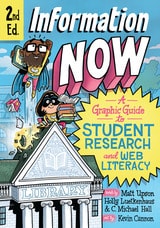
Information Now, Second Edition
A Graphic Guide to Student Research and Web LiteracyMatt Upson, Holly Luetkenhaus, C. Michael Hall, and Kevin Cannon
University of Chicago Press, 2021
This second edition of the popular guide incorporates critical analysis of information systems, asking students to think about the biases and problems in how databases and search engines are designed and used. It also addresses how different populations of people are disproportionately affected by the algorithmic biases built into information systems. And it includes revised critical thinking exercises in every chapter.
Written and revised by library professionals, Information Now is a fun and insightful tool for high school and college students, writers, and anyone wanting to improve their research skills.
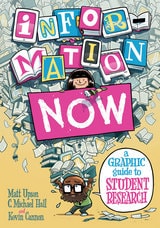
Information Now
A Graphic Guide to Student ResearchMatt Upson, C. Michael Hall, and Kevin Cannon
University of Chicago Press, 2015
Information Now is an innovative approach to information literacy that will reinvent the way college students think about research. Instead of the typical textbook format, it uses illustrations, humor, and reflective exercises to teach students how to become savvy researchers. Students will learn how to evaluate information, to incorporate it into their existing knowledge base, to wield it effectively, and to understand the ethical issues surrounding its use. Written by two library professionals, it incorporates concepts and skills drawn from the Association of College and Research Libraries’ Information Literacy Competency Standards for Higher Education and their Framework for Information Literacy for Higher Education. Thoroughly researched and highly engaging, Information Now offers the tools that students need to become powerful consumers and creators of information.
Whether used by a high school student tackling a big paper, an undergrad facing the newness of a university library, or a writer wanting to go beyond Google, Information Now is a powerful tool for any researcher’s arsenal.
Information Power
Building Partnerships for LearningAmerican Library Association, 1998
Information Services to Diverse Populations
Competent Humility for Library ProfessionalsNicole A. Cooke
American Library Association, 2026
Foreword by Cynthia Sturgis Landrum
The development of cultural competency skills and social awareness benefits LIS students, their future employers, and the library profession at large―not to mention library customers and society as a whole. Cooke's freshly updated text introduces readers to the contexts and situations that promote the development of empathy and build cultural competence. It marshals cutting edge research and relevant best practices to give readers a strong grasp of the political, social, economic, and technological divides among library patrons. It also covers outreach and library services to diverse populations, how to evaluate such services, and many other key topics. Complete with an updated syllabus, lesson plans, and exercises ready-made for course use, Cooke’s text
- demonstrates why social responsibility is a foundational value of librarianship;
- considers library services to members of marginalized racial or ethnic groups, older adults, people with mental health or physical disabilities, neurodiverse library users, refugees and immigrants, people experiencing homelessness or hunger, those growing up in or experiencing poverty, members of the LGBTQIA+ communities, and people who are incarcerated;
- features a myriad of testimonials drawn from a wide variety of settings that highlight the experiences of library and museum practitioners who are working with diverse populations;
- introduces a new model of cultural competence and cultural humility;
- authoritatively covers such essential concepts as intersectionality, privilege, marginalization, cultural competence, cultural humility, and counter-storytelling along with discussions of how they interplay in the communities that libraries serve;
- explores the impact of overwhelming whiteness of the library profession and what can be done to recruit, welcome, mentor, and retain racially and ethnically diverse library workers; and
- identifies potential employment and networking opportunities related to diversity and social justice in librarianship.
Information Sharing
Reference and Presupposition in Language Generation and InterpretationEdited by Kees van Deemter and Rodger Kibble
CSLI, 2002
Informed Learning
Christine Bruce
Assoc of College & Research Libraries, 2011
Informed Learning
Christine Bruce
Assoc of College & Research Libraries, 2011
Informing Innovation
Tracking Student Interest in Emerging Library Technologies at Ohio UniversityChar Booth
Assoc of College & Research Libraries, 2011
Informing Innovation
Tracking Student Interest in Emerging Library Technologies at Ohio UniversityChar Booth
Assoc of College & Research Libraries, 2011
Innovative Approaches to Teaching Technical Communication
edited by Tracy Bridgeford, Karla Saari Kitalong, and Dickie Selfe
Utah State University Press, 2004
Programs in technical writing, technical communication, and/or professional communication have recently grown in enrollment as the demand among employers for formally prepared technical writers and editors has grown. In response, scholarly treatments of the subject and the teaching of technical writing are also burgeoning, and the body of research and theory being published in this field is many times larger and more accessible than it was even a decade ago.
Although many theoretical and disciplinary perspectives can potentially inform technical communication teaching, administration, and curriculum development, the actual influences on the field's canonical texts have traditionally come from a rather limited range of disciplines. Innovative Approaches to Teaching Technical Communication brings together a wide range of scholars/teachers to expand the existing canon.
Innovative Library Workplaces
Transformative Human Resource StrategiesLisa Kallman Hopkins
Assoc of College & Research Libraries, 2024
In two parts, Innovative Library Workplaces provides the tools you need to make your workplace a good one for your employees.
- Human Resources in Libraries
- Recruiting and Hiring
- Onboarding and Training
- Salary Studies and Unions
- Work Culture and Organization
- Employee Morale
- Flexible Work Arrangements
- Strategic Planning and Reorganizing
Innovative Practices for Teaching Sign Language Interpreters
Cynthia B. Roy
Gallaudet University Press, 2000
Researchers now understand interpreting as an active process between two languages and cultures, with social interaction, sociolinguistics, and discourse analysis as more appropriate theoretical frameworks. Roy’s penetrating new book acts upon these new insights by presenting six dynamic teaching practices to help interpreters achieve the highest level of skill.
Jeffrey Davis illustrates the translation skills that form the basis for teaching consecutive and simultaneous interpreting to help students understand the intended meaning of the source message, and also the manner in which listeners understand it. Rico Peterson demonstrates the use of recall protocols, which can be used to teach metacognitive skills and to assess the student’s sign language comprehension. Finally, Janice Humphrey details the use of graduation portfolios, a valuable assessment tool used by faculty to determine a student’s level of competency. These imaginative techniques in Innovative Practices promise gains in sign language interpreting that will benefit teachers, students, and clients alike in the very near future.
Inquire
Lori E. Donovan
American Library Association, 2022
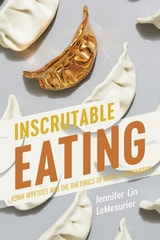
Inscrutable Eating
Asian Appetites and the Rhetorics of Racial ConsumptionJennifer Lin LeMesurier
The Ohio State University Press, 2023
“You are what you eat,” but what if you’re seen as a rat eater, bat lover, or MSG user? In Inscrutable Eating, Jennifer Lin LeMesurier considers how everyday assumptions about Asian food influence the perception of Asian and Asian American identity within the US racial landscape, demonstrating that beliefs about how certain people eat are inseparable from attitudes that support hierarchies around race, gender, and sexuality. Drawing on rhetorical theory, affect theory, and Asian American studies, LeMesurier analyzes messages in US popular culture about Asian eating to develop the concept of gut orientations: rhetorically dominant ways of interacting with food that scale upward to feelings of desire and disgust toward social groups. Looking at examples from fears around MSG to uproar over wet markets as the source of COVID-19, she argues that these “gut” reactions establish certain racial views as common-sense truths rather than cultural biases, reinforcing dominant norms about what belongs on whose plate, or who belongs at what table. In demystifying marginalizing discourse around food and eating, LeMesurier shows how exposing the tacit, felt ideas of consumption is necessary to contest broader forms of discrimination.
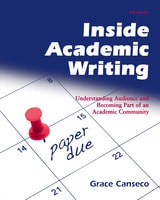
Inside Academic Writing
Understanding Audience and Becoming Part of an Academic CommunityGrace Canseco
University of Michigan Press, 2010
Inside Academic Writing is designed to prepare students in any academic discipline for graduate-level writing. The text situates students within their writing communities by prioritizing the steps of learning; students are directed to use common threads of academic writing across disciplines. The goal of Inside Academic Writing is to give students the opportunity to write for a variety of audiences and to develop the knowledge necessary to recognize how to write for different audiences and purposes.
Inside Academic Writing allows students to examine basic assumptions about writing before they learn specific strategies for targeting the audience or mapping the flow of information. Through the material in this textbook, students will create a portfolio of writings that includes a biographical statement and a research interest essay—important pieces of writing that are rarely taught in courses. Other types of writing featured are a summary, a problem-solution text, a comparative structure paper, and a commentary.
Other textbooks prepare students for graduate writing, but Inside Academic Writing was designed to bridge the gap between non-academic writing and the writing required within an academic community, with one’s peers, colleagues, and field experts. In addition, Inside Academic Writing offers guidance on writing materials for grants, fellowships, conferences, and publication.