Results by title
2817 books match the query 'Nature' and 83 start with i
Indigenous Perspective to Climate and Environment
Darren Parry
University of Utah Press, 2024
Indigenous Political Ecology
Clint Carroll
University of Minnesota Press, 2027
Advancing Indigenous and allied voices to address urgent environmental questions at the crossroads of Indigenous and settler state sovereignty
Authored by a group of majority Indigenous scholars from across Canada and the United States, this collection enacts a radical intervention into colonial impulses in traditional political ecology scholarship and its examination of state power in environmental conflicts. Centering the human–nature relationality of Indigenous cosmologies, this book confronts the terms by which land and water degradation, climate change, and other disastrous effects of extractive capitalism are understood.
Drawing on family histories, storytelling, autoethnography, and community-grounded research, Indigenous Political Ecology showcases a deeply self-reflexive examination of intergenerational struggles over land rights and attempts to resist settler colonial dynamics, including struggles over knowledge itself. Contributors recount the fraught history of Bears Ears National Monument, decades of Seminole-led efforts to restore the Everglades ecosystem, the creation of land education programs advancing Cherokee sovereignty, the impact of mining development on Mushkegowuk homelands in the Ring of Fire, and many other ongoing stories in which the “ecological” and “political” are being redefined.
Through its collectively led efforts and transdisciplinary approach, Indigenous Political Ecology models a new type of environmental scholarship that considers its modes of production integral to its contributors’ broader ethical and political commitments. Rooted in Indigenous sovereignty and self-determination, this groundbreaking volume sets forth a powerful blueprint for a more just and sustainable path through the field of political ecology.
Contributors: Nicholas A. Brown, Jessica R. Catellino, Andrew Curley, Michelle Daigle, Jean Dennison, Ashley Nichole Lewis, Beth Rose Middleton Manning, Teresa Montoya, Dana E. Powell, Kyle Powys Whyte, Jen Rose Smith, Lisa Wilson.
Retail e-book files for this title are screen-reader friendly with images accompanied by short alt text and/or extended descriptions.
Infested
How the Bed Bug Infiltrated Our Bedrooms and Took Over the WorldBrooke Borel
University of Chicago Press, 2015
In Infested, Borel introduces readers to the biological and cultural histories of these amazingly adaptive insects, and the myriad ways in which humans have responded to them. She travels to meet with scientists who are rearing bed bug colonies—even by feeding them with their own blood (ouch!)—and to the stages of musicals performed in honor of the pests. She explores the history of bed bugs and their apparent disappearance in the 1950s after the introduction of DDT, charting how current infestations have flourished in direct response to human chemical use as well as the ease of global travel. She also introduces us to the economics of bed bug infestations, from hotels to homes to office buildings, and the expansive industry that has arisen to combat them.
Hiding during the day in the nooks and seams of mattresses, box springs, bed frames, headboards, dresser tables, wallpaper, or any clutter around a bed, bed bugs are thriving and eager for their next victim. By providing fascinating details on bed bug science and behavior as well as a captivating look into the lives of those devoted to researching or eradicating them, Infested is sure to inspire at least a nibble of respect for these tenacious creatures—while also ensuring that you will peek beneath the sheets with prickly apprehension.
Infinite Nature
R. Bruce Hull
University of Chicago Press, 2006
In this impassioned and judicious work, R. Bruce Hull argues that environmentalism will never achieve its goals unless it sheds its fundamentalist logic. The movement is too bound up in polarizing ideologies that pit humans against nature, conservation against development, and government regulation against economic growth. Only when we acknowledge the infinite perspectives on how people should relate to nature will we forge solutions that are respectful to both humanity and the environment.
Infinite Nature explores some of these myriad perspectives, from the scientific understandings proffered by anthropology, evolution, and ecology, to the promise of environmental responsibility offered by technology and economics, to the designs of nature envisioned in philosophy, law, and religion. Along the way, Hull maintains that the idea of nature is social: in order to reach the common ground where sustainable and thriving communities are possible, we must accept that many natures can and do exist.
Incisive, heartfelt, and brimming with practical solutions, Infinite Nature brings a much-needed and refreshing voice to the table of environmental reform.
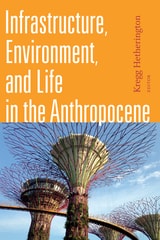
Infrastructure, Environment, and Life in the Anthropocene
Kregg Hetherington, editor
Duke University Press, 2019
Contributors. Nikhil Anand, Andrea Ballestero, Bruce Braun, Ashley Carse, Gastón R. Gordillo, Kregg Hetherington, Casper Bruun Jensen, Joseph Masco, Shaylih Muehlmann, Natasha Myers, Stephanie Wakefield, Austin Zeiderman
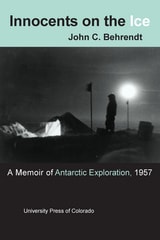
Innocents on the Ice
A Memoir of Antarctic Exploration, 1957John C. Behrendt
University Press of Colorado, 1998
"Adventures in the Antarctic only happen when someone makes a mistake.”
—From the Preface
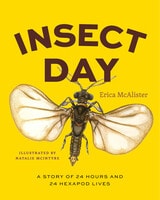
Insect Day
A Story of 24 Hours and 24 Hexapod LivesErica McAlister
University of Chicago Press, 2026
An hourly guide that follows twenty-four insects as they find food, mates, and safety from predators.
In this short book, celebrated scientist and award-winning author Erica McAlister leads readers on a worldwide field trip in search of insects. Each chapter of Insect Day introduces a single insect during a single hour, highlighting how twenty-four different species spend their time.
Early in our day, we meet a cold Arctic bumblebee, basking among poppy flower petals to warm itself. Even when the world around her is very cold, she keeps remarkably warm simply by vibrating. Near midday, there is enough sunlight for the blue-winged helicopter, a damselfly, to navigate the forests for her prey. When our insect spots a spider web, she looks for its creator—one vicious hunter eyeing up another. The giant damselfly reverses away from the web and then launches into an attack, grabbing onto the spider with her forelegs. If successful (many spiders are dropped), she perches while feasting. And then, like the most fastidious of diners, she cleans off any gossamer threads with a good preen. In the dark, the dung beetle also looks to the sky, using the Milky Way to orient itself as it rolls a ball of dung—a future home for its offspring. And, as our day closes, a tiger moth escapes bat hunters by fighting sound with sound—jamming bats’ sonar with ultrasonic clicking noises.
For each chapter, artist Natalie McIntyre has depicted these insects in stunning illustrations, blending traditional scientific drawing methods with fine art techniques. Working together to narrate and illustrate these unique moments in time, McAlister and McIntyre have created an engaging read that is a perfect way to spend an hour or two—and a true gift for readers, amateur naturalists, and all insect lovers.
Insect Media
An Archaeology of Animals and TechnologyJussi Parikka
University of Minnesota Press, 2010
Through close engagement with the pioneering work of insect ethologists, including Jakob von Uexküll and Karl von Frisch, posthumanist philosophers, media theorists, and contemporary filmmakers and artists, Parikka develops an insect theory of media, one that conceptualizes modern media as more than the products of individual human actors, social interests, or technological determinants. They are, rather, profoundly nonhuman phenomena that both draw on and mimic the alien lifeworlds of insects.
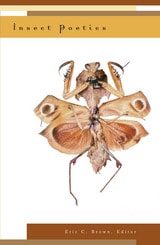
Insect Poetics
Eric C. Brown
University of Minnesota Press, 2006
In Insect Poetics, the first book to comprehensively explore the cultural and textual meanings of bugs, editor Eric Brown argues that insects are humanity’s “other.” In order to be experienced, the insect world must be mediated by art or technology (as in the case of an ant farm or Kafka’s Metamorphoses) while humans observe, detached and fascinated.
In eighteen original essays, this book illuminates the ways in which our human intellectual and cultural models have been influenced by the natural history of insects. Through critical readings contributors address such topics as performing insects in Shakespeare’s Coriolanus, the cockroach in the contemporary American novel, the butterfly’s “voyage out” in Virginia Woolf, and images of insect eating in literature and popular culture. In surprising ways, contributors tease out the particularities of insects as cultural signifiers and propose ways of thinking about “insectivity,” suggesting fertile cross-pollinations between entomology and the arts, between insects and the humanities.
Contributors: May Berenbaum, Yves Cambefort, Marion W. Copeland, Nicky Coutts, Bertrand Gervais, Sarah Gordon, Cristopher Hollingsworth, Heather Johnson, Richard J. Leskosky, Tony McGowan, Erika Mae Olbricht, Marc Olivier, Roy Rosenstein, Rachel Sarsfield, Charlotte Sleigh, Andre Stipanovic.
Eric C. Brown is assistant professor of English at the University of Maine at Farmington. He has written previously about insects and eschatology in Edmund Spenser’s Muiopotmos.
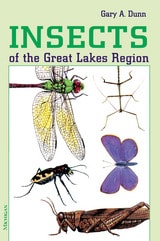
Insects of the Great Lakes Region
Gary A. Dunn
University of Michigan Press, 1996
The insects are the world's most amazing animals and comprise over eighty-five percent of the known animal species. Insects of the Great Lakes Region is the first comprehensive guide to document the rich and diverse insect fauna of the Great Lakes region. In Insects of the Great Lakes Region, educators, insect enthusiasts, and the general public will find high-quality, well-presented, easy-to-understand information with over 250 illustrations of the insects found in yards, gardens, fields, and forests. Among the topics discussed are the geological, biological, and entomological history of the Great Lakes region, the distributional patterns of insects in the Great Lakes region, and insect classification and identification. Appendixes guide the reader to entomological organizations, entomological periodicals, public insect collections, regulations on collecting insects from public lands in the Great Lakes region, as well as rare, threatened, and endangered insects. This guide shows the amateur entomologist everything he needs to know, from where to collect milkweed bugs to how often to feed his pet tarantula.
Gary Dunn is Executive Director and Editor, Young Entomologists' Society, Inc., International Headquarters, Lansing, Michigan.
Intelligibility of Nature
A William A. Wallace ReaderWilliam A. Wallace
Catholic University of America Press, 2022
International Code of Nomenclature for algae, fungi, and plants (Madrid Code)
Editorial Committee of the Madrid Code
University of Chicago Press, 2025
The International Code of Nomenclature for algae, fungi, and plants, known as “the Code,” is the set of internationally agreed rules and recommendations that govern the naming of these organisms. Scientific naming has deep historical roots. Indeed, the system of naming organisms is one of the first truly global scientific standards. This essential reference originates in Alphonse de Candolle’s 1867 Lois de la nomenclature botanique. This 2025 edition of the Code, the Madrid Code, reflects the decisions made at the Twentieth International Botanical Congress, which met in Madrid, Spain, in July 2024. The congress debated 447 proposals to amend the Code and accepted important new rules, including a mechanism for voluntary registration of plant and algal names, clarifications for naming fossil taxa, the option to reject a new name if it is derogatory to a group of people, and the replacement of an epithet that was considered particularly offensive (revising to afra, afrorum, and afrum).
Interspecies Politics
Nature, Borders, StatesRafi Youatt
University of Michigan Press, 2020
This book explores the ways that international politics is a form of interspecies politics, one that involves the interactions, ideas, and practices of multiple species, both human and nonhuman, to generate differences and create commonalities. While we frequently think of having an international politics “of” the environment, a deep and thoroughgoing anthropocentrism guides our idea of what political life can be, which prevents us from thinking about a politics “with” the environment. This anthropocentric assumption about politics drives both ecological degradation and deep forms of interhuman injustice and hierarchy.
Interspecies Politics challenges that assumption, arguing that a truly ecological account of interstate life requires us to think about politics as an activity that crosses species lines. It therefore explores a postanthropocentric account of international politics, focusing on a series of cases and interspecies practices in the American borderlands, ranging from the US-Mexico border in southern Texas, to Guantánamo Bay in Cuba, to Isle Royale, near the US-Canadian border. The book draws on international relations, environmental political theory, anthropology, and animal studies, to show how key international dimensions of states—sovereignty, territory, security, rights—are better understood as forms of interspecies assemblage that both generate new forms of multispecies inclusion, and structure forms of violence and hierarchy against human and nonhuman alike.
Interwoven Rosewood
Collaborative Ecologies, Colonial Entanglements, and Indigenous ResistanceJulie Velásquez Runk, the Wounaan National Congress, and the Wounaan Local Congress of Majé
University of Arizona Press, 2026
Interwoven Rosewood is a collaborative exploration of the global rosewood trade and its entanglements with Indigenous lifeways, colonial histories, and environmental crises. Co-authored by Julie Velásquez Runk and members of the Wounaan National Congress and its Local Congress of the Majé community, this book traces the story of cocobolo rosewood from Wounaan lands in Panama to international markets, revealing how centuries of settler colonialism and extractive capitalism continue to shape landscapes, livelihoods, and relationships. At its heart, the book is a meditation on well-being and belonging—how people live in relation to land, each other, and the more-than-human world.
Drawing on more than a decade of community-based research and six collaborative book workshops, the authors weave together first-person narratives, ecological analysis, historical context, and Indigenous knowledge. The result is a richly textured account that challenges dominant narratives of environmental degradation by centering Wounaan experiences of joy, resistance, and conviviality. The book’s structure reflects its method: interwoven chapters authored or spoken by Wounaan colleagues, grounded in consent protocols and shaped by ancestral storytelling traditions.
Accessibly written, Interwoven Rosewood is ideal for courses in environmental conservation, Indigenous studies, anthropology, Latin American studies, and political ecology. With its interdisciplinary reach and classroom-ready discussion questions, the book invites readers to reflect on the global forces behind environmental catastrophe—and the enduring power of Indigenous ways of knowing, being, and becoming.
Interwoven
Junipers and the Web of BeingKristen Rogers-Iversen
University of Utah Press, 2017
Throughout prehistory and history, junipers have influenced ecosystems, cultures, mythologies, economics, politics, and environmental controversies. In terms of their effects on human lives the juniper may be the most significant tree in the interior West. Interwoven explores these interconnecting aspects of junipers. Ghost beads, biotic communities, gin, tree masticators, Puebloan diapers, charcoal, folklore, historic explorers, spiral grain, tree life cycles, spirituality, packrat middens, climate changes, wildfire, ranching, wilderness, and land management policies are among the many different threads the book follows. These and other topics shed light on a fascinating organism, but the book is more than a compilation of facts. At once a scientific, experiential, historical, and metaphorical walk among junipers and their interrelationships, Interwoven may change readers’ experiences with these trees and the natural world.
Finalist for the Utah State Historical Society Best Book Award.
Finalist for the 2019 ASLE Book Award for excellence in ecocriticism and environmental creative writing.
Named a “notable book” by the prize committee of the 2018 Sigurd F. Olson Nature Writing Award.
Intimate Fathers
The Nature and Context of Aka Pygmy Paternal Infant CareBarry S. Hewlett
University of Michigan Press, 1991
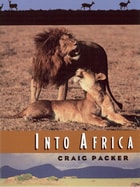
Into Africa
Craig Packer
University of Chicago Press, 1994
As in the works of George Schaller and Cynthia Moss, Packer transports us to life in the field. He is addicted to this land—to the beauty of a male lion striding across the Serengeti plains, to the calls of a baboon troop through the rain forests of Gombe—and to understanding the animals that inhabit it. Through his vivid narration, we feel the dust and the bumps of the Arusha Road, smell the rosemary in the air at lunchtime on a Serengeti verandah, and hear the lyrics of the Grateful Dead playing off bootlegged tapes.
Into Africa also explores the social lives of the animals and the threats to their survival. Packer grapples with questions he has passionately tried to answer for more than two decades. Why do female lions raise their young in crèches? Why do male baboons move from troop to troop while male chimps band together? How can humans and animals continue to coexist in a world of diminishing resources? Immediate demands—logistical nightmares, political upheavals, physical exhaustion—yield to the larger inescapable issues of the interdependence of the land, the animals, and the people who inhabit it.
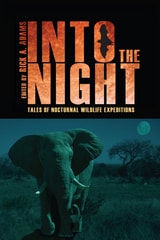
Into the Night
Rick Adams
University Press of Colorado, 2013
Contributors tell of confronting North American bears, cougars, and rattlesnakes; suffering red ctenid spider bites in the tropical rain forest; swimming through layers of feeding-frenzied hammerhead sharks in the Galapagos; evading the wrath of African bull elephants in South Africa; and delighting in the curious and gentle nature of foxes and unconditional acceptance by a family of owls. They describe “fire in the sky” across a treeless tundra, a sea ablaze with bioluminescent algae, nighttime earthquakes on the Pacific Rim, and hurricanes and erupting volcanoes on a Caribbean island.
Into the Night reveals rare and unexpected insights into nocturnal field research, illuminating experiences, discoveries, and challenges faced by intrepid biologists studying nature’s nightly marvels across the globe. This volume will be of interest to scientists and general readers alike.

Introduction to Animal Rights
Your Child or the Dog?Gary L. Francione, foreword by Alan Watson
Temple University Press, 2000
In this easy-to-read introduction, animal rights advocate Gary Francione looks at our conventional moral thinking bout animals. Using examples, analogies, and thought-experiments, he reveals the dramatic inconsistency between what we say we believe about animals and how we actually treat them.
Introduction to Animal Rights: Your Child or the Dog? provides a guidebook to examining our social and personal ethical beliefs. It takes us through concepts of property and equal consideration to arrive at the basic contention of animal rights: that everyone -- human and non-human -- has the right not to be treated as a means to an end. Along the way, it illuminates concepts and theories that all of us use but few of us understand -- the nature of "rights" and "interests," for example, and the theories of Locke, Descartes, and Bentham.
Filled with fascinating information and cogent arguments, this is a book that you may love or hate, but that will not fail to inform, enlighten, and educate.
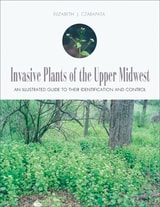
Invasive Plants of the Upper Midwest
An Illustrated Guide to Their Identification and ControlElizabeth J. Czarapata
University of Wisconsin Press, 2005
Invasive plants are a growing threat to ecosystems everywhere. Often originating in distant climes, they spread to woodlands, wetlands, prairies, roadsides, and backyards that lack the biological controls which kept these plant populations in check in their homelands.
Invasive Plants of the Upper Midwest includes more than 250 color photos that will help anyone identify problem trees, shrubs, vines, grasses, sedges, and herbaceous plants (including aquatic invaders). The text offers further details of plant identification; manual, mechanical, biological, and chemical control techniques; information and advice about herbicides; and suggestions for related ecological restoration and community education efforts. Also included are literature references, a glossary, a matrix of existing and potential invasive species in the Upper Midwest, an index with both scientific and common plant names, advice on state agencies to contact with invasive plant questions, and other helpful resources.
The information in this book has been carefully reviewed by staffs of the Wisconsin Department of Natural Resources Bureau of Endangered Resources and the University of Wisconsin-Madison Arboretum and other invasive plant experts.
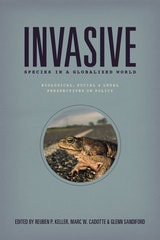
Invasive Species in a Globalized World
Ecological, Social, and Legal Perspectives on PolicyEdited by Reuben P. Keller, Marc W. Cadotte, and Glenn Sandiford
University of Chicago Press, 2014
Yet even though ecological research has led to public conversation and policy recommendations, those recommendations have frequently been ignored, and the efforts to counter invasive species have been largely unsuccessful. Recognizing the need to engage experts across the life, social, and legal sciences as well as the humanities, the editors of this volume have drawn together a wide variety of ecologists, historians, economists, legal scholars, policy makers, and communications scholars, to facilitate a dialogue among these disciplines and understand fully the invasive species phenomenon. Aided by case studies of well-known invasives such as the cane toad of Australia and the emerald ash borer, Asian carp, and sea lampreys that threaten US ecosystems, Invasive Species in a Globalized World offers strategies for developing and implementing anti-invasive policies designed to stop their introduction and spread, and to limit their effects.
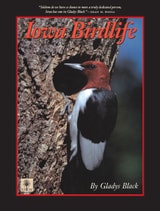
Iowa Birdlife
Gladys Black
University of Iowa Press, 1992

Iowa Breeding Bird Atlas
Laura Spess Jackson
University of Iowa Press, 1996
The Iowa Breeding Bird Atlas—the first comprehensive statewide survey of Iowa's breeding birds—provides a detailed record of the composition and distribution of the avifauna of the Hawkeye State. The atlas documents the presence of 199 species, 158 of which were confirmed breeding. This landmark volume will alert Iowans to the limited distribution of numerous species and serve as a guide to the management practices—such as forest and wetland management, set-aside programs, reduction in farm chemical use, and crop diversity—which could help insure that many future changes are positive ones. The Iowa Breeding Bird Atlas provides a welcome and much-needed baseline for future comparisons of changes in Iowa's birdlife and, by extension, the lives of all animals in the state.
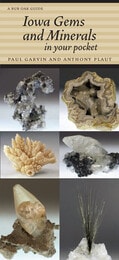
Iowa Gems and Minerals in Your Pocket
Paul Garvin and Anthony Plaut
University of Iowa Press, 2012
Most, if not all, of Iowa’s gems and minerals are products of crystallization in underground cavities that filled with water containing dissolved chemicals. The famed Iowa geodes (Iowa’s state rock) are products of a complex process of replacement and cavity-filling in the Warsaw Shale. Armored by a rind of tough chalcedonic quartz, these spheroidal masses, which range up to more than a meter across, weather out of the host rock and accumulate along streams in the southeastern part of the state. During the Pleistocene Epoch, large masses of glacial ice rafted the ultra-fine-grained variety of quartz called Lake Superior agates, which had previously weathered out of their host rocks, southward into Iowa. They can be found in the gravels that have accumulated along major streams in the eastern half of the state.
Iowa’s long record of mining lead, coal, gypsum, and limestone contains a rich history; the forty-seven mineral specimens inIowa Gems and Minerals in Your Pocketmake up a fascinating illustrated guide to that history. Carefully lit and photographed to reveal both maximum detail and maximum beauty, each specimen becomes a work of art.
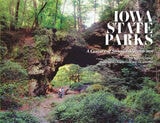
Iowa State Parks
A Century of Stewardship, 1920-2020Rebecca Conard, Angela Corio, and Jim Scheffler
University of Iowa Press, 2020
The photo essays at the heart of this book feature the artistry of well-known nature photographers such as Carl Kurtz, Brian Gibbs, Don Poggensee, and Larry Stone. The images help tell the stories of Iowa’s state parks, recreation areas, preserves, and forests. A historical overview sets the stage, followed by essays on key aspects of our park system.
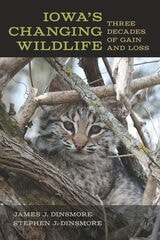
Iowa's Changing Wildlife
Three Decades of Gain and LossJames J. Dinsmore
University of Iowa Press, 2023
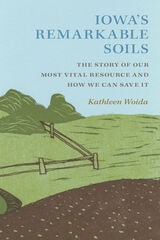
Iowa's Remarkable Soils
The Story of Our Most Vital Resource and How We Can Save ItKathleen Woida
University of Iowa Press, 2021
Its soils are what make Iowa a premier agricultural state, both in terms of acres planted and bushels harvested. But in the last hundred years, large-scale intensive agriculture and urban development have severely degraded most of our soils. However, as Woida documents, some innovative Iowans are beginning to repair and regenerate their soils by treating them as the living ecosystem and vast carbon store that they are. To paraphrase Aldo Leopold, these new pioneers are beginning to see their soils as part of a community to which they and their descendants belong, rather than commodities belonging to them.
Iowa's Wild Places
Carl Kurtz
University of Iowa Press, 1996
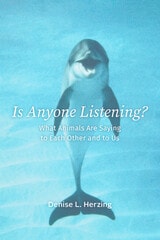
Is Anyone Listening?
What Animals Are Saying to Each Other and to UsDenise L. Herzing
University of Chicago Press, 2024
If you could pose one question to a dolphin, what would it be? And what might a dolphin ask you? For forty years, researcher and author Denise L. Herzing has investigated these and related questions of marine mammal communication. With the assistance of a friendly community of Atlantic spotted dolphins in the Bahamas, Herzing studies two-way communication between different dolphin species and between humans and dolphins using a variety of cutting-edge experiments. But the dolphins are not the only ones talking, and in this wide-ranging and accessible book, Herzing explores the astonishing realities of interspecies communication, a skill that humans currently lack.
Is Anyone Listening? connects research on dolphin communication to findings from Jane Goodall on chimpanzees, Dian Fossey on mountain gorillas, Cynthia Moss on African elephants, and others driving today’s exploration of possible animal languages. Although humans have long attempted to crack animal communication codes, only now do we have the advanced machine-learning tools to help. As Herzing reveals, researchers are finding fascinating hints of language in nonhuman species, including linguistic structures, vowel equivalents, and complex repeated sequences. By looking at the many ways animals use and manipulate signals, we see that we’ve only just begun to appreciate the diversity of animal intelligence and the complicated and subtle aspects of animal communication.
Considering dolphins and other nonhuman animals as colleagues instead of research subjects, Herzing asks us to meet animals as both speakers and listeners, as mutually curious beings, and to listen to what they are saying.
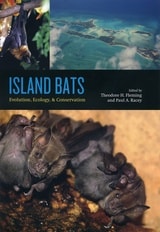
Island Bats
Evolution, Ecology, and ConservationEdited by Theodore H. Fleming and Paul A. Racey
University of Chicago Press, 2010
The second largest order of mammals, Chiroptera comprises more than one thousand species of bats. Because of their mobility, bats are often the only native mammals on isolated oceanic islands, where more than half of all bat species live. These island bats represent an evolutionarily distinctive and ecologically significant part of the earth’s biological diversity.
Island Bats is the first book to focus solely on the evolution, ecology, and conservation of bats living in the world’s island ecosystems. Among other topics, the contributors to this volume examine how the earth’s history has affected the evolution of island bats, investigate how bat populations are affected by volcanic eruptions and hurricanes, and explore the threat of extinction from human disturbance. Geographically diverse, the volume includes studies of the islands of the Caribbean, the Western Indian Ocean, Micronesia, Indonesia, the Philippines, and New Zealand.
With its wealth of information from long-term studies, Island Bats provides timely and valuable information about how this fauna has evolved and how it can be conserved.
Island Between
Margaret E. Murie with Illustrations by Olaus J. Murie
University of Alaska Press, 2008
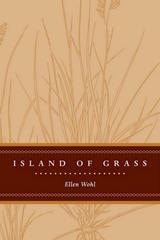
Island of Grass
Ellen E. Wohl
University Press of Colorado, 2009

It's All for Sale
The Control of Global ResourcesJames Ridgeway
Duke University Press, 2004
Revealing the surprisingly small number of companies that control many of the basic commodities we use in everyday life, It’s All for Sale confirms in specific detail that globalization has been accompanied by an extraordinary concentration of ownership. At the same time, it is about much more than what company has cornered the market in corn or diamonds. Corporations and captains of industry, wars and swindles, oppressors and the oppressed, empires and colonies, military might and commercial power, economic boom and bust—all these come alive in Ridgeway’s canny and arresting reporting about the global scramble for power and profit. It’s All for Sale is an invaluable source for researchers, activists, and all those concerned with globalization, corporate power, and the exploitation of individuals and the environment.