4127 books match the query 'Science' and 154 start with i
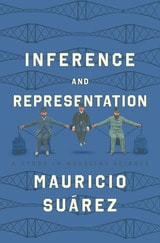
cover of Inference and Representation: A Study in Modeling Science

Inference and Representation

A Study in Modeling Science

Mauricio Suárez

University of Chicago Press, 2024

The first comprehensive defense of an inferential conception of scientific representation with applications to art and epistemology.
 
Mauricio Suárez develops a conception of representation that delivers a compelling account of modeling practice. He begins by discussing the history and methodology of model building, charting the emergence of what he calls the modeling attitude, a nineteenth-century and fin de siècle development. Prominent cases of models, both historical and contemporary, are used as benchmarks for the accounts of representation considered throughout the book. After arguing against reductive naturalist theories of scientific representation, Suárez sets out his own account: a case for pluralism regarding the means of representation and minimalism regarding its constituents. He shows that scientists employ a variety of modeling relations in their representational practice—which helps them to assess the accuracy of their representations—while demonstrating that there is nothing metaphysically deep about the constituent relation that encompasses all these diverse means.
 
The book also probes the broad implications of Suárez’s inferential conception outside scientific modeling itself, covering analogies with debates about artistic representation and philosophical thought over the past several decades.

[more]
cover of Infertile Environments: Epigenetic Toxicology and the Reproductive Health of Chinese Men

Infertile Environments

Epigenetic Toxicology and the Reproductive Health of Chinese Men

Janelle Lamoreaux

Duke University Press, 2023
In Infertile Environments, Janelle Lamoreaux investigates how epigenetic research into the effects of toxic exposure conceptualizes and configures environments. Drawing on fieldwork in a Nanjing, China, toxicology lab that studies the influence of pesticides and other pollutants on male reproductive and developmental health, Lamoreaux shows how the lab’s everyday research practices bring national, hormonal, dietary, maternal, and laboratory environments into being. She situates the lab’s work within broader Chinese history as well as the contemporary cultural and political moment, in which declining fertility rates and reproductive governance and technology are growing concerns. She also points to how toxicology in China is a transnational endeavor tied to both local conditions and international research agendas and infrastructures, which highlights the myriad scales and scope of epigenetic environments. At a moment of growing concerns about toxins, endocrine-disrupting chemicals, and climate change, Lamoreaux demonstrates that epigenetic research’s proliferation of environments produces new kinds of toxic relations that impact multiple generations of humans.
[more]
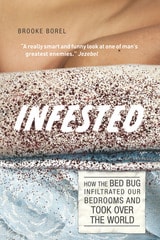
cover of Infested: How the Bed Bug Infiltrated Our Bedrooms and Took Over the World

Infested

How the Bed Bug Infiltrated Our Bedrooms and Took Over the World

Brooke Borel

University of Chicago Press, 2015

Bed bugs. Few words strike such fear in the minds of travelers. In cities around the world, lurking beneath the plush blankets of otherwise pristine-looking hotel beds are tiny bloodthirsty beasts just waiting for weary wanderers to surrender to a vulnerable slumber. Though bed bugs today have infested the globe, the common bed bug is not a new pest at all. Indeed, as Brooke Borel reveals in this unusual history, this most-reviled species may date back over 250,000 years, wreaking havoc on our collective psyche while even inspiring art, literature, and music—in addition to vexatious red welts.
 
In Infested, Borel introduces readers to the biological and cultural histories of these amazingly adaptive insects, and the myriad ways in which humans have responded to them. She travels to meet with scientists who are rearing bed bug colonies—even by feeding them with their own blood (ouch!)—and to the stages of musicals performed in honor of the pests. She explores the history of bed bugs and their apparent disappearance in the 1950s after the introduction of DDT, charting how current infestations have flourished in direct response to human chemical use as well as the ease of global travel. She also introduces us to the economics of bed bug infestations, from hotels to homes to office buildings, and the expansive industry that has arisen to combat them.

Hiding during the day in the nooks and seams of mattresses, box springs, bed frames, headboards, dresser tables, wallpaper, or any clutter around a bed, bed bugs are thriving and eager for their next victim. By providing fascinating details on bed bug science and behavior as well as a captivating look into the lives of those devoted to researching or eradicating them, Infested is sure to inspire at least a nibble of respect for these tenacious creatures—while also ensuring that you will peek beneath the sheets with prickly apprehension.
[more]
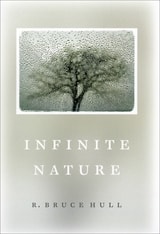
cover of Infinite Nature

Infinite Nature

R. Bruce Hull

University of Chicago Press, 2006

You would be hard-pressed to find someone who categorically opposes protecting the environment, yet most people would agree that the environmentalist movement has been ineffectual and even misguided. Some argue that its agenda is misplaced, oppressive, and misanthropic—a precursor to intrusive government, regulatory bungles, and economic stagnation. Others point out that its alarmist rhetoric and preservationist solutions are outdated and insufficient to the task of galvanizing support for true reform. 

In this impassioned and judicious work, R. Bruce Hull argues that environmentalism will never achieve its goals unless it sheds its fundamentalist logic. The movement is too bound up in polarizing ideologies that pit humans against nature, conservation against development, and government regulation against economic growth. Only when we acknowledge the infinite perspectives on how people should relate to nature will we forge solutions that are respectful to both humanity and the environment.

Infinite Nature explores some of these myriad perspectives, from the scientific understandings proffered by anthropology, evolution, and ecology, to the promise of environmental responsibility offered by technology and economics, to the designs of nature envisioned in philosophy, law, and religion. Along the way, Hull maintains that the idea of nature is social: in order to reach the common ground where sustainable and thriving communities are possible, we must accept that many natures can and do exist.

Incisive, heartfelt, and brimming with practical solutions, Infinite Nature brings a much-needed and refreshing voice to the table of environmental reform.

[more]
cover of Infinite-Dimensional Optimization and Convexity

Infinite-Dimensional Optimization and Convexity

Ivar Ekeland and Thomas Turnbull

University of Chicago Press, 1983
In this volume, Ekeland and Turnbull are mainly concerned with existence theory. They seek to determine whether, when given an optimization problem consisting of minimizing a functional over some feasible set, an optimal solution—a minimizer—may be found.
[more]
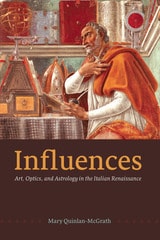
cover of Influences: Art, Optics, and Astrology in the Italian Renaissance

Influences

Art, Optics, and Astrology in the Italian Renaissance

Mary Quinlan-McGrath

University of Chicago Press, 2013

Today few would think of astronomy and astrology as fields related to theology. Fewer still would know that physically absorbing planetary rays was once considered to have medical and psychological effects. But this was the understanding of light radiation held by certain natural philosophers of early modern Europe, and that, argues Mary Quinlan-McGrath, was why educated people of the Renaissance commissioned artworks centered on astrological themes and practices.
 
Influences is the first book to reveal how important Renaissance artworks were designed to be not only beautiful but also—perhaps even primarily—functional. From the fresco cycles at Caprarola, to the Vatican’s Sala dei Pontefici, to the Villa Farnesina, these great works were commissioned to selectively capture and then transmit celestial radiation, influencing the bodies and minds of their audiences. Quinlan-McGrath examines the sophisticated logic behind these theories and practices and, along the way, sheds light on early creation theory; the relationship between astrology and natural theology; and the protochemistry, physics, and mathematics of rays.
 
An original and intellectually stimulating study, Influences adds a new dimension to the understanding of aesthetics among Renaissance patrons and a new meaning to the seductive powers of art.  
[more]
cover of Information and Experimental Knowledge

Information and Experimental Knowledge

James Mattingly

University of Chicago Press, 2021

An ambitious new model of experimentation that will reorient our understanding of the key features of experimental practice.

What is experimental knowledge, and how do we get it? While there is general agreement that experiment is a crucial source of scientific knowledge, how experiment generates that knowledge is far more contentious. In this book, philosopher of science James Mattingly explains how experiments function. Specifically, he discusses what it is about experimental practice that transforms observations of what may be very localized, particular, isolated systems into what may be global, general, integrated empirical knowledge. Mattingly argues that the purpose of experimentation is the same as the purpose of any other knowledge-generating enterprise—to change the state of information of the knower. This trivial-seeming point has a non-trivial consequence: to understand a knowledge-generating enterprise, we should follow the flow of information. Therefore, the account of experimental knowledge Mattingly provides is based on understanding how information flows in experiments: what facilitates that flow, what hinders it, and what characteristics allow it to flow from system to system, into the heads of researchers, and finally into our store of scientific knowledge.
[more]
cover of Infrahumanisms: Science, Culture, and the Making of Modern Non/personhood

Infrahumanisms

Science, Culture, and the Making of Modern Non/personhood

Megan H. Glick

Duke University Press, 2018

In Infrahumanisms Megan H. Glick considers how conversations surrounding nonhuman life have impacted a broad range of attitudes toward forms of human difference such as race, sexuality, and health. She examines the history of human and nonhuman subjectivity as told through twentieth-century scientific and cultural discourses that include pediatrics, primatology, eugenics, exobiology, and obesity research. Outlining how the category of the human is continuously redefined in relation to the infrahuman—a liminal position of speciation existing between the human and the nonhuman—Glick reads a number of phenomena, from early twentieth-century efforts to define children and higher order primates as liminally human and the postwar cultural fascination with extraterrestrial life to anxieties over AIDS, SARS, and other cross-species diseases. In these cases the efforts to define a universal humanity create the means with which to reinforce notions of human difference and maintain human-nonhuman hierarchies. In foregrounding how evolving definitions of the human reflect shifting attitudes about social inequality, Glick shows how the consideration of nonhuman subjectivities demands a rethinking of long-held truths about biological meaning and difference.
[more]
cover of Infrastructural Development, Corruption, Xenophobia, and Colonization in Central and Southeastern Europe

Infrastructural Development, Corruption, Xenophobia, and Colonization in Central and Southeastern Europe

Silvia Marton

Central European University Press, 2026
Infrastructural development is most often understood as shorthand for the arrival of ‘modernity’, both holding the promise of prosperity, and carrying with it the threat of disruption. The present volume examines historical attitudes to the infrastructural revolution that transformed Central and Southeastern Europe in the long nineteenth century, homing in on the scandals and controversies that shaped national and transnational debates alike. Historicizing vocabularies of contestation brings to light a conceptual nexus: the entanglement between infrastructure, xenophobia, corruption, and colonization. Fears that ‘corrupting’ foreign Others would gain ‘colonial’ ascendancy through the conduits of infrastructure, capital, and expertise were a recurring feature of public debates. Yet other permutations of these terms were also possible, making this nexus an all the more relevant lens for reassessing this formative moment for empire- and nation-building in the region. Theoretically innovative and empirically rich, the volume aims to reshape our understanding of how infrastructure acted as a flashpoint for political and cultural reflection.
[more]
cover of Inland Fishes of the Greater Southwest: Chronicle of a Vanishing Biota

Inland Fishes of the Greater Southwest

Chronicle of a Vanishing Biota

W. L. Minckley and Paul C. Marsh

University of Arizona Press, 2009

This comprehensive new book replaces and substantially expands upon the landmark Fishes of Arizona, which has been the authoritative source since it was first published in 1973. Inland Fishes of the Greater Southwest is a one-volume guide to native and non-native fishes of the lower Colorado River basin, downstream from the Grand Canyon, and of the northern tributaries of the Sea of Cortez in the United States and Mexico. In all, there are in-depth accounts of more than 165 species representing 30 families. The book is not limited to the fish. It provides insights into their aquatic world with information on topography, drainage relations, climate, geology, vegetational history, aquatic habitats, human-made water systems, and conservation. A section of the book is devoted to fish identification, with keys to native and non-native families as well as family keys to species. The book is illustrated with more than 120 black-and-white illustrations, 47 full-color plates of native fishes, and nearly 40 maps and figures.

Many native fish species are unique to the Southwest. They possess interesting and unusual adaptations to the challenges of the region, able to survive silt-laden floods as well as extreme water temperatures and highly fluctuating water flows ranging from very low levels to flash floods. However, in spite of being well-adapted, many of the fish described here are threatened or endangered, often due to the acts of humans who have altered the natural habitat. For that reason, Inland Fishes of the Greater Southwest presents a vast amount of information about the ecological relationships between the fishes it describes and their environments, paying particular attention to the ways in which human interactions have modified aquatic ecosystems—and to how humans might work to ensure the survival of rapidly disappearing native species.
[more]
cover of Inner Space/Outer Space

Inner Space/Outer Space

Edited by Edward Kolb, Michael Turner, Keith Olive, David Seckel, and David Lind

University of Chicago Press, 1986

Inner Space/Outer Space brings together much of the exciting work contributing to a new synthesis of modern physics. Particle physicists, concerned with the "inner space" of the atom, are making discoveries that their colleagues in astrophysics, studying outer space, can use to develop and test hypotheses about the events that occurred in the microseconds after the Big Bang and that shaped the universe as we know it today.

The papers collected here, from scores of scientists, constitute the proceedings of the first major international conference on research at the interface of particle physics and astrophysics, held in May 1984. The editors have written introductions to each major section that draw out the central themes and elaborate on the primary implications of the papers that follow.
[more]
cover of Insect Day: A Story of 24 Hours and 24 Hexapod Lives

Insect Day

A Story of 24 Hours and 24 Hexapod Lives

Erica McAlister

University of Chicago Press, 2026

An hourly guide that follows twenty-four insects as they find food, mates, and safety from predators. 

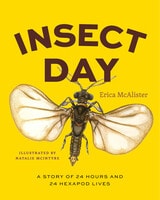
In this short book, celebrated scientist and award-winning author Erica McAlister leads readers on a worldwide field trip in search of insects. Each chapter of Insect Day introduces a single insect during a single hour, highlighting how twenty-four different species spend their time. 

Early in our day, we meet a cold Arctic bumblebee, basking among poppy flower petals to warm itself. Even when the world around her is very cold, she keeps remarkably warm simply by vibrating. Near midday, there is enough sunlight for the blue-winged helicopter, a damselfly, to navigate the forests for her prey. When our insect spots a spider web, she looks for its creator—one vicious hunter eyeing up another. The giant damselfly reverses away from the web and then launches into an attack, grabbing onto the spider with her forelegs. If successful (many spiders are dropped), she perches while feasting. And then, like the most fastidious of diners, she cleans off any gossamer threads with a good preen. In the dark, the dung beetle also looks to the sky, using the Milky Way to orient itself as it rolls a ball of dung—a future home for its offspring. And, as our day closes, a tiger moth escapes bat hunters by fighting sound with sound—jamming bats’ sonar with ultrasonic clicking noises. 

For each chapter, artist Natalie McIntyre has depicted these insects in stunning illustrations, blending traditional scientific drawing methods with fine art techniques. Working together to narrate and illustrate these unique moments in time, McAlister and McIntyre have created an engaging read that is a perfect way to spend an hour or two—and a true gift for readers, amateur naturalists, and all insect lovers.
[more]
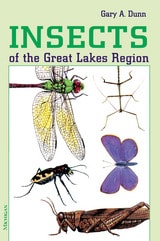
cover of Insects of the Great Lakes Region

Insects of the Great Lakes Region

Gary A. Dunn

University of Michigan Press, 1996

The insects are the world's most amazing animals and comprise over eighty-five percent of the known animal species. Insects of the Great Lakes Region is the first comprehensive guide to document the rich and diverse insect fauna of the Great Lakes region. In Insects of the Great Lakes Region, educators, insect enthusiasts, and the general public will find high-quality, well-presented, easy-to-understand information with over 250 illustrations of the insects found in yards, gardens, fields, and forests. Among the topics discussed are the geological, biological, and entomological history of the Great Lakes region, the distributional patterns of insects in the Great Lakes region, and insect classification and identification. Appendixes guide the reader to entomological organizations, entomological periodicals, public insect collections, regulations on collecting insects from public lands in the Great Lakes region, as well as rare, threatened, and endangered insects. This guide shows the amateur entomologist everything he needs to know, from where to collect milkweed bugs to how often to feed his pet tarantula.

Gary Dunn is Executive Director and Editor, Young Entomologists' Society, Inc., International Headquarters, Lansing, Michigan.
[more]
cover of Inside Science: Stories from the Field in Human and Animal Science

Inside Science

Stories from the Field in Human and Animal Science

Robert E. Kohler

University of Chicago Press, 2019

Context and situation always matter in both human and animal lives. Unique insights can be gleaned from conducting scientific studies from within human communities and animal habitats. Inside Science is a novel treatment of this distinctive mode of fieldwork. Robert E. Kohler illuminates these resident practices through close analyses of classic studies: of Trobriand Islanders, Chicago hobos, corner boys in Boston’s North End, Jane Goodall’s chimpanzees of the Gombe Stream Reserve, and more. Intensive firsthand observation; a preference for generalizing from observed particulars, rather than from universal principles; and an ultimate framing of their results in narrative form characterize these inside stories from the field.
 
Resident observing takes place across a range of sciences, from anthropology and sociology to primatology, wildlife ecology, and beyond. What makes it special, Kohler argues, is the direct access it affords scientists to the contexts in which their subjects live and act. These scientists understand their subjects not by keeping their distance but by living among them and engaging with them in ways large and small. This approach also demonstrates how science and everyday life—often assumed to be different and separate ways of knowing—are in fact overlapping aspects of the human experience. This story-driven exploration is perfect for historians, sociologists, and philosophers who want to know how scientists go about making robust knowledge of nature and society.

[more]
cover of Inside the Body of Black Feminism: Science, Race, Culture

Inside the Body of Black Feminism

Science, Race, Culture

Samantha Pinto

Duke University Press, 2026

Inside the Body of Black Feminism connects historical studies of medical racism with Black feminist theories of the body to reimagine the material and metaphoric possibilities for political subjectivity across race, gender, and culture.

Inside the Body of Black Feminism charts a cultural genealogy of antiracist and feminist engagement with some of the most objectified internal “parts” of racist medical and scientific inquiry: bones and blood, brains and hearts, guts and wombs. In a move counterintuitive to Black feminism’s emphasis on externalized representations of the body, Samantha Pinto reinterprets the relationship between embodiment, health, and race through cultural archives that reimagine the inside of the Black body. Working through materials such as medical textbooks, memoirs, data visualizations, museum displays, speculative fiction, and horror films, Pinto explores how a visually inaccessible corporeal interior becomes discernible and racialized in the public sphere. Inside the Body of Black Feminism engages expressive cultural work to ask how we might know the inside of the Black body differently through Black feminist theory and how scientific and medical inquiry might enable us to understand political subjectivity anew.

[more]
cover of Instabilities, Bifurcations, and Fluctuations in Chemical Systems

Instabilities, Bifurcations, and Fluctuations in Chemical Systems

Edited by L. E. Reichl and W. C. Schieve

University of Texas Press, 1982

Twentieth-century research in the field of chemical pattern formation saw extraordinary progress due to the pathbreaking contributions of Nobel laureate Ilya Prigogine and his co-workers. Evidence exists that the dissipative structures studied by Prigogine and his colleagues may play a dominant role in the processes of self-organization of biological systems, the fundamental phenomena that govern all life forms.

Brought together in this valuable volume are topical papers from the this research. Important aspects of nonlinear chemical pattern formation—dissipative structures—in chemical, biochemical, and geological systems are surveyed by leading scientists in the field of nonlinear chemistry. Topics covered include experimental observations of pattern formation in a variety of systems, bifurcation theory and analysis of nonlinear chemical rate equations, and the stochastic theory of nonlinear chemical reactions. Of particular interest are the studies of the effects of electric fields on the determination of nonequilibrium states of chemical systems.

[more]
cover of Instrumental Biology, or The Disunity of Science

Instrumental Biology, or The Disunity of Science

Alexander Rosenberg

University of Chicago Press, 1994

Do the sciences aim to uncover the structure of nature, or are they ultimately a practical means of controlling our environment?

In Instrumental Biology, or the Disunity of Science, Alexander Rosenberg argues that while physics and chemistry can develop laws that reveal the structure of natural phenomena, biology is fated to be a practical, instrumental discipline. Because of the complexity produced by natural selection, and because of the limits on human cognition, scientists are prevented from uncovering the basic structure of biological phenomena. Consequently, biology and all of the disciplines that rest upon it—psychology and the other human sciences—must aim at most to provide practical tools for coping with the natural world rather than a complete theoretical understanding of it.
[more]
cover of Instrumentality: On Technical Objects and Orientations in the Later Middle Ages

Instrumentality

On Technical Objects and Orientations in the Later Middle Ages

J. Allan Mitchell

University of Minnesota Press, 2024

From medieval to modern, exploring instrumental attitudes toward physical gadgets, diagrams, concepts, methods, and disciplines

Opening up the instrumental condition of the human for critical reflection and renewal, Instrumentality illuminates key moments in the intellectual history of the European Middle Ages. J. Allan Mitchell reveals how, in the predigital past, we can recognize many of the operative technics, analytics, and metaphorics that continue to shape human sense and cognition today.

Exploring the diverse modalities of medieval instruments, Mitchell’s case studies encompass techniques as seemingly distinct as time-keeping mechanisms, mathematical diagrams, logical syllogisms, and the literary devices of Geoffrey Chaucer and John Gower. A cultural and intellectual history, Mitchell’s work leads readers from three-dimensional objects (physical mechanisms) to two-dimensional inscriptions (maps and diagrams) and onward to overarching disciplinary norms in the early liberal and mechanical arts. Prying loose the subtle, adaptable, and generative concept of technical objects from limiting contemporary frameworks, he shows how these instruments are indispensable to the past—and the future—of the arts and culture at large.

[more]
cover of Instruments of Music Theory

Instruments of Music Theory

Alexander Rehding

University of Chicago Press, 2027

Shows how musical instruments and the sounds they produce are not incidental, but an integral part of music theory.

Many musicians dread music theory: Its rules and diagrams can feel stern and lifeless, far removed from the sounds that make music so thrilling. In this book, Alexander Rehding looks at music theory from a different angle. He argues that the sounds of the instruments on which music theory is demonstrated—starting with the piano in the music classroom—play a much more active role than we usually notice. They are “instruments” in a double sense: musical noisemakers, but also tools in a kind of scientific experiment. Rehding strips these devices down to their sound-generating mechanisms to show us how to read musical instruments for their theoretical content.

Instruments of Music Theory turns our attention to instruments such as multiphonic sirens, tuning forks, Chladni plates, Aeolian harps, and Wheatstone concertinas—these devices generate sounds that call for new ways of listening, measuring, and thinking about music. Bringing together music theory, critical organology, and media theory, this book can be read as a user’s manual for how to put sound back into music theory. Rehding shows us how instruments do not only produce sound—they produce knowledge about music. Through the lens of these new instruments, Instruments of Music Theory recasts fundamental musical ideas such as pitch, harmony, form, and scale from the ground up to give new meaning to the stuff we call music.

[more]
cover of Insurgent Democracy: The Nonpartisan League in North American Politics

Insurgent Democracy

The Nonpartisan League in North American Politics

Michael J. Lansing

University of Chicago Press, 2015

In 1915, western farmers mounted one of the most significant challenges to party politics America has seen: the Nonpartisan League, which sought to empower citizens and restrain corporate influence. Before its collapse in the 1920s, the League counted over 250,000 paying members, spread to thirteen states and two Canadian provinces, controlled North Dakota’s state government, and birthed new farmer-labor alliances. Yet today it is all but forgotten, neglected even by scholars.

Michael J. Lansing aims to change that. Insurgent Democracy offers a new look at the Nonpartisan League and a new way to understand its rise and fall in the United States and Canada. Lansing argues that, rather than a spasm of populist rage that inevitably burned itself out, the story of the League is in fact an instructive example of how popular movements can create lasting change. Depicting the League as a transnational response to economic inequity, Lansing not only resurrects its story of citizen activism, but also allows us to see its potential to inform contemporary movements.
[more]
cover of Intangible Materialism: The Body, Scientific Knowledge, and the Power of Language

Intangible Materialism

The Body, Scientific Knowledge, and the Power of Language

Ronald Schleifer

University of Minnesota Press, 2009

Taking as his point of departure Norbert Weiner’s statement that information is basic to understanding materialism in our era, Ronald Schleifer shows how discoveries of modern physics have altered conceptions of matter and energy and the ways in which both information theory and the study of literature can enrich these conceptions. Expanding the reductive notion of “the material” as simply matter and energy, he formulates a new, more inclusive idea of materialism.

Schleifer’s project attempts to bridge the divisions between the humanities and the sciences and to create a nonreductive materialism for the information age. He presents a materialistic account of human bodily experience by delving into language and literature that powerfully represents our faces, voices, hands, and pain. For example, he examines the material resources of poetic “literariness” as it is revealed in the condition of Tourette’s syndrome. Schleifer also investigates gestures of the hand in the formation of sociality, and he studies pain as both a physiological and phenomenological experience.

This ambitious work explores physiological analyses, evolutionary explanations, and semiotic descriptions of materialism to reveal how aspects of physical existence discover meaning in experience. 

[more]
cover of Intellectual Mastery of Nature. Theoretical Physics from Ohm to Einstein, Volume 1: The Torch of Mathematics, 1800 to 1870

Intellectual Mastery of Nature. Theoretical Physics from Ohm to Einstein, Volume 1

The Torch of Mathematics, 1800 to 1870

Christa Jungnickel and Russell McCormmach

University of Chicago Press, 1986

Christina Jungnickel and Russell McCormmach have created in these two volumes a panoramic history of German theoretical physics. Bridging social, institutional, and intellectual history, they chronicle the work of the researchers who, from the first years of the nineteenth century, strove for an intellectual mastery of nature.

Volume 1 opens with an account of physics in Germany at the beginning of the nineteenth century and of German physicists' reception of foreign mathematical and experimental work. Jungnickel and McCormmach follow G. S. Ohm, Wilhelm Weber, Franz Neumann, and others as these scientists work out the new possibilities for physics, introduce student laboratories and instruction in mathematical physics, organize societies and journals, and establish and advance major theories of classical physics. Before the end of the nineteenth century, German physics and its offspring, theoretical physics, had acquired nearly their present organizational forms. The foundations of the classical picture of the physical world had been securely laid, preparing the way for the developments that are the subject of volume 2.
[more]
cover of Intellectual Mastery of Nature. Theoretical Physics from Ohm to Einstein, Volume 2: The Now Mighty Theoretical Physics, 1870 to 1925

Intellectual Mastery of Nature. Theoretical Physics from Ohm to Einstein, Volume 2

The Now Mighty Theoretical Physics, 1870 to 1925

Christa Jungnickel and Russell McCormmach

University of Chicago Press, 1986

Winner of the 1987 Pfizer Award of the History of Science Society

"A majestic study of a most important spoch of intellectual
history."—Brian Pippard, Times Literary Supplement

"The authors' use of archival sources hitherto almost
untouched gives their story a startling vividness. These volumes
are among the finest works produced by historians of physics."—Jed
Z. Buchwald, Isis

"The authors painstakingly reconstruct the minutiae of
laboratory budgets, instrument collections, and student numbers;
they disentangle the intrigues of faculty appointments and the
professional values those appointments reflected; they explore
collegial relationships among physicists; and they document the
unending campaign of scientists to wring further support for
physics from often reluctant ministries."—R. Steven Turner, Science

"Superbly written and exhaustively researched."—Peter Harman,
Nature

[more]
cover of Intelligently Designed: How Creationists Built the Campaign against Evolution

Intelligently Designed

How Creationists Built the Campaign against Evolution

Edward Caudill

University of Illinois Press, 2013
Tracing the growth of creationism in America as a political movement, this book explains why the particularly American phenomenon of anti-evolution has succeeded as a popular belief. Conceptualizing the history of creationism as a strategic public relations campaign, Edward Caudill examines why this movement has captured the imagination of the American public, from the explosive Scopes trial of 1925 to today's heated battles over public school curricula. Caudill shows how creationists have appealed to cultural values such as individual rights and admiration of the rebel spirit, thus spinning creationism as a viable, even preferable, alternative to evolution.
 
In particular, Caudill argues that the current anti-evolution campaign follows a template created by Clarence Darrow and William Jennings Bryan, the Scopes trial's primary combatants. Their celebrity status and dexterity with the press prefigured the Moral Majority's 1980s media blitz, more recent staunchly creationist politicians such as Sarah Palin and Mike Huckabee, and creationists' savvy use of the Internet and museums to publicize their cause. Drawing from trial transcripts, media sources, films, and archival documents, Intelligently Designed highlights the importance of historical myth in popular culture, religion, and politics and situates this nearly century-old debate in American cultural history.
[more]
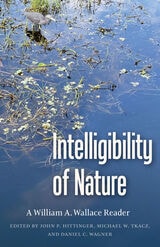
cover of Intelligibility of Nature: A William A. Wallace Reader

Intelligibility of Nature

A William A. Wallace Reader

William A. Wallace

Catholic University of America Press, 2022
The intelligibility of nature was a persistent theme of William A. Wallace, OP, one of the most prolific Catholic scholars of the late twentieth century. This Reader aims to make available a representative selection of his work in the history of science, natural philosophy, and theology illustrating his defense and development of this central theme. Wallace is among the most important Galileo scholars of the past fifty years and a key figure in the recent revival of scientific realism. Further, his long and productive scholarly career has been shaped by a continuous effort to bring the resources of the Aristotelian-Thomistic tradition to the solution of contemporary problems of philosophy and science. Through all of these contributions, Wallace has provided the foundation for a renewed confidence in the capacity of human knowers to attain understanding of the natural order. Consequently, the overall aim of this volume is to secure continued access to his scholarship for readers in the new millennium. The Intelligibility of Nature will contain twenty-nine previously published essays written by Wallace over a period of some forty years. Many of these essays are currently not readily accessible. They are arranged in five thematic groups, each representing a major subject-area of Wallace's scholarly interests. The first group is devoted to essays on making nature intelligible through the use of scientific models. The second group of essays investigates various ways in which the Aristotelian-Thomistic tradition is foundational to contemporary scientific research. Essays in the third group are historical studies on the origins of modern science. The fourth group of essays discuss the viability of the cosmological argument for the existence of God in light of natural science. The final group of essays consider the relation of science and religion. Together these essays provide a representative sample of Wallace's multifaceted contributions to scholarship.
[more]
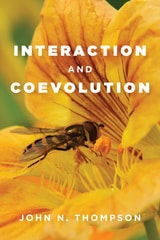
cover of Interaction and Coevolution

Interaction and Coevolution

John N. Thompson

University of Chicago Press, 1982
“It is not only the species that change evolutionarily through interactions . . . the interactions themselves also change.” Thus states John N. Thompson in the foreword to Interaction and Coevolution, the first title in his series of books exploring the relentless nature of evolution and the processes that shape the web of life. Originally published in 1982 more as an idea piece—an early attempt to synthesize then academically distinct but logically linked strands of ecological thought and to suggest avenues for further research—than as a data-driven monograph, Interaction and Coevolution would go on to be considered a landmark study that pointed to the beginning of a new discipline. Through chapters on antagonism, mutualism, and the effects of these interactions on populations, speciation, and community structure, Thompson seeks to explain not only how interactions differ in the selection pressures they exert on species, but also when interactions are most likely to lead to coevolution. In this era of climate change and swiftly transforming environments, the ideas Thompson puts forward in Interaction and Coevolution are more relevant than ever before.
[more]
cover of International Code of Nomenclature for algae, fungi, and plants (Madrid Code)

International Code of Nomenclature for algae, fungi, and plants (Madrid Code)

Editorial Committee of the Madrid Code

University of Chicago Press, 2025

The latest, updated edition of the essential, authoritative reference for botanical, mycological, and phycological names.
 
The International Code of Nomenclature for algae, fungi, and plants, known as “the Code,” is the set of internationally agreed rules and recommendations that govern the naming of these organisms. Scientific naming has deep historical roots. Indeed, the system of naming organisms is one of the first truly global scientific standards. This essential reference originates in Alphonse de Candolle’s 1867 Lois de la nomenclature botanique. This 2025 edition of the Code, the Madrid Code, reflects the decisions made at the Twentieth International Botanical Congress, which met in Madrid, Spain, in July 2024. The congress debated 447 proposals to amend the Code and accepted important new rules, including a mechanism for voluntary registration of plant and algal names, clarifications for naming fossil taxa, the option to reject a new name if it is derogatory to a group of people, and the replacement of an epithet that was considered particularly offensive (revising to afra, afrorum, and afrum).

[more]
cover of International Environmental Policy: From the Twentieth to the Twenty-First Century

International Environmental Policy

From the Twentieth to the Twenty-First Century

Lynton Keith Caldwell

Duke University Press, 1996

In this newly revised and expanded edition of the award-winning International Environmental Policy, Lynton Keith Caldwell updates his comprehensive survey of the global international movement for protection of the environment. Serving as a history of international cooperation on environmental issues, this book focuses primarily on the development of international agreements and institutional arrangements—both governmental and nongovernmental—along with the impact of science, technology, trade, and communication on environmental policy. With implications for multinational commerce, population policy, agriculture, energy issues, biological and cultural diversity, transnational equity, ideology, and education, this book takes a broad view of the policy outcomes of what may be the most important social movement of the 20th century, and addresses the events and politics that have significantly affected the movement over the last twenty years and will continue to affect it into the next century.
[more]
cover of International Journal of Plant Sciences, volume 183 number 6 (July/August 2022)

International Journal of Plant Sciences, volume 183 number 6 (July/August 2022)

The University of Chicago Press

University of Chicago Press Journals, 2022

[more]
cover of International Journal of Plant Sciences, volume 183 number 7 (September 2022)

International Journal of Plant Sciences, volume 183 number 7 (September 2022)

The University of Chicago Press

University of Chicago Press Journals, 2022

[more]
cover of International Journal of Plant Sciences, volume 183 number 8 (October 2022)

International Journal of Plant Sciences, volume 183 number 8 (October 2022)

The University of Chicago Press

University of Chicago Press Journals, 2022
[more]
cover of International Journal of Plant Sciences, volume 183 number 9 (November/December 2022)

International Journal of Plant Sciences, volume 183 number 9 (November/December 2022)

The University of Chicago Press

University of Chicago Press Journals, 2022
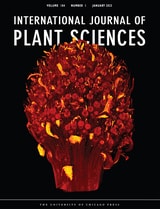
This is volume 183 issue 9 of International Journal of Plant Sciences. Since 1875, the International Journal of Plant Sciences (IJPS) has presented high-quality, original, peer-reviewed research from laboratories around the world and in all areas of the plant sciences. Topics covered include genetics and genomics, developmental and cell biology, biochemistry and physiology, morphology and anatomy, systematics, evolution, paleobotany, plant-microbe interactions, and ecology. IJPS welcomes research articles that describe novel results and new perspectives on topics of interest to the international community of plant scientists. The journal also features reviews and special issues in growing areas of the field.
[more]
cover of International Journal of Plant Sciences, volume 184 number 1 (January 2023)

International Journal of Plant Sciences, volume 184 number 1 (January 2023)

The University of Chicago Press

University of Chicago Press Journals, 2023
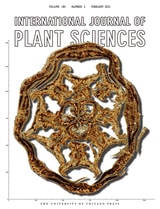
This is volume 184 issue 1 of International Journal of Plant Sciences. Since 1875, the International Journal of Plant Sciences (IJPS) has presented high-quality, original, peer-reviewed research from laboratories around the world and in all areas of the plant sciences. Topics covered include genetics and genomics, developmental and cell biology, biochemistry and physiology, morphology and anatomy, systematics, evolution, paleobotany, plant-microbe interactions, and ecology. IJPS welcomes research articles that describe novel results and new perspectives on topics of interest to the international community of plant scientists. The journal also features reviews and special issues in growing areas of the field.
[more]
cover of International Journal of Plant Sciences, volume 184 number 2 (February 2023)

International Journal of Plant Sciences, volume 184 number 2 (February 2023)

The University of Chicago Press

University of Chicago Press Journals, 2023
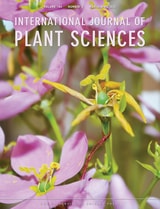
This is volume 184 issue 2 of International Journal of Plant Sciences. Since 1875, the International Journal of Plant Sciences (IJPS) has presented high-quality, original, peer-reviewed research from laboratories around the world and in all areas of the plant sciences. Topics covered include genetics and genomics, developmental and cell biology, biochemistry and physiology, morphology and anatomy, systematics, evolution, paleobotany, plant-microbe interactions, and ecology. IJPS welcomes research articles that describe novel results and new perspectives on topics of interest to the international community of plant scientists. The journal also features reviews and special issues in growing areas of the field.
[more]
cover of International Journal of Plant Sciences, volume 184 number 3 (March/April 2023)

International Journal of Plant Sciences, volume 184 number 3 (March/April 2023)

The University of Chicago Press

University of Chicago Press Journals, 2023
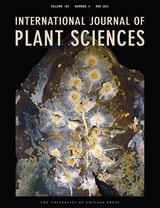
This is volume 184 issue 3 of International Journal of Plant Sciences. Since 1875, the International Journal of Plant Sciences (IJPS) has presented high-quality, original, peer-reviewed research from laboratories around the world and in all areas of the plant sciences. Topics covered include genetics and genomics, developmental and cell biology, biochemistry and physiology, morphology and anatomy, systematics, evolution, paleobotany, plant-microbe interactions, and ecology. IJPS welcomes research articles that describe novel results and new perspectives on topics of interest to the international community of plant scientists. The journal also features reviews and special issues in growing areas of the field.
[more]
cover of International Journal of Plant Sciences, volume 184 number 4 (May 2023)

International Journal of Plant Sciences, volume 184 number 4 (May 2023)

The University of Chicago Press

University of Chicago Press Journals, 2023

This is volume 184 issue 4 of International Journal of Plant Sciences. Since 1875, the International Journal of Plant Sciences (IJPS) has presented high-quality, original, peer-reviewed research from laboratories around the world and in all areas of the plant sciences. Topics covered include genetics and genomics, developmental and cell biology, biochemistry and physiology, morphology and anatomy, systematics, evolution, paleobotany, plant-microbe interactions, and ecology. IJPS welcomes research articles that describe novel results and new perspectives on topics of interest to the international community of plant scientists. The journal also features reviews and special issues in growing areas of the field.
[more]
cover of International Journal of Plant Sciences, volume 184 number 5 (June 2023)

International Journal of Plant Sciences, volume 184 number 5 (June 2023)

The University of Chicago Press

University of Chicago Press Journals, 2023
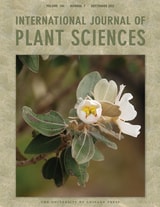
This is volume 184 issue 5 of International Journal of Plant Sciences. Since 1875, the International Journal of Plant Sciences (IJPS) has presented high-quality, original, peer-reviewed research from laboratories around the world and in all areas of the plant sciences. Topics covered include genetics and genomics, developmental and cell biology, biochemistry and physiology, morphology and anatomy, systematics, evolution, paleobotany, plant-microbe interactions, and ecology. IJPS welcomes research articles that describe novel results and new perspectives on topics of interest to the international community of plant scientists. The journal also features reviews and special issues in growing areas of the field.
[more]
cover of International Journal of Plant Sciences, volume 184 number 7 (September 2023)

International Journal of Plant Sciences, volume 184 number 7 (September 2023)

The University of Chicago Press

University of Chicago Press Journals, 2023
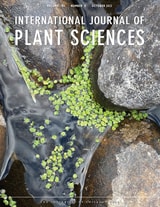
This is volume 184 issue 7 of International Journal of Plant Sciences. Since 1875, the International Journal of Plant Sciences (IJPS) has presented high-quality, original, peer-reviewed research from laboratories around the world and in all areas of the plant sciences. Topics covered include genetics and genomics, developmental and cell biology, biochemistry and physiology, morphology and anatomy, systematics, evolution, paleobotany, plant-microbe interactions, and ecology. IJPS welcomes research articles that describe novel results and new perspectives on topics of interest to the international community of plant scientists. The journal also features reviews and special issues in growing areas of the field.
[more]
cover of International Journal of Plant Sciences, volume 184 number 8 (October 2023)

International Journal of Plant Sciences, volume 184 number 8 (October 2023)

The University of Chicago Press

University of Chicago Press Journals, 2023
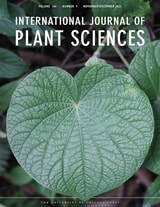
This is volume 184 issue 8 of International Journal of Plant Sciences. Since 1875, the International Journal of Plant Sciences (IJPS) has presented high-quality, original, peer-reviewed research from laboratories around the world and in all areas of the plant sciences. Topics covered include genetics and genomics, developmental and cell biology, biochemistry and physiology, morphology and anatomy, systematics, evolution, paleobotany, plant-microbe interactions, and ecology. IJPS welcomes research articles that describe novel results and new perspectives on topics of interest to the international community of plant scientists. The journal also features reviews and special issues in growing areas of the field.
[more]
cover of International Journal of Plant Sciences, volume 184 number 9 (November/December 2023)

International Journal of Plant Sciences, volume 184 number 9 (November/December 2023)

The University of Chicago Press

University of Chicago Press Journals, 2023
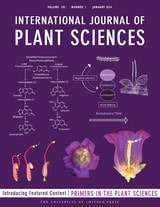
This is volume 184 issue 9 of International Journal of Plant Sciences. Since 1875, the International Journal of Plant Sciences (IJPS) has presented high-quality, original, peer-reviewed research from laboratories around the world and in all areas of the plant sciences. Topics covered include genetics and genomics, developmental and cell biology, biochemistry and physiology, morphology and anatomy, systematics, evolution, paleobotany, plant-microbe interactions, and ecology. IJPS welcomes research articles that describe novel results and new perspectives on topics of interest to the international community of plant scientists. The journal also features reviews and special issues in growing areas of the field.
[more]
cover of International Journal of Plant Sciences, volume 185 number 1 (January 2024)

International Journal of Plant Sciences, volume 185 number 1 (January 2024)

The University of Chicago Press

University of Chicago Press Journals, 2024
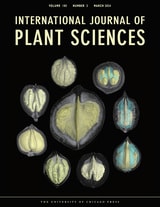
This is volume 185 issue 1 of International Journal of Plant Sciences. Since 1875, the International Journal of Plant Sciences (IJPS) has presented high-quality, original, peer-reviewed research from laboratories around the world and in all areas of the plant sciences. Topics covered include genetics and genomics, developmental and cell biology, biochemistry and physiology, morphology and anatomy, systematics, evolution, paleobotany, plant-microbe interactions, and ecology. IJPS welcomes research articles that describe novel results and new perspectives on topics of interest to the international community of plant scientists. The journal also features reviews and special issues in growing areas of the field.
[more]
cover of International Journal of Plant Sciences, volume 185 number 2 (March/April 2024)

International Journal of Plant Sciences, volume 185 number 2 (March/April 2024)

The University of Chicago Press

University of Chicago Press Journals, 2024
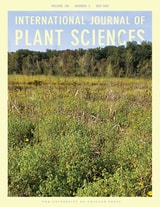
This is volume 185 issue 2 of International Journal of Plant Sciences. Since 1875, the International Journal of Plant Sciences (IJPS) has presented high-quality, original, peer-reviewed research from laboratories around the world and in all areas of the plant sciences. Topics covered include genetics and genomics, developmental and cell biology, biochemistry and physiology, morphology and anatomy, systematics, evolution, paleobotany, plant-microbe interactions, and ecology. IJPS welcomes research articles that describe novel results and new perspectives on topics of interest to the international community of plant scientists. The journal also features reviews and special issues in growing areas of the field.
[more]
cover of International Journal of Plant Sciences, volume 185 number 3 (May 2024)

International Journal of Plant Sciences, volume 185 number 3 (May 2024)

The University of Chicago Press

University of Chicago Press Journals, 2024
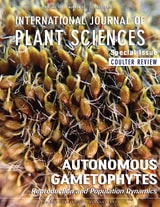
This is volume 185 issue 3 of International Journal of Plant Sciences. Since 1875, the International Journal of Plant Sciences (IJPS) has presented high-quality, original, peer-reviewed research from laboratories around the world and in all areas of the plant sciences. Topics covered include genetics and genomics, developmental and cell biology, biochemistry and physiology, morphology and anatomy, systematics, evolution, paleobotany, plant-microbe interactions, and ecology. IJPS welcomes research articles that describe novel results and new perspectives on topics of interest to the international community of plant scientists. The journal also features reviews and special issues in growing areas of the field.
[more]
cover of International Journal of Plant Sciences, volume 185 number 4 (July/August 2024)

International Journal of Plant Sciences, volume 185 number 4 (July/August 2024)

The University of Chicago Press

University of Chicago Press Journals, 2024
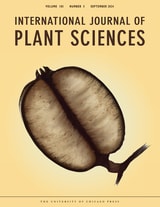
This is volume 185 issue 4 of International Journal of Plant Sciences. Since 1875, the International Journal of Plant Sciences (IJPS) has presented high-quality, original, peer-reviewed research from laboratories around the world and in all areas of the plant sciences. Topics covered include genetics and genomics, developmental and cell biology, biochemistry and physiology, morphology and anatomy, systematics, evolution, paleobotany, plant-microbe interactions, and ecology. IJPS welcomes research articles that describe novel results and new perspectives on topics of interest to the international community of plant scientists. The journal also features reviews and special issues in growing areas of the field.
[more]
cover of International Journal of Plant Sciences, volume 185 number 5 (September 2024)

International Journal of Plant Sciences, volume 185 number 5 (September 2024)

The University of Chicago Press

University of Chicago Press Journals, 2024
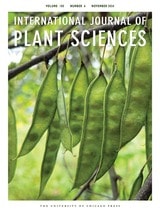
This is volume 185 issue 5 of International Journal of Plant Sciences. Since 1875, the International Journal of Plant Sciences (IJPS) has presented high-quality, original, peer-reviewed research from laboratories around the world and in all areas of the plant sciences. Topics covered include genetics and genomics, developmental and cell biology, biochemistry and physiology, morphology and anatomy, systematics, evolution, paleobotany, plant-microbe interactions, and ecology. IJPS welcomes research articles that describe novel results and new perspectives on topics of interest to the international community of plant scientists. The journal also features reviews and special issues in growing areas of the field.
[more]
cover of International Journal of Plant Sciences, volume 185 number 6 (November/December 2024)

International Journal of Plant Sciences, volume 185 number 6 (November/December 2024)

The University of Chicago Press

University of Chicago Press Journals, 2024
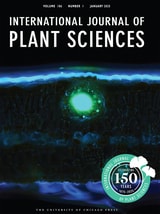
This is volume 185 issue 6 of International Journal of Plant Sciences. Since 1875, the International Journal of Plant Sciences (IJPS) has presented high-quality, original, peer-reviewed research from laboratories around the world and in all areas of the plant sciences. Topics covered include genetics and genomics, developmental and cell biology, biochemistry and physiology, morphology and anatomy, systematics, evolution, paleobotany, plant-microbe interactions, and ecology. IJPS welcomes research articles that describe novel results and new perspectives on topics of interest to the international community of plant scientists. The journal also features reviews and special issues in growing areas of the field.
[more]
cover of International Journal of Plant Sciences, volume 186 number 1 (January 2025)

International Journal of Plant Sciences, volume 186 number 1 (January 2025)

The University of Chicago Press

University of Chicago Press Journals, 2025
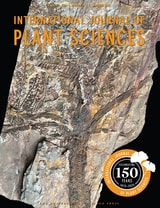
This is volume 186 issue 1 of International Journal of Plant Sciences. Since 1875, the International Journal of Plant Sciences (IJPS) has presented high-quality, original, peer-reviewed research from laboratories around the world and in all areas of the plant sciences. Topics covered include genetics and genomics, developmental and cell biology, biochemistry and physiology, morphology and anatomy, systematics, evolution, paleobotany, plant-microbe interactions, and ecology. IJPS welcomes research articles that describe novel results and new perspectives on topics of interest to the international community of plant scientists. The journal also features reviews and special issues in growing areas of the field.
[more]
cover of International Journal of Plant Sciences, volume 186 number 2 (March/April 2025)

International Journal of Plant Sciences, volume 186 number 2 (March/April 2025)

The University of Chicago Press

University of Chicago Press Journals, 2025
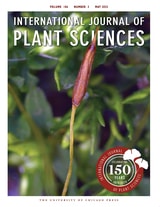
This is volume 186 issue 2 of International Journal of Plant Sciences. Since 1875, the International Journal of Plant Sciences (IJPS) has presented high-quality, original, peer-reviewed research from laboratories around the world and in all areas of the plant sciences. Topics covered include genetics and genomics, developmental and cell biology, biochemistry and physiology, morphology and anatomy, systematics, evolution, paleobotany, plant-microbe interactions, and ecology. IJPS welcomes research articles that describe novel results and new perspectives on topics of interest to the international community of plant scientists. The journal also features reviews and special issues in growing areas of the field.
[more]
cover of International Journal of Plant Sciences, volume 186 number 3 (May 2025)

International Journal of Plant Sciences, volume 186 number 3 (May 2025)

The University of Chicago Press

University of Chicago Press Journals, 2025
This is volume 186 issue 3 of International Journal of Plant Sciences. Since 1875, the International Journal of Plant Sciences (IJPS) has presented high-quality, original, peer-reviewed research from laboratories around the world and in all areas of the plant sciences. Topics covered include genetics and genomics, developmental and cell biology, biochemistry and physiology, morphology and anatomy, systematics, evolution, paleobotany, plant-microbe interactions, and ecology. IJPS welcomes research articles that describe novel results and new perspectives on topics of interest to the international community of plant scientists. The journal also features reviews and special issues in growing areas of the field.
[more]
cover of International Journal of Plant Sciences, volume 186 number 5 (September 2025)

International Journal of Plant Sciences, volume 186 number 5 (September 2025)

The University of Chicago Press

University of Chicago Press Journals, 2025

This is volume 186 issue 5 of International Journal of Plant Sciences. Since 1875, the International Journal of Plant Sciences (IJPS) has presented high-quality, original, peer-reviewed research from laboratories around the world and in all areas of the plant sciences. Topics covered include genetics and genomics, developmental and cell biology, biochemistry and physiology, morphology and anatomy, systematics, evolution, paleobotany, plant-microbe interactions, and ecology. IJPS welcomes research articles that describe novel results and new perspectives on topics of interest to the international community of plant scientists. The journal also features reviews and special issues in growing areas of the field.
[more]