Results by title
3576 books match the query 'American' and 115 start with i

Inventory
Rob Schlegel
University of Chicago Press, 0
A book-length poem serving as a son’s elegy for his late father, an artist and forest steward.
Rob Schlegel’s long poem Inventory emerges from three discrete inventories the poet must catalog in the aftermath of a sudden loss: a selection of his father’s art to be organized for a posthumous exhibition, two hundred acres of trees in a forest stewarded by his father in western Oregon, and his own emotional landscape in the aftermath of his father’s death. As Schlegel moves through these collections of objects and emotions, he learns how to navigate grief. His father’s paintings act as an inventory of the poet’s own life, with each landscape recalling a moment in time, each sketch holding a story. Celebrating a close relationship while mourning its loss, Schlegel reflects on the ties between art and grief, parents and children, people and trees.
At the time of his father’s death, an extreme heatwave was moving across the region, broadening the scope of grief from the personal and familial to encompass tragedies on a larger scale. Social disintegration and climate disaster weave through the lives of a family in mourning as they navigate the complexity of how to sit with loss, change, love, and art. Through quiet, measured verse and arresting simplicity, Inventory extends the ekphrastic tradition into a contemporary elegy rich in both profound sadness and optimism for the future.

Inverse Sky
John Isles
University of Iowa Press, 2008
Part Baudelairian flâneur, an Arcadian shepherd, the speaker in John Isles’s brave new Inverse Sky encounters a fragmented history. It is nineteenth-century California, and the missions are still burning after the Americans establish the Bear Flag Republic; it is the twenty-first century, and the miners of '49 are relegated to a mural in an arcade. Both a loner and a lover, Isles’s pilgrim-poet takes us on a journey where Native Americans are “missing persons” outside a diorama of their ancestors, then sets us adrift in settings ranging from film noir to the clear-cut hills of modern-day California landscapes, under siege but not defeated.
Inverse Sky evokes the paradigm of a shocked and disbelieving child dealing with a broken promise, yet the poems carry within themselves the knowledge that promises will be kept. The only response to broken promises is “to come undone / to come and go in a single breath.” But this is a beginning as well as an end. Each poem becomes a new world—for if there is anything on earth worth loving, it is something made with the world as it has been handed down to us. Inverse Sky is an insistent effort to "love the things not loving back.”
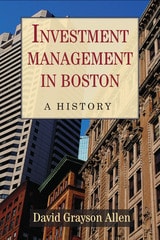
Investment Management in Boston
A HistoryDavid Grayson Allen
University of Massachusetts Press, 2015
Presented here for the first time is the history of Boston's evolution as a center of American money management from early settlement to the twenty-first century. Within a few decades after the Revolution, Bostonians built up an impressive mercantile and industrial economy, and used wealth accrued from the China trade, New England mills, and other ventures to establish the most important stock exchange in America. They also created the “Boston trustee,” a unique professional who managed private fortunes over generations. During the late nineteenth century, Boston financial institutions were renowned as bastions of stability and conservatism in an era of recurrent economic panics and frequent failures.
It was not until the twentieth century that Boston became better known for its role in investment management. In 1924, local financiers created the first mutual fund, an innovation almost a century in the making. After World War II, Boston originated venture capital with the founding of American Research & Development. This was soon followed by the development of private equity, the growth of the mutual fund industry, the pension “revolution” that changed and strengthened money management, the evolution in management of institutional endowments, and the rise of new family offices and hedge funds. The contributions of fiduciaries and investment managers have played an important part in the rise of the “New Boston” and made the city one of the most vibrant financial capitals in the world.
Investment Management in Boston is published in association with Massachusetts Historical Society.
Involuntary Lyrics
Aaron Shurin
Omnidawn, 2005
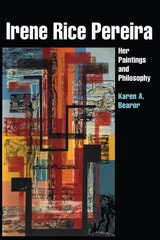
Irene Rice Pereira
Her Paintings and PhilosophyBy Karen Bearor
University of Texas Press, 1993
Artist Irene Rice Pereira was a significant figure in the New York art world of the 1930s and 1940s, who shared an interest in Jungianism with the better-known Abstract Expressionists and with various women artists and writers seeking "archetypal" imagery. Yet her artistic philosophy and innovative imagery elude easy classification with her artistic contemporaries. In consequence, her work is rarely included in studies of the period and is almost unknown to the general public. This first intellectual history of the artist and her work seeks to change that.
Karen A. Bearor thoroughly re-creates the artistic and philosophical milieu that nourished Pereira’s work. She examines the options available to Pereira as a woman artist in the first half of the twentieth century and explores how she used those options to contribute to the development of modernism in the United States. Bearor traces Pereira’s interest in the ideas of major thinkers of the period—among them, Spengler, Jung, Einstein, Cassirer, and Dewey—and shows how Pereira incorporated their ideas into her art. And she demonstrates how Pereira’s quest to understand something of the nature of ultimate reality led her from an early utopianism to a later interest in spiritualism and the occult.
This lively intellectual history amplifies our knowledge of a time of creative ferment in American art and society. It will appeal to a wide range of readers interested in the modernist period.
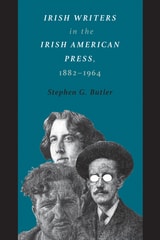
Irish Writers in the Irish American Press, 1882-1964
Stephen G. Butler
University of Massachusetts Press, 2018
Irish Writers in the Irish American Press spans the period from Oscar Wilde's 1882 American lecture tour to the months following JFK's assassination and covers the century in which Irish American identity was shaped by immigration, religion, politics, and economic advancement. Through a close engagement with Irish American periodicals, Butler offers a more nuanced understanding of the connections between Irish literary studies and Irish American culture during this period.
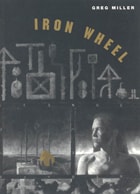
Iron Wheel
Greg Miller
University of Chicago Press, 1998

Isolato
Larissa Szporluk
University of Iowa Press, 2000
The short lyric poems in Larissa Szporluk's new collection, Isolato, search for meaning and beauty—for poetry—in an unpredictable and incomprehensible world. Their voices break from the contemporary preoccupation with autobiography, held together by language rather than a sustained narrative or plot. Yet the narrative fragments clearly evoke certain themes and moods: interaction of and struggle between the human and natural world; violence, particularly against women and children; alienation and betrayal; the mysteries of the universe, God, and death; and, of course, poetry itself.
Variously called a religious, a metaphysical, or a visionary poet, Szporluk has been compared to Emily Dickinson and George Herbert as well as to twentieth-century poets like Sylvia Plath, Mark Strand, and Louise Glück. Her work is concise, experimental, and challenging. Language and syntax are often elusive, the logic that of dreams or music, the imagery mysterious. The poems, once read, are not easily dismissed. Like the poet's “Deer Crossing the Sea,”readers find “the promise of nectar / haunts them forever, the shore pecked out / of their eyes, and there, in its stead, / something greater to catch, / a scent that would paralyze God.”
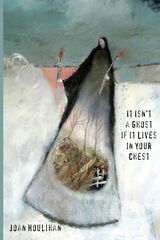
It Isn’t a Ghost if It Lives in Your Chest
Joan Houlihan
Four Way Books, 2021
Houlihan’s sixth collection of lyric poems reflects upon the persistence of what is lost and the accidental ruptures of trauma that allow re-entry into our world. These poems are at once despairing and hopeful.
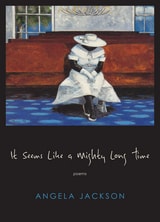
It Seems Like a Mighty Long Time
PoemsAngela Jackson
Northwestern University Press, 2015
2015 PEN Open Book Award Finalist
Angela Jackson’s latest collection of poetry borrows its title from a lyric in Barbara Lewis’s 1963 hit single “Hello Stranger,” recorded at Chess Records in Chicago. Like the song, Jackson’s poems are a melodic ode to the African American experience, informed by both individual lives and community history, from the arrival of the first African slave in Virginia in 1619 to post-Obama America.
It Seems Like a Mighty Long Time reflects the maturity of Jackson’s poetic vision. The Great Migration, the American South, and Chicago all serve as signposts, but it is the complexity of individual lives—both her own and those who have gone before, walk beside, and come after—that invigorate this collection. Upon surveying so vast a landscape, Jackson finds that sorrow meets delight, and joy lifts up anger and despair. And for all this time, love is the agent, the wise and just rule and guide.
It Was Fever That Made The World
Jim Powell
University of Chicago Press, 1989
"I find it difficult to overpraise the ease of this writing, which in one act combines succinct physical presentation and explanation of it. . . . It is perhaps here that Jim Powell, not yet forty, most shows his superiority to many of his contemporaries and seniors. He not only understands the way in which opposites are necessary to one another, he achieves his knowledge in the poem, and so we grasp it as we read. . . . he has tapped a subject matter that is endless and important, and by the thoroughgoingness and the subtlety of his exploration shows he has the power to do almost anything."—Thom Gunn, Shelf Life
"His title burns away everywhere in the volume, in the fevers of eros, divination, memory, destruction, and grief. . . . Page for page, there is more sheer fine, clear, yet syntactically subtle and metaphorically gorgeous writing in Powell than I have seen in some time."—Mary Kinzie, Poetry
"Jim Powell's poems, like those of Thomas Hardy, are haunted forms, full of ghosts and mocking gods, shadows and foreshadowings. But Powell is a Hardy whose poems we've never read, a Hardy with his hand in the blaze, not stirring the ash in a cold and wind-torn grate."—Jennifer Clarvoe, The Threepenny Review
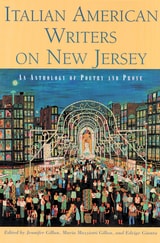
Italian American Writers on New Jersey
An Anthology of Poetry and ProseEdited by Jennifer Gillan, Maria Mazziotti Gillan, and Edvige Giunta
Rutgers University Press, 2003
This anthology gathers fiction, poetry, memoirs, oral histories, and journalistic pieces by some of the best writers to chronicle the Italian American experience in the Garden State. These works focus on ethnic identity and the distinctive culture of New Jersey, which has long been home to a large and vital Italian American community.
Filled with passion, humor, and grace, these writings depict a variety of experiences, including poignant but failed attempts at conformity and the alienation often felt by ethnic Americans. The authors also speak of the strength gained through the preservation of their communities and the realization that it is often the appreciation of their heritage that helps them to succeed. Although presented from the vantage point of only one ethnic group, this book addresses in microcosm the complexities of American identity, depicting situations and conveying emotions that will resonate with people of all immigrant ancestries.
Among the many writers featured are Gay Talese, Bill Ervolino, Tom Perrotta, Louise DeSalvo, Carole Mazo, Diane di Prima, and Maria Laurino. Each of the contributors provides a fresh perspective on the diversity, complexity, and richness of the Italian American experience.
Publication of this book is made possible in part by a grant from the Institute of Italian and Italian American Heritage Studies, State of New Jersey.
Italian Signs, American Streets
The Evolution of Italian American NarrativeFred L. Gardaphé
Duke University Press, 1996
Gardaphé draws on Vico’s concept of history, as well as the work of Gramsci, to establish a culture-specific approach to reading Italian American literature. He begins his historical reading with narratives informed by oral traditions, primarily autobiography and autobiographical fiction written by immigrants. From these earliest social–realist narratives, Gardaphé traces the evolution of this literature through tales of “the godfather” and the mafia; the “reinvention of ethnicity” in works by Helen Barolini, Tina DeRosa, and Carole Maso; the move beyond ethnicity in fiction by Don DeLillo and Gilbert Sorrentino; to the short fiction of Mary Caponegro, which points to a new direction in Italian American writing.
The result is both an ethnography of Italian American narrative and a model for reading the signs that mark the “self-fashioning” inherent in literary and cultural production. Italian Signs, American Streets promises to become a landmark in the understanding of literature and culture produced by Italian Americans. It will be of interest not only to students, critics, and scholars of this ethnic experience, but also to those concerned with American literature in general and the place of immigrant and ethnic literatures within that wide framework.

Italy and American Female Imagination
Debra Bernardi
The Ohio State University Press, 2025

Itch Like Crazy
Wendy Rose
University of Arizona Press, 2002
In her latest work, Rose returns to these major motifs while exploring a new dimension: using poetry as a tool to delve into the buried secrets of family history—and all of American history as well. Confronting questions of personal history that itch like crazy—the irritations that drive human existence—she acknowledges and pays tribute to her Indian and European ancestors without hiding her anger with American society.
Rose's poems are strong political and social statements that have a distinctly narrative flavor. Here are Europeans who first set foot on America's shores while Taino Indians greeted them as if they were visiting neighbors; Hopi and Miwok "Clan Mothers, grand-daughters, all those the missionaries erased"; and European forebears who as settlers pushed their way relentlessly west. Through her vivid imagery, she speaks to and for these ancestors with a sense of loss and an itching caused by the biases provoked by ethnic chauvinism.
Itch Like Crazy is a finely crafted literary work that is also a manifesto addressing contacts and conflicts in the history of Indian-white relations. By presenting another view of U.S. history and its impact on the Native Americans who are her ancestors, it offers a new appreciation of the issue of "tribal identity" that too often faces Native peoples of the Americas—and is too often misunderstood by Euro-American society.