Results by title
4030 books match the query 'Language Arts & Disciplines' and 223 start with i

Inside the Antisemitic Mind
The Language of Jew-Hatred in Contemporary GermanyMonika Schwarz-Friesel and Jehuda Reinharz
Brandeis University Press, 2017
Inside the Teaching Machine
Rhetoric and the Globalization of the U.S. Public Research UniversityCatherine Chaput
University of Alabama Press, 2008
An incisive critique of the corporatized university, tracing the entanglement of academic missions with economic, political, and cultural systems.
Advocates of higher education have long contended that universities should operate above the crude material negotiations of economics and politics. Such arguments, ignore the historical reality that the American university system emerged through, and in service to, a capitalist political economy that unevenly combines corporate, state, and civil interests.
As the corporatization of U.S. universities becomes nearly impossible to deny, the common response from many academics has been a superior stand against the contamination of the professional ideal by tainted corporate interests. Inside the Teaching Machine proposes a correction to this view through the lens of historical materialism.
Chaput argues that the U.S. public research university has always been a vital component of the capitalist political economy. While conventional narratives of public higher education emphasize civic preparation and upward mobility, Chaput demonstrates that supposedly egalitarian policies like the Morrill Land-Grant Act and the G.I. Bill served the changing interests of capitalism much as education, creating a professional class that supports the capitalist political economy. Chaput also focuses on the relationship between American universities and globalization, showing how the trend toward professionalization contributes to the production of surplus value, and the ways that the American university model circulates outside the United States. Chaput concludes by advocating rhetorical strategies for the professional who opposes the capitalist logic of the global university system, proposing concrete options for engaging and redirecting globalization within the university system.

Inside, Outside, and Online
Building Your Library CommunityChrystie Hill
American Library Association, 2009
Insider Histories of the Vietnam Era Underground Press, Part 1
Ken Wachsberger
Michigan State University Press, 2011
This enlightening book offers a collection of histories of underground papers from the Vietnam Era as written and told by key staff members of the time. Their stories (as well as those to be included in Part 2, forthcoming) represent a wide range of publications: counterculture, gay, lesbian, feminist, Puerto Rican, Native American, Black, socialist, Southern consciousness, prisoner's rights, New Age, rank-and-file, military, and more. The edition includes forewords by former Chicago Seed editor Abe Peck, radical attorney William M. Kunstler, and Markos Moulitsas, founder of the Daily Kos, along with an introductory essay by Ken Wachsberger.
Wachsberger notes that the underground press not only produce a few well-known papers but also was truly national and diverse in scope. His goal is to capture the essence of "the countercultural community."
A fundamental resource for anyone seeking a deeper understanding of a dramatic era in U.S. history.
Insider Histories of the Vietnam Era Underground Press, Part 2
Ken Wachsberger
Michigan State University Press, 2011
This enlightening book offers a collection of histories of underground papers from the Vietnam Era as written and told by key staff members of the time. Their stories, building on those presented in Part 1, represent a wide range of publications: countercultural, gay, lesbian, feminist, Puerto Rican, Native American, Black, socialist, Southern consciousness, prisoners’ rights, New Age, rank-and-file, military, and more. Wachsberger notes that the underground press not only produced a few well-known papers but also was truly national and diverse in scope. His goal is to capture the essence of “the countercultural community.” This book will be a fundamental resource for anyone seeking a deeper understanding of a dramatic era in U.S. history, as well as offering a younger readership a glimpse into a generation of idealists who rose up to challenge and improve government and society.
Insiders, Outliers
Centering Adult Student Writers at an HBCUCollie Fulford
Rutgers University Press, 2025
Winner of the 2026 Outstanding Book Award in the Monograph category from the Conference on College Composition and Communication
Insiders, Outliers invites readers into the lives of adult HBCU students for whom college is one meaningful activity among many. Although adults over the age of twenty-four comprise a quarter of all undergraduates, they are institutionally segregated and only partially served by a US higher education system that remains organized around traditional-aged learners. Even as such students are regarded as a market for postsecondary institutions, they are routinely marginalized by institutional barriers. Students’ stories of their personal, professional, community, and academic writing experiences illuminate a critical need for more age-inclusive practices across academia. Their cases also offer new conceptual models of writing as an ethical and emotional practice that fuels changes for individuals and the people and institutions that they care about—including higher education. What adult students reveal about writing across their life domains has powerful implications for conceptualizing writing as a complex form of agency and for teaching writing across the curriculum.
Inspired Collaboration
Ideas for Discovering and Applying Your PotentialDorothy Stoltz
American Library Association, 2016
Inspired Thinking
Big Ideas to Enrich Yourself and Your CommunityDorothy Stoltz
American Library Association, 2020
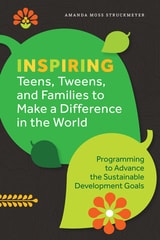
Inspiring Teens, Tweens, and Families to Make a Difference in the World
Programming to Advance the Sustainable Development GoalsAmanda Moss Struckmeyer
American Library Association, 2025
- programs and activities related to such topics as good health and well-being, ending poverty, peace and justice, responsible consumption and production, decent work, and clean water and sanitation;
- ideas perfect for multi-age audiences (families), tweens, and teens that can be tailored for different group sizes, programming spaces, budgets, and time frames;
- a plethora of flexible, cost-effective passive programs that patrons can engage in at any time;
- guidance on outreach opportunities for fostering partnerships with local experts and guest speakers; and
- pointers on additional and supporting resources including books, videos, and websites.
Institutional Ethnography as Writing Studies Practice
Michelle LaFrance
University Press of Colorado, 2024
Institutional Ethnography
A Theory of Practice for Writing Studies ResearchersMichelle LaFrance
Utah State University Press, 2019
In this book, Michelle LaFrance introduces the theories, rhetorical frames, and methods that ground and animate institutional ethnography. Three case studies illustrate key aspects of the methodology in action, tracing the work of writing assignment design in a linked gateway course, the ways annual reviews coordinate the work of faculty and writing center administrators and staff, and how the key term “information literacy” socially organizes teaching in a first-year English program. Through these explorations of the practice of ethnography within sites of writing and writing instruction, LaFrance shows that IE is a methodology keenly attuned to the material relations and conditions of work in twenty-first-century writing studies contexts, ideal for both practiced and novice ethnographers who seek to understand the actualities of social organization and lived experience in the sites they study.
Institutional Ethnography expands the field’s repertoire of research methodologies and offers the grounding necessary for work with the IE framework. It will be invaluable to writing researchers and students and scholars of writing studies across the spectrum—composition and rhetoric, literacy studies, and education—as well as those working in fields such as sociology and cultural studies.
Institutional Literacies
Engaging Academic IT Contexts for Writing and CommunicationStuart A. Selber
University of Chicago Press, 2020
Institutional Literacies argues that writing and communication teachers and program directors should collaborate more closely and engage more deeply with IT staff as technology projects are planned, implemented, and expanded. Teachers need to both analyze how their institutions approach information technologies and intervene in productive ways as active university citizens with relevant expertise. To help them do so, the book offers a three-part heuristic, reflecting the reality that academic IT units are complex and multilayered, with historical, spatial, and textual dimensions. It discusses six ways teachers can intervene in the academic IT work of their own institutions: maintaining awareness, using systems and services, mediating for audiences, participating as user advocates, working as designers, and partnering as researchers. With these strategies in hand, educators can be proactive in helping institutional IT approaches align with the professional values and practices of writing and communication programs.
Institutional Repositories
Josh C. Cromwell
Against the Grain, LLC, 2026
Institutional Repositories manage and preserve an institution’s own content. Since their introduction over 25 years ago, Institutional Repositories have been established in universities and institutions around the world. Yet many people, even within the scholarly world, are unaware of the work that repositories carry out, and the essential role they play. Institutional Repositories is a much-needed guide to repositories, past and present. Written by a repository manager and trainer, this fully peer-reviewed book assumes no prior knowledge, and guides the reader through all the activities carried out by the repository team, including (but not limited to) ensuring green Open Access, and ensuring maximum impact for the institution’s research output, as well as providing a collective memory for the organization, often capturing content that would otherwise be lost.
- Wide-ranging, from staffing and managing the repository, to accessibility, preservation, and metadata
- Includes practical guidance for the daily tasks carried out by repository staff
- Compares national repository strategies
- With glossary of repository-related terms
Cromwell achieves something rare: a book that is comprehensive, detailed, readable, and useful all at once. He understands the benefits and untapped potential of the global network of open-access repositories, and offers practical advice for taking full advantage of this community-led infrastructure. Recommended for all institutions hosting or planning to host a repository.
Peter Suber, Director of the Harvard Open Access Project
Institutional Repositories
Clipp #44Brighid Gonzales
American Library Association, 2018
Institutions of Reading
The Social Life of Libraries in the United StatesThomas Augst
University of Massachusetts Press, 2007
Tracing the evolution of the library as a modern institution from the late eighteenth century to the digital era, this book explores the diverse practices by which Americans have shared reading matter for instruction, edification, and pleasure. Writing from a rich variety of perspectives, the contributors raise important questions about the material forms and social shapes of American culture. What is a library? How have libraries fostered communities of readers and influenced the practice of reading in particular communities? How did the development of modern libraries alter the boundaries of individual and social experience, and define new kinds of public culture? To what extent have libraries served as commercial enterprises, as centers of power, and as places of empowerment for African Americans, women, and immigrants? Institutions of Reading offers at once a social history of literacy and leisure, an intellectual history of institutional and technological innovations that facilitated the mass distribution and consumption of printed books and periodicals, and a cultural history of the symbolic meanings and practical uses of reading in American life. In addition to the editors, contributors include Elizabeth Amann, Michael Baenen, James Green, Elizabeth McHenry, Barbara Mitchell, Christine Pawley, Janice Radway, James Raven, Karin Roffman, and Roy Rosenzweig.
Instructional Design for Librarians and Information Professionals
American Library Association, 2011
Instructional Design for Teaching Information Literacy Online
A Student-Centered ApproachJanna Mattson
Assoc of College & Research Libraries, 2025
Instructional Design for Teaching Information Literacy Online: A Student-Centered Approach introduces light-hearted tips and advice with author-curated playlists and practical tips on rapidly designing online instruction. It offers scenarios, learning activities, lesson plan examples, rubrics, worksheets, and more, using the classic instructional design model ADDIE to frame the process and the universal design for learning framework, the community of inquiry model, and asset-based pedagogy to address the social and emotional needs of diverse online learners. Six parts offer a theoretical grounding, practical resources, and the enhanced confidence and skills needed to create successful learning experiences.
- Foundational Knowledge
- Analysis
- Design
- Development
- Implementation
- Evaluation
Instructional Identities and Information Literacy
Three Volume SetAmanda Nichols Hess
Assoc of College & Research Libraries, 2023
Grappling with this potentially unexpected identity comes amid a time of significant transition for higher education itself. Academic librarians must figure out how to counter mis-, dis-, and malinformation, address shrinking funding for collections while costs increase, and establish meaningful partnerships in diverse, data-driven environments. And writ large, librarianship as a profession continues to grapple with its responsibility to challenge information illiteracy across contexts, its support of systemic systems of oppression under the guise of neutrality, and its value to a society flooded with information.
In three volumes, Instructional Identities and Information Literacy uses transformative learning theory—a way of understanding adult learning and ourselves—to explore the ways librarians can meaningfully advance how we think about our identities, instructional work, and learning as transformation. Three volumes explore:
- Transforming Ourselves
- Transforming Our Programs, Institutions, and Profession
- Transforming Student Learning, Information Seeking, and Experiences
Instructional Identities and Information Literacy
Volume 1: Transforming OurselvesAmanda Nichols Hess
Assoc of College & Research Libraries, 2023
Grappling with this potentially unexpected identity comes amid a time of significant transition for higher education itself. Academic librarians must figure out how to counter mis-, dis-, and malinformation, address shrinking funding for collections while costs increase, and establish meaningful partnerships in diverse, data-driven environments. And writ large, librarianship as a profession continues to grapple with its responsibility to challenge information illiteracy across contexts, its support of systemic systems of oppression under the guise of neutrality, and its value to a society flooded with information.
In three volumes, Instructional Identities and Information Literacy uses transformative learning theory—a way of understanding adult learning and ourselves—to explore the ways librarians can meaningfully advance how we think about our identities, instructional work, and learning as transformation. Three volumes explore:
- Transforming Ourselves
- Transforming Our Programs, Institutions, and Profession
- Transforming Student Learning, Information Seeking, and Experiences
Instructional Identities and Information Literacy
Volume 3: Transforming Student Learning, Information Seeking, and ExperiencesAmanda Nichols Hess
Assoc of College & Research Libraries, 2023
Grappling with this potentially unexpected identity comes amid a time of significant transition for higher education itself. Academic librarians must figure out how to counter mis-, dis-, and malinformation, address shrinking funding for collections while costs increase, and establish meaningful partnerships in diverse, data-driven environments. And writ large, librarianship as a profession continues to grapple with its responsibility to challenge information illiteracy across contexts, its support of systemic systems of oppression under the guise of neutrality, and its value to a society flooded with information.
In three volumes, Instructional Identities and Information Literacy uses transformative learning theory—a way of understanding adult learning and ourselves—to explore the ways librarians can meaningfully advance how we think about our identities, instructional work, and learning as transformation. Three volumes explore:
- Transforming Ourselves
- Transforming Our Programs, Institutions, and Profession
- Transforming Student Learning, Information Seeking, and Experiences
Integrated Library Planning
A New Model for Strategic and Dynamic Planning, Management, and AssessmentMyka Kennedy Stephens
Assoc of College & Research Libraries, 2023
In a concise seven chapters offering illustrations, charts, sample outlines, and many tools and resources, Integrated Library Planning offers a different kind of approach to planning that is both strategic and dynamic. It is fueled by open communication, honest assessment, and astute observation. Voices at the table, near the table, and far from the table are heard and considered. Its perpetual rhythm gives space to consider new information when it emerges and freedom to make changes at a time that makes sense instead of when it is most convenient or expected.
The era of fixed-length strategic plans is coming to an end. Five-year strategic plans had already given way to three-year strategic plans, and now we find ourselves needing to plan and function when nothing is certain beyond the present moment. The components of this model might look deceptively similar to the strategic planning practices used in libraries and organizations for decades; however, when implemented as a whole, with a monthly review cycle on a rolling planning horizon and space for regular analysis of information needs and behavior, it has the potential to shatter any previous notions of planning that serve only to satisfy administrators. Integrated Library Planning can help libraries effectively navigate and become agents of change.
Integrating Academic Libraries When Institutions Merge
Edited by Scott R. DiMarco, Lisandra R. Carmichael, and Courtney Heatley
American Library Association, 2026
University and college mergers are increasingly common, and merging institutions have consequences for and demand new skills from their academic libraries. How do you turn an independent organization steeped in its own procedures and mission into a merged library that is effective, cohesive, and student-centered?
Integrating Academic Libraries When Institutions Merge can help library workers experiencing a merger understand the process and prepare for some of the challenges. In three sections, authors who have undergone a merger provide strategies for integrating collections, systems, and teams while maintaining critical library operations.
- Preparing to Merge
- The New Integrated Culture
- Managing Change
The key to every merger is almost always the same: People and culture working together to get the job done and, in the process, creating a new culture. Integrating Academic Libraries When Institutions Merge can help you confront the past, adapt to the present, and strategize for a sustainable future.
Intellectual Freedom Manual
Trina Magi
American Library Association, 2015
Intellectual Freedom Manual
Trina Magi
American Library Association, 2021
The newest edition of the Intellectual Freedom Manual is more than simply an update of a foundational text that has served as a crucial resource for more than four decades. It is a living document that serves as the authoritative reference for day-to-day guidance on maintaining free and equal access to information for all people. Whether you’re developing or revising policies, on-boarding new staff or trustees, responding to challenges and controversies, or studying librarianship, you’ll find this an indispensable resource, with features such as
- ALA policy statements, approved by committees and Council, articulating core intellectual freedom principles and best practices;
- 8 new interpretations of the Library Bill of Rights, which address urgent issues like internet filtering, public performances, political activity, religion, and equity, diversity, and inclusion;
- “Issues at a Glance” sidebars which present key concepts, points of law, tips, and questions for reflection;
- expanded content about developing library policies that support intellectual freedom;
- updated information on censorship of library programs, displays, and databases;
- “Advocacy and Assistance,” a section offering concrete guidance when you’re called on to talk to the media or meet with legislators;
- Deeper Look essays which examine the laws related to library operations;
- advice on when to call the police, when not to, and how to handle personally identifiable information when they arrive; and
- an expanded glossary.
Intellectual Freedom Manual
American Library Association, 2006
Intellectual Freedom Manual
American Library Association, 2010
Intellectual Freedom Manual, Eleventh Edition
Erin Office for Intellectual Freedom
American Library Association, 2026
When someone faces a difficult intellectual freedom (IF) issue, they usually don’t have time to wade through dense text to find the answers they need. Designed as a real-world reference, OIF’s Intellectual Freedom Manual provides trusted, comprehensive guidance for every library worker, from the volunteer to the director, in plain language. Whether you’re developing or reviewing policies, on-boarding new staff or trustees, responding to challenges and controversies, or studying librarianship, you’ll find this a vital tool, with features such as
- contributions that center the voices of Black, Indigenous, and other People of Color (BIPOC) and LGBTQIA+ people, who are often targeted by censorship efforts;
- chapters that begin with an overview explaining the big ideas and offering reflection questions;
- an introduction to IF and why it matters, drawing on ALA's core IF documents and supported with adaptable policy worksheets;
- information and best practice guidance on key topics such as access, children and youth, censorship and internet filtering, collection development and management, copyright, meeting rooms and exhibit spaces, library programming, politics and religion, privacy, and visits and requests from law enforcement;
- stories from real people whose lives have been impacted by IF, showing how library policies shape culture, protect staff and users, and affect real people;
- concise breakdowns of IF issues from legal experts, helping you understand the laws and how they apply in real situations;
- practical advice on advocating for IF, getting help when challenges arise, lobbying, and working with your elected officials;
- a thorough index to help you quickly find the information you need; and
- a helpful glossary and selected bibliography of additional resources.
Intellectual Freedom Stories from a Shifting Landscape
Valerie Nye
American Library Association, 2020
Intellectual freedom is a complex concept that democracies and free societies around the world define in different ways but always strive to uphold. And ALA has long recognized the crucial role that libraries play in protecting this right. But what does it mean in practice? How do library workers handle the ethical conundrums that often accompany the commitment to defending it? Rather than merely laying out abstract policies and best practices, this important new collection gathers real-world stories of intellectual freedom in action to illuminate the difficulties, triumphs, and occasional setbacks of advocating for free and equal access to information for all people in a shifting landscape. Offering insight to LIS students and current practitioners on how we can advance the profession of librarianship while fighting censorship and other challenges, these personal narratives explore such formidable situations as
- presenting drag queen story times in rural America;
- a Black Lives Matter “die-in” at the undergraduate library of the University of Wisconsin-Madison;
- combating censorship at a prison library;
- hosting a moderated talk about threats to modern democracy that included a neo-Nazi spokesman;
- a provocative exhibition that triggered intimidating phone calls, emails, and a threat to burn down an art library;
- calls to eliminate non-Indigenous children’s literature from the collection of a tribal college library; and
- preserving patrons’ right to privacy in the face of an FBI subpoena.
Intellectual Freedom for Teens
A Practical Guide for Young Adult & School LibrariansKristin Fletcher-Spear
American Library Association, 2014
Intellectual Populism
Democracy, Inquiry, and the PeoplePaul Stob
Michigan State University Press, 2020
Intellectual Property
Everything the Digital-Age Librarian Needs to KnowTimothy Lee American Library Association
American Library Association, 2008

Intelligent Linguistic Architectures
Variations on Themes by Ronald M. KaplanEdited by Miriam Butt, Mary Dalrymple, and Tracy Holloway King
CSLI, 2006
Ronald M. Kaplan has made foundational contributions to the development of computational linguistic research and linguistic theory, particularly within Lexical-Functional Grammar. Intelligent Linguistic Architectures, a tribute to Kaplan’s cutting-edge work, collects computational and theoretical linguistics papers in his research areas. From machine translation to grammar engineering, from formal issues to semantic theory, this ambitious volume represents the newest developments in linguistic scholarship.
Interacting with History
Teaching with Primary SourcesKatharine Lehman
American Library Association, 2014
Interacting with Print
Elements of Reading in the Era of Print SaturationThe Multigraph Collective
University of Chicago Press, 2018
Each entry builds on its term in order to resituate print and book history within a broader media ecology throughout the eighteenth and nineteenth centuries. The central theme is interactivity, in three senses: people interacting with print; print interacting with the non-print media that it has long been thought, erroneously, to have displaced; and people interacting with each other through print. The resulting book will introduce new energy to the field of print studies and lead to considerable new avenues of investigation.
Interactive Journalism
Hackers, Data, and CodeNikki Usher
University of Illinois Press, 2016
Nikki Usher brings together a comprehensive portrait of nothing less than a new journalistic identity. Usher provides a history of the impact of digital technology on reporting, photojournalism, graphics, and other disciplines that define interactive journalism. Her eyewitness study of the field's evolution and accomplishments ranges from the interactive creation of Al Jazeera English to the celebrated data desk at the Guardian to the New York Times' Pulitzer-endowed efforts in the new field. What emerges is an illuminating, richly reported profile of the people coding a revolution that may reverse the decline and fall of traditional journalism.

Interdisciplinarity And Academic Libraries
ACRL 66Craig Gibson
Assoc of College & Research Libraries, 2012
Interdisciplinary and Academic Libraries
Daniel C. Mack
Assoc of College & Research Libraries, 2012
Interfaces and Domains of Quantification
Javier Gutiérrez-Rexach
The Ohio State University Press, 2014
Interfaces and Domains of Quantification advocates an interface approach to the grammar of Spanish quantification. Only a precise characterization of the syntactic properties of quantificational constructions and of their associated meanings allows us to understand how more general syntactic and semantic constraints are at work. Among other findings, the interaction of scope and parallelism with ellipsis is reconsidered; the structural significance of modal anchoring and essential properties for the interpretation of indefiniteness is explored in detail; additionally, quantificational variability and correlativity phenomena in relative clauses are analyzed; degree expression is characterized for concessive conditionals and superlatives; and, finally, several discourse particles with a quantificational core are shown to be critical for the articulation of semantic and discourse-pragmatic relations. Taking a detailed look at the different forms, patterns and structures associated with several quantificational domains seems to be the only fully explanatory way to advance our knowledge of the syntax, semantics and pragmatics of quantificational structures.
Interim Leadership in Libraries
Building Relationships, Making Decisions, and Moving OnJennifer E. Knievel
American Library Association, 2022
Interim Leadership in Libraries: Building Relationships, Making Decisions, and Moving On draws on evidence-based research, professional expertise, and personal experience to address the practical implications that arise from the decision to appoint interim leaders. Authors from a variety of institutions who have served in many different interim roles explore this unique type of leadership in five thorough sections:
- Building Relationships for Interim Leaders
- Leading with Confidence
- Making Long-Term Decisions as an Interim Leader
- Leading Through Contraction: When No One Can Be Hired
- Moving On: When the Dust Settles
Interlibrary Loan Practices Handbook
Cherié L. Weible
American Library Association, 2011
Interlibrary Loan Practices Handbook
American Library Association, 1997
Intermediate Conversational Sign Language
Willard J Madsen
Gallaudet University Press, 1982
This fully illustrated text offers a unique approach to using American Sign Language (ASL) and English in a bilingual setting. Each of the 25 lessons involve sign language conversation using colloquialisms that are prevalent in informal conversations. Each lesson includes equivalent expressions in English, plus:
- Glossed Vocabulary Review
- Translation Exercises from ASL to English to ASL
- Grammatical Notes
- Substitution Drills
- Suggested Activities
The text also includes practice tests, a bibliography, and a glossed alphabetical index.
Intermediate Horizons
Book History and Digital HumanitiesEdited by Mark Vareschi and Heather Wacha
University of Wisconsin Press, 2024
Integrating intermedial practices and assessments, the editors and contributors explore issues surrounding the access to and materiality of digitized materials, and the challenge of balancing preservation of traditional archival materials with access. They offer an assessment in our present moment of the early visions of book history and DH projects. In revisiting these projects, they ask us to shift our thinking on the promises and perils of archival and creative work in different media. Taken together, this volume reconsiders the historical intersections of book history and DH and charts a path for future scholarship across disciplinary boundaries.
Internal Rhetorics
Toward a History and Theory of Self-PersuasionJean Nienkamp
Southern Illinois University Press, 2001
Since its early history in Greek culture, traditional rhetorical study has focused primarily on persuasive language used in the public sphere. There has been little study, however, of what Jean Nienkamp calls internal rhetoric, which “occurs between one aspect of the self and another” inside one’s mind. Nienkamp opens the study of internal rhetoric by discussing how the concept developed alongside traditional classical and modern rhetorical theory.
Nienkamp shows how we talk to ourselves, or more specifically, how we talk ourselves into things: justifications, actions, opinions, theories. She explains that just because we see ourselves as divided, as torn in different directions by conflicting desires, duties, and social mores, it does not mean that we are fragmented, nor does it mean that we are split into discrete identities that neither interrelate nor interact.
In this groundbreaking study, Nienkamp identifies two major aspects of internal rhetoric: “the conscious ‘art’ of cultivated internal rhetoric” and “the unconscious ‘nature’ of primary internal rhetoric.” Selecting a small number of figures from the history of rhetoric—including Isocrates, Plato, Aristotle, Francis Bacon, Lord Shaftesbury, Richard Whately, Kenneth Burke, Chaim Perelman and Lucie Olbrechts-Tyteca, George Herbert Mead, and Lev Vygotsky—Nienkamp argues for a “version of the rhetorical self that takes into account both the ways we are formed by and formulate internal and external rhetorics and the ways our physical bodies act as a contributing scene—an agora—for internal rhetoric.”
International Journal of American Linguistics, volume 87 number 2 (April 2021)
The University of Chicago Press
University of Chicago Press Journals, 2021
International Journal of American Linguistics, volume 87 number 3 (July 2021)
The University of Chicago Press
University of Chicago Press Journals, 2021
International Journal of American Linguistics, volume 87 number 4 (October 2021)
The University of Chicago Press
University of Chicago Press Journals, 2021
International Journal of American Linguistics, volume 88 number 1 (January 2022)
The University of Chicago Press
University of Chicago Press Journals, 2022
International Journal of American Linguistics, volume 88 number 2 (April 2022)
The University of Chicago Press
University of Chicago Press Journals, 2022
International Journal of American Linguistics, volume 88 number 3 (July 2022)
The University of Chicago Press
University of Chicago Press Journals, 2022