Results by title
8113 books match the query 'Literary Criticism' and 256 start with i
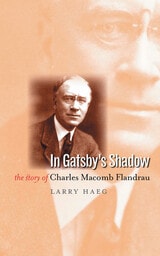
In Gatsby's Shadow
The Story of Charles Macomb FlandrauLarry Haeg
University of Iowa Press, 2004
Flandrau, a model of style and worldly sophistication and destined, almost everyone agreed, for greatness, was among the most talented young writers of his generation. His short stories about Harvard in the 1890s were called “the first realistic description of undergraduate life in American colleges” and sold out of the first printing in a few weeks. From 1899 to 1902 Flandrau was among the most popular contributors to the Saturday Evening Post. Alexander Woollcott rated him the best essayist in America. And Viva Mexico!, Flandrau’s account of life on a Mexican coffee plantation, is a classic, perhaps the best travel book ever written by an American. Yet Flandrau turned his back on it all. Financially independent, he chose a solitary, epicurean life in St. Paul, Mexico, Majorca, Paris, and Normandy. In later years, he confined his writing to local newspaper pieces and letters to his small circle of family and friends.
Using excerpts from these newspaper columns and unpublished letters, Larry Haeg has painstakingly recreated the story of this urbane, talented, witty, lazy, enigmatic, supremely private man who never reached the peak of literary success to which his talent might have taken him.
This very readable biography provides a detailed and honest portrayal of Flandrau and his times. It will fascinate readers interested in writers’ life stories and scholars of American literature as well as general readers interested in midwestern literary history.
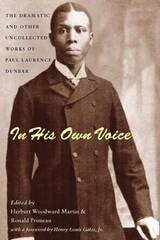
In His Own Voice
The Dramatic and Other Uncollected Works of Paul Laurence DunbarPaul Laurence Dunbar
Ohio University Press, 2002
In Human Scale
Victorian Literature and the Planetary ImaginationBenjamin Morgan
University of Chicago Press, 2027
An innovative account of how literature has helped bridge the gap between ordinary human experience and the vast scale of the natural world.
Is it possible to connect our lived experience of time to the vast eons of the planet’s history? This question has perplexed writers and scientists for more than two hundred years, from Darwin’s account of natural selection through contemporary writing about climate change. Benjamin Morgan’s insightful study shows how literature of the nineteenth century helped readers leap from their everyday sense of time and space to the vast, inhuman scales of the natural world.
Exploring writings that range from Arctic voyage narratives to Thomas Hardy’s novels, utopian fiction of the 1880s, H. G. Wells’s The Time Machine, and beyond, Morgan situates scalar incommensurability in its deeper intellectual and cultural contexts. Victorians struggled to grasp senses of proportion not only through time scales but also through scales of aesthetic magnitude, of relative value, of social totality, and of the planet’s future. Morgan argues that a scale is not just a timeline; it is a way of finding order and proportion through many kinds of comparative measurement. His literary history of scale illuminates both the challenge of imagining the vastness of planetary time and the history of creating a human sense of proportion.

In One Act
Adrienne Kennedy
University of Minnesota Press, 1988
“Since her earliest plays. . . [Adrienne Kennedy] has been creating frightful and seductive theatrical images of her memories and fantasies. Her black, female protagonists enact Kennedy’s nightmares, then make them ours, enveloping the audience in their relentless anger, madness, and fear . . . time and place shift constantly, plot lines are parceled out in bits, and a contextual frame comes clear gradually, like a reflection is stilling waters.”
-Alisa SolomonVillage Voice
In Poe's Wake
Travels in the Graphic and the AtmosphericJonathan Elmer
University of Chicago Press, 2024
You’ll find his face everywhere, from coffee mugs, bobbleheads, and T-shirts to the cover of the Beatles’ Sergeant Pepper’s Lonely Hearts Club Band. Edgar Allan Poe is one of American culture’s most recognizable literary figures, his life and works inspiring countless derivations beyond the literary realm. Poe’s likeness and influence have been found in commercial illustration and kitsch, art installations, films, radio plays, children’s cartoons, and video games. What makes Poe so hugely influential in media other than his own? What do filmmakers, composers, and other artists find in Poe that suits their purposes so often and so variously?
In Poe’s Wake locates the source of the writer’s enduring legacy in two vernacular aesthetic categories: the graphic and the atmospheric. Jonathan Elmer uses Poe to explore these two terms and track some deep patterns in their use, not through theoretical labor but through close encounters with a wide sampling of aesthetic objects that avail themselves of Poe’s work. Poe’s writings are violent and macabre, memorable both for certain grisly images and for certain prevailing moods or atmospheres—dread, creepiness, and mournfulness. Furthermore, a bundle of Poe traits—his thematic emphasis on extreme sensation, his flexible sense of form, his experimental and modular method, and his iconic visage—amount to what could be called a Poe “brand,” one as likely to be found in music videos or comics as in novels and stories. Encompassing René Magritte, Claude Debussy, Lou Reed, Roger Corman, Spongebob Squarepants, and many others, Elmer’s book shows how the Poe brand opens trunk lines to aesthetic experiences fundamental to a multi-media world.
In Praise of Antiheroes
Figures and Themes in Modern European Literature, 1830-1980Victor Brombert
University of Chicago Press, 1999
Though they fail, by design, to live up to conventional expectations of mythic heroes, antiheroes are not necessarily "failures." They display different kinds of courage more in tune with our time and our needs: deficiency translated into strength, failure experienced as honesty, dignity achieved through humiliation. Brombert explores these paradoxes in the works of Büchner, Gogol, Dostoevsky, Flaubert, Svevo, Hašek, Frisch, Camus, and Levi. Coming from diverse cultural and linguistic traditions, these writers all use the figure of the antihero to question handed-down assumptions, to reexamine moral categories, and to raise issues of survival and renewal embodying the spirit of an uneasy age.
In Science's Shadow
Literary Constructions of Late Victorian WomenPatricia Murphy
University of Missouri Press, 2006
The Victorian era was characterized by great scientific curiosity—as exemplified by the publication of Darwin’s Descent of Man—as well as by new questions regarding the place of women in society. Patricia Murphy now explores the tenuous interplay of gender and science to show how the era’s literature both challenged and reinforced a constrictive role for Victorian women. Focusing on a specific body of literature involving women intensely associated with scientific pursuits, and examining selected noncanonical writings—both fictional and nonfictional representations of scientific women—Murphy demonstrates how these works informed the “Woman Question” by reinforcing or rejecting presumed truths about gender and science.

In Search of Admiration and Respect
Chinese Cultural Diplomacy in the United States, 1875–1974Yanqui Zheng
University of Michigan Press, 2024
In Search of Admiration and Respect uses the Chinese case to underscore what Zheng calls “infrastructure of persuasion,” in which American philanthropy, museums, exhibitions, and show business had disproportionate power in setting the agenda of unequal intercultural encounters. This volume also provides historical insights into China’s ongoing quest for international recognition. Drawing upon diverse archival sources, Zheng expands the contours of cultural diplomacy beyond established powers and sheds light on the limited agency of peripheral nations in their self-representation.
In Search of an Alternative Biopolitics
Anti-Bullfighting, Animality, and the Environment in Contemporary SpainKatarzyna Olga Beilin
The Ohio State University Press, 2015
Analyses of the synergy of press debates on bullfighting and the War on Terror, as well as media debates on King Juan Carlos’s hunt in Botswana and his resignation, reveal how the concepts structuring human/animal relations condition national biopolitics. Beilin traces a main principle, where sacrifice of some lives is deemed necessary for the sake of others, from bullfighting, through environmental destruction and immigration policies, to bioeconomy. Ultimately, In Search of an Alternative Biopolitics argues that to address ever-increasing threats of global warming and future catastrophes, we urgently need to redefine concepts structuring the human and the nonhuman realms.

In Search of the Paper Tiger
A Sociological Perspective of Myth, Formula, and the Mystery Genre in the Entertainment Print Mass MediumGary Hoppenstand
University of Wisconsin Press, 1987

In Search of the True Russia
The Provinces in Contemporary Nationalist DiscourseLyudmila Parts
University of Wisconsin Press, 2020
Surveying a largely unexplored body of Russian journalism, literature, and film from the late twentieth and early twenty-first centuries, Parts finds that the harshest portrayals of the provinces arise within "high" culture. Popular culture, however, has increasingly turned from the newly prosperous, multiethnic, and westernized Moscow to celebrate the hinterlands as repositories of national traditions and moral strength. This change, she argues, has directed debate about Russia's identity away from its loss of imperial might and global prestige and toward a hermetic national identity based on the opposition of "us vs. us" rather than "us vs. them." She offers an intriguing analysis of the contemporary debate over what it means to be Russian and where "true" Russians reside.
In Stalin's Time
Middleclass Values in Soviet FictionVera S. Dunham
Duke University Press, 1990
In Time
Poets, Poems, and the RestC. K. Williams
University of Chicago Press, 2012
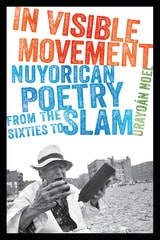
In Visible Movement
Nuyorican Poetry from the Sixties to SlamUrayoan Noel
University of Iowa Press, 2014
The first book-length study specifically devoted to Nuyorican poetry, In Visible Movement is unique in its historical and formal breadth, ranging from the foundational poets of the 1960s and 1970s to a variety of contemporary poets emerging in and around the Nuyorican Poets Cafe “slam” scene of the 1990s and early 2000s. It also unearths a largely unknown corpus of poetry performances, reading over forty years of Nuyorican poetry at the intersection of the printed and performed word, underscoring the poetry’s links to vernacular and Afro-Puerto Rican performance cultures, from the island’s oral poets to the New York sounds and rhythms of Latin boogaloo, salsa, and hip-hop. With depth and insight, Urayoán Noel analyzes various canonical Nuyorican poems by poets such as Pedro Pietri, Victor Hernández Cruz, Miguel Algarín, Miguel Piñero, Sandra María Esteves, and Tato Laviera. He discusses historically overlooked poets such as Lorraine Sutton, innovative poets typically read outside the Nuyorican tradition such as Frank Lima and Edwin Torres, and a younger generation of Nuyorican-identified poets including Willie Perdomo, María Teresa Mariposa Fernández, and Emanuel Xavier, whose work has received only limited critical consideration. The result is a stunning reflection of how New York Puerto Rican poets have addressed the complexity of identity amid diaspora for over forty years.

In a Closet Hidden
The Life and Work of Mary E. Wilkins FreemanLeah Blatt Glasser
University of Massachusetts Press, 1996
The first literary biography of a much-neglected American writer, this book explores the multiple tensions at the core of Mary E. Wilkins Freeman's life and work. A prolific short story writer and novelist, Freeman (1852–1930) developed a reputation as a local colorist who depicted the peculiarities of her native New England. Yet as Leah Blatt Glasser shows, Freeman was one of the first American authors to write extensively about the relationships women form outside of marriage and motherhood, the role of work in women's lives, the complexity of women's sexuality, and the interior lives of women who rebel rather than conform to patriarchal strictures.
In a Closet Hidden traces Freeman's evolution as a writer, showing how her own inner conflicts repeatedly found expression in her art. As Glasser demonstrates, Freeman's work examined the competing claims of creativity and convention, self-fulfillment and self-sacrifice, spinsterhood and marriage, lesbianism and heterosexuality.
In a Maelstrom
The History of Russian-Jewish Prose, 1860–1940Zsuzsa Hetényi
Central European University Press, 2008
In a Persian Mirror
Images of the West and Westerners in Iranian FictionBy M. R. Ghanoonparvar
University of Texas Press, 1993
The extreme anti-Western actions and attitudes of Iranians in the 1980s astonished and dismayed the West, which has characterized the Iranian positions as irrational and inexplicable. In this groundbreaking study of images of the West in Iranian literature, however, M. R. Ghanoonparvar reveals that these attitudes did not develop suddenly or inexplicably but rather evolved over more than two centuries of Persian-Western contact.
Notable among the authors whose works Ghanoonparvar discusses are Sadeq Hedayat, M. A. Jamalzadeh, Hushang Golshiri, Gholamhoseyn Sa'edi, Simin Daneshvar, Moniru Ravanipur, Sadeq Chubak, and Jalal Al-e Ahmad. This survey significantly illuminates the sources of Iranian attitudes toward the West and offers many surprising discoveries for Western readers, not least of which is the fact that Iranians have often found Westerners to be as enigmatic and incomprehensible as we have believed them to be.
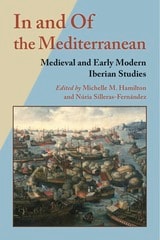
In and Of the Mediterranean
Medieval and Early Modern Iberian StudiesMichelle M. Hamilton
Vanderbilt University Press, 2014

In the Company of Books
Literature and Its "Classes" in Nineteenth-Century AmericaSarah Wadsworth
University of Massachusetts Press, 2006
With sections focusing on segmentation by age, gender, and cultural status, In the Company of Books analyzes the ways authors and publishers carved up the field of literary production into a multitude of distinct submarkets, differentiated their products, and targeted specific groups of readers in order to guide their book-buying decisions. Combining innovative approaches to canonical authors such as Nathaniel Hawthorne, Louisa May Alcott, Mark Twain, and Henry James with engaging investigations into the careers of many lesser-known literary figures, Sarah Wadsworth reveals how American writers responded to—and contributed to—this diverse, and diversified, market.
In the Company of Books contends that specialized editorial and marketing tactics, in concert with the narrative strategies of authors and the reading practices of the book-buying public, transformed the literary landscape, leading to new roles for the book in American culture, the innovation of literary genres, and new relationships between books and readers. Both an exploration of a fragmented print culture through the lens of nineteenth-century American literature and an analysis of nineteenth-century American literature from the perspective of this subdivided marketplace, this wide-ranging study offers fresh insight into the impact of market forces on the development of American literature.

In the Company of Radical Women Writers
Rosemary Hennessy
University of Minnesota Press, 2023
Recovering the bold voices and audacious lives of women who confronted capitalist society’s failures and injustices in the 1930s—a decade unnervingly similar to our own
In the Company of Radical Women Writers rediscovers the political commitments and passionate advocacy of seven writers—Black, Jewish, and white—who as young women turned to communism around the Great Depression and, over decades of national crisis, spoke to issues of labor, land, and love in ways that provide urgent, thought-provoking guidance for today. Rosemary Hennessy spotlights the courageous lives of women who confronted similar challenges to those we still face: exhausting and unfair labor practices, unrelenting racial injustice, and environmental devastation.
As Hennessy brilliantly shows, the documentary journalism and creative and biographical writings of Marvel Cooke, Louise Thompson Patterson, Claudia Jones, Alice Childress, Josephine Herbst, Meridel Le Sueur, and Muriel Rukeyser recognized that life is sustained across a web of dependencies that we each have a duty to maintain. Their work brought into sharp focus the value and dignity of Black women’s domestic work, confronted the destructive myths of land exploitation and white supremacy, and explored ways of knowing attuned to a life-giving erotic energy that spans bodies and relations. In doing so, they also expanded the scope of American communism.
By tracing the attention these seven women pay to “life-making” as the relations supporting survival and wellbeing—from Harlem to the American South and Midwest—In the Company of Radical Women Writers reveals their groundbreaking reconceptions of the political and provides bracing inspiration in the ongoing fight for justice.
In the Face of Adversity
Translating Difference and DissentEdited by Thomas Nolden
University College London, 2023
In the Face of Adversity explores the dynamics of translating texts that articulate particular notions of adverse circumstances. The contributors show how literary records of painful experiences and dissenting voices are at risk of being stripped of their authenticity when not carefully handled by the translator, how cultural moments in which the translation of a text that would have otherwise fallen into oblivion instead gave rise to a translator who enabled its preservation while ultimately coming into their own as an author as a result, and how the difficulties the translator faces in intercultural or transnational constellations in which prejudice plays a role endangers projects meant to facilitate mutual understanding. The authors address translation as a project of making available and preserving a corpus of texts that would otherwise be in danger of becoming censored, misperceived, or ignored. They look at translation and adaptation as a project of curating textual models of personal, communal, or collective perseverance, and they offer insights into the dynamics of cultural inclusion and exclusion through a series of theoretical frameworks, as well as through a set of concrete case studies drawn from different cultural and historical contexts.
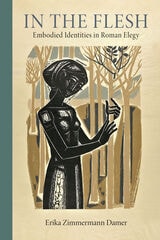
In the Flesh
Embodied Identities in Roman ElegyErika Zimmermann Damer
University of Wisconsin Press, 2022
Recognizing this power of material flesh to shape elegiac poetry, she asserts, grants figures at the margins of this poetic discourse—mistresses, rivals, enslaved characters, overlooked members of households—their own identities, even when they do not speak. She demonstrates how the three poets create a prominent aesthetic of corporeal abjection and imperfection, associating the body as much with blood, wounds, and corporeal disintegration as with elegance, refinement, and sensuality.
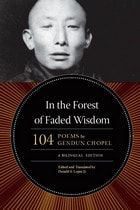
In the Forest of Faded Wisdom
104 Poems by Gendun Chopel, a Bilingual EditionGendun Chopel
University of Chicago Press, 2009
In a culture where poetry is considered the highest form of human language, Gendun Chopel is revered as Tibet’s greatest modern poet. Born in 1903 as British troops were preparing to invade his homeland, Gendun Chopel was identified at any early age as the incarnation of a famous lama and became a Buddhist monk, excelling in the debating courtyards of the great monasteries of Tibet. At the age of thirty-one, he gave up his monk’s vows and set off for India, where he would wander, often alone and impoverished, for over a decade. Returning to Tibet, he was arrested by the government of the young Dalai Lama on trumped-up charges of treason, emerging from prison three years later a broken man. He died in 1951 as troops of the People’s Liberation Army marched into Lhasa.
Throughout his life, from his childhood to his time in prison, Gendun Chopel wrote poetry that conveyed the events of his remarkable life. In the Forest of Faded Wisdom is the first comprehensive collection of his oeuvre in any language, assembling poems in both the original Tibetan and in English translation. A master of many forms of Tibetan verse, Gendun Chopel composed heartfelt hymns to the Buddha, pithy instructions for the practice of the dharma, stirring tributes to the Tibetan warrior-kings, cynical reflections on the ways of the world, and laments of a wanderer, forgotten in a foreign land. These poems exhibit the technical skill—wordplay, puns, the ability to evoke moods of pathos and irony—for which Gendun Chopel was known and reveal the poet to be a consummate craftsman, skilled in both Tibetan and Indian poetics. With a directness and force often at odds with the conventions of belles lettres, this is a poetry that is at once elegant and earthy. In the Forest of Faded Wisdom is a remarkable introduction to Tibet’s sophisticated poetic tradition and its most intriguing twentieth-century writer.

In the Future of Yesterday
A Life of Stefan ZweigRüdiger Görner
Haus Publishing, 2025
In the Future of Yesterday delves into Stefan Zweig’s considerable contribution to world literature, rooted in the Austro-Jewish tradition. His privileged social background saw him embrace European culture and cosmopolitanism. A world traveler from the outset, he liked to uproot himself, but whether he stayed in London, New York, or, eventually, in Brazil, his literary baggage continued to contain the flair of fin de siècle Vienna.
This biography re-examines Zweig’s influential time in England and offers new insights into his final years in the United States and Brazil. It discusses some of his prolific literary output in relation to his life and explores his political views on Europe, Zionism, and the world order in greater depth than previous appraisals of Zweig’s life.
The book also considers the many contradictions in Zweig’s views and attitudes, which included an initial, and surprising, leniency towards fascism. Most importantly, though, In the Future of Yesterday presents Zweig as a towering figure of a form of writing that was bursting with life and that was written in the knowledge that there can only be a future if we remain conscious of the past. In that sense, Zweig is a writer for our time.
In the Master's Eye
Representations of Women, Blacks, and Poor Whites in Antebellum Southern LiteratureSusan J. Tracy
University of Massachusetts Press, 1995
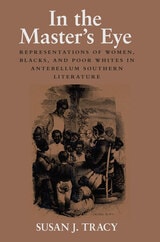
This book explores the way in which literature can be used to reinforce social power. Through rigorous readings of a series of antebellum plantation novels, Susan J. Tracy shows how the narrative strategies employed by proslavery Southern writers served to justify and perpetuate the oppression of women, blacks, and poor whites.
Tracy focuses on the historical romances of six authors: George Tucker, James Ewell Heath, William Alexander Caruthers, John Pendleton Kennedy, Nathaniel Beverley Tucker, and William Gilmore Simms. Using variations on a recurring plot—in which a young planter/hero rescues a planter's daughter from an “enemy” of her class—each of these novelists reinforced an idealized vision of a Southern civilization based on male superiority, white supremacy, and class inequality. It is a world in which white men are represented as the natural leaders of loyal and dependent women, grateful and docile slaves, and inferior poor whites. According to Tracy, the interweaving of these themes reveals the extent to which the Southern defense of slavery in the years leading up to the Civil War was an argument not only about race relations but about gender and class relations as well.
In the Mirror
New and Selected Poems of Wong Phui NamWong Phui Nam
National University of Singapore Press, 2025
The poetry of Wong Phui Nam is foundational to Malaysian literature in English. While his early work is often cited in this regard, this edited collection of his poetry and critical essays makes it clear that his lifelong trajectory as a poet and critic is of deep interest. In the Mirror by Wong Phui Nam is a critical exploration of Malaysia's fractured post-colonial identity and literary landscapes.
Like many of his English-speaking peers at the University of Malaya, by the 1960s, Wong became disillusioned with the stark contradictions of writing in a colonial language while striving to build or maintain a national literary tradition. In 1969, when Malaysia's national cultural policy firmly emphasized the primacy of the Bahasa Malaysian language over English, Wong proclaimed, "I no longer wanted to write, at least not in a language I was told was a colonial leftover."
Over the years, however, he returned to poetry in English, often publishing privately. He came to believe that English was the language “most capable of representing our predicament,” given the spiritual and cultural vacuums left by colonialism's great ruptures in the region, and the ongoing neocolonial structure of the state and economy. His work challenges the reader to confront the realities of cultural displacement and the complexities of a multi-ethnic society grappling with its past and future.
This collection includes both recent works as well as some of his earlier achievements, starting with How the Hills are Distant, and also includes a foreword linking Wong's work with contemporary literary work in the region. An afterword by Wong's contemporary, Singaporean literary pioneer Edwin Thumboo, completes the volume.
In the Name of the Mother
Italian Americans, African Americans, and Modernity from Booker T. Washington to Bruce SpringsteenSamuele F. S. Pardini
Dartmouth College Press, 2017
In the Neighborhood
Women's Publication in Early AmericaCaroline Wigginton
University of Massachusetts Press, 2016
Winner of the 2018 Early American Literature Book Prize
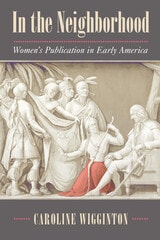
In this compelling and original book, Caroline Wigginton reshapes our understanding of early American literary history. Overturning long-standing connections between the male-dominated print culture of pamphlets, broadsides, and newspapers and the transformative ideas that instigated the American Revolution, Wigginton explores how women's “relational publications”—circulated texts, objects, and performances—transformed their public and intimate worlds. She argues that Native, black, and white women's interpersonal "publications" revolutionized the dynamics of power and connection in public and private spaces, whether those spaces were Quaker meeting houses, Creek talwas, trading posts, burial grounds, or the women's own "neighborhoods."
Informed by deep and rich archival research, Wigginton's case studies explore specific instances of “relational publication.” The book begins with a pairing of examples—the statement a grieving Lenape mother made through a wampum belt and the political affiliations created when a salon hostess shared her poetry. Subsequent chapters trace a history of women's publication practice, including a Creek woman's diplomatic and legal procession-spectacles in the colonial Southeast, a black mother's expression of protest in Newport, Rhode Island, and the resulting evangelical revival, Phillis Wheatley's elegies that refigured neighborhoods of enslaved and free Bostonians, and a Quaker woman's pious and political commonplace book in Revolutionary Philadelphia.
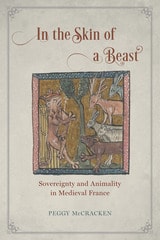
In the Skin of a Beast
Sovereignty and Animality in Medieval FrancePeggy McCracken
University of Chicago Press, 2017
Peggy McCracken discusses a range of literary texts and images from medieval France, including romances in which animal skins appear in symbolic displays of power, fictional explorations of the wolf’s desire for human domestication, and tales of women and snakes converging in a representation of territorial claims and noble status. These works reveal that the qualities traditionally used to define sovereignty—lineage and gender among them—are in fact mobile and contingent. In medieval literary texts, as McCracken demonstrates, human dominion over animals is a disputed model for sovereign relations among people: it justifies exploitation even as it mandates protection and care, and it depends on reiterations of human-animal difference that paradoxically expose the tenuous nature of human exceptionalism.
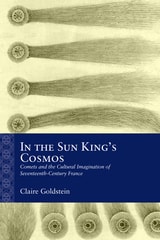
In the Sun King's Cosmos
Comets and the Cultural Imagination of Seventeenth-Century FranceClaire Goldstein
Northwestern University Press, 2025
Offering a new history of a formative cultural and political era through the cosmic phenomena that captured the public’s imagination
In the winters of 1664–65 and 1680–81, the French public was galvanized by two bright comets whose elliptical orbits could not be mapped with contemporary geometry and that thus seemed to appear in random and unpredictable locations. Bookending the period during which Louis XIV’s sun king mythology was created, these comets defied the heliocentric order to which French politics and culture aspired. As Claire Goldstein demonstrates, literary texts, cultural institutions, and architecture inspired by comets offer a different perspective on the relationship between sensory experience, ideology, and artistic form.
In the Sun King’s Cosmos: Comets and the Cultural Imagination of Seventeenth-Century France presents an alternative view of a formative era in cultural and political history, when distinctly modern forms of power and control were established through a regime of the spectacular. Goldstein shows how comets allow us to see the seventeenth century in ways that complicate the narrative of a race toward rationalization, classicism, and modernity, indexing instead a messy period in which the spectacular was sometimes also inscrutable.
In the Thick of the Fight
The Writing of Emily Wilding Davison, Militant SuffragetteCarolyn P. Collette
University of Michigan Press, 2013
One of the most memorable images of the British women’s suffrage movement occurred on June 4, Derby Day, 1913. As the field of horses approached a turning at Epsom, militant suffragette Emily Wilding Davison ducked out from under the railing and ran onto the track, reaching for the bridle of the King’s horse, and was killed in the collision. While her death transformed her into a heroine, it all but erased her identity. To identify what impelled Davison to suffer multiple imprisonments, to experience the torture of force-feedings and the insults of hostile members of the crowds who came to hear her speak, Carolyn P. Collette explores a largely ignored source—the writing to which Davison dedicated so much time and effort during the years from 1908 to 1913. Davison’s writing is an implicit apologia for why she lived the life of a militant suffragette and where she continually revisits and restates the principles that guided her: that woman suffrage was necessary to improve the lives of men, women, and children; that the freedom and justice women sought was sanctioned by God and unjustly withheld by humans whose opposition constituted a tyranny that had to be opposed; and that the evolution of human progress demanded that women become fully equal citizens of their nation in every respect— politically, economically, and culturally.
In the Thick of the Fight makes available for the first time the archive of published and unpublished writings of Emily Wilding Davison. Collette reorients both scholarly and public attention away from a single, defining event to the complexity of Davison’s contributions to modern feminist discourse, giving the reader a sense of the vibrancy and diversity of Davison’s suffrage writings.
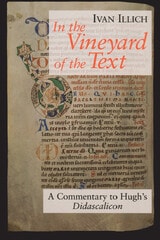
In the Vineyard of the Text
A Commentary to Hugh's DidascaliconIvan Illich
University of Chicago Press, 1993
Examining the Didascalicon of Hugh of St. Victor, Illich celebrates the culture of the book from the twelfth century to the present. Hugh's work, at once an encyclopedia and guide to the art of reading, reveals a twelfth-century revolution as sweeping as that brought about by the invention of the printing press and equal in magnitude only to the changes of the computer age—the transition from reading as a vocal activity done in the monastery to reading as a predominantly silent activity performed by and for individuals.
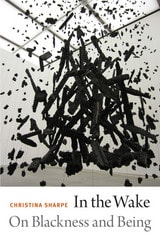
In the Wake
On Blackness and BeingChristina Sharpe
Duke University Press, 2016
In the Work of Their Hands Is Their Prayer
Cultural Narrative and Redemption on the American Frontiers, 1830-1930Joel Daehnke
Ohio University Press, 2003
Westward expansion on the North American continent by European settlers generated a flurry of writings on the frontier experience over the course of a hundred years. Asserting that the dominant ideology of America’s Manifest Destiny embodied a tense, often contradictory union of Christian and secular republican views of social progress, In the Work of Their Hands Is Their Prayer investigates the ambivalence of the frontier as it was inscribed with redemptive, historical significance by a host of frontier writers.
Enlisting canonical and noncanonical sources, Joel Daehnke examines the manner in which the imagery of the human figure at work and play in the frontier landscape participated in the nationalist, “civilizing” project of westward expansion. While he acknowledges the growing secularization of American life, Professor Daehnke surveys the continuing claims of the Christian redemptive scheme as a powerful symbolic domain for these writers’ meditations on social progress and the potential for human perfectibility in the landscapes of the West.
Whether discussing the Edenic imagery of women’s gardens, the advocacy of an ethics of land use, or the affairs of fortune in the mining districts of Nevada, In the Work of Their Hands Is Their Prayer presents an enlightening reexamination of an American ideology of progress and its enduring fascination with mission, Manifest Destiny, and the ends of history.
In the Work of Their Hands Is Their Prayer is a welcome addition to the extended library of critical attention to the ideology, history, and literary traditions of the American frontier.
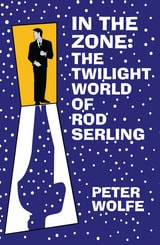
In the Zone
The Twilight World of Rod SerlingPeter Wolfe
University of Wisconsin Press, 1997

Inaugural Wounds
The Shaping of Desire in Five Nineteenth-Century English NarrativesRobert E. Lougy
Ohio University Press, 2004
Desire, Jacques Lacan suggests, is a condition or expression of our wounded nature. But because such desire is also unconscious, it can be expressed only indirectly, for what we consciously desire is hardly ever what we really want. Desire makes itself known, but disguises its presence—appearing, for example, in unconscious but repetitive, and sometimes even self-destructive, patterns of behavior.
Informed by the voices of Freud and Lacan regarding the nature of language and desire, Inaugural Wounds examines the ways in which five major nineteenth-century English writers explored the trajectories and shapes of desire. Arguing that we need to give to novels the same kind of close scrutiny we give to poetry, author Robert Lougy suggests that when we do so, we discover that they often astound us by the resonance and range of their language, as well as by their ability to take us to strange and haunting places.
The five narratives examined—Charles Dickens’s Martin Chuzzlewit, William Thackeray’s Journey from Cornhill to Grand Cairo, Elizabeth Gaskell’s Ruth, Wilkie Collins’s The Woman in White, and Thomas Hardy’s Jude the Obscure—testify to the mysterious origins of desire. Although each of the novels tells its own story in its own way, they share a fascination with the nature of desire itself.
Drawing upon recent work that has challenged historicist approaches toward nineteenth-century British literature, Professor Lougy uses the insights of psychoanalysis to enable us to more fully appreciate the depth and power of these novels. Of great value to Victorian and psychoanalytic scholars, Inaugural Wounds will be useful for teaching undergraduates as well.
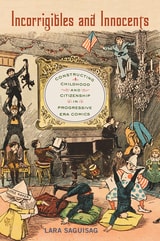
Incorrigibles and Innocents
Constructing Childhood and Citizenship in Progressive Era ComicsSaguisag, Lara
Rutgers University Press, 2019
Histories and criticism of comics note that comic strips published in the Progressive Era were dynamic spaces in which anxieties about race, ethnicity, class, and gender were expressed, perpetuated, and alleviated. The proliferation of comic strip children—white and nonwhite, middle-class and lower class, male and female—suggests that childhood was a subject that fascinated and preoccupied Americans at the turn of the century. Many of these strips, including R.F. Outcault’s Hogan’s Alley and Buster Brown, Rudolph Dirks’s The Katzenjammer Kids and Winsor McCay’s Little Nemo in Slumberland were headlined by child characters. Yet no major study has explored the significance of these verbal-visual representations of childhood. Incorrigibles and Innocents addresses this gap in scholarship, examining the ways childhood was depicted and theorized in late nineteenth- and early twentieth-century comic strips. Drawing from and building on histories and theories of childhood, comics, and Progressive Era conceptualizations of citizenship and nationhood, Lara Saguisag demonstrates that child characters in comic strips expressed and complicated contemporary notions of who had a right to claim membership in a modernizing, expanding nation.
Increase And Multiply
Governing Cultural Reproduction In Early Modern EnglandDavid Glimp
University of Minnesota Press, 2003
A wide-ranging study of the ideology of population control in early modern England
Across the sixteenth and seventeenth centuries, a growing notion of the value of a large populace created a sense of urgency about reproduction; accordingly, a wide array of English writers of the time voiced the need not merely to add more people but also to ensure that England had an abundance of the right kinds of people. This need, in turn, called for a variety of institutions to train—and thus make, through a kind of nonbiological procreation—pious, enterprising, and dutiful subjects. In Increase and Multiply, David Glimp examines previously unexplored links between this emergent demographic mentality and Renaissance literature.
Glimp’s analysis centers on humanist pedagogy as a mechanism for creating people capable of governing both themselves and others. Acknowledging the ways in which authors such as Sidney, Shakespeare, and Milton advance their own work by appealing to this vision, Glimp argues that their texts allow us to read the scope and limits of this generative ideal, its capacity to reinforce order and to become excessive and destabilizing. His work provides unprecedented insight into the role of fantasies of nonbiological reproduction in early modern political theory, government practice, and literary production.
Indecomposable Continuum
Topology and the Arts in JapanSteven C. Ridgely
University of Minnesota Press, 2027
Locating the diffusion of mathematical concepts into modern literature, experimental music, and critical theory in twentieth-century Japan
In Indecomposable Continuum, Steven C. Ridgely explores where theoretical mathematics meets culture in twentieth-century Japan, tracing how concepts from relativity theory and topology migrated into Japanese art and literature. Through readings of avant-garde fiction, experimental sound practices, and postmodern theory, Ridgely demonstrates how topology became a language for rethinking space and perception.
Ridgely focuses on abstract models such as the Klein bottle, non-Euclidean geometry, and the Lakes of Wada to reveal how Japanese artists and intellectuals like Yuasa Jōji, Inagaki Taruho, and Asada Akira transformed difficult mathematical ideas into powerful aesthetic and social imaginaries in surprising and clever ways. Rather than treating mathematics as separate from cultural studies, Ridgely positions topology itself as a cultural form whose abstractions generated new possibilities for artistic creation and theoretical inquiry in music, novels, and popular media.
Indecomposable Continuum demonstrates how Japanese artists made seemingly impossible abstractions accessible and compelling, revealing the unexpected creativity that emerged when modern mathematics entered the cultural sphere. In doing so, the book offers a fresh perspective on the relationship between scientific thought and artistic modernism in Japan.
Retail e-book files for this title are screen-reader friendly with images accompanied by short alt text and/or extended descriptions.
India's Prisoner
A Biography of Edward John Thompson, 1886-1946Mary Lago
University of Missouri Press, 2001
Edward John Thompson—novelist, poet, journalist, and historian of India—was a liberal advocate for Indian culture and political self-determination at a time when Indian affairs were of little general interest in England. As a friend of Nehru, Gandhi, and other Congress Party leaders, Thompson had contacts that many English officials did not have and did not know how to get. Thus, he was an excellent channel for interpreting India to England and England to India.
Thompson first went to India in 1910 as a Methodist missionary to teach English literature at Bankura Wesleyan College. It was there that he cultivated the literary circle of Rabindranath Tagore, as yet little known in England, and there Thompson learned of the political contradictions and deficiencies of India's educational system. His major conflict, personal and professional, was the lingering influence of Victorian Wesleyanism. In 1923, Thompson resigned and returned to teach at Oxford.
Interest in South Asia studies was minimal at Oxford, and Thompson turned increasingly to writing Indian history. That work, and his unique account of his experiences in the Mesopotamian campaign in World War I, supply a viewpoint found nowhere else, as well as personal views of literary figures such as Robert Graves and Robert Bridges. Thompson was also a major influence on the work of his son, E. P. Thompson, a modern historian of eighteenth-century England.
This important biography covers politically significant events between Thompson's arrival in India and up to his death, and casts considerable light on Thompson and his struggles with his religion and his relationship with India. The first biography of E. J. Thompson, "India's Prisoner" will have widespread appeal, especially to those interested in South Asian and English history, literature, and cultural history.
Indian Angles
English Verse in Colonial India from Jones to TagoreMary Ellis Gibson
Ohio University Press, 2011
A 2012 CHOICE “Outstanding Academic Title“
A new historical approach to Indian English literature
Mary Ellis Gibson shows that poetry, not fiction, was the dominant literary genre of Indian writing in English until 1860 and that poetry written in colonial situations can tell us as much or even more about figuration, multilingual literacies, and histories of nationalism than novels can. Gibson re-creates the historical webs of affiliation and resistance that were experienced by writers in colonial India—writers of British, Indian, and mixed ethnicities.
Advancing new theoretical and historical paradigms for reading colonial literatures, Indian Angles makes accessible many writers heretofore neglected or virtually unknown. Gibson recovers texts by British women, by nonelite British men, and by persons who would, in the nineteenth century, have been called Eurasian. Her work traces the mutually constitutive history of English-language poets from Sir William Jones to Toru Dutt and Rabindranath Tagore. Drawing on contemporary postcolonial theory, her work also provides new ways of thinking about British internal colonialism as its results were exported to South Asia.
In lucid and accessible prose, Gibson presents a new theoretical approach to colonial and postcolonial literatures.
Indian Giving
Economies of Power in Indian-White ExchangesDavid Murray
University of Massachusetts Press, 2000

Indian Nation
Native American Literature and Nineteenth-Century NationalismsCheryl Walker
Duke University Press, 1997
Walker examines the rhetoric and writings of nineteenth-century Native Americans, including William Apess, Black Hawk, George Copway, John Rollin Ridge, and Sarah Winnemucca. Demonstrating with unique detail how these authors worked to transform venerable myths and icons of American identity, Indian Nation chronicles Native American participation in the forming of an American nationalism in both published texts and speeches that were delivered throughout the United States. Pottawattomie Chief Simon Pokagon’s "The Red Man’s Rebuke," an important document of Indian oratory, is published here in its entirety for the first time since 1893.
By looking at this writing through the lens of the best theoretical work on nationality, postcoloniality, and the subaltern, Walker creates a new and encompassing picture of the relationship between Native Americans and whites. She shows that, contrary to previous studies, America in the nineteenth century was intercultural in significant ways.
Indian Summer
Musings on the Gift of LifeSam Pickering
University of Missouri Press, 2005
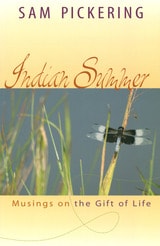
Returning to Nova Scotia every summer contributes to the illusion of smooth continuance, each summer not the first thread in a new fabric but another button on a cardigan, perhaps looser than buttons below but still familiar and comfortable. Every summer the songs of white-throated sparrows bounce from scrub like novelty tunes from the fifties. Early in the morning ravens grind woodenly. . . . No matter how slowly I jog, on the headland butterflies spring from my feet in clumps, first azures and orange crescents, then wood nymphs, and finally over the lowlands near the Beaver River outlet cabbage whites spiraling, dizzy with mating.
Indian Summer is the newest collection of personal essays by Sam Pickering. In typical Pickering fashion, he seeks to capture the gift of living. He brings to the page again his family, students, and a wealth of country characters who live in places that exist only in his imagination and who wander through the stories he tells.
Indians Playing Indian
Multiculturalism and Contemporary Indigenous Art in North AmericaMonika Siebert
University of Alabama Press, 2015
Explores how American Indian artists have responded to the pervasive misunderstanding of indigenous peoples as cultural minorities in the United States and Canada
Contemporary indigenous peoples in North America confront a unique predicament. While they are reclaiming their historic status as sovereign nations, mainstream popular culture continues to depict them as cultural minorities similar to other ethnic Americans. These depictions of indigenous peoples as “Native Americans” complete the broader narrative of America as a refuge to the world’s immigrants and a home to contemporary multicultural democracies, such as the United States and Canada. But they fundamentally misrepresent indigenous peoples, whose American history has been not of immigration but of colonization.
Monika Siebert’s Indians Playing Indian first identifies this phenomenon as multicultural misrecognition, explains its sources in North American colonial history and in the political mandates of multiculturalism, and describes its consequences for contemporary indigenous cultural production. It then explores the responses of indigenous artists who take advantage of the ongoing popular interest in Native American culture and art while offering narratives of the political histories of their nations in order to resist multicultural incorporation.
Each chapter of Indians Playing Indian showcases a different medium of contemporary indigenous art—museum exhibition, cinema, digital fine art, sculpture, multimedia installation, and literary fiction—and explores specific rhetorical strategies artists deploy to forestall multicultural misrecognition and recover political meanings of indigeneity. The sites and artists discussed include the National Museum of the American Indian in Washington, DC; filmmakers at Inuit Isuma Productions; digital artists/photographers Dugan Aguilar, Pamela Shields, and Hulleah Tsinhnahjinnie; sculptor Jimmie Durham; and novelist LeAnne Howe.

Indigeneity in the Mexican Cultural Imagination
Thresholds of BelongingAnalisa Taylor
University of Arizona Press, 2009
The book focuses on representations of indigenous peoples in post-revolutionary literary and intellectual history by examining key cultural texts. Using these analyses as a foundation, Analisa Taylor links her critique to national Indian policy, rights, and recent social movements in Southern Mexico. In addition, she moves beyond her analysis of indigenous peoples in general to take a gendered look at indigenous women ranging from the villainized Malinche to the highly romanticized and sexualized Zapotec women of the Isthmus of Tehuantepec.
The contradictory treatment of the Indian in Mexico’s cultural imagination is not unique to that country alone. Rather, the situation there is representative of a phenomenon seen throughout the world. Though this book addresses indigeneity in Mexico specifically, it has far-reaching implications for the study of indigenaety across Latin America and beyond. Much like the late Edward Said’s Orientalism, this book provides a glimpse at the very real effects of literary and intellectual discourse on those living in the margins of society.
This book’s interdisciplinary approach makes it an essential foundation for research in the fields of anthropology, history, literary critique, sociology, and cultural studies. While the book is ideal for a scholarly audience, the accessible writing and scope of the analysis make it of interest to lay audiences as well. It is a must-read for anyone seeking a deeper understanding of the politics of indigeneity in Mexico and beyond.
Indigenous Journeys, Transatlantic Perspectives
Relational Worlds in Contemporary Native American LiteratureAnna M Brígido-Corachán
Michigan State University Press, 2023

Indigenous Narratives of Territory and Creation
Hemispheric PerspectivesPenelope Kelsey and Leila Gómez, special issue editors
Duke University Press, 2020
Contributors. Amber Meadow Adams, Alexandre Belmonte, Enrique Manuel Bernales Albites, Andrew Cowell, Ella Deloria, Leila Gómez, Sarah Hernandez, Penelope Kelsey, José Antonio Mazzotti, Javier Muñoz-Díaz, Craig Perez, Cheryl Savageau, Ángel Tuninetti, Christopher T. Vecsey
Indigenous Poetics
Inés Hernández-Ávila
Michigan State University Press, 2025
Indiscreet Fantasies
Iberian Queer CinemaAndrés Lema-Hincapié
Bucknell University Press, 2021
Published by Bucknell University Press. Distributed worldwide by Rutgers University Press.