Results by title
4155 books match the query 'State & Local' and 130 start with i

Intimacy Across Borders
Race, Religion, and Migration in the U.S. MidwestJane Juffer
Temple University Press, 2013
Examining how encounters produced by migration lead to intimacies-ranging from sexual, spiritual, and neighborly to hateful and violent, Jane Juffer considers the significant changes that have occurred in small towns following an influx of Latinos to the Midwest.
Intimacy across Borders situates the story of the Dutch Reformed Church in Iowa and South Africa within a larger analysis of race, religion, and globalization. Drawing on personal narrative, ethnography, and sociopolitical critique, Juffer shows how migration to rural areas can disrupt even the most thoroughly entrenched religious beliefs and transform the schools, churches, and businesses that form the heart of small-town America. Conversely, such face-to-face encounters can also generate hatred, as illustrated in the increasing number of hate crimes against Latinos and the passage of numerous anti-immigrant ordinances.
Juffer demonstrates how Latino migration to new areas of the U.S. threatens certain groups because it creates the potential for new kinds of families—mixed race, mixed legal status, and transnational—that challenge the conservative definition of community based on the racially homogeneous, coupled, citizen family.
Into The Wilderness Dream
Donald A Barclay
University of Utah Press, 1994
Not just an exploration of our early Western European roots, these rich chronicles read as literature, first-person narratives of the greatest exploration adventures in historic times.
From the Platonic vision of Atlantis to Arthur’s Avalon, pre-Columbus Europeans imagined fabulous lands to the west—and after 1492, initial reports of a new world filled with golden El Dorados, warrior queens, and Fountains of Youth merely provided confirmation.
Although these dreams were soon tempered by reality, explorers continued to set off with expectation that shaped what they say, how they saw, and how they reacted. This complex of attitudes continues to affect the way we view our world, and these accounts provide an excellent source for insight into the metaphorical systems that have permeated European and American writing about the West since the Sixteenth century.
Into the Wilderness Dreams draws from the best of three dozen accounts by the Spanish, French, English, and American explorers who came before Lewis and Clark, and explores the roots of present Western Euro-American culture.
Inventing Ethan Allen
John J. Duffy and H. Nicholas Muller
University Press of New England, 2014
Inventing the Boston Game
Football, Soccer, and the Origins of a National MythKevin Tallec Marston and Mike Cronin
University of Massachusetts Press, 2024
Honorable Mention, 2025 North American Society for Sport History Book Award
On Boston Common stands a monument dedicated to the Oneida Football Club. It honors the site where, in the 1860s, sixteen boys played what was then called the “Boston game”—an early version of football in the United States. The boys were largely the sons of upper-class Boston Brahmins, and they lived through the transformative periods of the Civil War, Reconstruction, and the Gilded Age. Later as they grew old, in the 1920s, a handful of them orchestrated a series of commemorative events about their boyhood game. Benefitting from elite networks developed through the city’s social and educational institutions, including Harvard University, they donated artifacts (such as an oddly shaped, battered black ball) to museums, deposited self-penned histories into libraries and archives, and erected bronze and stone memorials, all to elevate themselves as the inventors of American football (and later, by extension, soccer). But was this origin story of what, by then, had become one of America’s favorite games as straightforward as they made it seem or a myth-making hoax?
In Inventing the Boston Game, Kevin Tallec Marston and Mike Cronin investigate the history of the Oneida Football Club and reveal what really happened. In a compelling, well told narrative that is informed by sports history, Boston history, and the study of memory, they posit that these men engaged in self-memorialization to reinforce their elite cultural status during a period of tremendous social and economic change, and particularly increased immigration. This exploration of the Club’s history provides fascinating insight into how and why origin stories are created in the first place.
Investment Management in Boston
A HistoryDavid Grayson Allen
University of Massachusetts Press, 2015
Presented here for the first time is the history of Boston's evolution as a center of American money management from early settlement to the twenty-first century. Within a few decades after the Revolution, Bostonians built up an impressive mercantile and industrial economy, and used wealth accrued from the China trade, New England mills, and other ventures to establish the most important stock exchange in America. They also created the “Boston trustee,” a unique professional who managed private fortunes over generations. During the late nineteenth century, Boston financial institutions were renowned as bastions of stability and conservatism in an era of recurrent economic panics and frequent failures.
It was not until the twentieth century that Boston became better known for its role in investment management. In 1924, local financiers created the first mutual fund, an innovation almost a century in the making. After World War II, Boston originated venture capital with the founding of American Research & Development. This was soon followed by the development of private equity, the growth of the mutual fund industry, the pension “revolution” that changed and strengthened money management, the evolution in management of institutional endowments, and the rise of new family offices and hedge funds. The contributions of fiduciaries and investment managers have played an important part in the rise of the “New Boston” and made the city one of the most vibrant financial capitals in the world.
Investment Management in Boston is published in association with Massachusetts Historical Society.
Invisible Hawkeyes
African Americans at the University of Iowa during the Long Civil Rights EraLena M. Hill and Michael D. Hill
University of Iowa Press, 2016
By examining the quieter collisions between Iowa’s polite midwestern progressivism and African American students’ determined ambition, Invisible Hawkeyes focuses attention on both local stories and their national implications. By looking at the University of Iowa and a smaller midwestern college town like Iowa City, this collection reveals how fraught moments of interracial collaboration, meritocratic advancement, and institutional insensitivity deepen our understanding of America’s painful conversion into a diverse republic committed to racial equality.
SUBJECTS COVERED
Edison Holmes Anderson, George Overall Caldwell, Elizabeth Catlett, Fanny Ellison, Oscar Anderson Fuller, Michael Harper, James Alan McPherson, Herbert Franklin Mells, Herbert Nipson, Thomas Pawley, William Oscar Smith, Mitchell Southall, Margaret Walker
CONTRIBUTORS
Dora Martin Berry, Richard M. Breaux, Kathleen A. Edwards, Lois Eichaker, Brian Hallstoos, Lena M. Hill, Michael D. Hill, Dianna Penny, Donald W. Tucker, Ted Wheeler
Invisible Masters
Gender, Race, and the Economy of Service in Early New EnglandElisabeth Ceppi
Dartmouth College Press, 2018
Iowa History Reader
Marvin Bergman
University of Iowa Press, 1996
Marvin Bergman has drawn upon his years of editing the Annals of Iowa to gather contributors who cross disciplines, model the craft of writing a historical essay, cover more than one significant topic, and above all interpret history rather than recite it. In his preface to this new printing, he calls attention to publications that begin to fill the gaps noted in the 1996 edition.
Rather than survey the basic facts, the essayists engage readers in the actual making of Iowa’s history by trying to understand the meaning of its past. By providing comprehensive accounts of topics in Iowa history that embrace the broader historiographical issues in American history, such as the nature of Progressivism and Populism, the debate over whether women’s expanded roles in wartime carried over to postwar periods, and the place of quantification in history, the essayists contribute substantially to debates at the national level at the same time that they interpret Iowa’s distinctive culture.
Iowa Past to Present
The People and the Prairie, Revised Third EditionDorothy Schwieder
University of Iowa Press, 2011
Iowa's Archaeological Past
Lynn M. Alex
University of Iowa Press, 2000
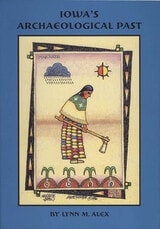
The core of this book—which includes many historic photographs and maps as well as numerous new maps and drawings and a generous selection of color photos—explores in detail what archaeologists have learned from studying the state's material remains and their contexts. Examining the projectile points, potsherds, and patterns that make up the archaeological record, Alex describes the nature of the earliest settlements in Iowa, the development of farming cultures, the role of the environment and environmental change, geomorphology and the burial of sites, interaction among native societies, tribal affiliation of early historic groups, and the arrival and impact of Euro-Americans. In a final chapter, she examines the question of stewardship and the protection of Iowa's many archaeological resources.
Iowa's Forgotten General
Matthew Mark Trumbull and the Civil WarKenneth L. Lyftogt
University of Iowa Press, 2005
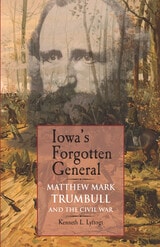
Matthew Mark Trumbull was a Londoner who immigrated at the age of twenty. Within ten years of his arrival in America, he had become a lawyer in Butler County, Iowa; two years later a member of the state legislature; and two years after that a captain in the Union Army. By the end of the Civil War, he was a brevet brigadier general, and in his later years he was an author and lecturer. Kenneth Lyftogt’s biography details the amazing life of this remarkable man, also shedding light on the histories of the Third Iowa Volunteer Infantry and the Ninth Iowa Volunteer Cavalry.

Iowa's Historic Architects
A Biographical DictionaryWesley I. Shank
University of Iowa Press, 1998
Among the prominent Iowa architects of the late nineteenth and early twentieth centuries were a remarkable few who had little training in architecture; their natural talents and their capacity for hard work made up for their lack of experience. Beginning in 1927, however, an Iowa architect had to meet state requirements of experience and training in order to practice. Shank includes an introduction to the history of the profession in Iowa: the development of professional education and training, the founding of professional societies and their roles, the different personalities and talents of the architects, the demography of architectural offices in the state, and the relative importance of Iowa architects both statewide and nationally.

Iowa
The Middle LandDorothy Schwieder
University of Iowa Press, 1996

Irish in Michigan
Seamus P. Metress
Michigan State University Press, 2006
Irish immigration to the United States can be divided into five general periods, from 1640 to the present: the colonial, prestarvation, great starvation, post-starvation, and post- independence periods. Immigration to the Great Lakes region and, more specifically, to Michigan was differentially influenced during each of these times. The oppressive historical roots of the Irish in both Ireland and nineteenth century America are important to understand in gaining an appreciation for their concern with socioeconomic status.
The Irish first entered the Great Lakes by way of the Ohio River and Appalachian passes, spreading north along the expanding frontier. After the War of 1812, the Irish were heavily represented in frontier military garrisons. Many Irish moved into the Detroit metropolitan area as well as to farming areas throughout Michigan. In the 1840s, a number of Irish began fishing in the waters off Beaver Island, Mackinac Island, Bay City, Saginaw, and Alpena. From 1853 to 1854, Irish emigrants from the Great Starvation dug the Ste. Marie Canal while others dug canals in Grand Rapids and Saginaw.
Irish nationalism in both Michigan and the United States has been closely linked with the labor movement in which Irish Americans were among the earliest organizers and leaders. Irish American nationalism forced the Irish regardless of their local Irish origins to assume a larger Irish identity. Irish Americans have a long history of involvement in the struggle for Irish Freedom dating from the 1840s.
As Patrick Ford, editor of Irish World has said, America led the Irish from the "littleness of countyism into a broad feeling of nationalism."

Irish in Wisconsin
David G. Holmes
Wisconsin Historical Society Press, 2004
Irma
A Chicago Woman's Story, 1871-1966Ellen Fitzsimmons Steinberg
University of Iowa Press, 2004
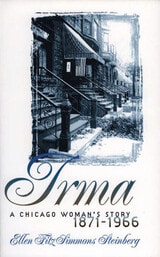
Irma’s journals and diaries were private accounts in which she chronicled the rhythm of her days and the shape of her life. She recorded her thoughts and short quotations from her reading, jotted down her own poems and short stories, constructed dinner-party menus, and wrote biographical sketches of her family. Interspersed among the records of what she did when and with whom are a number of lengthy reflections on Chicago history, her early life, religious beliefs, education, her aspirations, disappointments, sorrows, and successes. She documented her family’s activities during the Chicago Fire, the city’s rebuilding, early educational curricula in the city’s schools, what it was like to participate in the suffrage movement and vote for the first time, the effect of the Great Depression on the middle class, and World War II as seen from her perspective.
In each chapter, Ellen Steinberg has set Irma’s contemporary entries and later memoirs against the context of the Chicago history that Irma knew so well. Irma’s story will fascinate those interested in diaries and autobiography, women’s history, and Chicago history. From a plethora of rich source materials—including over half a million words of Irma’s writings alone—Steinberg has created a seamless, fascinating narrative about a Chicago woman who, although “nobody famous” (in her words), lived a vital life in a vibrant city.
Iron Valley
The Transformation of the Iron Industry in Ohio's Mahoning Valley, 1802–1913Clayton J. Ruminski
The Ohio State University Press, 2017
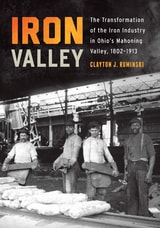
Youngstown, Ohio, and the surrounding Mahoning Valley supplied the iron that helped transform the United States into an industrial powerhouse in the nineteenth century. The story of the Mahoning Valley’s unorthodox rise from mid-scale iron producer to twentieth-century “Steel Valley” is a tale of innovation, stagnation, and, above all, extreme change. Located halfway between Pittsburgh and Cleveland, the Mahoning Valley became a major supplier of pig iron to America’s biggest industrial regions. For much of the nineteenth century, outside consumers relied on the Valley’s pig iron, but this reliance nurtured a reluctance on the part of Youngstown iron companies to diversify or expand their production.
In Iron Valley: The Transformation of the Iron Industry in Ohio’s Mahoning Valley, 1802–1913, Clayton J. Ruminski argues that Youngstown-area iron manufacturers were content to let others in the industry innovate, and only modernized when market conditions forced them to do so. Desperate to find new markets, some Youngstown iron manufacturers eventually looked toward steel and endured a rapid, but successful, industrial transformation that temporarily kept their old enterprises afloat in a rapidly evolving industry. Richly illustrated with rare photographs of Mahoning Valley ironmasters, mills, furnaces, and workers, Iron Valley sheds light on a previously underrepresented and vital region that built industrial America.
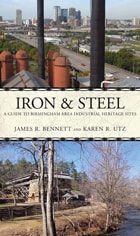
Iron and Steel
A Driving Guide to the Birmingham Area Industrial HeritageJames R. Bennett and Karen R. Utz
University of Alabama Press, 2010
This guidebook of historic iron-production sites is designed to give the reader a factual and illuminating look at the people and events that shaped Birmingham into one of America’s leading steel centers. Iron & Steel is heavily illustrated with both color and historical black-and-white photographs. It can be used while visiting parks or read as a coherent volume before or after a visit.
The book contains chapters devoted to the larger preserved sites open to the public, such as Sloss Furnaces National Historic Landmark and Tannehill Ironworks Historical State Park. It also highlights lesser-known, yet still accessible, sites such as Blocton Coke Ovens Park. The work provides easy-to-follow maps for every site as well as driving directions to the more remote locations, giving visitors easy access to all the notable iron and steel sites in Jefferson, Shelby, Tuscaloosa, and Bibb counties. Each chapter also includes a variety of historical information, with accompanying photographs, in order to present the reader with a detailed and comprehensive account of the Birmingham Iron and Steel District.
Featured sites include: Tannehill Ironworks Historical State Park; Shelby Ironworks Park; Billy Gould Coke Ovens Park; Brierfield Ironworks Historical State Park; Oxmoor Furnace Site; Irondale Furnace Park; Helena Rolling Mill Site; Red Mountain Park, Iron Ore Mines; Lewisburg Coke Ovens Park; Sloss Furnaces National Historic Landmark; Ruffner Mountain Nature Center; Blocton Coke Ovens Park; and Vulcan Park and Museum.
Iroquois Culture History in the Niagara Frontier Area of New York State
Marian E. White
University of Michigan Press, 1961
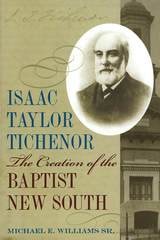
Isaac Taylor Tichenor
The Creation of the Baptist New SouthMichael E. Williams Sr.
University of Alabama Press, 2005
The influential role Tichenor played in shaping both the Baptist denomination and southern culture
Isaac Taylor Tichenor worked as a Confederate chaplain, a mining executive, and as president of the Agricultural and Mechanical College of Alabama (now Auburn University). He also served as corresponding secretary for the Home Mission Board of the Southern Baptist Convention in Atlanta from 1882 until 1899. In these capacities Tichenor developed the New South ideas that were incorporated into every aspect of his work and ultimately influenced many areas of southern life, including business, education, religion, and culture.
In Isaac Taylor Tichenor: The Creation of the Baptist New South, Michael E. Williams Sr. provides a comprehensive analysis of Tichenor’s life, examining the overall impact of his life and work. This volume also documents the methodologies Tichenor used to rally Southern Baptist support around its struggling Home Mission Board, which defined the makeup of the Southern Baptist Convention and defended the territory of the convention.
Tichenor was highly influential in forming a uniquely southern mindset prior to and at the turn of the century. Williams contends that Tichenor’s role in shaping Southern Baptists as they became the largest denomination in the South was crucial in determining their identity both the identities of the region and the SBC.

Island Folk
The People of Isle RoyalePeter Oikarinen
University of Minnesota Press, 2008
The history of a working fishing community comes alive in this collection of stories from the people who made a life on Isle Royale. In Island Folk, candid photographs illuminate the dramatic and sometimes life-and-death experiences of the unique individuals who chose to live in this beautiful and isolated setting.
In this lively and charming book, find out how moose actually make their way to Isle Royale or what amount of food is necessary to survive a winter. Hear about the ships that sank in the tricky waters surrounding the island and the raw beauty of the landscape from those who know it intimately.
Recalled memories, honestly shared, tell a familiar tale of the ongoing transformation of the island from a quiet working fishing village to a national park haven for tourists who travel by boat or seaplane to experience a vanishing way of life.
Peter Oikarinen is a freelance writer and photographer who lives on Lake Superior on Michigan’s Keeweenaw Peninsula. He is the author of Armour: A Lake Superior Fisherman.

It Happened in Southern Illinois
John W. Allen
Southern Illinois University Press, 1968
In this collection of articles describing the people, places, and folkways of southern Illinois, John W. Allen provides entertaining and informative glimpses into the region’s past. Included here are sketches of the early pioneering days when wolves were literally chased from the door, stories about the many Indian artifacts discovered among the rolling hills and valleys of the area, and articles pertaining to the strategic role the region played during the Civil War. Allen also describes the activities of such infamous outlaws as Samuel Mason and the Harpe brothers as well as the famous Illinois-born heroes “Bat” Masterson, “Wild Bill” Hickok, and Wyatt Earp.
In his warm and friendly style, Allen reminisces about the self-sufficient and satisfying rural life of a previous generation with its oxcarts, pie suppers, threshing machines, kerosene lamps, and blacksmith shops. Any reader interested in southern Illinois and its history will delight in this collection of stories from John W. Allen’s popular newspaper column, “It Happened in Southern Illinois.”

It Started with the Hats
The Life Experiences of Boston’s Founding Street Gang MembersPaul F. Joyce, with a foreword by J. Larry Mayes
Southern Illinois University Press, 2024
In the late 1980s, the introduction of crack cocaine and easy access to guns led to the emergence of the street gang culture and an explosion of gun violence in Boston. Black and Latino youth were both perpetrators and victims of firearm violence as the city grappled with a staggering number of shootings and homicides. Officers within the Boston Police Department struggled to find new and creative ways to combat the growing violence and neutralize gang influence. Paul Joyce was one of those officers.
Throughout his extensive career with the Boston Police, Joyce was at the forefront of the Department’s anti-gang and youth violence initiatives, including during the height of gang and gun violence in the late 1980s through early 1990s. Later in his career, after thirty-one years in policing, Joyce transitioned to academia as a criminologist, seeking to better understand the lives of the gang members he had encountered during his time as an officer. He interviewed thirty Black and Latino men who witnessed and led the emergence of the street gang phenomenon in Boston. Joyce’s strong relationship with community leaders led to the recruitment of the men, who ultimately entrusted him with their life stories and their inner worlds. Using the men’s own words to describe the tragedies they endured, the crimes they committed, and the penalties they paid, Joyce now shares their stories of life before, during, and after gang membership.
Joyce examines the influences that motivated the men toward joining gangs, their gang experiences, and the turning points that shaped their paths later in life, whether leading to desistance from or continued persistence in criminal behavior. Joyce explores their lives from childhood into adulthood, providing a deep analysis of the factors that influenced the entire trajectory of gang members’ lives. By utilizing this life-course approach, Joyce adds to the discourse regarding what influences a gang member’s ability or inability to transition out of criminality and the gang life.
This uniquely candid look at gang membership, humanized by the perspectives of the men who experienced it, provides invaluable insight into the complex interplay of the social, cultural, and personal factors that shape individuals’ life courses. This, in turn, has important implications regarding the types of outside interventions that would be the most effective in making a positive difference in the lives of current and former gang members.
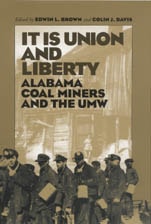
It is Union and Liberty
Alabama Coal Miners, 1898-1998Edwin L. Brown
University of Alabama Press, 1999
One union, many voices—Alabama coal miners and the century-long fight for justice.
Much of Alabama's labor history is written in its coal fields. This book records the critical contribution that District 20 of the United Mine Workers of America played in the state's labor movement through its strong stands on such issues as child labor, public education, and inter-racial unions.
Standing at the cutting edge of social and political history, these essays cover five periods over a century of union activity: the emergence of a militant labor force during mining's formative years; the World War I era, when mine operators tried to divide black and white labor; the increasing role of the state in labor relations during the interwar years; rapid changes in the union between 1942 and 1975; and the 1977-79 strike, the largest in the United Mine Workers' history.
Through historic photographs and depictions of living and working conditions, contributors Edwin L. Brown, Colin J. Davis, Daniel Letwin, Brian M. Kelly, Peter Alexander, Glenn Feldman, and Robert H. Woodrum portray the world that miners, both black and white, made. In a state where racial segregation was the norm,even the earliest District 20 contract proposals demanded equal pay for equal work regardless of color. It Is Union and Liberty shows that the UMW in Alabama stands apart from perceptions of southern trade unionism as exclusionary and racially fragmented. It sheds light on an important segment of the state's labor history and is a testament to District 20 on its centennial celebration.
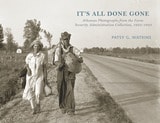
It's All Done Gone
Arkansas Photographs from the Farm Security Administration Collection, 1935-1943Patsy Watkins
University of Arkansas Press, 2018
Of the roughly one thousand FSA photographs taken in Arkansas, approximately two hundred have been selected for inclusion in this volume. Portraying workers picking cotton for five cents an hour, families evicted from homes for their connection with the Southern Tenant Farmers Union, and the effects of flood and drought that cruelly exacerbated the impact of economic disaster, these remarkable black-and-white images from Ben Shahn, Arthur Rothstein, Dorothea Lange, Walker Evans, Russell Lee, and other acclaimed photographers illustrate the extreme hardships that so many Arkansans endured throughout this era.
These powerful photographs continue to resonate, providing a glimpse of life in Arkansas that will captivate readers as they connect to a shared past.

It's Official!
The Real Stories behind Arkansas’s State SymbolsDavid Ware
Butler Center for Arkansas Studies, 2015
Italian Immigration in the American West
1870-1940Kenneth Scambray
University of Nevada Press, 2021
The lives of immigrants in the West differed greatly from those of their counterparts on the East Coast in many ways. The development of the West—with its cheap land and mining, forestry, and agriculture industries\--created a demand for labor that enabled newcomers to achieve stability and success. Moreover, female immigrants had many more opportunities to contribute materially to their family’s well-being, either by overseeing new revenue streams for their farms and small businesses, or as paid workers outside the home.
Despite this success, Italian immigrants in the West could not escape the era’s xenophobia. Scambray also discusses the ways that Italians, perceived by many as non-White, interacted with other Euro-Americans, other immigrant groups, and Native Americans and African Americans.
By placing the Italian immigrant experience within the context of other immigrant narratives, Italian Immigration in the American West provides rich insights into the lives and contributions of individuals and families who sought to build new lives in the West. This unique study reveals the impact of Italian immigration and the immense diversity of the immigrant experience outside the East’s urban centers.
Italians in Michigan
Russell M. Magnaghi
Michigan State University Press, 2001
For more than 350 years, Italian immigrants have played important roles in the opening and development of the land that is now Michigan, from their participation in the French fur trade up to the present day. Through an emphasis on the family as the essential institution in ethnic group success, Russell M. Magnaghi celebrates the accomplishments of Michigan's famous and not-so-famous Italian sons and daughters as he documents their struggles and achievements. Through the tenacity and hard work of the immigrants and their descendants, Italians in Michigan have progressed from unskilled laborers to some of the highest positions in business, politics, culture, and education.
Ivy and Industry
Business and the Making of the American University, 1880-1980Christopher Newfield
Duke University Press, 2003
Newfield views management as neither inherently good nor bad, but rather as a challenge to and tool for negotiating modern life. In Ivy and Industry he integrates business and managerial philosophies from Taylorism through Tom Peters’s “culture of excellence” with the speeches and writings of leading university administrators and federal and state education and science policies. He discusses the financial dependence on industry and government that was established in the university’s early years and the equal influence of liberal arts traditions on faculty and administrators. He describes the arrival of a managerial ethos on campus well before World War II, showing how managerial strategies shaped even fields seemingly isolated from commerce, like literary studies. Demonstrating that business and the humanities have each had a far stronger impact on higher education in the United States than is commonly thought, Ivy and Industry is the dramatic story of how universities have approached their dual mission of expanding the mind of the individual while stimulating economic growth.
I’ll Tell You a Tale
An AnthologyBy J. Frank Dobie
University of Texas Press, 1981
I'll Tell You a Tale is a garland of some of Frank Dobie's best writing, put together by Isabel Gaddis, one of his former students at the University of Texas. The tales included are those the author himself liked best, and he even rewrote some of them especially for this anthology. Ben Carlton Mead has contributed 32 original line drawings to illustrate the stories.
These tales spring from the soil and folklore of our land; but more than this, they make the readers contemporary with the times, filling us with the wonder of something past and yet still with us. They are arranged topically into sections whose titles speak for them: "The Longhorn Breed," "Mustangs and Mustangers," "The Saga of the Saddle," "Characters and Happenings of Long Ago," "Animals of the Wild," "In Realms of Gold," and "Ironies."