Results by title
4030 books match the query 'Language Arts & Disciplines' and 223 start with i
International Journal of American Linguistics, volume 88 number 4 (October 2022)
The University of Chicago Press
University of Chicago Press Journals, 2022
International Journal of American Linguistics, volume 88 number S1 (April 2022)
The University of Chicago Press
University of Chicago Press Journals, 2022
International Journal of American Linguistics, volume 89 number 1 (January 2023)
The University of Chicago Press
University of Chicago Press Journals, 2023
International Journal of American Linguistics, volume 89 number 2 (April 2023)
The University of Chicago Press
University of Chicago Press Journals, 2023
International Journal of American Linguistics, volume 89 number 3 (July 2023)
The University of Chicago Press
University of Chicago Press Journals, 2023
International Journal of American Linguistics, volume 89 number 4 (October 2023)
The University of Chicago Press
University of Chicago Press Journals, 2023
International Journal of American Linguistics, volume 90 number 1 (January 2024)
The University of Chicago Press
University of Chicago Press Journals, 2024
International Journal of American Linguistics, volume 90 number 2 (April 2024)
The University of Chicago Press
University of Chicago Press Journals, 2024
International Journal of American Linguistics, volume 90 number 3 (July 2024)
The University of Chicago Press
University of Chicago Press Journals, 2024
International Journal of American Linguistics, volume 90 number 4 (October 2024)
The University of Chicago Press
University of Chicago Press Journals, 2024
International Journal of American Linguistics, volume 90 number S1 (April 2024)
The University of Chicago Press
University of Chicago Press Journals, 2024
International Journal of American Linguistics, volume 91 number 1 (January 2025)
The University of Chicago Press
University of Chicago Press Journals, 2025
International Journal of American Linguistics, volume 91 number 2 (April 2025)
The University of Chicago Press
University of Chicago Press Journals, 2025
International Journal of American Linguistics, volume 91 number 3 (July 2025)
The University of Chicago Press
University of Chicago Press Journals, 2025
International Journal of American Linguistics, volume 91 number 4 (October 2025)
The University of Chicago Press
University of Chicago Press Journals, 2025
International Journal of American Linguistics, volume 91 number S1 (April 2025)
The University of Chicago Press
University of Chicago Press Journals, 2025
International Journal of American Linguistics, volume 92 number 1 (January 2026)
The University of Chicago Press
University of Chicago Press Journals, 2026
International Journal of American Linguistics, volume 92 number 2 (April 2026)
The University of Chicago Press
University of Chicago Press Journals, 2026
International Journal of American Linguistics, volume 92 number 3 (July 2026)
The University of Chicago Press
University of Chicago Press Journals, 2026
International Journal of American Linguistics, volume 92 number 4 (October 2026)
The University of Chicago Press
University of Chicago Press Journals, 2026
International Journal of American Linguistics, volume 92 number S1 (April 2026)
The University of Chicago Press
University of Chicago Press Journals, 2026
International Perspectives on Sign Language Interpreter Education
Jemina Napier
Gallaudet University Press, 2009
The Fourth Volume in the Interpreter Education Series
From the moment the World Association of Sign Language Interpreters (WASLI) was established in 2005, an overwhelming wave of requests from around the world arrived seeking information and resources for educating and training interpreters. This new collection provides those answers with an international overview on interpreter training from experts in Austria, Australia, Brazil, Canada, Fiji, Finland, Ireland, Japan, Kenya, Kosovo, the Netherlands, New Zealand, Scotland, Sweden, and the United States. Whether from income-rich or income-poor countries, the 31 contributors presented here provide insights on how sign language interpreter training has developed in each nation, and also how trainers have dealt with the difficulties that they encountered.
Many of the contributors relate the movement away from ad hoc short courses sponsored by Deaf communities. They mark the transition from the early struggles of trainers against the stigmatization of sign languages to full-time degree programs in institutions of higher education funded by their governments. Others investigate how culture, religion, politics, and legislation affect the nurturing of professional sign language interpreters, and they address the challenges of extending training opportunities nationally through the use of new technology. Together, these diverse perspectives offer a deeper understanding and comparison of interpreter training issues that could benefit the programs in every nation.
International Perspectives on Sign Language Translator and Interpreter Education
Jemina Napier
Gallaudet University Press, 2024
Each chapter, authored collaboratively by deaf and hearing educators, surveys general interpreter education and training, examines the status of the profession for both deaf and hearing practitioners, and addresses specific challenges faced within the different national frameworks. Contributors also discuss ongoing and future trends, including the impact of the Covid-19 pandemic on educational practices.
This volume disseminates extensive knowledge on sign language translator and interpreter education, covering established programs as well as ad hoc training, and highlighting effective teaching pedagogies and structured classroom strategies. Contributors emphasize a holistic approach to the field, integrating SLTI education, the current profession, future practitioners, and deaf communities. Although the state of the field varies widely around the world depending on the national context, this volume reveals a shared goal of advancing professional standards and improving the provision of service to deaf people worldwide.
International Sign
Linguistic, Usage, and Status IssuesRachel Rosenstock
Gallaudet University Press, 2015
Editors Rachel Rosenstock and Jemina Napier have assembled an international group of renowned linguists and interpreters to examine various aspects of International Sign. Their contributions are divided into three parts: International Sign as a Linguistic System; International Sign in Action—Interpreting, Translation, and Teaching; and International Sign Policy and Language Planning. The chapters cover a range of topics, including the morphosyntactic and discursive structures of interpreted IS, the interplay between conventional linguistic elements and nonconventional gestural elements in IS discourse, how deaf signers who use different signed languages establish communication, Deaf/hearing IS interpreting teams and how they sign depicting verbs, how best to teach foundation-level IS skills, strategies used by IS interpreters when interpreting from IS into English, and explorations of the best ways to prepare interpreters for international events.
The work of the editors and contributors in this volume makes International Sign the most comprehensive, research-based analysis of a young but growing field in linguistics and interpretation.

International Students And Academic Libraries Initiatives
Pamela Jackson
Assoc of College & Research Libraries, 2011
International Students and Academic Libraries
Initiatives for SuccessPamela A. Jackson
Assoc of College & Research Libraries, 2011
International Students in First-Year Writing
A Journey Through Socio-Academic SpaceMegan M. Siczek
University of Michigan Press, 2018
This study raises questions about how to support international students:
- In what ways can it inform our practices and policies relative to the internationalization of education and the development of global perspectives and competencies?
- What does it reveal that could impact daily instruction of L2 writing, particularly when it comes to international students’ need to meet the expectations of “university-level writing” in U.S. institutions of higher education?
- On an individual level, what can we learn from these students and about ourselves as a result of our interactions?
Internationalization of US Writing Programs
Shirley K Rose
Utah State University Press, 2018
The Internationalization of US Writing Programs illuminates the role writing programs and WPAs play in defining goals, curriculum, placement, assessment, faculty development, and instruction for international student populations. The volume offers multiple theoretical approaches to the work of writing programs and illustrates a wide range of well-planned writing program–based empirical research projects.
As of 2016, over 425,000 international students were enrolled as undergraduates in US colleges and universities, part of a decade-long trend of increasing numbers of international students coming to the United States for both undergraduate and graduate degrees. Writing program administrators and writing teachers across the country are beginning to recognize this changing demographic as a useful catalyst for change in writing programs, which are tasked with preparing all students, regardless of initial level of English proficiency, for academic and professional writing.
The Internationalization of US Writing Programs is the first collection to focus specifically on this crucial aspect of the roles and responsibilities of WPAs, who are leading efforts to provide all students on their campuses, regardless of nationality or first language, with competencies in writing that will serve them in the academy and beyond.
Contributors: Jonathan Benda, Michael Dedek, Christiane Donahue, Chris W. Gallagher, Kristi Girdharry, Tarez Samra Graban, Jennifer E. Haan, Paula Harrington, Yu-Kyung Kang, Neal Lerner, David S. Martins, Paul Kei Matsuda, Heidi A. McKee, Libby Miles, Susan Miller-Cochran, Matt Noonan, Katherine Daily O’Meara, Carolina Pelaez-Morales, Stacey Sheriff, Gail Shuck, Christine M. Tardy, Stanley Van Horn, Daniel Wilber, Margaret Willard-Traub
Interpreter Education in the Digital Age
Innovation, Access, and ChangeSuzanne Ehrlich
Gallaudet University Press, 2015
Initiatives described in this collection range from the implementation of on-demand interpreting using iPad technology to create personalized, small-group, multidimensional models suited to digital media for 160 languages; introducing students to interpreting in a 3D world through an IVY virtual environment; applying gaming principles to interpreter education; assessing the amenability of the digital pen in the hybrid mode of interpreting; developing multimedia content for both open access and structured interpreter education environments; to preparing interpreting students for interactions in social media forums, and more. Interpreter Education in the Digital Age provides a context for the application of technologies in interpreter education from an international viewpoint across languages and modalities.
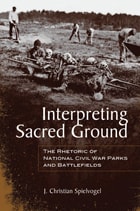
Interpreting Sacred Ground
The Rhetoric of National Civil War Parks and BattlefieldsJ. Christian Spielvogel
University of Alabama Press, 2013
A rhetorical analysis of Civil War battlefields and parks, and the ways various commemorative traditions—and their ideologies of race, reconciliation, emancipation, and masculinity—compete for dominance.
The National Park Service (NPS) is known for its role in the preservation of public sites deemed to have historic, cultural, and natural significance. In Interpreting Sacred Ground, J. Christian Spielvogel studies the NPS’s secondary role as an interpreter or creator of meaning at such sites, specifically Gettysburg National Military Park, Harpers Ferry National Historical Park, and Cold Harbor Visitor Center.
Spielvogel studies in detail the museums, films, publications, tours, signage, and other media at these sites, and he studies and analyzes how they shape the meanings that visitors are invited to construct. Though the NPS began developing interpretive exhibits in the 1990s that highlighted slavery and emancipation as central facets to understanding the war, Spielvogel argues that the NPS in some instances preserves outmoded narratives of white reconciliation and heroic masculinity, obscuring the race-related causes and consequences of the war as well as the war’s savagery.
The challenges the NPS faces in addressing these issues are many, from avoiding unbalanced criticism of either the Union or the Confederacy, to foregrounding race and violence as central issues, preserving clear and accurate renderingsof battlefield movements and strategies, and contending with the various public constituencies with their own interpretive stakes in the battle for public memory.
Spielvogel concludes by arguing for the National Park Service’s crucial role as a critical voice in shaping twentieth-first-century Civil War public memory and highlights the issues the agency faces as it strives to maintain historical integrity while contending with antiquated renderings of the past.
Interpreting in Legal Settings
Debra Russell
Gallaudet University Press, 2009
The work of interpreters in legal settings, whether they are spoken or signed language interpreters, is filled with enormous complexity and challenges. This engrossing volume presents six, data-based studies from both signed and spoken language interpreter researchers on a diverse range of topics, theoretical underpinnings, and research methodologies.
In the first chapter, Ruth Morris analyzes the 1987 trial of Ivan (John) Demjanjuk in Jerusalem, and reveals that what might appear to be ethical breaches often were no more than courtroom dynamics, such as noise and overlapping conversation. Waltraud Kolb and Franz Pöchhacker studied 14 asylum appeals in Austria and found that interpreters frequently aligned themselves with the adjudicators. Bente Jacobsen presents a case study of a Danish-English interpreter whose discourse practices expose her attempts to maintain, mitigate, or enhance face among the participants.
In the fourth chapter, Jemina Napier and David Spencer investigate the effectiveness of interpreting in an Australian courtroom to determine if deaf citizens should participate as jurors. Debra Russell analyzed the effectiveness of preparing sign language interpreter teams for trials in Canada and found mixed results. The final chapter presents Zubaidah Ibrahim-Bell’s research on the inadequate legal services in Malaysia due to the fact that only seven sign interpreters are available. Taken together, these studies point to a “coming of age” of the field of legal interpreting as a research discipline, making Interpreting in Legal Settings an invaluable, one-of-a-kind acquisition.
Interpreting in Multilingual, Multicultural Contexts
Rachel Locker McKee
Gallaudet University Press, 2010
The Seventh Volume in the Studies in Interpretation Series
Nineteen international authorities contribute their research and findings to Interpreting in Multilingual, Multicultural Contexts, probing the complex nature of interpreted interaction involving Deaf and hearing people of diverse linguistic and cultural backgrounds. They also analyze the contextualized interpreting practices and considerations that transpire from this diversity.
In three parts, this trenchant collection shows how Deaf and hearing people use language in fluctuating ways to connect with each other. The chapters in Part 1 — Expanding Frontiers: ASL-English-Spanish Interpreting in the United States — consider sign language interpreting at the border between Baja California and the state; trilingual video relay service (VRS) interpreting; and constructing a valid, reliable trilingual interpreting testing instrument. Part 2 — Mediating Indigenous Voices — explores how to construct roles in a Maori Deaf trilingual context; considerations for interpreting signed languages of American Indian Communities; and interpreting for indigenous Deaf clients in far north Queensland, Australia.
In the final section, Part 3 — Globalizing: Interpreting in International Contexts — protocols for interpreting in multilingual international conferences are analyzed. The last chapter describes the arduousness of sign language interpreting in multilingual, international settings. It acts as a fitting conclusion to this examination of the challenges to the sociolinguistic repertoire of interpreters mediating across multiplex combinations of culture and language.
Interpreting in the Zone
How the Conscious and Unconscious Function in InterpretationJack Hoza
Gallaudet University Press, 2016
Jack Hoza’s newest research examines the components that enable interpreters to perform successfully, looking at literature in interpretation, cognitive science, education, psychology, and neuroscience, as well as reviewing the results of two qualitative studies he conducted. He seeks to uncover what it means to interpret in the zone by understanding exactly how the brain works in interpretation scenarios. He explores a range of dichotomies that influence interpretation outcomes, such as:
- Intuition vs. rational thought
- Left brain vs. right brain
- Explicit vs. implicit learning
- Novice vs. master
- Spoken vs. signed languages
- Emotion vs. reasoning
Interpreting in the Zone shows that cognitive research can help us better understand the intricacies of the interpreting process and has implications for how to approach the interpreting task. This resource will be of value to both the interpreter-in-training as well as the seasoned practitioner.
Interrogating Gendered Pathologies
Erin A. Clark
Utah State University Press, 2020
These chapters engage common narratives about the ways in which gender in healthcare is secondary and highlights the stories of people who have battled to prioritize their own bodies through extraordinary difficulties. Employing a multiplicity of voices, the book represents a number of different perspectives on what it might look like to return health and medical data to embodied experience, to consider the effects of gendered and intersectional biomedical norms on lived realities, and to subvert the power of institutions in ways that move us toward biomedical justice.
This collection contributes to the burgeoning field of health and medical rhetorics by rhetorically and theoretically intervening in what are often seen as objective and neutral decisions related to the body and to scientific and medical data about bodies. Interrogating Gendered Pathologies will be of interest to feminist scholars in the field of rhetoric and writing studies, specifically those in the rhetorics of health and medicine, as well as scholars of technical communication, feminist studies, gender studies, technoscience studies, and bioethics.
Contributors: Leslie Anglesey, Mary Assad, Beth Boser, Lillian Campbell, Marleah Dean, Lori Beth De Hertogh, Leandra Hernandez, Elizabeth Horn-Walker, Caitlin Leach, Jordan Liz, Miriam Mara, Cathryn Molloy, Kerri Morris, Maria Novotny, Sage Perdue, Colleen Reilly
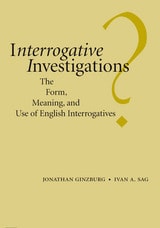
Interrogative Investigations
The Form, Meaning, and Use of English InterrogativesJonathan Ginzburg and Ivan A. Sag
CSLI, 2001
This book closes the gap in research on this subject. By developing the frameworks of Head Driven Phrase Structure Grammar and Situation Semantics, the authors provide an account that rigorously integrates syntactic, semantic, and contextual dimensions of interrogatives. The challenge of providing exhaustive coverage of the interrogative constructions of English, including various constructions that occur solely in dialogue interaction, leads to new insights about a variety of contentious theoretical issues. These include matters of semantic ontology, the quantificational status of wh-phrases, the semantic effect of wh-fronting, the status of constructions in grammatical theory, the integration of illocutionary information in the grammar, and the nature of ellipsis resolution in dialogue. The account is stated with sufficient rigor to enable fairly direct computational implementation.
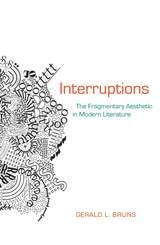
Interruptions
The Fragmentary Aesthetic in Modern LiteratureGerald L. Bruns
University of Alabama Press, 2018
A history of fragmentary—or interrupted—writing in avant-garde poetry and prose by a renowned literary critic.
In Interruptions: The Fragmentary Aesthetic in Modern Literature, Gerald L. Bruns explores the effects of parataxis, or fragmentary writing as a device in modern literature. Bruns focuses on texts that refuse to follow the traditional logic of sequential narrative. He explores numerous examples of self-interrupting composition, starting with Friedrich Schlegel's inaugural theory and practice of the fragment as an assertion of the autonomy of words, and their freedom from rule-governed hierarchies.
Bruns opens the book with a short history of the fragment as a distinctive feature of literary modernism in works from Gertrude Stein to Paul Celan to present-day authors. The study progresses to the later work of Maurice Blanchot and Samuel Beckett, and argues, controversially, that Blanchot's writings on the fragment during the 1950s and early 1960s helped to inspire Beckett’s turn toward paratactic prose.
The study also extends to works of poetry, examining the radically paratactic arrangements of two contemporary British poets, J. H. Prynne and John Wilkinson, focusing chiefly on their most recent, and arguably most abstruse, works. Bruns also offers a close study of the poetry and poetics of Charles Bernstein.
Interruptions concludes with two chapters about James Joyce. First, Bruns tackles the language of Finnegans Wake, namely the break-up of words themselves, its reassembly into puns, neologisms, nonsense, and even random strings of letters. Second, Bruns highlights the experience of mirrors in Joyce’s fiction, particularly in Dubliners, Portrait of the Artist as a Young Man, and Ulysses, where mirrored reflections invariably serve as interruptions, discontinuities, or metaphorical displacements and proliferations of self-identity.

Intersectional Activism in Environmental Communication
Changemakers Respond to Ecological CrisesEmma Frances Bloomfield
Michigan State University Press, 2025

Intertextuality and the 24-Hour News Cycle
A Day in the Rhetorical Life of Colin Powell's U.N. AddressJohn Oddo
Michigan State University Press, 2014
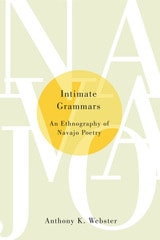
Intimate Grammars
An Ethnography of Navajo PoetryAnthony K. Webster
University of Arizona Press, 2015
Intimate Grammars takes an ethnographic and ethnopoetic approach to language and culture in contemporary time, in which poetry and poets are increasingly important and visible in the Navajo Nation. Webster uses interviews and linguistic analysis to understand the kinds of social work that Navajo poets engage in through their poetry.
Based on more than a decade of ethnographic and linguistic research, Webster’s book explores a variety of topics: the emotional value assigned to various languages spoken on the Navajo Nation through poetry (Navajo English, Navlish, Navajo, and English), why Navajo poets write about the “ugliness” of the Navajo Nation, and the way contemporary Navajo poetry connects young Navajos to the Navajo language. Webster also discusses how contemporary Navajo poetry challenges the creeping standardization of written Navajo and how boarding school experiences influence how Navajo poets write poetry and how Navajo readers appreciate contemporary Navajo poetry.
Through the work of poets such as Luci Tapahonso, Laura Tohe, Rex Lee Jim, Gloria Emerson, Blackhorse Mitchell, Esther Belin, Sherwin Bitsui, and many others, Webster provides new ways of thinking about contemporary Navajo poets and poetry. Intimate Grammars offers an exciting new ethnography of speaking, ethnopoetics, and discourse-centered examinations of language and culture.
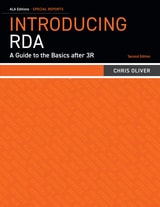
Introducing RDA
A Guide To The Basics After 3RChris Oliver
American Library Association, 2021
Since Oliver’s guide was first published in 2010, thousands of LIS students, records managers, and catalogers and other library professionals have relied on its clear, plainspoken explanation of RDA: Resource Description and Access as their first step towards becoming acquainted with the cataloging standard. Now, reflecting the changes to RDA after the completion of the 3R Project, Oliver brings her Special Report up to date. This essential primer
- concisely explains what RDA is, its basic features, and the main factors in its development;
- describes RDA’s relationship to the international standards and models that continue to influence its evolution;
- provides an overview of the latest developments, focusing on the impact of the 3R Project, the results of aligning RDA with IFLA’s Library Reference Model (LRM), and the outcomes of internationalization;
- illustrates how information is organized in the post 3R Toolkit and explains how to navigate through this new structure; and
- discusses how RDA continues to enable improved resource discovery both in traditional and new applications, including the linked data environment.

Introducing RDA
A Guide to the BasicsChris Oliver
American Library Association, 2010
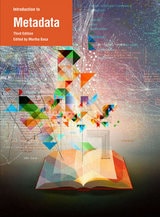
Introduction to Metadata
Third EditionMurtha Baca
J. Paul Getty Trust, The, 2016
The third edition of Introduction to Metadata, first published in 1998, provides an overview of metadata, including its types, roles, and characteristics; a discussion of metadata as it relates to Web resources; and a description of methods, tools, standards, and protocols for publishing and disseminating digital collections. This revised edition is an indispensable resource in the field, addressing advances in standards such as Linked Open Data, changes in intellectual property law, and new computing technologies, and offering an expanded glossary of essential terms.
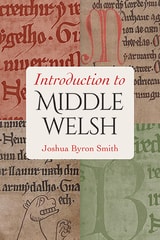
Introduction to Middle Welsh
Joshua Byron Smith
Catholic University of America Press, 2026

Introduction to Natural Language Semantics
Henriëtte de Swart
CSLI, 1998
This text examines what issues semantics, as a theory of meaning, should address; determining what the meanings of words of the language are and how to semantically combine elements of a language to build up complex meanings. Logical languages are then developed as formal metalanguages to natural language. Subsequent chapters address propositional logic, the syntax and semantics of (first-order) predicate logic as an extension of propositional logic, and Generalized Quantifier theory. Going beyond extensional theory, Henri'tte de Swart relativizes the interpretation of expressions to times to account for verbal tense, time adverbials and temporal connectives and introduces possible worlds to model intensions, modal adverbs and modal auxiliaries.
This broad overview of natural language semantics should cover most of the points addressed in an introductory course. Numerous exercises punctuate each chapter and an example exam based on the materials presented is included, making this volume a perfect textbook and resource for any undergraduate or graduate-level introductory course in semantics.

Introduction to Old Javanese Language and Literature
A Kawi Prose AnthologyMary S. Zurbuchen
University of Michigan Press, 1976
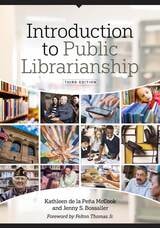
Introduction to Public Librarianship
Kathleen de la Peña McCook
American Library Association, 2018
Put simply, there is no text about public librarianship more rigorous or comprehensive than McCook's survey. Now, the REFORMA Lifetime Achievement Award-winning author has teamed up with noted public library scholar and advocate Bossaller to update and expand her work to incorporate the field's renewed emphasis on outcomes and transformation. This "essential tool" (Library Journal) remains the definitive handbook on this branch of the profession. It covers every aspect of the public library, from its earliest history through its current incarnation on the cutting edge of the information environment, including
- statistics, standards, planning, evaluations, and results;
- legal issues, funding, and politics;
- organization, administration, and staffing;
- all aspects of library technology, from structure and infrastructure to websites and makerspaces;
- adult services, youth services, and children's services;
- associations, state library agencies, and other professional organizations;
- global perspectives on public libraries; and
- advocacy, outreach, and human rights.
Exhaustively researched and expansive in its scope, this benchmark text continues to serve both LIS students and working professionals.
Introduction to Public Librarianship
Kathleen de la Peña McCook
American Library Association, 2011
Introduction to Public Librarianship
American Library Association, 2004
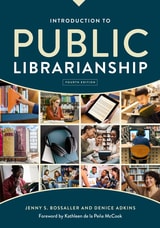
Introduction to Public Librarianship, Fourth Edition
Jenny S. Bossaller and Denice Adkins; Foreword by Kathleen de la Peña McCook
American Library Association, 2024
Dubbed "a peerless ambassador for public libraries, educating future professionals, current professionals in other parts of the field, and anyone else interested about the irreplaceable and irrepressible entities that are public libraries” (Library Quarterly), the newest edition of this trusted resource has been reimagined and restructured to make it even more relevant and useful. The definitive handbook on this branch of the profession, it covers every aspect of the public library, from its earliest history through its current incarnation on the cutting edge of the information environment, including
- a summary of current and historical issues in public libraries;
- a new chapter on financing which covers traditional sources, creative funding, capital campaigns, special projects, and the pros and cons of public/private partnerships;
- statistics, standards, planning, evaluations, and results;
- legal issues and politics, including how different states are set up, the role of state libraries, defining service population, and when the law and values conflict (such as union/non-union scenarios);
- updated coverage of important advocacy issues, including advocacy for access, the legal limits of advocacy, involving the community in advocacy, and communicating the effectiveness of the public library to stakeholders;
- organization, administration, and staffing, from the differences between small libraries and large systems to current issues like non-MLIS library workers and unionization;
- learning about who public libraries serve by utilizing community analysis, community needs assessments, and diversity considerations;
- adult services, youth services, children's services, and serving special populations such as older adults, adults with special needs, schools, daycares, and the incarcerated;
- library technology, from structure and infrastructure to websites and makerspaces;
- issues related to library buildings and master plans, such as gathering community input and working with an architect on library spaces and library services outside of the library;
- library associations, state library agencies, and other professional organizations;
- disaster planning and recovery from technological, ecological, and biological disasters; and
- global perspectives on public libraries.
Introduction to Reference Sources in Health Science
American Library Association, 2008