Results by title
22279 books match the query 'Social Science' and 851 start with i
Immigrant Identity and the Politics of Citizenship
A Collection of Articles from the Journal of American Ethnic HistoryJohn J Bukowczyk
University of Illinois Press, 2016

Immigrant Minds, American Identities
Making the United States Home, 1870-1930Orm Overland
University of Illinois Press, 2000
Devised by middle-class ethnic leaders and spread through ethnic media, banquets, and rallies, homemaking myths uncovered a role for immigrants in the nation's founding, a place of honor in the nation's wars, and traces of American democratic political ideology in the immigrants' ethnic past. These stories proclaim that immigrants, in the person of their ancestors, disembarked from Christopher Columbus's ships, fought for victory over the Axis, and brought American values of freedom and democracy from their native lands. By virtue of their ethnic group's contributions, these myths maintain, non-Anglo European immigrants came to America not as foreigners but as ready-made ideal citizens of the Republic.
Øverland shows that the plots and themes of homemaking myths share so many characteristics that they must be considered an American phenomenon rather than one peculiar to an individual ethnic group. As a symbol of the immigrant's insider status, these stories have played a crucial role in forming American ethnic identities and in carving out a place for immigrants in an Anglo-dominated society.
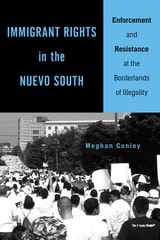
Immigrant Rights in the Nuevo South
Enforcement and Resistance at the Borderlands of IllegalityMeghan Conley
Temple University Press, 2020
Every day, undocumented immigrants are rendered vulnerable through policies and practices that illegalize them. Moreover, they are socially constructed into dangerous criminals and taxpayer burdens who are undeserving of rights, dignity, and respect. Meghan Conley’s timely book, Immigrant Rights in the Nuevo South, seeks to expose and challenge these dehumanizing ideas and practices byexamining the connections between repression and resistance for unauthorized immigrants in communities across the American Southeast.
Conley uses on-the-ground interviews to describe fear and resistance from the perspective of those most affected by it. She shows how, for example, the Illegal Immigration Reform and Enforcement Act in Georgia prompted marches and an action that became “a day of non-compliance.” Likewise, an “enforcement lottery” that created unpredictable threats of arrest and deportation in the region mobilized immigrants to organize and demonstrate. However, as immigrant rights activists mobilize in opposition to the criminalization of undocumented people, they may unintentionally embrace stories of who deserves to be in the United States and who does not. Immigrant Rights in the Nuevo South explores these paradoxes while offering keen observations about the nature and power of Latinx resistance.
Immigrant Voices
New Lives in America, 1773-2000Edited by Thomas Dublin
University of Illinois Press, 2014
A classroom staple, Immigrant Voices: New Lives in America, 1773-2000 has been updated with writings that reflect trends in immigration to the United States through the turn of the twenty-first century. New chapters include a selection of letters from Irish immigrants fleeing the famine of the 1840s, writings from an immigrant who escaped the civil war in Liberia during the 1980s, and letters that crossed the U.S.-Mexico border during the late 1980s and early '90s. With each addition editor Thomas Dublin has kept to his original goals, which was to show the commonalities of the U.S. immigrant experience across lines of gender, nation of origin, race, and even time.
Immigrant Women Workers in the Neoliberal Age
Edited by Nilda Flores-Gonzalez, Anna Romina Guevarra, Maura Toro-Morn, and Grace Chang
University of Illinois Press, 2013
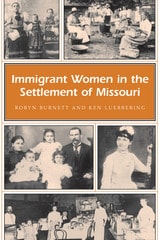
Immigrant Women in the Settlement of Missouri
Robyn Burnett & Ken Luebbering
University of Missouri Press, 2005
Because it examines the lives of women from many social classes and ethnic backgrounds, Immigrant Women in the Settlement of Missouri does much to explain the rich cultural diversity Missouri enjoys today. The photographs and narratives relating to Czech, French, German, Hungarian, Irish, Italian, and Polish life will remind descendants of immigrants that many customs and traditions they grew up practicing have roots in their home countries and will also promote understanding of the customs of other cultures. In addition to the ethnic and class differences that affected these women’s lives, the book also notes the impact of the various eras in which they lived, their education, the circumstances of their migrations, and their destinations across Missouri.
With their engaging and straightforward narrative, Burnett and Luebbering take the reader chronologically through the history of the state from the colonial period to the Civil War and industrialization. Like all Missouri Heritage Readers, this one is presented in an accessible format with abundant illustrations, and it is sure to please both general readers and those engaged in immigrant and women’s studies.

Immigrants Raising Citizens
Undocumented Parents and Their ChildrenHirokazu Yoshikawa
Russell Sage Foundation, 2011
Immigrants against the State
Yiddish and Italian Anarchism in AmericaKenyon Zimmer
University of Illinois Press, 2015
Zimmer focuses on Italians and Eastern European Jews in San Francisco, New York City, and Paterson, New Jersey. Tracing the movement's changing fortunes from the pre–World War I era through the Spanish Civil War, Zimmer argues that anarchists, opposed to both American and Old World nationalism, severed all attachments to their nations of origin but also resisted assimilation into their host society. Their radical cosmopolitan outlook and identity instead embraced diversity and extended solidarity across national, ethnic, and racial divides. Though ultimately unable to withstand the onslaught of Americanism and other nationalisms, the anarchist movement nonetheless provided a shining example of a transnational collective identity delinked from the nation-state and racial hierarchies.
Immigrants and Boomers
Forging a New Social Contract for the Future of AmericaDowell Myers
Russell Sage Foundation, 2007
Immigrants and Welfare
The Impact of Welfare Reform on America's NewcomersMichael E. Fix
Russell Sage Foundation, 2009
Immigrants in the Far West
Historical Identities and ExperiencesJessie L. Embry
University of Utah Press, 2014
Immigrants in the Valley
Irish, Germans, and Americans in the Upper Mississippi Country, 1830-1860Mark Wyman
Southern Illinois University Press, 1984
Immigrants, Evangelicals, and Politics in an Era of Demographic Change
Janelle S. Wong
Russell Sage Foundation, 2018
Asian Americans and Latinos currently constitute 13 percent of evangelicals, and their churches are among the largest, fastest growing organizations in their communities. While evangelical identity is associated with conservative politics, Wong draws from national surveys and interviews to show that non-white evangelicals express political attitudes that are significantly less conservative than those of their white counterparts. Black, Asian American, and Latino evangelicals are much more likely to support policies such as expanded immigration rights, increased taxation of the wealthy, and government interventions to slow climate change. As Wong argues, non-white evangelicals’ experiences as members of racial or ethnic minority groups often lead them to adopt more progressive political views compared to their white counterparts.
However, despite their growth in numbers, non-white evangelicals—particularly Asian Americans and Latinos—are concentrated outside of swing states, have lower levels of political participation than white evangelicals, and are less likely to be targeted by political campaigns. As a result, white evangelicals dominate the evangelical policy agenda and are overrepresented at the polls. Also, many white evangelicals have adopted even more conservative political views in response to rapid demographic change, perceiving, for example, that discrimination against Christians now rivals discrimination against racial and ethnic minorities.
Wong demonstrates that immigrant evangelicals are neither “natural” Republicans nor “natural” Democrats. By examining the changing demographics of the evangelical movement, Immigrants, Evangelicals, and Politics in an Era of Demographic Change sheds light on an understudied constituency that has yet to find its political home.

Immigration Law and the U.S.–Mexico Border
¿Sí se puede?Kevin R. Johnson and Bernard Trujillo
University of Arizona Press, 2011
In clear, reasonable prose, Johnson and Trujillo explore the long history of discrimination against US citizens of Mexican ancestry in the United States and the current movement against “illegal aliens”—persons depicted as not deserving fair treatment by US law. The authors argue that the United States has a special relationship with Mexico by virtue of sharing a 2,000-mile border and a “land-grab of epic proportions” when the United States “acquired” nearly two-thirds of Mexican territory between 1836 and 1853.
The authors explain US immigration law and policy in its many aspects—including the migration of labor, the place of state and local regulation over immigration, and the contributions of Mexican immigrants to the US economy. Their objective is to help thinking citizens on both sides of the border to sort through an issue with a long, emotional history that will undoubtedly continue to inflame politics until cooler, and better-informed, heads can prevail. The authors conclude by outlining possibilities for the future, sketching a possible movement to promote social justice. Great for use by students of immigration law, border studies, and Latino studies, this book will also be of interest to anyone wondering about the general state of immigration law as it pertains to our most troublesome border.
Immigration Research for a New Century
Multidisciplinary PerspectivesNancy Foner
Russell Sage Foundation, 2000

Immigration and American History
Essays in Honor of Theodore C. BlegenHenry Steele Commager, Editor
University of Minnesota Press, 1961
Immigration and American History was first published in 1961. Minnesota Archive Editions uses digital technology to make long-unavailable books once again accessible, and are published unaltered from the original University of Minnesota Press editions.
Ten scholars noted for their studies in immigration history contribute essays to this volume. Dr. Commager surveys the course of immigration studies over the years. Oscar Handlin reappraises the role of immigration in American life. Ingrid Semmingsen, Norwegian historian, writes on the image of American in Europe. Philip D. Jordan focuses on the immigrant's view of America. John T. Flanagan discusses the immigrant in fiction. Carlton C. Qualey contributes two essays. In the first he surveys world population movements and in the second he suggests new source materials for immigration studies. Henry A. Pochmann discusses the migration of ideas—what ideas have come into America, from where, and to what end? Franklin D. Scott inquires into the value of immigration studies of nationality groups. The Reverend Colman J. Barry explores possibilities for future immigration studies. Theodore C. Blegen takes a backward glance and a forward look at immigration studies.
The volume is based on the papers given at a conference held at the University of Minnesota in honor of Dr. Blegen on his retirement from the university.
Immigration and Opportuntity
Race, Ethnicity, and Employment in the United StatesFrank D. Bean
Russell Sage Foundation, 1999
Immigration and the Law
Race, Citizenship, and Social ControlEdited by Sofía Espinoza Álvarez and Martin Guevara Urbina
University of Arizona Press, 2018
In today’s highly charged atmosphere, Immigration and the Law gives readers a grounded and broad overview of U.S. immigration law in a single book. Encompassing issues such as shifting demographics, a changing criminal justice system, and volatile political climate, the book is critically significant for academic, political, legal, and social arenas.
The contributors offer sound evidence to expose the historical legacy of violence, brutality, manipulation, oppression, marginalization, prejudice, discrimination, power, and control. Demystifying the ways that current ideas of ethnicity, race, gender, and class govern immigration and uphold the functioning and legitimacy of the criminal justice system, Immigration and the Law presents a variety of studies and perspectives that offer a pathway toward addressing long-neglected but vital topics in the discourse on immigration and the law.
Contributors
Sofía Espinoza Álvarez
Steven W. Bender
Leo R. Chávez
Arnoldo De León
Daniel Justino Delgado
Roxanne Lynn Doty
Brenda I. Gill
Ruth Gomberg-Muñoz
Peter Laufer
Lupe S. Salinas
Mary C. Sengstock
Martin Guevara Urbina
Claudio G. Vera Sánchez
Immigration and the Politics of American Sovereignty, 1890-1990
Cheryl Shanks
University of Michigan Press, 2001
Immigration and the Remaking of Black America
Tod G. Hamilton
Russell Sage Foundation, 2019
Honorable Mention for the 2020 Thomas and Znaniecki Award from the International Migration Section of the American Sociological Association
Over the last four decades, immigration from the Caribbean and sub-Saharan Africa to the U. S. has increased rapidly. In several states, African immigrants are now major drivers of growth in the black population. While social scientists and commentators have noted that these black immigrants’ social and economic outcomes often differ from those of their native-born counterparts, few studies have carefully analyzed the mechanisms that produce these disparities. In Immigration and the Remaking of Black America, sociologist and demographer Tod Hamilton shows how immigration is reshaping black America. He weaves together interdisciplinary scholarship with new data to enhance our understanding of the causes of socioeconomic stratification among both the native-born and newcomers.
Hamilton demonstrates that immigration from the Caribbean and sub-Saharan Africa is driven by selective migration, meaning that newcomers from these countries tend to have higher educational attainment than those who stay behind. As a result, they arrive in the U.S. with some advantages over native-born blacks, and, in some cases, over whites. He also shows the importance of historical context: prior to the Civil Rights Movement, black immigrants’ socioeconomic outcomes resembled native-born blacks’ much more closely, regardless of their educational attainment in their country of origin. Today, however, certain groups of black immigrants have better outcomes than native-born black Americans—such as lower unemployment rates and higher rates of homeownership—in part because they immigrated at a time of expanding opportunities for minorities and women in general. Hamilton further finds that rates of marriage and labor force participation among native-born blacks that move away from their birth states resemble those of many black immigrants, suggesting that some disparities within the black population stem from processes associated with migration, rather than from nativity alone.
Hamilton argues that failing to account for this diversity among the black population can lead to incorrect estimates of the social progress made by black Americans and the persistence of racism and discrimination. He calls for future research on racial inequality to disaggregate different black populations. By richly detailing the changing nature of black America, Immigration and the Remaking of Black America helps scholars and policymakers to better understand the complexity of racial disparities in the twenty-first century.
Immigration, Diversity, and Broadcasting in the United States 1990—2001
Vibert C. Cambridge
Ohio University Press, 2004
Immigration, Poverty, and Socioeconomic Inequality
David Card
Russell Sage Foundation, 2013

Impasse of the Angels
Scenes from a Moroccan Space of MemoryStefania Pandolfo
University of Chicago Press, 1997
Impasse of the Angels explores what it means to be a subject in the historical and poetic imagination of a southern Moroccan society. Passionate and lyrical, ironic and tragic, the book listens to dissonant, often idiosyncratic voices—poetic texts, legends, social spaces, folktales, conversations—which elaborate in their own ways the fractures, wounds, and contradictions of the Maghribî postcolonial present. Moving from concrete details in a traditional ethnographic sense to a creative, experiential literary style, Impasse of the Angels is a tale of life and death compellingly addressing readers from anthropology, literature, philosophy, postcolonial criticism, and Middle Eastern studies.
Imperial Affects
Sensational Melodrama and the Attractions of American CinemaEagle, Jonna
Rutgers University Press, 2017

Imperial Blues
Geographies of Race and Sex in Jazz Age New YorkFiona I. B. Ngô
Duke University Press, 2013
Imperial Brotherhood
Gender and the Making of Cold War Foreign PolicyRobert D. Dean
University of Massachusetts Press, 2001
This provocative book begins with a question about the Vietnam War. How is it, asks Robert D. Dean, that American policymakers—men who prided themselves on “hardheaded pragmatism” and shunned “fuzzy idealism”—could have committed the nation to such a ruinous, costly, and protracted war? The answer, he argues, lies not simply in the imperatives of anticommunist ideology or in any reasonable calculation of national interest. At least as decisive in determining the form and content of American Cold War foreign policy were the common background and shared values of its makers, especially their deeply ingrained sense of upper-class masculinity.
Dean begins by examining the institutions that shaped the members of the U.S. foreign policy establishment—all-male prep schools, Ivy League universities, collegiate secret societies, and exclusive men's clubs—that instilled stoic ideals of competition, duty, and loyalty. Service in elite military units during World War II further reinforced this pattern of socialization, eventually creating an “imperial brotherhood” imbued with a common global vision. More than that, according to Dean, the commitment to tough-minded masculinity shared by these men encouraged the pursuit of policies that were aggressively interventionist abroad and intolerant of dissent at home.
Applying his gendered analysis to the McCarthy era, Dean reveals how the purge of suspected homosexuals in the State Department not only paralleled the repression of the political left, but also reflected a bitter contest for power between the foreign policy elite and provincial Congressional conservatives. He then shows how issues of manliness similarly influenced the politics and policies of the Kennedy and Johnson administrations. Just as programs like the Peace Corps were grounded in ideals of masculine heroism, decisions about intervention in Vietnam were inextricably bound up with ideas about male strength and power. In the end, Dean makes a persuasive case that these elite constructions of male identity fundamentally shaped the course of American foreign policy during the early decades of the Cold War.

Imperial Creatures
Humans and Other Animals in Colonial Singapore, 1819-1942Timothy P. Barnard
National University of Singapore Press, 2019
Through a multidisciplinary consideration of fauna, Imperial Creatures weaves together a series of tales to document how animals were cherished, monitored, employed, and slaughtered in a colonial society. All animals, including humans, Barnard shows, have been creatures of imperialism in Singapore. Their stories teach us lessons about the structures that upheld such a society and how it developed over time, lessons of relevance to animal historians, to historians of Singapore, and to urban historians and imperial historians with an interest in environmental themes.
Imperial Debris
On Ruins and RuinationAnn Laura Stoler, ed.
Duke University Press, 2013
Contributors. Ariella Azoulay, John F. Collins, Sharad Chari, E. Valentine Daniel, Gastón Gordillo, Greg Grandin, Nancy Rose Hunt, Joseph Masco, Vyjayanthi Venuturupalli Rao, Ann Laura Stoler
Imperial Entanglements of Policing
Julian Go and Stuart Schrader
Duke University Press, 2026

Imperial Imaginings
The Dean C. Worcester Photographic Collection of the PhilippinesCarla M Sinopoli
University of Michigan Press, 2021
Imperial Peripheries in the Neo-Assyrian Period
Craig W. Tyson
University Press of Colorado, 2018
An international team of archaeologists and historians draws upon both new and existing evidence from excavations, surveys, texts, and material culture to highlight the strategies that the Neo-Assyrian Empire applied to manage its diverse and widespread empire as well as the mixed reception of those strategies by subjects close to and far from the center. Case studies from around the ancient Near East illustrate a remarkable variety of responses to Assyrian aggression, economic policies, and cultural influences. As a whole, the volume demonstrates both the destructive and constructive roles of empire, including unintended effects of imperialism on socioeconomic and cultural change.
Imperial Peripheries in the Neo-Assyrian Period aligns with the recent movement in imperial studies to replace global, top-down materialist models with theories of contingency, local agency, and bottom-up processes. Such approaches bring to the foreground the reality that the development and lifecycles of empires in general, and the Neo-Assyrian Empire in particular, cannot be completely explained by the activities of the core. The book will be welcomed by archaeologists of the Ancient Near East, Assyriologists, and scholars concerned with empires and imperial power in history.
Contributors: Stephanie H. Brown, Anna Cannavò, Megan Cifarelli, Erin Darby, Bleda S. Düring, Avraham Faust, Guido Guarducci, Bradley J. Parker
Imperial Policing
Weaponized Data in Carceral ChicagoAndy Clarno
University of Minnesota Press, 2024
Exposing the carceral webs and weaponized data that shape Chicago’s police wars
Chicago is a city with extreme concentrations of racialized poverty and inequity, one that relies on an extensive network of repressive agencies to police the poor and suppress struggles for social justice. Imperial Policing examines the role of local law enforcement, federal immigration authorities, and national security agencies in upholding the city’s highly unequal social order.
Collaboratively authored by the Policing in Chicago Research Group, Imperial Policing was developed in dialogue with movements on the front lines of struggles against racist policing in Black, Latinx, and Arab/Muslim communities. It analyzes the connections between three police “wars”—on crime, terror, and immigrants—focusing on the weaponization of data and the coordination between local and national agencies to suppress communities of color and undermine social movements. Topics include high-tech, data-based tools of policing; the racialized archetypes that ground the police wars; the manufacturing of criminals and terrorists; the subversion of sanctuary city protections; and abolitionist responses to policing, such as the Erase the Database campaign.
Police networks and infrastructure are notoriously impenetrable to community members and scholars, making Imperial Policing a rare, vital example of scholars working directly with community organizations to map police networks and intervene in policing practices. Engaging in a methodology designed to provide support for transformative justice organizations, the Policing in Chicago Research Group offers a critical perspective on the abolition of imperial policing, both in Chicago and around the globe.
Imperial Texas
An Interpretive Essay in Cultural GeographyBy D. W. Meinig
University of Texas Press, 1969
Imperial Texas examines the development of Texas as a human region, from the simple outline of the Spanish colony to the complex patterns of the modern state. In this study in cultural geography set into a historical framework, D. W. Meinig discusses the "various peoples of Texas, who they are, where they came from, where they settled, and how they are proportioned one to another from place to place." After examining the historical framework, he then presents detailed analyses of the major regions of modem Texas and an over-all characterization of the state and its people. He concludes that, although Texas has never been the empire that it has sometimes been called, "nevertheless... Texas is something more than just one-fourteenth of the American area, one-twentieth of the American people, and one-fiftieth of the American union."
Imperial Transformations in Sixteenth-Century Yucay, Peru
Transcribed and edited by R. Alan Covey and Donato Amado González
University of Michigan Press, 2008
Imperial White
Race, Diaspora, and the British EmpireRadhika Mohanram
University of Minnesota Press, 2007
Radhika Mohanram shows not just how British imperial culture shaped the colonies, but how the imperial rule of colonies shifted—and gave new meanings to—what it meant to be British.
Imperial White looks at literary, social, and cultural texts on the racialization of the British body and investigates British whiteness in the colonies to address such questions as: How was the whiteness in Britishness constructed by the presence of Empire? How was whiteness incorporated into the idea of masculinity? Does heterosexuality have a color? And does domestic race differ from colonial race? In addition to these inquiries on the issues of race, class, and sexuality, Mohanram effectively applies the methods of whiteness studies to British imperial material culture to critically racialize the relationship between the metropole and the peripheral colonies.
Considering whether whiteness, like theory, can travel, Mohanram also provides a new perspective on white diaspora, a phenomenon of the nineteenth century that has been largely absent in diaspora studies, ultimately rereading—and rethinking—British imperial whiteness.
Radhika Mohanram teaches postcolonial cultural studies in the School of English, Communication and Philosophy at Cardiff University, Wales. She is the author of Black Body: Women, Colonialism, Space (Minnesota, 1999) and edits the journal Social Semiotics.
Imperialist Imagination
German Colonialism and Its LegacySara Friedrichsmeyer, Sara Lennox, and Susanne Zantop, Editors
University of Michigan Press, 1998
Impermanence
Exploring Continuous Change across CulturesEdited by Haidy Geismar, Ton Otto, and Cameron David Warner
University College London, 2022
Nothing lasts forever. This common experience can be the source of much anxiety, but also of hope. The concept of impermanence or continuous change opens up a range of timely questions and discussions that speak to globally shared experiences of transformation and concerns for the future. Impermanence engages with an emergent body of social theory that emphasizes flux and transformation and brings it into a dialogue with other traditions of thought and practice, such as Buddhism, that have sustained a long-lasting and sophisticated meditation on impermanence.
In cases drawn from all over the world, this volume investigates the significance of impermanence in such diverse contexts as social death, atheism, alcoholism, migration, ritual, fashion, oncology, museums, cultural heritage, and art. The authors draw on a wide range of disciplines, including anthropology, archaeology, art history, Buddhist studies, cultural geography, and museology. This volume also includes numerous photographs, artworks, and poems that evocatively communicate notions and experiences of impermanence.
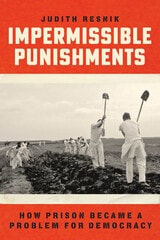
Impermissible Punishments
How Prison Became a Problem for DemocracyJudith Resnik
University of Chicago Press, 2025
An original transatlantic history of the invention of the corrections profession and of ensuing debates about punishment’s purposes and prisoners’ rights.
Impermissible Punishments explores the history of punishment inside prisons and how governments grappled with obligations to justify the punishments they impose. Legal scholar Judith Resnik charts the creation of the corrections profession and weaves together the stories of people who made rules for prisons and the stories of those living under the resulting regimes.
Resnik maps three centuries of shifting ideas, norms, and legal standards aiming to draw lines between permissible and impermissible punishments. Her account documents the impact of World War II, the United Nations, the US Civil Rights movement, and the pioneering prisoners who insisted that law should protect their individual dignity. Taking us to the present, Resnik analyzes the expansion of imprisonment, the inability of public and private prisons to provide safe housing, and the impact of abolition politics.
Exploring the interdependency of people in and out of prisons, Impermissible Punishments examines what governments committed to equality owe to the people they detain and argues that many contemporary forms of punishment need to end.
Implementing Inequality
The Invisible Labor of International DevelopmentRebecca Warne Peters
Rutgers University Press, 2020

Importing Care, Faithful Service
Filipino and Indian American Nurses at a Veterans HospitalStephen M. Cherry
Rutgers University Press, 2022
Imports and Immigrants
Near Eastern Contacts with Iron Age CreteGail L. Hoffman
University of Michigan Press, 1998
Drawing together all the evidence and arguments for Near Eastern immigrants in Crete, Hoffman demonstrates there are basic problems with the accepted interpretations. Evidence of continued technical expertise casts doubt on the necessity of reintroduction, while careful scrutiny of the evidence supporting immigrant craftsmen reveals many inadequacies in the currently accepted analyses.
Imports and Immigrants identifies the need for reassessing all dimensions of the question of artistic relationships between ancient Greece and other regions of the Aegean basin and suggests new avenues of inquiry in this important debate. The volume also reassesses arguments made for the presence of Near Eastern immigrants in Crete. This book includes a catalogue indispensable for future work on these issues and illustrations of most of the known imports to Crete.
Gail L. Hoffman is Associate Professor of Greek Art and Archaeology, Department of Classics, Yale University.
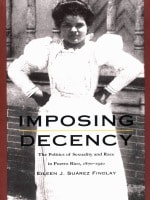
Imposing Decency
The Politics of Sexuality and Race in Puerto Rico, 1870–1920Eileen J. Suárez Findlay
Duke University Press, 2000
In showing how political projects and alliances in Puerto Rico were affected by racially contingent definitions of “decency” and “disreputability,” Findlay argues that attempts at moral reform and the state’s repression of “sexually dangerous” women were weapons used in batttles between elite and popular, American and Puerto Rican, and black and white. Based on a thorough analysis of popular and elite discourses found in both literature and official archives, Findlay contends that racialized sexual norms and practices were consistently a central component in the construction of social and political orders. The campaigns she analyzes include an attempt at moral reform by elite male liberals and a movement designed to enhance the family and cleanse urban space that ultimately translated into repression against symbollically darkened prostitutes. Findlay also explores how U.S. officials strove to construct a new colonial order by legalizing divorce and how feminist, labor, and Afro-Puerto Rican political demands escalated after World War I, often focusing on the rehabilitation and defense of prostitutes.
Imposing Decency forces us to rethink previous interpretations of political chronologies as well as reigning conceptualizations of both liberalism and the early working-class in Puerto Rico. Her work will appeal to scholars with an interest in Puerto Rican or Latin American studies, sexuality and national identity, women in Latin America, and general women’s studies.
Impossible Citizens
Dubai's Indian DiasporaNeha Vora
Duke University Press, 2013
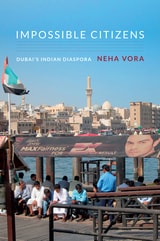
While their legal status defines them as perpetual outsiders, Indians are integral to the Emirati nation-state and its economy. At the same time, Indians—even those who have established thriving diasporic neighborhoods in the emirate—disavow any interest in formally belonging to Dubai and instead consider India their home. Vora shows how these multiple and conflicting logics of citizenship and belonging contribute to new understandings of contemporary citizenship, migration, and national identity, ones that differ from liberal democratic models and that highlight how Indians, rather than Emiratis, are the quintessential—yet impossible—citizens of Dubai.
Impossible Desires
Queer Diasporas and South Asian Public CulturesGayatri Gopinath
Duke University Press, 2005
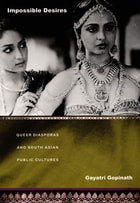
Gopinath juxtaposes diverse texts to indicate the range of oppositional practices, subjectivities, and visions of collectivity that fall outside not only mainstream narratives of diaspora, colonialism, and nationalism but also most projects of liberal feminism and gay and lesbian politics and theory. She considers British Asian music of the 1990s alongside alternative media and cultural practices. Among the fictional works she discusses are V. S. Naipaul’s classic novel A House for Mr. Biswas, Ismat Chughtai’s short story “The Quilt,” Monica Ali’s Brick Lane, Shyam Selvadurai’s Funny Boy, and Shani Mootoo’s Cereus Blooms at Night. Analyzing films including Deepa Mehta’s controversial Fire and Mira Nair’s Monsoon Wedding, she pays particular attention to how South Asian diasporic feminist filmmakers have reworked Bollywood’s strategies of queer representation and to what is lost or gained in this process of translation. Gopinath’s readings are dazzling, and her theoretical framework transformative and far-reaching.

Impossible Purities
Blackness, Femininity, and Victorian CultureJennifer DeVere Brody
Duke University Press, 1998
Opening with a reading of Daniel Defoe’s “A True-Born Englishman,” which posits the mixed origins of English identity, Brody goes on to analyze mulattas typified by Rhoda Swartz in William Thackeray’s Vanity Fair, whose mixed-race status reveals the “unseemly origins of English imperial power.” Examining Victorian stage productions from blackface minstrel shows to performances of The Octoroon and Uncle Tom’s Cabin, she explains how such productions depended upon feminized, “black” figures in order to reproduce Englishmen as masculine white subjects. She also discusses H.G. Wells’s The Island of Dr. Moreau in the context of debates about the “new woman,” slavery, and fears of the monstrous degeneration of English gentleman. Impossible Purities concludes with a discussion of Bram Stoker’s novella, “The Lair of the White Worm,” which brings together the book’s concerns with changing racial representations on both sides of the Atlantic.
This book will be of interest to scholars in Victorian studies, literary theory, African American studies, and cultural criticism.

Impossible Things
Miller Oberman
Duke University Press, 2024
Impossible Union
The Epic Story of Organizing America’s Agribusiness Workers from the Great Depression to the Cold WarJarod Roll and Erik S. Gellman
University of Illinois Press, 2027
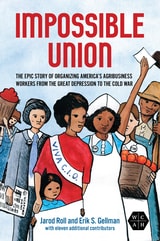
Workers of many racial, ethnic, and social identities united under the UCAPAWA-FTA banner. Their grassroots activism and bold national leadership fueled the union’s success despite opposition from employers, the government, and other labor groups. The union’s common sense anti-fascist ideology empowered workers to forge solidarities across their vast differences and linked workers’ rights to campaigns against racism and inequality. UCAPAWA-FTA advocated for an inclusive American democracy that can inform today’s struggles for dignity and security. This unique volume includes a special collection of essays by affiliated scholars that explore specific aspects of the union’s larger history.
Expansive and monumental, Impossible Union chronicles the labor organization that brought personhood and power to America’s marginal yet essential workers.
Additional contributors: Benjamin Makani Fortun, Dorothy Fujita-Rony, Robert Korstad, Bernadette Pérez, Michael Pierce, Charles Romney, Vicki L. Ruiz, Dan Sidorick, Dwana Waugh, John Weber, and Lane Windham
Impostors
Literary Hoaxes and Cultural AuthenticityChristopher L. Miller
University of Chicago Press, 2018
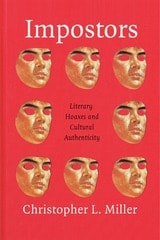
In the United States, such hoaxes are familiar. Forrest Carter’s The Education of Little Tree and JT LeRoy’s Sarah are two infamous examples. Miller’s contribution is to study hoaxes beyond our borders, employing a comparative framework and bringing French and African identity hoaxes into dialogue with some of their better-known American counterparts. In France, multiculturalism is generally eschewed in favor of universalism, and there should thus be no identities (in the American sense) to steal. However, as Miller demonstrates, this too is a ruse: French universalism can only go so far and do so much. There is plenty of otherness to appropriate. This French and Francophone tradition of imposture has never received the study it deserves. Taking a novel approach to this understudied tradition, Impostors examines hoaxes in both countries, finding similar practices of deception and questions of harm.
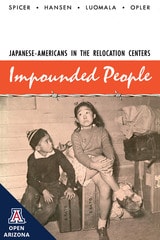
Impounded People
Japanese-Americans in the Relocation CentersEdward H. Spicer, Asael T. Hansen, Katherine Luomala, and Marvin K. Opler
University of Arizona Press, 1969

Impressionist Subjects
Gender, Interiority, and Modernist Fiction in EnglandTamar Katz
University of Illinois Press, 2000
Sophisticated and tightly argued, Impressionist Subjects is a substantial contribution to the reassessment and expansion of the modernist fiction canon.