Results by title
28164 books match the query 'History' and 997 start with i
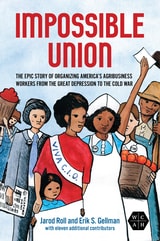
Impossible Union
The Epic Story of Organizing America’s Agribusiness Workers from the Great Depression to the Cold WarJarod Roll and Erik S. Gellman
University of Illinois Press, 2027
Workers of many racial, ethnic, and social identities united under the UCAPAWA-FTA banner. Their grassroots activism and bold national leadership fueled the union’s success despite opposition from employers, the government, and other labor groups. The union’s common sense anti-fascist ideology empowered workers to forge solidarities across their vast differences and linked workers’ rights to campaigns against racism and inequality. UCAPAWA-FTA advocated for an inclusive American democracy that can inform today’s struggles for dignity and security. This unique volume includes a special collection of essays by affiliated scholars that explore specific aspects of the union’s larger history.
Expansive and monumental, Impossible Union chronicles the labor organization that brought personhood and power to America’s marginal yet essential workers.
Additional contributors: Benjamin Makani Fortun, Dorothy Fujita-Rony, Robert Korstad, Bernadette Pérez, Michael Pierce, Charles Romney, Vicki L. Ruiz, Dan Sidorick, Dwana Waugh, John Weber, and Lane Windham

Impotence
A Cultural HistoryAngus McLaren
University of Chicago Press, 2007
As anyone who has watched television in recent years can attest, we live in the age of Viagra. From Bob Dole to Mike Ditka to late-night comedians, our culture has been engaged in one long, frank, and very public talk about impotence—and our newfound pharmaceutical solutions. But as Angus McLaren shows us in Impotence, the first cultural history of the subject, the failure of men to rise to the occasion has been a recurrent topic since the dawn of human culture.
Drawing on a dazzling range of sources from across centuries, McLaren demonstrates how male sexuality was constructed around the idea of potency, from times past when it was essential for the purpose of siring children, to today, when successful sex is viewed as a component of a healthy emotional life. Along the way, Impotence enlightens and fascinates with tales of sexual failure and its remedies—for example, had Ditka lived in ancient Mesopotamia, he might have recited spells while eating roots and plants rather than pills—and explanations, which over the years have included witchcraft, shell-shock, masturbation, feminism, and the Oedipal complex. McLaren also explores the surprising political and social effects of impotence, from the revolutionary unrest fueled by Louis XVI’s failure to consummate his marriage to the boost given the fledgling American republic by George Washington’s failure to found a dynasty. Each age, McLaren shows, turns impotence to its own purposes, using it to help define what is normal and healthy for men, their relationships, and society.
From marraige manuals to metrosexuals, from Renaissance Italy to Hollywood movies, Impotence is a serious but highly entertaining examination of a problem that humanity has simultaneously regarded as life’s greatest tragedy and its greatest joke.
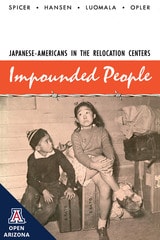
Impounded People
Japanese-Americans in the Relocation CentersEdward H. Spicer, Asael T. Hansen, Katherine Luomala, and Marvin K. Opler
University of Arizona Press, 1969

Impressions of the Big Thicket
Michael Frary
University of Texas Press, 1973
Before the establishment of the Big Thicket Nature Preserve, the Big Thicket of Texas became a symbol of nature's last stand against encroaching civilization. Here, in a mingling of ecological zones, come together plants, animals, and birds—many of them rare—the flora and fauna of north and south, east and west. Northern maples and beeches stand not too great a distance from cypresses and Southern magnolias. American hollies grow large and orchids bloom among Northern ferns. Mesquite and tumbleweed, plants of the Western desert, survive where the annual rainfall averages sixty inches. On a major flyway, the Big Thicket is a stopping place for many birds in passage as well as home to a wide variety. Beavers build their dams there, and an occasional coyote yips in the night.
Because of its great beauty and rich natural resources, use of the Big Thicket was the object of a forty-year struggle involving financiers, politicians, conservationists, and countless Thicket lovers. Each group viewed the Thicket from a different perspective and foresaw its future in different terms.
This book records the impressions of two Thicket lovers. Michael Frary's paintings and drawings of woods and water, of birds in flight and strange plants growing close to the moist earth are pictures of a place, a time, a mood caught today—and not the same if left until tomorrow. The qualities of gentleness and violence are constant, but often hidden—there to be brought out by human need or human greed.
William Owens writes of the people who have lived their lives in the Big Thicket, who have stirred its stillness with whoop and holler across the waters, who have taken in its stillness and explosive beauty until they themselves are made up of gentleness and violence.
Together the impressions show what the Big Thicket was and is. What it will be—that is the chief concern of the book.
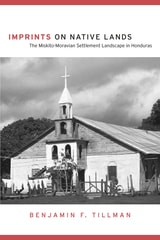
Imprints on Native Lands
The Miskito-Moravian Settlement Landscape in HondurasBenjamin F. Tillman
University of Arizona Press, 2011
Much like the Spanish and English attempts before them, German colonizing efforts in the region never completely took hold. Still, as Benjamin Tillman shows, for the region’s indigenous inhabitants, the Miskito people, the arrival of the Moravian missionaries marked the beginning of an important cultural interface.
Imprints on Native Lands documents Moravian contributions to the Miskito settlement landscape in sixty four villages of eastern Honduras through field observations of material culture, interviews with village residents, and research in primary sources in the Moravian Church archives. Tillman employs the resulting data to map a hierarchy of Moravian centers, illustrating spatially varying degrees of Moravian influence on the Miskito settlement landscape.
Tillman reinforces Miskito claims to ancestral lands by identifying and mapping their created ethnic landscape, as well as supporting earlier efforts at land-use mapping in the region. This book has broad implications, providing a methodology that will be of help to those with an interest in geography, anthropology, or Latin American studies, and to anyone interested in documenting and strengthening indigenous land claims.

Imprints
The Pokagon Band of Potawatomi Indians and the City of ChicagoJohn N. Low
Michigan State University Press, 2016
Imprints: The Pokagon Band of Potawatomi Indians and the City of Chicago examines the ways some Pokagon Potawatomi tribal members have maintained a distinct Native identity, their rejection of assimilation into the mainstream, and their desire for inclusion in the larger contemporary society without forfeiting their “Indianness.” Mindful that contact is never a one-way street, Low also examines the ways in which experiences in Chicago have influenced the Pokagon Potawatomi. Imprints continues the recent scholarship on the urban Indian experience before as well as after World War II.

Improbable Patriot
The Secret History of Monsieur de Beaumarchais, the French Playwright Who Saved the American RevolutionHarlow Giles Unger
Brandeis University Press, 2026
In 1776, the playwright and inventor Pierre-Augustin Caron de Beaumarchais (1732–99) conceived an audacious plan to send aid to the American rebels. What’s more, he convinced King Louis XVI to bankroll the project and single-handedly carried it out. By war’s end, he had supplied Washington’s army with most of its weapons and powder, though he was never paid or acknowledged by the United States. To some, he was a dashing hero, a towering intellect who saved the American Revolution. To others, he was a pure rogue, a double-dealing adventurer who stopped at nothing to advance his fame and fortune. In fact, he was both, and more: an advisor to kings, an arms dealer, and an author of some of the most enduring works of the stage, including The Marriage of Figaro and The Barber of Seville. Now in paperback, Improbable Patriot introduces readers to an unrecognized power player in the Revolutionary War.

Improbable Patriot
The Secret History of Monsieur de Beaumarchais, the French Playwright Who Saved the American RevolutionHarlow Giles Unger
University Press of New England, 2011

Improper Advances
Rape and Heterosexual Conflict in Ontario, 1880-1929Karen Dubinsky
University of Chicago Press, 1993
Karen Dubinsky relies on criminal case files, a revealing but largely untapped source for social historians, to retell individual stories of sexual danger—crimes such as rape, abortion, seduction, murder, and infanticide. Her research supports many feminist analyses of sexual violence: that crimes are expressions of power, that courts are prejudiced by the victim's background, and that most assaults occur within the victims' homes and communities.
Dubinsky distinguishes herself from most feminist scholars, however, by refusing to view women solely as victims and sex as a tool of oppression. She finds that these women actively sought and took pleasure in sexuality, but they distinguished between wanted and unwanted sexual encounters and attempted to punish coercive sex despite obstacles in the court system and the community.
Confronting a number of key theoretical and historiographic controversies, including recent debates over sexuality in feminist theory and politics, she challenges current thinking on the history of women, gender, and sexuality.

Improper Names
Collective Pseudonyms from the Luddites to AnonymousMarco Deseriis
University of Minnesota Press, 2015
Improper Names offers a genealogy and theory of the “improper name,” which author Marco Deseriis defines as the adoption of the same pseudonym by organized collectives, affinity groups, and individual authors. Although such names are often invented to pursue a specific social or political agenda, they are soon appropriated for different and sometimes diverging purposes. This book examines the tension arising from struggles for control of a pseudonym’s symbolic power.
Deseriis provides five fascinating and widely varying case studies. Ned Ludd was the legendary and eponymous leader of the English Luddites, textile workers who threatened the destruction of industrial machinery and then advanced a variety of economic and political demands. Alan Smithee—an alias coined by Hollywood film directors in 1969 in order to disown films that were recut by producers—became a contested signature and was therefore no longer effective to signal prevarication to Hollywood insiders. Monty Cantsin was an “open pop star” created by U.S. and Canadian artists in the late 1970s to critique bourgeois notions of authorship, but its communal character was compromised by excessive identification with individual users of the name. The Italian media activists calling themselves Luther Blissett, aware of the Cantsin experience, implemented measures to prevent individuals from assuming the alias, which was used to author media pranks, sell apocryphal manuscripts to publishers, fabricate artists and artworks, and author best-selling novels. The longest chapter here is devoted to the contemporary “hacktivist” group known as Anonymous, which protests censorship and restricted access to information and information technologies.
After delving into a rich philosophical debate on community among those who have nothing in common, the book concludes with a reflection on how the politics of improper names affects present-day anticapitalist social movements such as Occupy and 15-M.

Improve, Perfect, & Perpetuate
Oliver S. Hayward
Dartmouth College Press, 1998

Improvising Medicine
An African Oncology Ward in an Emerging Cancer EpidemicJulie Livingston
Duke University Press, 2012

Impunity, Human Rights, and Democracy
Chile and Argentina, 1990-2005By Thomas C. Wright
University of Texas Press, 2014
Universal human rights standards were adopted in 1948, but in the 1970s and 1980s, violent dictatorships in Argentina and Chile flagrantly defied the new protocols. Chilean general Augusto Pinochet and the Argentine military employed state terrorism in their quest to eradicate Marxism and other forms of “subversion.” Pinochet constructed an iron shield of impunity for himself and the military in Chile, while in Argentina, military pressure resulted in laws preventing prosecution for past human rights violations. When democracy was reestablished in both countries by 1990, justice for crimes against humanity seemed beyond reach.
Thomas C. Wright examines how persistent advocacy by domestic and international human rights groups, evolving legal environments, unanticipated events that impacted public opinion, and eventual changes in military leadership led to a situation unique in the world—the stripping of impunity not only from a select number of commanders of the repression but from all those involved in state terrorism in Chile and Argentina. This has resulted in trials conducted by national courts, without United Nations or executive branch direction, in which hundreds of former repressors have been convicted and many more are indicted or undergoing trial.
Impunity, Human Rights, and Democracy draws on extensive research, including interviews, to trace the erosion and collapse of the former repressors’ impunity—a triumph for human rights advocates that has begun to inspire authorities in other Latin American countries, including Peru, Uruguay, Brazil, and Guatemala, to investigate past human rights violations and prosecute their perpetrators.
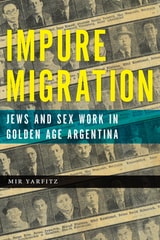
Impure Migration
Jews and Sex Work in Golden Age ArgentinaMir Yarfitz
Rutgers University Press, 2019

In Africa's Forest and Jungle
Six Years Among the YorubasRichard Henry Stone, edited by Betty Finklea Florey
University of Alabama Press, 2009
Stone served in Africa with his wife and successfully learned the Yoruba language. He was an intelligent, self-reflective, and reliable observer, making his works important sources of information on Yoruba society before the intervention of European colonialism. In Africa's Forest and Jungle is a rare account of West African culture, made all the more complete by the additional journal entries, letters, and photographs collected in this edition.
In Another Time
Harold Schindler
Utah State University Press, 1998
An illustrated collection of historical articles originally published in the Salt Lake Tribune from 1993 to 1996, In
Another Time provides both an entertaining introduction to Utah and a distinguished and popular historian's summary views of the state's peculiar history.
Another Time will entertain and inform newcomers seeking an introductory understanding of what has made Utah different, old hands wanting to know more about the rich complexity of the state's past, and anyone who enjoys well-told historical tales.
In Clouds of Glory
American Airmen Who Flew with the British during the Great WarJames J. Hudson
University of Arkansas Press, 1999

In Common Cause
The “Conservative” Frances Trollope and the “Radical” Frances WrightSusan S. Kissel
University of Wisconsin Press, 1993

In Contagion's Wake
Black Writers and the Development of Modern Outbreak NarrativesKelly L. Bezio
University of Massachusetts Press, 2026
An examination of early American literature that highlights how racial divides exacerbated—and were exacerbated by—the spread of infection
In April of 1721, the HMS Seahorse arrived in Boston from the West Indies, causing a smallpox epidemic that would plague the city for the next year. Of its 12,000 inhabitants, nearly fifty percent were infected, and 900 people died. Like the coronavirus pandemic that began in 2020, the outbreak also brought to the surface deep divides in the social fabric of colonial New England and laid the groundwork for racialized political inequities that we continue to grapple with today.
In Contagion’s Wake examines a range of American outbreak narratives, both historical and fictional, written between the early 1700s and the early 1900s—from the rise of inoculation through the advent of germ theory. Author Kelly L. Bezio argues that during this period, literature about communicable disease was dominated by white authors, such as Cotton Mather and Edgar Allen Poe, who tended to privilege white suffering and survival while obscuring Black suffering and vulnerability. Black authors, however, such as Olaudah Equiano and Frances E.W. Harper, developed variations on plot structures, metaphors, and imagery that drew upon contagion to represent racial injustice and further the cause of Black liberation.
The diverse texts Bezio analyzes vary extensively in genre and geographical location, and in the illnesses that feature in their pages. Significant disorders from the era, including yellow fever, smallpox, consumption, and cholera, make frequent appearances, as do less culturally dominant diseases such as St. Anthony’s Fire. In Contagion’s Wake contends that representations of communicable disease should not be understood only as within their own historical moment; rather, they function more like a DNA code for our present time.
In Contempt
Defending Free Speech, Defeating HUACEd Yellin and Jean Fagan Yellin
University of Michigan Press, 2022
So began a decade of hardship for Ed and Jean Yellin and their three young children as the repressive weight of the U.S. government, caught up in the throes of McCarthyism, crashed down upon their careers, their daily household budget, and their relationships to colleagues, neighbors, and their country. In Contempt is a faithful, factual testament to the enduring quality of patriotic dissent in our evolving democracy—and a loving reconstruction of what it meant to be labeled “unAmerican” for defending the Constitution.
In Contempt
Nineteenth-Century Women, Law, and LiteratureKristin Kalsem
The Ohio State University Press, 2012
In Contempt: Nineteenth-Century Women, Law, and Literature, by Kristin Kalsem, explores the legal advocacy performed by nineteenth-century women writers in publications of nonfiction and fiction, as well as in real-life courtrooms and in the legal forum provided by the novel form.

In Darkness and Secrecy
The Anthropology of Assault Sorcery and Witchcraft in AmazoniaNeil L. Whitehead and Robin Wright, eds.
Duke University Press, 2004
These essays, by leading anthropologists of South American shamanism, consider assault sorcery as it is practiced in parts of Brazil, Guyana, Venezuela, and Peru. They analyze the social and political dynamics of witchcraft and sorcery and their relation to cosmology, mythology, ritual, and other forms of symbolic violence and aggression in each society studied. They also discuss the relations of witchcraft and sorcery to interethnic contact and the ways that shamanic power may be co-opted by the state. In Darkness and Secrecy includes reflections on the ethical and practical implications of ethnographic investigation of violent cultural practices.
Contributors. Dominique Buchillet, Carlos Fausto, Michael Heckenberger, Elsje Lagrou, E. Jean Langdon, George Mentore, Donald Pollock, Fernando Santos-Granero, Pamela J. Stewart, Andrew Strathern, Márnio Teixeira-Pinto, Silvia Vidal, Neil L. Whitehead, Johannes Wilbert, Robin Wright

In Defense of American Liberties, Second Edition
A History of the ACLUSamuel Walker
Southern Illinois University Press, 1999
This updated comprehensive history of the American Civil Liberties Union recounts the ACLU's stormy history since its founding in 1920 to fight for free speech and explores its involvement in some of the most famous causes in American history, including the Scopes "monkey trial," the internment of Japanese Americans during World War II, the Cold War anti-Communist witch hunts, and the civil rights movement. The new introduction covers the history of the organization and developments in civil liberties in the 1990s, including the U.S. Supreme Court's declaration of the Communications Decency Act as unconstitutional in ACLU v. Reno.

In Defense of Honor
Sexual Morality, Modernity, and Nation in Early-Twentieth-Century BrazilSueann Caulfield
Duke University Press, 2000
While some Brazilian elites used the issue of sexual purity to boast of their country’s moral superiority, others claimed that the veneration of such concepts as virginity actually frustrated efforts at modernization. Moreover, although individuals of all social classes invoked values they considered “traditional,” such as the confinement of women’s sexuality within marriage, these values were at odds with social practices—such as premarital sex, cohabitation, divorce, and female-headed households—that had been common throughout Brazil’s history. The persistence of these practices, together with post-World War I changes in both official and popular moral ideals, presented formidable obstacles to the Estado Novo’s renewed drive to define and enforce public morality and private family values in the late 1930s.
With sophisticated theoretical underpinnings, In Defense of Honor is written in a clear and lively manner, making it accessible to students and scholars in a variety of disciplines, including Brazilian and Latin American studies, gender studies, and legal history.

In Defense of Justice
Joseph Kurihara and the Japanese American Struggle for EqualityEileen H. Tamura
University of Illinois Press, 2013

In Defense of La Raza
The Los Angeles Mexican Consulate and the Mexican Community, 1929 to 1936Francisco E. Balderrama
University of Arizona Press, 1982
Los Angeles’s consulate was confronted with the country’s largest concentration of Mexican Americans, for whom the consuls often assumed a position of community leadership. Whether helping the unemployed secure repatriation and relief or intervening in labor disputes, consuls uniquely adapted their roles in international diplomacy to the demands of local affairs.

In Defense of Negativity
Attack Ads in Presidential CampaignsJohn G. Geer
University of Chicago Press, 2006
In Defense of Negativity, Geer’s study of negative advertising in presidential campaigns from 1960 to 2004, asserts that the proliferating attack ads are far more likely than positive ads to focus on salient political issues, rather than politicians’ personal characteristics. Accordingly, the ads enrich the democratic process, providing voters with relevant and substantial information before they head to the polls.
An important and timely contribution to American political discourse, In Defense of Negativity concludes that if we want campaigns to grapple with relevant issues and address real problems, negative ads just might be the solution.

In Defense of Sovereignty
Protecting the Oneida Nation's Inherent Right to Self-DeterminationRebecca M. Webster
University of Wisconsin Press, 2023
As in so many conflicts between Indigenous nations and local municipalities, the media narrative about the Oneida Nation’s battle for sovereignty has been dominated by the local government’s standpoint. In Defense of Sovereignty offers another perspective, that of a nation citizen directly involved in the litigation, augmented by contributions from historians, attorneys, and a retired nation employee. It makes an important contribution to public debates about the inherent right of Indigenous nations to continue to exist and exercise self-governance within their territories without being challenged at every turn.

In Defense of Women
A Bilingual EditionPompeo Colonna
Iter Press, 2024
Pompeo Colonna’s In Defense of Women (1530), presented in this volume in Latin and English translation, is one of several important defenses of women composed in the fifteenth and sixteenth centuries by male advocates of women’s moral and intellectual worth. Known as a cardinal and a warrior, but also as an active participant in sixteenth-century Italian literary circles, Colonna addresses the work to his cousin Vittoria Colonna, the most renowned Italian woman poet of the era, who, he writes, had urged him to undertake it. His Defense not only refutes arguments of women’s inferiority and incapacity but, remarkably, asserts their ability to hold political office and govern. It contains original Latin text and a critical introduction by Franco Minonzio. It also features a foreword by Margaret L. King, as well as a postscript by King, tracing the separate male-authored and female-authored Renaissance defenses of women.

In Dialogue with the Other Voice in Sixteenth-century Italy
Literary and Social Contexts for Women's WritingEdited by Julie D. Campbell and Maria Galli Stampino
Iter Press, 2011
—Elissa Weaver
Professor of Italian, Emerita, University of Chicago

In Divided Unity
Haudenosaunee Reclamation at Grand RiverTheresa McCarthy
University of Arizona Press, 2016
In February 2006, the Six Nations occupation of a 132-acre construction site in Caledonia, Ontario, reignited a 200-year-long struggle to reclaim land and rights in the Grand River region. Framed by this ongoing reclamation, In Divided Unity explores community-based initiatives that promote Haudenosaunee traditionalism and languages at Six Nations of the Grand River as crucial enactments of sovereignty both historically and in the present.
Drawing from Haudenosaunee oral traditions, languages, and community-based theorists, In Divided Unity engages the intersecting themes of knowledge production and resistance against the backdrop of the complicated dynamics of the Six Nations community, which has the largest population of all First Nations in Canada. Comprising the Mohawk, Oneida, Onondaga, Cayuga, Seneca, and Tuscarora nations, citizens of the Six Nations Confederacy collectively refer to themselves as Haudenosaunee, which means “we build the house.”
Theresa McCarthy critiques settler colonial narratives of Haudenosaunee decline used to rationalize land theft and political subjugation. In particular, McCarthy illustrates that current efforts to discredit the reclamation continue to draw on the flawed characterizations of Haudenosaunee tradition, factionalism, and “failed” self-government popularized by conventional scholarship about the Iroquois. Countering these narratives of decline and failure, McCarthy argues that the 2006 reclamation ushered in an era of profound intellectual and political resurgence at Six Nations, propelled by the contributions of Haudenosaunee women.
Centering Haudenosaunee intellectual traditions, In Divided Unity provides an important new model for community-based activism and scholarship. Through the active practice and adaptation of ancient teachings and philosophies, McCarthy shows that the Grand River Haudenosaunee are continuing to successfully meet the challenges of reclaiming their land, political autonomy, and control of their future.

In Essentials, Unity
An Economic History of the Grange MovementJenny Bourne
Ohio University Press, 2017
The Patrons of Husbandry—or the Grange—is the longest-lived US agricultural society and, since its founding shortly after the Civil War, has had immeasurable influence on social change as enacted by ordinary Americans. The Grange sought to relieve the struggles of small farmers by encouraging collaboration. Pathbreaking for its inclusion of women, the Grange is also well known for its association with Gilded Age laws aimed at curbing the monopoly power of railroads.
In Essentials, Unity takes as its focus Grange founder Oliver Kelley and his home organization in Minnesota. Jenny Bourne draws upon numerous historical records to present a lively picture of a fraternal organization devoted to improving the lot of farmers but whose legacies extend far beyond agriculture. From struggles over minimum wage, birth control, and environmental regulation to the conflicts surrounding the Affordable Care Act, and from lunch-counter sit-ins to Occupy Wall Street, the Grange has shaped the very notion of collective action and how it is deployed even today. As this compact book so effectively illustrates, the history of the Patrons of Husbandry exposes the classic tension between the desires for achieving overall economic success and determining how the spoils are split.
In Excess
Sergei Eisenstein's MexicoMasha Salazkina
University of Chicago Press, 2009
During the 1920s and ’30s, Mexico attracted an international roster of artists and intellectuals—including Orson Welles, Katherine Anne Porter, and Leon Trotsky—who were drawn to the heady tumult engendered by battling cultural ideologies in an emerging center for the avant-garde. Against the backdrop of this cosmopolitan milieu, In Excess reconstructs the years that the renowned Soviet director Sergei Eisenstein spent in the country to work on his controversial film ¡Que Viva Mexico!
Illuminating the inextricability of Eisenstein’s oeuvre from the global cultures of modernity and film, Masha Salazkina situates this unfinished project within the twin contexts of postrevolutionary Mexico and the ideas of such contemporaneous thinkers as Walter Benjamin. In doing so, Salazkina explains how Eisenstein’s engagement with Mexican mythology, politics, and art deeply influenced his ideas, particularly about sexuality. She also uncovers the role Eisenstein’s bisexuality played in his creative thinking and identifies his use of the baroque as an important turn toward excess and hybrid forms. Beautifully illustrated with rare photographs, In Excess provides the most complete genealogy available of major shifts in this modern master’s theories and aesthetics.
In Fielding’s Wake
Jeremy Black
St. Augustine's Press, 2022
Fielding's epic comic novel, Tom Jones, is unforgettable for many reasons, but the author must be credited with an aptitude for documenting contemporary cultural history and his contribution to a new species of writing. Black's treatment of Fielding draws to the fore a man who was of his time but not confined to it. "Philosophy in practice encompassed his stance as a man of action as well as a reflective writer of genius." Fielding is shown to provide across the breadth of his work extensive and invaluable commentary on issues as diverse as law and order, marriage, women, and the interplay of urban and rural life. Black, an historian, is here a student of storytelling and recovers Fielding's rich descriptions of the human heart and call to defy the vices with which circumstances might taunt it.
Black has done a service along many fronts at once: the science of the novel and genre, the history of a people and the figure of a memorable writer.

In Good Relation
History, Gender, and Kinship in Indigenous FeminismsSarah Nickel
University of Manitoba Press, 2020

In Griot Time
Banning Eyre
Temple University Press, 2000
Djelimady Tounkara is only one of the memorable people you will meet in this dramatic narrative of life among the griot musicians of Mali. Born into families where music and the tradition of griot story-telling is a heritage and a privilege, Djelimady and his fellow griots -- both men and women -- live their lives at the intersection of ancient traditions and the modern entertainment industry. During the seven months he spent living and studying with Djelimady, Banning Eyre immersed himself in a world that will fascinate you as it did him.
Eyre creates a range of unforgettable portraits. Some of the people who stride through his pages are internationally known, musicians like Salif Keita, Oumou Sangare, and Grammy winner Ali Farka Toure. But the lesser-known characters are equally fascinating: Adama Kouyate, Djelimady's dynamic wife; Moussa Kouyate, the Tounkara family's own griot; Yayi Kanoute, the flamboyant jelimuso (female griot) who failed to take America by storm; Foutanga Babani Sissoko, the mysterious millionaire who rebuilt an entire town and whose patronage is much sought after by the griots of Bamako.
But the picture Eyre draws is not just a series of portraits. Out of their interactions comes a perceptive panorama of life in Mali in the late twentieth century. The narrative gives us a street-level view of the transformation of musical taste and social customs, the impact of technology and the pressures of poverty, at a crucial time in Mali's history. In individual after individual, family after family, we see the subtle conflicts of heritage and change. Even the complications of democracy -- with democracy, mango vendors think they can charge anything they want, Djelimady points out -- are woven into an unforgettable saga of one man, his family, his profession, and the world of Malian music.
In Hock
Pawning in America from Independence through the Great DepressionWendy A. Woloson
University of Chicago Press, 2009

In Hush to Harbor
Black Sanctuary from Slavery to Trump's AmericaLa-Toya L. Scott
Rutgers University Press, 2026
Black communities in America have a long history of constructing sanctuaries amid oppression, from the secret hush harbors of slavery to the digital refuges created in response to the resurgence of white supremacist violence in the Trump era. These havens have offered places to grieve and to gather, to imagine freedom when the world denied it, and to practice care and resistance in the face of constant danger. They remind us that even in the darkest moments, Black people have made space to grieve, rest, heal, strategize, and imagine new futures.
In Hush to Harbor traces this enduring sanctuary-making through both historical memory and contemporary expression from the legacy of Freedmen’s Towns and Green Books for Motorists in the Jim Crow era as testaments to Black mobility and mutual protection to present-day digital activism and grassroots organizing that reimagine safety in the public sphere.
Blending literary criticism, cultural history, and ethnography, Scott demonstrates that sanctuary is not merely a place of retreat but a political and spiritual practice that calls forth a collective act of making space when none is offered. In Hush to Harbor offers not just a chronicle of survival but a blueprint for sustaining Black refuge in a time of urgent need, redefining what it means to be safe in a nation that has never guaranteed safety for Black life.
In Idi Amin’s Shadow
Women, Gender, and Militarism in UgandaAlicia C. Decker
Ohio University Press, 2014
Finalist for the 2015 Aidoo-Snyder Prize
In Idi Amin’s Shadow is a rich social history examining Ugandan women’s complex and sometimes paradoxical relationship to Amin’s military state. Based on more than one hundred interviews with women who survived the regime, as well as a wide range of primary sources, this book reveals how the violence of Amin’s militarism resulted in both opportunities and challenges for women. Some assumed positions of political power or became successful entrepreneurs, while others endured sexual assault or experienced the trauma of watching their brothers, husbands, or sons “disappeared” by the state’s security forces. In Idi Amin’s Shadow considers the crucial ways that gender informed and was informed by the ideology and practice of militarism in this period. By exploring this relationship, Alicia C. Decker offers a nuanced interpretation of Amin’s Uganda and the lives of the women who experienced and survived its violence.
Each chapter begins with the story of one woman whose experience illuminates some larger theme of the book. In this way, it becomes clear that the politics of military rule were highly relevant to women and gender relations, just as the politics of gender were central to militarism. By drawing upon critical security studies, feminist studies, and violence studies, Decker demonstrates that Amin’s dictatorship was far more complex and his rule much more strategic than most observers have ever imagined.
In Lady Liberty's Shadow
The Politics of Race and Immigration in New JerseyRobyn Magalit Rodriguez
Rutgers University Press, 2017
In Lady Liberty’s Shadow examines popular white perceptions of danger represented by immigrants and their children, as well the specter that lurks at the edges of suburbs in the shape of black and Latino urban underclasses and the ever more nebulous hazard of (presumed-Islamic) terrorism that threatening to undermine “life as we know it.” Robyn Magalit Rodriguez explores the impact of anti-immigrant municipal ordinances on a range of immigrant groups living in varied suburban communities, from undocumented Latinos in predominantly white suburbs to long-established Asian immigrants in “majority-minority” suburbs. The “American Dream” that suburban life is supposed to represent is shown to rest on a racialized, segregated social order meant to be enjoyed only by whites. Although it is a case study of New Jersey, In Lady Liberty’s Shadow offers crucial insights that can shed fresh light on the national immigration debate.
For more information, go to: https://www.facebook.com/inlibertysshadow

In Levittown’s Shadow
Poverty in America's Wealthiest Postwar SuburbTim Keogh
University of Chicago Press, 2023
Highlights how low-wage residents have struggled to live and work in a place usually thought of as affluent: suburbia.
There is a familiar narrative about American suburbs: after 1945, white residents left cities for leafy, affluent subdivisions and the prosperity they seemed to embody. In Levittown’s Shadow tells us there’s more to this story, offering an eye-opening account of diverse, poor residents living and working in those same neighborhoods. Tim Keogh shows how public policies produced both suburban plenty and deprivation—and why ignoring suburban poverty doomed efforts to reduce inequality.
Keogh focuses on the suburbs of Long Island, home to Levittown, often considered the archetypal suburb. Here military contracts subsidized well-paid employment welding airplanes or filing paperwork, while weak labor laws impoverished suburbanites who mowed lawns, built houses, scrubbed kitchen floors, and stocked supermarket shelves. Federal mortgage programs helped some families buy orderly single-family homes and enter the middle class but also underwrote landlord efforts to cram poor families into suburban attics, basements, and sheds. Keogh explores how policymakers ignored suburban inequality, addressing housing segregation between cities and suburbs rather than suburbanites’ demands for decent jobs, housing, and schools.
By turning our attention to the suburban poor, Keogh reveals poverty wasn’t just an urban problem but a suburban one, too. In Levittown’s Shadow deepens our understanding of suburbia’s history—and points us toward more effective ways to combat poverty today.
In Levittown’s Shadow
Poverty in America’s Wealthiest Postwar SuburbTim Keogh
University of Chicago Press, 2023
There is a familiar narrative about American suburbs: after 1945, white residents left cities for leafy, affluent subdivisions and the prosperity they seemed to embody. In Levittown’s Shadow tells us there’s more to this story, offering an eye-opening account of diverse, poor residents living and working in those same neighborhoods. Tim Keogh shows how public policies produced both suburban plenty and deprivation—and why ignoring suburban poverty doomed efforts to reduce inequality.
Keogh focuses on the suburbs of Long Island, home to Levittown, often considered the archetypal suburb. Here military contracts subsidized well-paid employment welding airplanes or filing paperwork, while weak labor laws impoverished suburbanites who mowed lawns, built houses, scrubbed kitchen floors, and stocked supermarket shelves. Federal mortgage programs helped some families buy orderly single-family homes and enter the middle class but also underwrote landlord efforts to cram poor families into suburban attics, basements, and sheds. Keogh explores how policymakers ignored suburban inequality, addressing housing segregation between cities and suburbs rather than suburbanites’ demands for decent jobs, housing, and schools.
By turning our attention to the suburban poor, Keogh reveals poverty wasn’t just an urban problem but a suburban one, too. In Levittown’s Shadow deepens our understanding of suburbia’s history—and points us toward more effective ways to combat poverty today.

In Lincoln's Shadow
The 1908 Race Riot in Springfield, IllinoisRoberta Senechal de la Roche
Southern Illinois University Press, 2008
Winner of the Gustavus Myers Center Award for the Study of Human Rights in the United States!
Winner of the Illinois State Historical Society Superior Achievement Award!
This detailed case study of the 1908 race riot in Springfield, Illinois, which began only a few blocks from Abraham Lincoln’s family home, explores the social origins of rioting by whites against the city’s African American community after a white woman alleged that a black man had raped her. Over two days rioters wrecked black-owned businesses, burned neighborhoods to the ground, killed two black men, and injured many others.
Author Roberta Senechal de la Roche draws from a wide range of sources to describe the riot, identify the rioters and their victims, and challenge previous interpretations that attribute rioting to interracial competition for jobs, housing, or political influence. Written in a direct and clear style, In Lincoln’s Shadow documents a violent explosion of racial hatred that shocked the nation and reveals the complexity of white racial attitudes in the early twentieth century.
In My Father'S Study
Ben Orlove
University of Iowa Press, 1995
In 1921 Solomon Orlovski, a Russian Jew born in 1904, emigrated to America and transformed himself into Robert Orlove, a pattern maker in two senses of the term: during the day, he worked in the fur trade in New York and Chicago, making patterns for toys and hats; in his private life he became a self-taught artist who created prints, sketches, and collages in his study. More than sixty years later his son Ben—an anthropologist educated at Harvard and Berkeley—walked through the doorway of the deceased Robert's study and began to explore more than a half century of his father's experiences, thoughts, and emotions as well as his own very different life. His wry, sensitive combination of biography, memoir, and autobiography taps a remarkably rich vein of individual and collective experience in our diverse society.
Ben Orlove's dual narrative constitutes a family history of notable breadth and immediacy. By turns passionate and cool, dramatic and analytic, he excavates his father Robert's lifetime accumulation of diaries, letters, clippings, photographs, and artworks to create a convincing, deeply satisfying portrait that link both father and son.

In Oceania
Visions, Artifacts, HistoriesNicholas Thomas
Duke University Press, 1997
In Oceania documents and analyzes the "rhetorical artifacts" of explorers, missionaries, fiction and travel writers, and the people of the Pacific themselves to illustrate how Oceanic identities have been represented over time. Not content with conventional methods of anthropology or history, Thomas draws on postcolonial theory and literary analysis in extraordinarily wide-ranging analyses of texts, visual images, and historical processes. He demonstrates how cultures of the Pacific Islands have dealt with colonialist ventures, modernity, and the debate about the recuperation of histories and traditions. The picture Thomas paints of Oceania, however, is not one of a group of societies stripped of meaning, but one that shows how the interactions between indigenous cultures and European influences have created entirely new identities.
In Order to Live Untroubled
Inuit of the Central Artic 1550 to 1940Renee Fossett
University of Manitoba Press, 2001

In Our Own Hands
Essays in Deaf History, 1780–1970Brian H. Greenwald
Gallaudet University Press, 2016
These essays reveal how deaf people used their agency to engage in vigorous debates about issues that constantly tested the values of deaf people as Americans. The debates overlapped with social trends and spilled out into particular physical and social spaces such as clubs and churches, as well as within families. These previously unexplored areas in Deaf history intersect with important subthemes in American history, such as Southern history, religious history, and Western history.
The contributors demonstrate that as deaf people pushed for their rights as citizens, they met with resistance from hearing people, and the results of their efforts were decidedly mixed. These works reinforce the Deaf community’s longstanding desire to be part of the nation. In Our Own Hands contributes to an increased understanding of the struggle for citizenship and expands our current understanding of race, gender, religion, and other trends in Deaf history.

In Permanent Crisis
Ethnicity in Contemporary European Media and CinemaIpek A. Celik
University of Michigan Press, 2015

In Plain Sight
Impunity and Human Rights in ThailandTyrell Haberkorn
University of Wisconsin Press, 2019
In Plenty and in Time of Need
Popular Culture and the Remapping of Barbadian IdentityLia T. Bascomb
Rutgers University Press, 2020