Results by title
28164 books match the query 'History' and 997 start with i

In Pursuit of Civility
Manners and Civilization in Early Modern EnglandKeith Thomas
Brandeis University Press, 2018
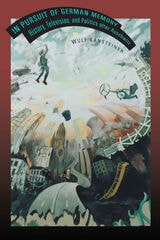
In Pursuit of German Memory
History, Television, and Politics after AuschwitzWulf Kansteiner
Ohio University Press, 2006
The collective memories of Nazism that developed in postwar Germany have helped define a new paradigm of memory politics. From Europe to South Africa and from Latin America to Iraq, scholars have studied the German case to learn how to overcome internal division and regain international recognition.
In Pursuit of German Memory: History, Television, and Politics after Auschwitz examines three arenas of German memory politics—professional historiography, national politics, and national public television—that have played key roles in the reinvention of the Nazi past in the last sixty years. Wulf Kansteiner shows that the interpretations of the past proposed by historians, politicians, and television producers reflect political and generational divisions and an extraordinary concern for Germany's image abroad. At the same time, each of these theaters of memory has developed its own dynamics and formats of historical reflection.
Kansteiner’s analysis of the German scene reveals a complex social geography of collective memory. In Pursuit of German Memory underscores the fact that German memories of Nazism, like many other collective memories, combine two seemingly contradictory qualities: They are highly mediated and part of a global exchange of images and story fragments but, at the same time, they can be reproduced only locally, in narrowly circumscribed networks of communication.

In Pursuit of Giants
One Man's Global Search for the Last of the Great FishMatt Rigney
University Press of New England, 2017
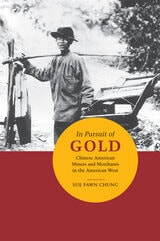
In Pursuit of Gold
Chinese American Miners and Merchants in the American WestSue Fawn Chung
University of Illinois Press, 2011
Both a history of an overlooked community and a well-rounded reassessment of prevailing assumptions about Chinese miners in the American West, In Pursuit of Gold brings to life in rich detail the world of turn-of-the-century mining towns in the Northwest. Sue Fawn Chung meticulously recreates the lives of Chinese immigrants, miners, merchants, and others who populated these towns and interacted amicably with their white and Native American neighbors, defying the common perception of nineteenth-century Chinese communities as insular enclaves subject to increasing prejudice and violence.
While most research has focused on Chinese miners in California, this book is the first extensive study of Chinese experiences in the towns of John Day in Oregon and Tuscarora, Island Mountain, and Gold Creek in Nevada. Chung illustrates the relationships between miners and merchants within the communities and in the larger context of immigration, arguing that the leaders of the Chinese and non-Chinese communities worked together to create economic interdependence and to short-circuit many of the hostilities and tensions that plagued other mining towns.
Peppered with fascinating details about these communities from the intricacies of Chinese gambling games to the techniques of hydraulic mining, In Pursuit of Gold draws on a wealth of historical materials, including immigration records, census manuscripts, legal documents, newspapers, memoirs, and manuscript collections. Chung supplements this historical research with invaluable first-hand observations of artifacts that she experienced in archaeological digs and restoration efforts at several of the sites of the former booming mining towns.
In clear, analytical prose, Chung expertly characterizes the movement of Chinese miners into Oregon and Nevada, the heyday of their mining efforts in the region, and the decline of the communities due to changes in the mining industry. Highlighting the positive experiences and friendships many of the immigrants had in these relatively isolated mining communities, In Pursuit of Gold also suggests comparisons with the Chinese diaspora in other locations such as British Columbia and South Africa.
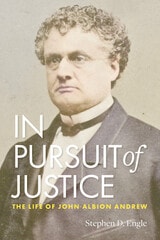
In Pursuit of Justice
The Life of John Albion AndrewStephen D. Engle
University of Massachusetts Press, 2023
Widely known as the “poor man’s lawyer” in antebellum Boston, John Albion Andrew (1818–1867) was involved in nearly every cause and case that advanced social and racial justice in Boston in the years preceding the Civil War. Inspired by the legacies of John Quincy Adams and Ralph Waldo Emerson, and mentored by Charles Sumner, Andrew devoted himself to the battle for equality. By day, he fought to protect those condemned to the death penalty, women seeking divorce, and fugitives ensnared by the Fugitive Slave Law. By night, he coordinated logistics and funding for the Underground Railroad as it ferried enslaved African Americans northward.
In this revealing and accessible biography, Stephen D. Engle traces Andrew’s life and legacy, giving this important, but largely forgotten, figure his due. Rising to national prominence during the Civil War years as the governor of Massachusetts, Andrew raised the African American regiment known as the Glorious 54th and rallied thousands of soldiers to the Union cause. Upon his sudden death in 1867, a correspondent for Harper’s Weekly wrote, “Not since the news came of Abraham Lincoln’s death were so many hearts truly smitten.”
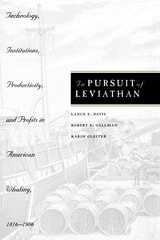
In Pursuit of Leviathan
Technology, Institutions, Productivity, and Profits in American Whaling, 1816-1906Lance E. Davis, Robert E. Gallman, and Karin Gleiter
University of Chicago Press, 1997
Providing a wealth of historical information, In Pursuit of Leviathan is a classic industry study that will provide intriguing reading for anyone interested in the history of whaling.

In Pursuit of Peace in Israel and Palestine
Gershon Baskin
Vanderbilt University Press, 2017
Despite the atmosphere of fear, Baskin found he could talk with both Jews and Palestinians, and that very few others were engaged in efforts at mutual understanding. At his initiative, the Ministry of Education and the office of right-wing prime minister Menachem Begin created the Institute for Education for Jewish-Arab Coexistence with Baskin himself as director. Eight years later he founded and codirected the only joint Israeli-Palestinian public policy think-and-do tank in the world, the Israel/Palestine Center for Research and Information. For decades he continued to cross borders, often with a kaffiyeh (Arab headdress) on his dashboard to protect his car in Palestinian neighborhoods. Airport passport control became Kafkaesque as Israeli agents routinely identified him as a security threat.
During the many cycles of peace negotiations, Baskin has served both as an outside agitator for peace and as an advisor on the inside of secret talks—for example, during the prime ministership of Yitzhak Rabin and during the initiative led by Secretary of State John Kerry. Baskin ends the book with his own proposal, which includes establishing a peace education program and cabinet-level Ministries of Peace in both countries, in order to foster a culture of peace.
In Pursuit of Their Dreams
A History of Azorean Immigration to the United StatesJerry R. Williams
Tagus Press, 2007
Jerry Williams' history of Azorean immigration to the United States offers us valuable insight into the experience and culture of Portuguese immigrants and their descendants. This account fills a major gap in American immigration history and gives us a comprehensive overview of how Portuguese-Americans—now numbering close to a million people—have come to constitute a vibrant and highly visible presence within southeastern New England, the areas around San Francisco and San Diego, Hawaii, and the New Jersey/New York metropolitan area. Even though Azorean immigrants all came from similar cultural and social backgrounds, Williams shows how regionally specific opportunity structures and social hierarchies have contributed to significant differences within the Portuguese-American experience.
Starting with the whaling routes that first connected the mid-Atlantic archipelago with the ports of call in New England and California in the early 1800s, Williams lays out the complex relationship between the Azores and the US that has continued into the present. We learn how particular patterns of poverty, overpopulation and social inequality in the Azores pushed large numbers of the islands' inhabitants to leave their homes in search of better opportunities for themselves and their children. He tells the story of how the early whalers who jumped ship in New Bedford, San Francisco, or Hawaii were followed by kin and fellow villagers who had heard of plentiful jobs in New England's textile mills, gold and land in California, or agricultural work on Hawaiian plantations. Williams' account allows us to understand the importance of family and community connections throughout the immigrants' arduous transition from peasant life to industrial society.

In Pursuit of a Useful Science
The Life of Ellen Swallow RichardsSerenity Sutherland
University of Massachusetts Press, 2027
Recovering the life of a woman who believed science could and should change the world
In May 1921, Marie Curie stood at Carnegie Hall and accepted a prize named for a woman she had never met. Ellen Swallow Richards had been dead for ten years, but her network of college-educated women had raised $2,000 to fund Curie’s research into the medical uses of radium. In Pursuit of a Useful Science offers a richly layered biography of Richards: the first woman to study and teach at MIT—a pioneer of nutrition science, water chemistry, sanitation, and what would now be called science communication.
At the heart of this book is Richards’s defining conviction that science should be useful—applied to the everyday problems of real people, from baking bread to safe drinking water to the management of sewage—and communicated clearly to the public. She tested nutrition science in a public kitchen, researched sewage treatment at a physical water treatment plant, and proved that women could study science without threat to their health at MIT’s Woman’s Laboratory. She published over one hundred works for public audiences, organized exhibits and lectures, and at the end of her life gathered her wide-ranging work into one of the first scientifically informed calls to protect the natural environment.
As Serenity Sutherland shows, Richards grappled with the gap between scientific authority and everyday practice, even as she rarely confronted how her own assumptions shaped the knowledge she advanced. Drawing on extensive archival sources, this study situates Richards within the expanding role of women in science and the rising cultural authority of scientific expertise in American life.

In Pursuit
The Hunt for the Beltway SnipersDavid Reichenbaugh
University Press of New England, 2018

In Quest of History
On Czech Statehood and IdentityJirí Pribán and Karel Hvíždala
Karolinum Press, 2019

In Rare Form
A Pictorial History of Baseball Evangelist Billy SundayW. A. Firstenberger
University of Iowa Press, 2005
Through an organizational scheme that incorporates memorabilia from childhood (samplers, Civil War badges), baseball (Billy’s 1891 Philadelphia contract, scorecards), evangelism (cartoons, books such as Monkeys and Missing Links), social issues (KKK ads endorsing Sunday, his Women's Christian Temperance life membership certificate), life style (Arts and Crafts decorative pieces, extensive photos of the family's Mount Hood bungalow), and family relations (his personal possessions and those of his wife, Nell, and their children), In Rare Form brings together the inconsistencies between Sunday’s material world and his spiritual world.
Since Sunday might have objected to a materialistic analysis of his life, Firstenberger has allowed him a say: each section of the book begins with an apt quote from Sunday’s sermons and writings. Firstenberger also includes appendixes providing detailed information on Sunday’s revivals and speaking appearances, his 870,075 documented converts, the members of his evangelistic team, the overall structure of his family, and an extensive bibliography. Acknowledging Sunday’s faults and contradictions alongside his heroic accomplishments, the author presents a wryly insightful and innovative perspective on this larger-than-life figure.
In Sacred Loneliness
The DocumentsTodd Compton
Signature Books, 2022
This volume includes many autobiographical writings, diaries, and letters, with Compton providing annotations and introductory material that illuminates these crucial primary sources. This allows readers to take their understanding of this unique group of women to a new level and to drive home that fact that their lives go far beyond the Nauvoo experiment that forever links them to Mormonism’s founding prophet.
In Science's Shadow
Literary Constructions of Late Victorian WomenPatricia Murphy
University of Missouri Press, 2006
The Victorian era was characterized by great scientific curiosity—as exemplified by the publication of Darwin’s Descent of Man—as well as by new questions regarding the place of women in society. Patricia Murphy now explores the tenuous interplay of gender and science to show how the era’s literature both challenged and reinforced a constrictive role for Victorian women. Focusing on a specific body of literature involving women intensely associated with scientific pursuits, and examining selected noncanonical writings—both fictional and nonfictional representations of scientific women—Murphy demonstrates how these works informed the “Woman Question” by reinforcing or rejecting presumed truths about gender and science.

In Search of "Aryan Blood"
Serology in Interwar and National Socialist GermanyRachel E. Boaz
Central European University Press, 2012

In Search of Admiration and Respect
Chinese Cultural Diplomacy in the United States, 1875–1974Yanqui Zheng
University of Michigan Press, 2024
In Search of Admiration and Respect uses the Chinese case to underscore what Zheng calls “infrastructure of persuasion,” in which American philanthropy, museums, exhibitions, and show business had disproportionate power in setting the agenda of unequal intercultural encounters. This volume also provides historical insights into China’s ongoing quest for international recognition. Drawing upon diverse archival sources, Zheng expands the contours of cultural diplomacy beyond established powers and sheds light on the limited agency of peripheral nations in their self-representation.

In Search of Ancient North Africa
A History in Six LivesBarnaby Rogerson
Haus Publishing, 2019
In Search of Ancient North Africa sheds new light on a time and place at the crossroads of numerous histories and cultures. It offers the first history of ancient North Africa told through the lives of North Africans themselves.
In Search of Authenticity
The Formation of Folklore StudiesRegina Bendix
University of Wisconsin Press, 1997
Searches for authenticity, Bendix contends, have been a constant companion to the feelings of loss inherent in modernization, forever upholding a belief in a pristine yet endangered cultural essence and fueling cultural nationalism worldwide. Beginning with precursors of Herder and Emerson and the “discovery” of the authentic in expressive culture and literature, she traces the different, albeit intertwined, histories of German Volkskunde and American folklore studies. A Swiss native educated in American folklore programs, Bendix moves effortlessly between the two traditions, demonstrating how the notion of authenticity was used not only to foster national causes, but also to lay the foundations for categories of documentation and analysis within the nascent field of folklore studies.
Bendix shows that, in an increasingly transcultural world, where Zulu singers back up Paul Simon and where indigenous artists seek copyright for their traditional crafts, the politics of authenticity mingles with the forces of the market. Arguing against the dichotomies implied in the very idea of authenticity, she underscores the emptiness of efforts to distinguish between folklore and fakelore, between echt and ersatz.

In Search of First Contact
The Vikings of Vinland, the Peoples of the Dawnland, and the Anglo-American Anxiety of DiscoveryAnnette Kolodny
Duke University Press, 2012
Kolodny considers what the sagas reveal about the Native peoples encountered by the Norse in Vinland around the year A.D. 1000, and she recovers Native American stories of first contacts with Europeans, including one that has never before been shared outside of Native communities. These stories contradict the dominant narrative of "first contact" between Europeans and the New World. Kolodny rethinks the lingering power of a mythic American Viking heritage and the long-standing debate over whether Leif Eiriksson or Christopher Columbus should be credited as the first discoverer. With this paradigm-shattering work, Kolodny shows what literary criticism can bring to historical and social scientific endeavors.
In Search of Mechanisms
Discoveries across the Life SciencesCarl F. Craver and Lindley Darden
University of Chicago Press, 2013
In Search of New England's Native Past
Selected Essays by Gordon M. DayGordon M. Day
University of Massachusetts Press, 1998
This volume highlights the work of the late Gordon M. Day, renowned for his groundbreaking research on the history and culture of the Western Abenakis and their Indian neighbors. Where previous historians had tended to portray northern New England as an area largely devoid of aboriginal peoples, Day established beyond all doubt the presence of Abenaki settlements along the eastern shore of Lake Champlain as well as the upper reaches of the Connecticut and Merrimack rivers.
For nearly three decades, Day focused his work on the community of Saint Francis, or Odanak, in Quebec, to which Abenaki refugees from interior New England had fled, beginning in the mid-seventeenth century and continuing into the nineteenth. Drawing on the methods of several disciplines, including ethnology, linguistics, and ethnohistory, he synthesized data from fragmentary historical records, oral traditions, and place names to reconstruct a world assumed to be lost.
In Search of Portland
Exploring a Transforming CityBrian Libby
Oregon State University Press, 2026
“A good walking tour is not just about individual stops but the total experience of moving along a city’s streets, taking in a variety of neighborhoods, buildings, shops, parks, public art, and bridges: a chance to be the grand marshal in your own parade,” writes Brian Libby in the introduction of In Search of Portland. Starting from his 1997 home, the Empire Apartments at Southwest Eleventh Avenue and Jefferson Street, Libby shares one hundred fascinating points of interest through personal reflection, interviews, and anecdotal history.
The six excursions exploring Portland’s downtown, Old Town, and Pearl District not only focus on the city’s important landmarks and hidden gems but showcase an evolving city’s resilience and heart. Alongside his own experiences, Libby reveals how luminaries like Humphrey Bogart, Mark Rothko, Gus Van Sant, Vera Katz, and Bill Walton appreciated the City of Roses. From Pioneer Courthouse Square to the Crystal Ballroom, each location in the book celebrates the spirit of place in addition to its architecture.
More than a book about buildings, In Search of Portland reveals the stories behind the built landscape, the people, and the history that have created modern Portland.

In Search of Providence
Transnational Mayan Identities, Updated EditionPatricia Foxen
Vanderbilt University Press, 2020
In the mid-1990s, Patricia Foxen traveled back and forth between the Guatemalan highlands and Providence, Rhode Island, to understand the migration paths of K'iche' Mayan Indians who had fled the Guatemalan civil war to work in the factories and fisheries of New England. More than two decades later, many Mayans are still migrating to the US. As Foxen argues, the recent surge in Mayan border crossings must be contextualized within both the longer history of violence, marginality, and exclusion that has long led Guatemala's Indigenous populations to be "survivors on the move," as well as contemporary push factors such as climate change and growing inequality that have forced people from their communities.
And yet one of the most significant drivers of continued emigration today, ironically, is the very culture of migration (described in the book) that has accelerated social change within many Indigenous communities, setting in motion a complex series of economic and cultural shifts that have compelled a continuous movement of people and generations to the US. Reading this story in 2020—at a time of massive growth in flows of irregular migrations around the world—can help us better understand the highly complex set of factors that propel long-term migrations and that shape transnational communities on both sides of the border.
In Search of Providence offers a layered, historically grounded perspective that speaks to the local specificity behind the migration experience in order to point to the universal themes and contradictions of contemporary global displacements.
In Search of Tunga
Prosperity, Almighty God, and Lives in Motion in a Malian Provincial TownAndré Chappatte
University of Michigan Press, 2022
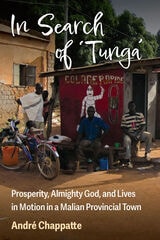
In the context of the current global war on terrorism, most studies of Muslim life have focused on the politics of piety of reformist movements, their leaders, and members. By contrast, In Search of “Tunga” takes a perspective from below. It opens piety up to “simply Muslims,” although the religious elites have always claimed authority and legitimacy over piety. Is piety an exclusive field of experiences for those who claim to strive for it? What does piety involve for the majority of Muslims, the non-elite and unaffiliated Muslims? This volume “democratizes” piety by documenting its practice as going beyond sharply defined religious affiliations and Islamic scholarship, and by showing it is both alive and normative, existential and prescriptive. As opposed to studies that build on the classic historical connections between the Maghreb and the Sahel, the southbound migration from the Sahel documented in this book stresses the overlooked historical connections between the southern shores of the Sahara and the lands south of those shores. It demonstrates how the Malian savanna, this former buffer-zone between ancient Mande kingdoms and thereafter remote areas of French Sudan, is increasingly becoming central in today’s Sahel contexts of desiccation and insecurity.
In Search of a Nation
Histories of Authority & Dissidence in TanzaniaGregory H. Maddox
Ohio University Press, 2005

In Search of the Amazon
Brazil, the United States, and the Nature of a RegionSeth Garfield
Duke University Press, 2013
In Search of the Black Panther Party
New Perspectives on a Revolutionary MovementJama Lazerow and Yohuru Williams, eds.
Duke University Press, 2006
One contributor evaluates the legal basis of the Panthers’ revolutionary struggle, explaining how they utilized and critiqued the language of the Constitution. Others explore the roles of individuals, looking at a one-time Panther imprisoned for a murder he did not commit and an FBI agent who monitored the activities of the Panthers’ Oakland branch. Contributors assess the Panthers’ relations with Students for a Democratic Society, the Young Lords, the Brown Berets, and the Peace and Freedom Party. They discuss the Party’s use of revolutionary aesthetics, and they show how the Panthers manipulated and were manipulated by the media. Illuminating some of the complexities involved in placing the Panthers in historical context, this collection demonstrates that the scholarly search for the Black Panthers has only just begun.
Contributors. Bridgette Baldwin, Davarian L. Baldwin, David Barber, Rod Bush, James T. Campbell, Tim Lake, Jama Lazerow, Edward P. Morgan, Jeffrey O. G. Ogbar, Roz Payne, Robert O. Self, Yohuru Williams, Joel Wilson
In Search of the Mexican Beverly Hills
Latino Suburbanization in Postwar Los AngelesGonzález, Jerry
Rutgers University Press, 2018
In Search of the Perfect Romanian
National Specificity, Racial Degeneration, and Social Selection in Modern RomaniaMarius Turda
Central European University Press, 2026
The book centers on debates about the Romanian national character and race between 1880s and 1950s. It also argues that during the early 1940s anti-Semitism and anti-Roma racism contributed directly to the programme of ethnic purification pursued by the Antonescu regime. Racism and eugenics explain not just the deportation and murder of the Jews but also the deportation and murder of the Roma. The Holocaust in Romania should therefore be understood as the result not just of anti-Semitism but also of biopolitical nationalism. Finally, the book suggests that the eugenic ideal of the ‘perfect’ Romanian did not disappear in 1945 but was embedded in the socialist definitions of the ‘new man’ and ‘perfect’ society emerging under communism.
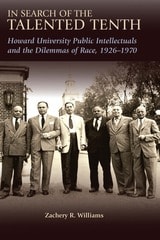
In Search of the Talented Tenth
Howard University Public Intellectuals and the Dilemmas of Race, 1926-1970Zachery R. Williams
University of Missouri Press, 2009
In Search of the Talented Tenth tells how individuals like Rayford Logan, E. Franklin Frazier, John Hope Franklin, Merze Tate, Charles Wesley, and Dorothy Porter left an indelible imprint on academia and black communities alike through their impact on civil rights, anticolonialism, and women’s rights. Zachery Williams explores W. E. B. Du Bois’s Talented Tenth by describing the role of public intellectuals from the Harlem Renaissance to the Black Power movement, in times as trying as the Jim Crow and Cold War eras.
Williams first describes how the years 1890 to 1926 laid the foundation for Howard’s emergence as the “capstone of Negro education” during the administration of university president Mordecai Johnson. He offers a wide-ranging discussion of how the African American community of Washington, D.C., contributed to the dynamism and intellectual life of the university, and he delineates the ties that linked many faculty members to one another in ways that energized their intellectual growth and productivity as scholars. He also discusses the interaction of Howard’s intellectual community with those of the West Indies, Africa, and other places, showing the international impact of Howard’s intellectuals and the ways in which black and brown elites outside the United States stimulated the thought and scholarship of the Howard intellectuals.
In Search of the Talented Tenth marks the first in-depth study of the intellectual activity of this community of scholars and further attests to the historic role of women faculty in shaping the university. It testifies to the impact of this group as a model against which the twenty-first century’s black public intellectuals can be measured.
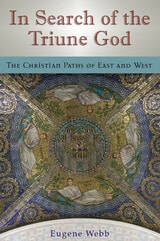
In Search of the Triune God
The Christian Paths of East and WestEugene Webb
University of Missouri Press, 2013
Under the broad umbrella of the Christian religion, there exists a great divide between two fundamentally different ways of thinking about key aspects of the Christian faith. Eugene Webb explores the sources of that divide, looking at how the Eastern and Western Christian worlds drifted apart due both to the different ways they interpreted their symbols and to the different roles political power played in their histories. Previous studies have focused on historical events or on the history of theological ideas. In Search of the Triune God delves deeper by exploring how the Christian East and the Christian West have conceived the relation between symbol and experience.
Webb demonstrates that whereas for Western Christianity discussion of the doctrine of the Trinity has tended toward speculation about the internal structure of the Godhead, in the Eastern tradition the symbolism of the Triune God has always been closely connected to religious experience. In their approaches to theology, Western Christianity has tended toward a speculative theology, and Eastern Christianity toward a mystical theology.
This difference of focus has led to a large range of fundamental differences in many areas not only of theology but also of religious life. Webb traces the history of the pertinent symbols (God as Father, Son of God, Spirit of God, Messiah, King, etc.) from the Hebrew Bible and New Testament through patristic thinkers and the councils that eventually defined orthodoxy. In addition, he shows how the symbols, interpreted through the different cultural lenses of the East and the West, gradually took on meanings that became the material of very different worldviews, especially as the respective histories of the Eastern and Western Christian worlds led them into different kinds of entanglement with ambition and power.
Through this incisive exploration, Webb offers a dramatic and provocative new picture of the history of Christianity.
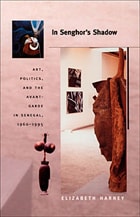
In Senghor's Shadow
Art, Politics, and the Avant-Garde in Senegal, 1960–1995Elizabeth Harney
Duke University Press, 2004
Heavily illustrated with nearly one hundred images, including some in color, In Senghor’s Shadow surveys the work of a range of Senegalese artists, including painters, muralists, sculptors, and performance-based groups—from those who worked at the height of Senghor’s patronage system to those who graduated from art school in the early 1990s. Harney reveals how, in the 1970s, avant-gardists contested Negritude beliefs by breaking out of established artistic forms. During the 1980s and 1990s, artists such as Moustapha Dimé, Germaine Anta Gaye, and Kan-Si engaged with avant-garde methods and local artistic forms to challenge both Senghor’s legacy and the broader art world’s understandings of cultural syncretism. Ultimately, Harney’s work illuminates the production and reception of modern Senegalese art within the global arena.

In Service to America
A History of VISTA in Arkansas, 1965-1985Marvin Schwartz
University of Arkansas Press, 1988
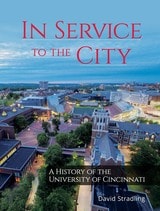
In Service to the City
A History of the University of CincinnatiDavid Stradling
University of Minnesota Press, 2018
In Service to the City: A History of the University of Cincinnati, the first history of the university written in over fifty years, explores the evolving, complex relationship between UC and the city of Cincinnati. In Service to the City casts an unvarnished lens on the details of student demographics, faculty research, curricular changes, and athletic controversy to challenges associated with campus architecture and planning, neighborhood relations, regional and national consequences of urban decline, and the roles of municipal, state, and federal governments within American higher education.
Urban, environmental historian David Stradling traces UC’s story through starts and stops, growth and contraction. In the 1870s the institution began its transformation into a comprehensive, municipal university located in America’s thriving heartland. Expansion continued through mergers with Cincinnati College-Conservatory of Music and Cincinnati Medical College, among others. In 1977, University President Warren Bennis and Governor Jim Rhodes signed papers ending UC’s municipal status while securing its future as part of the state university system of Ohio.
UC maintains its strong relationship with Cincinnati, pioneering countless community and regionally oriented programs, from its expanding co-op education system, the first in the nation, to the Niehoff Urban Studio. Stradling describes the social and political activism of UC students and faculty—front and center in the civil rights and women’s rights movements, as well as the public health and environmental movements. Often they struggled to change the culture within their own institution, which at times appeared conservative or reactionary.
Drawing on archival research, Stradling recounts in lively prose and through dozens of illustrations, two-hundred years of UC history, setting the story in the context of changes within higher education in the United States.
With the cost of higher education on the minds of legislators and the public, questions first posed by Daniel Drake in 1819 upon the founding of Cincinnati College remain relevant. Who should the college serve? What and how should students learn? How can we pay for it? In Service to the City encourages readers to consider how the University of Cincinnati—with a history so entwined with its city—can balance its urban-serving tradition with its aspiration to be a leader global research university.
In Sorcery's Shadow
A Memoir of Apprenticeship among the Songhay of NigerPaul Stoller and Cheryl Olkes
University of Chicago Press, 1989

In Space We Read Time
On the History of Civilization and GeopoliticsKarl Schlögel
Bard Graduate Center, 2016
Here is both a model for thinking about history within physical space and a stimulating history of thought about space, as Schlögel reads historical periods and events within the context of their geographical location. Discussions range from the history of geography in France to what a town directory from 1930s Berlin can say about professional trades that have since disappeared. He takes a special interest in maps, which can serve many purposes—one poignant example being the German Jewish community’s 1938 atlas of emigration, which showed the few remaining possibilities for escape. Other topics include Thomas Jefferson’s map of the United States; the British survey of India; and the multiple cartographers with Woodrow Wilson at the Paris Peace Conference, where the aim was to redraw Europe’s boundaries on the basis of ethnicity. Moving deftly from the Austro-Hungarian Empire to 9/11 and from Vermeer’s paintings to the fall of the Berlin Wall, this intriguing book presents history from a completely new perspective.

In Sputnik's Shadow
The President's Science Advisory Committee and Cold War AmericaWang, Zuoyue
Rutgers University Press, 2009
In today’s world of rapid advancements in science and technology, we need to scrutinize more than ever the historical forces that shape our perceptions of what these new possibilities can and cannot do for social progress. In Sputnik’s Shadow provides a lens to do just that, by tracing the rise and fall of the President’s Science Advisory Committee from its ascendance under Eisenhower in the wake of the Soviet launching of Sputnik to its demise during the Nixon years. Members of this committee shared a strong sense of technological skepticism; they were just as inclined to advise the president about what technology couldn’t do—for national security, space exploration, arms control, and environmental protection—as about what it could do.
Zuoyue Wang examines key turning points during the twentieth century, including the beginning of the Cold War, the debates over nuclear weapons, the Sputnik crisis in 1957, the struggle over the Vietnam War, and the eventual end of the Cold War, showing how the involvement of scientists in executive policymaking evolved over time. Bringing new insights to the intellectual, social, and cultural histories of the era, this book not only depicts the drama of Cold War American science, it gives perspective to how we think about technological advancements today.

In Step with the Times
Mapiko Masquerades of MozambiquePaolo Israel
Ohio University Press, 2014
The helmet-shaped mapiko masks of Mozambique have garnered admiration from African art scholars and collectors alike, due to their striking aesthetics and their grotesque allure. This book restores to mapiko its historic and artistic context, charting in detail the transformations of this masquerading tradition throughout the twentieth century.
Based on field research spanning seven years, this study shows how mapiko has undergone continuous reinvention by visionary individuals, has diversified into genres with broad generational appeal, and has enacted historical events and political engagements. This dense history of creativity and change has been sustained by a culture of competition deeply ingrained within the logic of ritual itself. The desire to outshine rivals on the dance ground drives performers to search for the new, the astonishing, and the topical. It is this spirit of rivalry and one-upmanship that keeps mapiko attuned to the times that it traverses.
In Step with the Times is illustrated with vibrant photographs of mapiko masks and performances. It marks the most radical attempt to date to historicize an African performative tradition.
In Sullivan's Shadow
The Use and Abuse of Libel Law during the Long Civil Rights StruggleAimee Edmondson
University of Massachusetts Press, 2019
Drawing on archival research and scholarship in journalism, legal history, and African American studies, Edmondson offers a new narrative of brave activists, bold journalists and publishers, and hardheaded southern officials. These little-known courtroom dramas at the intersection of race, libel, and journalism go beyond the activism of the 1960s and span much of the country's history, beginning with lawsuits filed against abolitionist William Lloyd Garrison and concluding with a suit spawned by the 1988 film Mississippi Burning.
In Tender Consideration
Women, Families, and the Law in Abraham Lincoln's IllinoisEdited by Daniel W. Stowell
University of Illinois Press, 2002
Drawing on the rich resources of The Law Practice of Abraham Lincoln: Complete Documentary Edition, a DVD version of Lincoln's complete legal papers, In Tender Consideration scans the full range of family woes that antebellum Americans took to the law. Deserted wives, destitute widows, jilted brides with illegitimate children, and slandered women brought their cases before the courts, often receiving a surprising degree of sympathy and support.
Through the stories of dozens of individuals who took legal action to obtain a divorce, contest a will, prosecute a rapist, or assert rights to family property, this volume illuminates the legal status of women and children in Illinois and their experiences with the law in action. Contributors document how the courts viewed children and how they responded to inheritance, custody, and other types of cases involving children or their interests. These cases also highlight Lincoln's life in law, placing him more clearly within the context of the legal culture in which he lived and raising intriguing questions about the influence of his legal life on his subsequent political one.
In The Scheme Of Things
Alternative Thinking on the Practice of ArchitectureThomas R. Fisher Fisher
University of Minnesota Press, 2006
In each of the twelve essays that comprise this timely volume, Fisher addresses issues of vital concern to architects and students, offering hard-hitting criticism and proposing innovative and practical ideas for reform at the level of both the individual practitioner and the profession as a whole. Through his thoughtful and nuanced consideration of architecture’s ideological foundations and its relationship to ecology, politics, and technology, as well as his subtle understanding of the architect’s interior life, Fisher challenges the demoralized design community to recapture its historical role as steward and visionary of the public realm.
Thomas R. Fisher is dean of the College of Architecture and Landscape Architecture at the University of Minnesota and coeditor of Architectural Research Quarterly. His essays have appeared in Design Quarterly, Architectural Record, and other leading journals.

In Their Letters, in Their Words
Illinois Civil War Soldiers Write HomeEdited by Mark Flotow
Southern Illinois University Press, 2019
A vital lifeline to home during the Civil War, the letters of soldiers to their families and friends remain a treasure for those seeking to connect with and understand the most turbulent period of American history. Rather than focus on the experiences of a few witnesses, this impressively researched book documents 165 Illinois Civil War soldiers’ and sailors’ lives through the lens of their personal letters. Editor Mark Flotow chose a variety of letter writers who hailed from counties throughout the state, served in different branches of the military at different ranks, and represented the gamut of social experiences and war outcomes.
Flotow provides extensive quotations from the letters. By allowing the soldiers to speak for themselves, he captures what mattered most to them. Illinois soldiers wrote about their reasons for enlisting; the nature of training and duties; necessities like eating, sleeping, marching, and making the best of often harsh and chaotic circumstances; Southern culture; slavery; their opinions of commanding officers and the president; disease, medicine, and hospitals; their prisoner-of-war experiences; and the ways they left the army. Through letters from afar, many soldiers sought to manage their homes and farms, while some single men attempted to woo their sweethearts.
Flotow includes brief biographies for each soldier quoted in the book, weaves historical context and analysis with the letters, and organizes them by topic. Thus, intimate details cited in individual letters reveal their significance for those who lived and shaped this tumultuous era. The result is not only insightful history but also compelling reading.
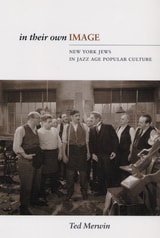
In Their Own Image
New York Jews in Jazz Age Popular CultureMerwin, Ted
Rutgers University Press, 2006
The Jazz Age of the 1920s is an era remembered for illegal liquor, innovative music and dance styles, and burgeoning ideas of social equality. It was also the period during which second-generation Jews began to emerge as a significant demographic in New York City. In TheirOwn Image examines thegrowing cultural visibility of Jewish life amid this vibrant scene.
From the vaudeville routines of Fanny Brice, Eddie Cantor, George Jessel, and Sophie Tucker, to the slew of Broadway comedies about Jewish life and the silent films that showed immigrant families struggling to leave the ghetto, images and representations of Jews became staples of interwar popular culture. Through the performing arts, Jews expressed highly ambivalent feelings about their identification with Jewish and American cultures. Ted Merwin shows how they became American by producing and consuming not images of another group, but images of themselves. As a result, they humanized Jewish stereotypes, softened anti-Semitic attitudes, and laid the groundwork for today’s Jewish comedians.
An entertaining look at the role popular culture plays in promoting the acculturation of an ethnic group, In Their Own Image enhances our understanding of American Jewish history and provides a model for the study of other groups and their integration into mainstream society.
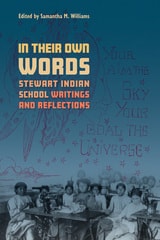
In Their Own Words
Stewart Indian School Writings and ReflectionsSamantha M. Williams
University of Nevada Press, 2027
In Their Own Words: Stewart Indian School Writings and Reflections examines Stewart Indian School through writings produced by its students. Stewart was established in 1890 in Carson City, Nevada, to educate and assimilate Native American children. Students from across the West attended the school, which evolved from a militaristic institution into one that, by the late 1960s and 1970s, emphasized academics and athletics. The U.S. government closed Stewart in 1980, citing financial and structural concerns.
In the book, student writings document daily lessons and activities, thoughts about academic and vocational training, and responses to life within the institution. The school’s publications also gave students a platform for expression, serving as a window into what it meant to be Native in a government-run boarding school system.
The book includes original interviews with Stewart alumni covering the 1950s, 1960s, and 1970s. These firsthand accounts provide new information about student life, including positive and negative perspectives, and offer context for the varied experiences of those who attended.
Together, the writings and interviews offer a fuller understanding of student life at Stewart.

In Time of War
Understanding American Public Opinion from World War II to IraqAdam J. Berinsky
University of Chicago Press, 2009
From World War II to the war in Iraq, periods of international conflict seem like unique moments in U.S. political history—but when it comes to public opinion, they are not. To make this groundbreaking revelation, In Time of War explodes conventional wisdom about American reactions to World War II, as well as the more recent conflicts in Korea, Vietnam, the Gulf, Afghanistan, and Iraq. Adam Berinsky argues that public response to these crises has been shaped less by their defining characteristics—such as what they cost in lives and resources—than by the same political interests and group affiliations that influence our ideas about domestic issues.
With the help of World War II–era survey data that had gone virtually untouched for the past sixty years, Berinsky begins by disproving the myth of “the good war” that Americans all fell in line to support after the Japanese bombed Pearl Harbor. The attack, he reveals, did not significantly alter public opinion but merely punctuated interventionist sentiment that had already risen in response to the ways that political leaders at home had framed the fighting abroad. Weaving his findings into the first general theory of the factors that shape American wartime opinion, Berinsky also sheds new light on our reactions to other crises. He shows, for example, that our attitudes toward restricted civil liberties during Vietnam and after 9/11 stemmed from the same kinds of judgments we make during times of peace.
With Iraq and Afghanistan now competing for attention with urgent issues within the United States, In Time of War offers a timely reminder of the full extent to which foreign and domestic politics profoundly influence—and ultimately illuminate—each other.
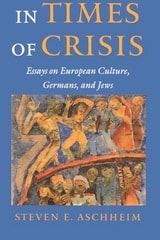
In Times of Crisis
Essays on European Culture, Germans, and JewsSteven E. Aschheim
University of Wisconsin Press, 2001
The nineteenth- and twentieth-century relationship between European culture, German history, and the Jewish experience produced some of the West’s most powerful and enduring intellectual creations—and, perhaps in subtly paradoxical and interrelated ways, our century’s darkest genocidal moments. In Times of Crisis explores the flashpoints of this vexed relationship, mapping the coordinates of a complex triangular encounter of immense historical import.
In essays that range from the question of Nietzsche’s legacy to the controversy over Daniel Goldhagen’s Hitler’s Willing Executioners, the distinguished historian Steven E. Aschheim presents this encounter as an ongoing dialogue between two evolving cultural identities. He touches on past dimensions of this exchange (such as the politics of Weimar Germany) and on present dilemmas of grasping and representing it (such as the Israeli discourse on the Holocaust). His work inevitably traces the roots and ramifications of Nazism but at the same time brings into focus historical circumstances and contemporary issues often overshadowed or distorted by the Holocaust.
These essays reveal the ubiquitous charged inscriptions of Nazi genocide within our own culture and illuminate the projects of some later thinkers and historians—from Hannah Arendt to George Mosse to Saul Friedlander—who have wrestled with its problematics and sought to capture its essence. From the broadly historical to the personal, from the politics of Weimar Germany to the experience of growing up German Jewish in South Africa, the essays expand our understanding of German Jewish history in particular, but also of historical processes in general.
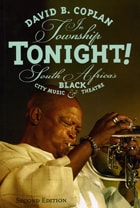
In Township Tonight!
South Africa's Black City Music and Theatre, Second EditionDavid B. Coplan
University of Chicago Press, 2008
In vivid detail, Coplan comprehensively explores more than three centuries of the diverse history of South Africa’s black popular culture, taking readers from indigenous musical traditions into the world of slave orchestras, pennywhistlers, clergyman-composers, the gumboot dances of mineworkers, and touring minstrelsy and vaudeville acts. This up-to-date edition of a landmark work will be welcomed by scholars of ethnomusicology and African studies, world music fans, and anyone concerned with South Africa and its development.
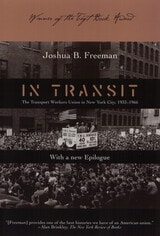
In Transit
Transport Workers Union In Nyc 1933-66Joshua Freeman
Temple University Press, 2001
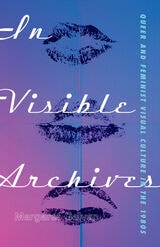
In Visible Archives
Queer and Feminist Visual Culture in the 1980sMargaret Galvan
University of Minnesota Press, 2023
Analyzing how 1980s visual culture provided a vital space for women artists to theorize and visualize their own bodies and sexualities
In 1982, the protests of antiporn feminists sparked the censorship of the Diary of a Conference on Sexuality, a radical and sexually evocative image-text volume whose silencing became a symbol for the irresolvable feminist sex wars. In Visible Archives documents the community networks that produced this resonant artifact and others, analyzing how visual culture provided a vital space for women artists to theorize and visualize their own bodies and sexualities.
Margaret Galvan explores a number of feminist and cultural touchstones—the feminist sex wars, the HIV/AIDS crisis, the women in print movement, and countercultural grassroots periodical networks—and examines how visual culture interacts with these pivotal moments. She goes deep into the records to bring together a decade’s worth of research in grassroots and university archives that include comics, collages, photographs, drawings, and other image-text media produced by women, including Hannah Alderfer, Beth Jaker, Marybeth Nelson, Roberta Gregory, Lee Marrs, Alison Bechdel, Gloria Anzaldúa, and Nan Goldin.
The art highlighted in In Visible Archives demonstrates how women represented their bodies and sexualities on their own terms and created visibility for new, diverse identities, thus serving as blueprints for future activism and advocacy—work that is urgent now more than ever as LGBTQ+ and women’s rights face challenges and restrictions across the nation.