Results by title
702 books match the query 'America' and 10 start with j

Jaguar
A Story of Africans in AmericaPaul Stoller
University of Chicago Press, 1999
Faced with economic hardship in Africa, Issa has left his home in Niger and his new wife, Khadija, to seek his fortune in America. Devout Muslims, the couple has entered into a "modern" marriage: Khadija is permitted to run her own business, and Issa has agreed not to take additional wives. Issa quickly adapts to his new surroundings, however, and soon attracts several girlfriends. Aided by a network of immigrants, he easily slips through gaps in the "system" and extends his stay in America indefinitely. Following a circuit of African-American cultural festivals across America, he marvels at African-Americans' attitudes toward Africa, and wonders if he'll ever return to Niger. Meanwhile, Khadija also struggles to make it—to become a "Jaguar"—as she combats loneliness, hostile in-laws, and a traditional, male-dominated society. The eventual success of her dry goods shop and her growing affection for a helpful Arab merchant make her wonder if she'll ever join Issa in America.
Drawing on his own decades of experience among Africans both in Niger and in New York, Paul Stoller offers enormous insight into the complexities of contemporary Africa. Alive with detail, Jaguar is a story of triumph and disappointment, of dislocation and longing, and of life lived in a world that no longer recognizes boundaries.
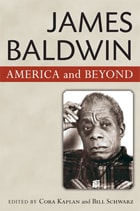
James Baldwin
America and BeyondBill Schwarz and Cora Kaplan, editors
University of Michigan Press, 2011
"This fine collection of essays represents an important contribution to the rediscovery of Baldwin's stature as essayist, novelist, black prophetic political voice, and witness to the Civil Rights era. The title provides an excellent thematic focus. He understood both the necessity, and the impossibility, of being a black 'American' writer. He took these issues 'Beyond'---Paris, Istanbul, various parts of Africa---but this formative experience only returned him to the unresolved dilemmas. He was a fine novelist and a major prophetic political voice. He produced some of the most important essays of the twentieth century and addressed in depth the complexities of the black political movement. His relative invisibility almost lost us one of the most significant voices of his generation. This welcome 'revival' retrieves it. Close call."
---Stuart Hall, Professor Emeritus, Open University
This interdisciplinary collection by leading writers in their fields brings together a discussion of the many facets of James Baldwin, both as a writer and as the prophetic conscience of a nation. The core of the volume addresses the shifting, complex relations between Baldwin as an American—“as American as any Texas GI” as he once wryly put it—and his life as an itinerant cosmopolitan. His ambivalent imaginings of America were always mediated by his conception of a world “beyond” America: a world he knew both from his travels and from his voracious reading. He was a man whose instincts were, at every turn, nurtured by America; but who at the same time developed a ferocious critique of American exceptionalism. In seeking to understand how, as an American, he could learn to live with difference—breaking the power of fundamentalisms of all stripes—he opened an urgent, timely debate that is still ours. His America was an idea fired by desire and grief in equal measure. As the authors assembled here argue, to read him now allows us to imagine new possibilities for the future.
With contributions by Kevin Birmingham, Douglas Field, Kevin Gaines, Briallen Hopper, Quentin Miller, Vaughn Rasberry, Robert Reid-Pharr, George Shulman, Hortense Spillers, Colm Tóibín, Eleanor W. Traylor, Cheryl A. Wall, and Magdalena Zaborowska.
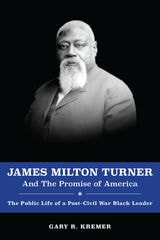
James Milton Turner and the Promise of America
The Public Life of a Post-Civil War Black LeaderGary R. Kremer
University of Missouri Press, 2020
Born a slave, Turner gained freedom when he was a child and received his education in clandestine St. Louis schools, later briefly attending Oberlin College. A self-taught lawyer, Turner earned a statewide reputation and wielded power far out of proportion to Missouri's relatively small black population.
After working nearly a decade in Liberia, Turner never regained the prominence he had enjoyed during Reconstruction.

Jane Addams
The Most Dangerous Woman in AmericaMarlene Targ Brill
Ohio University Press, 2024
Jazz Country
Ralph Ellison in AmericaHorace A. Porter
University of Iowa Press, 2001
Jesus in America and Other Stories from the Field
Claudia Gould
Utah State University Press, 2009
Drawing on ethnographic field work she conducted among Christians in her home state of North Carolina, Claudia Gould crafts stories that lay open the human heart and social complications of fundamentalist belief. These stories and the compelling characters who inhabit them draw us into the complex essence of religious experience among southern American Christians.
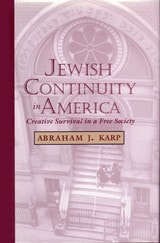
Jewish Continuity in America
Creative Survival in a Free SocietyAbraham J. Karp
University of Alabama Press, 1998
Presents an overview of a life's work by a preeminent scholar and brings new insight to the challenge of American Jewish continuity
Jews have historically lived within a paradox of faith and fear: faith that they are an eternal people and fear that their generation may be the last. In the United States, the Jewish community has faced to a heightened degree the enduring question of identity and assimilation: How does the Jewish community in this free, open, pluralistic society discover or create factors-both ideological and existential-that make group survival beneficial to the larger society and rewarding to the individual Jew?
Abraham J. Karp's Jewish Continuity in America focuses on the three major sources of American Judaism's continuing vitality: the synagogue, the rabbinate, and Jewish religious pluralism. Particularly illuminating is Karp's examination of the coexistence and unity-in-diversity of American religious Jewry's three divisions-Orthodox, Reform, and Conservative-and of how this Jewish religious pluralism fits into the larger picture of American religious pluralism.
Informing the larger enterprise through sharp and full delineation of discrete endeavors, the essays collected in Jewish Continuity in America-some already acknowledged as classics, some appearing here for the first time-describe creative individual and communal responses to the challenge of Jewish survival. As the title suggests, this book argues that continuity in a free and open society demands a high order of creativity, a creativity that, to be viable, must be anchored in institutions wholly pledged to continuity.
Jewish Renaissance and Revival in America
Edited by Eitan P. Fishbane and Jonathan D. Sarna
Brandeis University Press, 2011
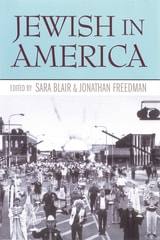
Jewish in America
Sara Blair and Jonathan Freedman, Editors
University of Michigan Press, 2004
-From the Introduction
This rare and original work of cultural studies offers uncommon and engaging perspectives-as well as provocative and humorous insights-on what it means to be Jewish in America.
Jewish in America features poetry, art, essays, and stories from an impressive and respected list of contributors, including among others Stephen Greenblatt, Richard Kostelanetz, Jacqueline Osherow, Robert Pinsky, Sharon Pomerantz, Nancy Reisman, Grace Schulman, Louis Simpson, Alisa Solomon, and Stephen J. Whitfield.
In addition to pieces by some of the country's leading writers, the book features a stunning gallery of original photographs that transport the viewer from the crowded Coney Island beaches of the 1940s to the landscapes of Oaxaca, Mexico in the 1990s.
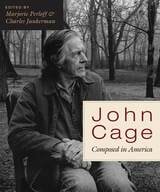
John Cage
Composed in AmericaEdited by Marjorie Perloff and Charles Junkerman
University of Chicago Press, 1994
John Cage: Composed in America is the first book-length work to address the "other" John Cage, a revisionist treatment of the way Cage himself has composed and been "composed" in America. Cage, as these original essays testify, is a contradictory figure. A disciple of Duchamp and Schoenberg, Satie and Joyce, he created compositions that undercut some of these artists' central principles and then attributed his own compositional theories to their "tradition." An American in the Emerson-Thoreau mold, he paradoxically won his biggest audience in Europe. A freewheeling, Californian artist, Cage was committed to a severe work ethic and a firm discipline, especially the discipline of Zen Buddhism.
Following the text of Cage's lecture-poem "Overpopulation and Art," delivered at Stanford shortly before his death and published here for the first time, ten critics respond to the challenge of the complexity and contradiction exhibited in his varied work. In keeping with Cage's own interdisciplinarity, the critics approach that work from a variety of disciplines: philosophy (Daniel Herwitz, Gerald L. Bruns), biography and cultural history (Thomas S. Hines), game and chaos theory (N. Katherine Hayles), music culture (Jann Pasler), opera history (Herbert Lindenberger), literary and art criticism (Marjorie Perloff), cultural poetics (Gordana P. Crnkovic, Charles Junkerman), and poetic practice (Joan Retallack). But such labels are themselves confining: each of the essays sets up boundaries only to cross them at key points. The book thus represents, to use Cage's own phrase, a much needed "beginning with ideas."